A deposition is a formal, sworn, out-of-court proceeding in which a witness answers questions from attorneys while a court reporter creates a verbatim transcript. In a California personal injury case, depositions are authorized by the Civil Discovery Act, specifically California Code of Civil Procedure sections 2025.010 through 2025.620. [1] The testimony carries the same legal weight as testimony given at trial, and the transcript can be used to impeach a witness who later says something different. Understanding what to expect from arrival to signature of the transcript is one of the most concrete steps an injured person can take before the day arrives.
Legal Snapshot
- Legal Topic: Personal Injury Deposition Procedure
- Jurisdiction: California (State Law)
- Case Stage: Pre-Trial Discovery
- Primary Legal Issue: Oral Deposition Rights and Obligations
- Primary Authority: California Code of Civil Procedure §§ 2025.010–2025.620 (Civil Discovery Act)
- Secondary Authority: Cal. Code Civ. Proc. §§ 2025.290 (time limits), 2025.310 (remote depositions), 2025.460 (objections), 2025.520 (transcript review)
- Legal Authority Last Reviewed: July 2025
What Is a Deposition and Why Does It Happen?
Discovery is the phase of a civil lawsuit in which each side gathers facts before trial. An oral deposition is one of the most powerful discovery tools because it captures live, spontaneous answers under oath. Unlike interrogatories, which allow a party to craft polished written responses, a deposition requires immediate, spoken answers in real time.
In a California personal injury case, either party may notice the deposition of the other party, any percipient witness who saw the incident, treating physicians, and retained experts. If the case involves a car accident on State Route 73 near Irvine or a commercial vehicle crash at a warehouse in Santa Ana, witnesses who saw the event, first responders, and nearby business owners may each be noticed for deposition.
California Code of Civil Procedure section 2025.010 permits any party to take the oral deposition of any person within California, including a party to the action. [1] The deposed person is called the deponent. If the deponent is a company rather than an individual, the organization must designate one or more representatives to testify on its behalf. [1]
Who Is in the Room?
Knowing exactly who will be present before you arrive eliminates one layer of uncertainty. A standard California personal injury deposition typically includes the following people:
| Person | Role |
|---|---|
| The deponent | The witness who answers questions under oath |
| Deposing attorney | The lawyer who asks questions; usually the opposing party’s attorney |
| Defending attorney | The deponent’s own attorney, who may object on the record but generally cannot instruct silence except for privilege |
| Court reporter (certified shorthand reporter) | Transcribes every spoken word verbatim; administers the oath |
| Videographer (if noticed) | Records audio-visual footage of the proceeding when the noticing party chooses that recording method |
| Additional counsel or parties | Other defendants, co-plaintiffs, or their lawyers may attend; their right to do so generally exists absent a protective order |
The deposition does not take place in a courtroom. It is usually held at a law office, a conference room rented by a court-reporting agency, or, in remote cases, over a secure video platform. California Code of Civil Procedure section 2025.310 permits a party or witness to appear by remote electronic means when the deposition is properly noticed for that purpose. [3]
The Oath and Opening Formalities
Before any substantive question is asked, the court reporter administers an oath. The deponent swears or affirms to tell the truth, the whole truth, and nothing but the truth. Giving false testimony at a deposition is perjury under California Penal Code section 118 because the testimony is taken under penalty of perjury. [4]
Once the oath is administered, the court reporter places the proceeding on the record. The reporter notes the date, time, and location of the deposition; identifies who is present; and confirms which method of recording is being used. If a videographer is present, cameras and audio equipment are switched on at this point. The deposing attorney then typically delivers a brief introduction explaining how the deposition will work: that the deponent should speak audibly for the record, ask for clarification if a question is unclear, and avoid speaking over the questioner so the reporter can capture complete sentences.
How Objections Work During a Deposition
Deposition objections work differently than courtroom objections. At trial, a judge rules immediately on each objection and either sustains it (the witness does not answer) or overrules it (the witness answers). There is no judge present at a deposition.
Under California Code of Civil Procedure section 2025.460, objections must be stated on the record, but the examination continues and the deponent must still answer the question subject to the objection. [5] The objection is preserved so that a court can rule on it later if the testimony is offered at trial. Common objections you may hear include:
- Vague and ambiguous – the question is unclear
- Calls for speculation – the question asks the witness to guess
- Assumes facts not in evidence – the question presupposes something not yet established
- Compound question – the question contains two separate questions in one
- Lacks foundation – a predicate fact has not been established
- Calls for a legal conclusion – asks the witness to make a legal determination
- Privilege – the only objection that typically results in an instruction not to answer
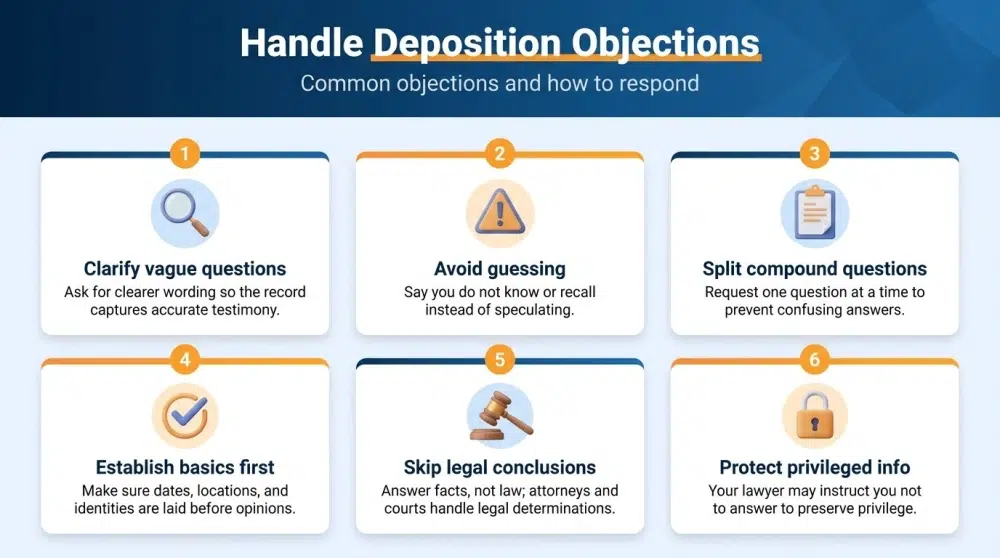
The defending attorney may instruct the deponent not to answer only when necessary to preserve a privilege (such as attorney-client privilege), to enforce a court order limiting the scope of discovery, or to seek a protective order. [5] Outside those narrow circumstances, the deponent must answer even when the defending attorney objects.
The Standard Question Arcs in a Personal Injury Deposition
Most California personal injury depositions follow a recognizable structure. The specific questions vary by case type, but the broad areas almost always include the following.
Background and Employment
The deposing attorney typically opens with questions about the deponent’s full name, residential history, educational background, and current and past employment. These questions serve two purposes: they warm up the deponent and they establish baseline facts about income and education that may bear on damages such as lost wages or loss of earning capacity.
For an injury claim arising from stop-and-go traffic on the I-405 through Costa Mesa or a merge-related crash on SR-55, the employment questioning may focus closely on whether the plaintiff’s injuries affected their ability to work, what their job duties entailed, and how much income they earned before the incident.
The Incident Itself
The core of almost every deposition is a detailed account of how the incident occurred. The attorney will ask the deponent to describe where they were, what they were doing, what they saw, heard, or felt, and what happened immediately before, during, and after the event. Follow-up questions test memory for detail: Was the signal light red or green? How fast were the vehicles traveling? Which lane was the other driver in when contact occurred?
The attorney may use exhibits, such as photographs of the scene, a diagram, or a police report, to frame specific questions. The deponent is asked to identify, annotate, or confirm facts shown in the exhibit. These exhibits become part of the deposition record.
A plaintiff injured in a rear-end collision near the Irvine Spectrum is deposed. The opposing attorney displays an aerial photograph of the SR-73 on-ramp where the crash occurred and asks the plaintiff to draw an arrow showing where each vehicle was positioned at the moment of impact. The marked exhibit is attached to the transcript. If the plaintiff’s trial testimony later places the vehicles differently, the attorney will use the deposition exhibit to confront that inconsistency.
Prior Injuries and Prior Claims
Attorneys routinely ask about every prior injury, illness, or accident that could affect the same body parts at issue in the current case. They will also ask whether the deponent has ever filed an insurance claim or been a party to a prior lawsuit. This line of questioning targets the issue of pre-existing conditions and causation. If the plaintiff had a prior lumbar spine condition, the defense will argue that at least some of the current back pain pre-dates the incident. The plaintiff is entitled to present evidence that the incident aggravated a pre-existing condition, but the deposition is where those facts first emerge formally on the record.
Current Symptoms and Daily Limitations
The deposing attorney will ask the deponent to describe every symptom they currently experience, where in the body each symptom is located, how severe it is on a numerical scale, and how it has changed since the incident. Questions about daily limitations typically cover sleep, household chores, recreational activities, exercise, and personal care. The answers to these questions directly inform the calculation of non-economic damages such as pain and suffering, physical impairment, and loss of enjoyment of activities.
This section is where personal injury lawyers carefully prepare clients. The deponent who understates their symptoms creates a record that may be used to minimize the damages claim. The deponent who overstates them risks an impeachment problem if surveillance footage or medical records show otherwise.
Social Media and Activity Evidence
California courts have recognized that publicly available social media content falls within the scope of civil discovery when it is relevant to the claims or defenses in the action. [6] During deposition, an attorney may display screenshots of posts, photos, or videos the deponent shared after the incident and ask the deponent to explain the context. A photograph showing the plaintiff hiking, carrying heavy items, or participating in a sporting event while claiming severe physical limitations is powerful impeachment material. Deponents should be prepared for this line of questioning regardless of privacy settings, since content that was public at any point may have already been captured.
How Prior Statements Surface at a Deposition
One of the most significant functions of a deposition is to lock in testimony that can be compared to statements made elsewhere. In a California personal injury case, prior statements may come from several sources:
- Recorded statements to insurance adjusters – Many insurers ask claimants for a recorded statement shortly after an incident, before the person has retained counsel. That recording may be transcribed and used to confront inconsistencies.
- Medical intake forms and provider notes – When a patient describes their injury history to an emergency room physician, urgent care provider, or physical therapist, those descriptions are entered into records. If the deponent tells a different story at deposition, the attorney will read the medical entry aloud and ask for an explanation.
- Prior written discovery responses – Answers to interrogatories submitted earlier in the litigation are a formal record. The attorney may compare those written answers to deposition testimony to expose inconsistencies.
- Communications and emails – Messages the deponent sent to friends, family members, or employers after the incident that describe their condition or the event itself may be introduced at deposition.
The principle underlying this process is that a witness who testifies inconsistently loses credibility. A prior inconsistent statement does not automatically win a case for either side, but it creates a factual issue that a jury must resolve. Personal injury lawyers representing clients who are injured in events as common as freeway merges near Newport Beach or intersection crashes in Fullerton spend considerable time reviewing these prior statements with clients before the deposition day.

The Discipline of Answering Only What Is Asked
Experienced attorneys advise deponents to answer the precise question asked and nothing more. This discipline is not evasion. It reflects the structure of the proceeding: the attorney controls the topics by choosing what to ask. A deponent who volunteers unrequested information often introduces new topics or confirms facts the attorney had not yet established.
If the deponent does not know the answer to a question, saying “I don’t know” is an accurate and appropriate response. If the deponent does not remember, “I don’t recall” is similarly appropriate. Guessing to be helpful can create a record that contradicts other evidence. If a question contains an assumption the deponent believes is incorrect, the deponent may say so rather than accepting the premise of the question in the answer.
The attorney asks: “So you were driving at least 55 miles per hour?” A deponent who simply answers “yes” to avoid conflict has now confirmed a speed that may not have been established anywhere else in the record. A more precise response might be: “I don’t know what speed I was traveling. I wasn’t watching the speedometer at that moment.”
How Long Does a Deposition Last?
California Code of Civil Procedure section 2025.290 establishes a presumptive limit of seven hours of testimony per deposition day. [2] That seven-hour period counts only the time the examination is actually underway; breaks for lunch, counsel conferences, or restroom stops do not count against the limit. A court may allow additional time upon a showing of good cause, and the parties may agree by stipulation to extend beyond seven hours without a court order.
In practice, a standard personal injury deposition of the plaintiff in a single-vehicle or two-vehicle collision case typically runs two to six hours. Cases involving multiple parties, complex causation disputes, significant claimed damages, or multiple prior injuries tend to run longer. Expert witness depositions frequently extend to a full day or more, particularly for treating physicians or retained economists who have reviewed extensive records.
How Remote Depositions Work in California
Under California Code of Civil Procedure section 2025.310, a party or deponent may appear at a deposition by remote electronic means. [3] Remote depositions became common practice following court closures in 2020 and have remained a standard option in many personal injury cases. The procedures for a remote deposition are substantially the same as for an in-person session:
- The noticing party specifies in the notice of deposition whether the proceeding will be conducted in person, remotely, or by a combination of the two.
- A court reporter (certified shorthand reporter) must still be present on the platform or at a designated location to administer the oath and record the transcript.
- If the proceeding is also being video-recorded, a licensed videographer handles the recording through the same platform or a coordinated setup.
- Exhibits may be pre-marked and shared electronically through a secure link, allowing the deponent to review them in real time.
- The court reporter may administer the oath to a deponent who is in a different county or even a different state, provided all applicable requirements are met.
One practical consideration in remote depositions is the risk of technical interruptions. Parties typically agree in advance on a protocol for handling connectivity issues: what happens if the video call drops, who controls which documents are displayed, and whether an interpreter will appear through the same platform or separately. These logistics are typically resolved in a pre-deposition stipulation between counsel.
Reviewing and Correcting the Deposition Transcript
After the deposition concludes, the certified shorthand reporter prepares the transcript and certifies that it accurately reflects the testimony given. Under California Code of Civil Procedure section 2025.520, the deponent has the right to review the transcript and make changes. [7] The process works as follows:
- The deponent or their attorney must request the opportunity to review the transcript before the deposition ends. If no request is made, the review right may be waived.
- Once the reporter notifies counsel that the certified transcript is available, the deponent has 35 days to review it and submit a written list of any changes, along with a statement of the reason for each change.
- Changes may address transcription errors (a misheard word) or substantive corrections (a corrected date or distance estimate).
- The original testimony is not erased. Any changes appear in an errata sheet attached to the transcript, and the original answers remain part of the record. The opposing attorney may use the original answers and the fact of the changes themselves at trial.
For injured people navigating a claim after a crash in Orange County, whether on State Route 133 near the Irvine Spectrum or on I-5 through Anaheim, the deposition transcript often becomes the foundation on which the rest of the case is built. Inconsistencies in that transcript can weaken a legitimate claim; a clear and consistent transcript strengthens it.
Understanding how the transcript review process works is one component of preparing for litigation. The broader discovery process, including what must be disclosed and when, is covered in our article on how to prepare for a car accident deposition.
What Evidence Can Come Up During a Deposition?
Attorneys use depositions to probe evidence they have already collected and to surface evidence they have not yet obtained. The following categories of evidence commonly arise in California personal injury depositions:
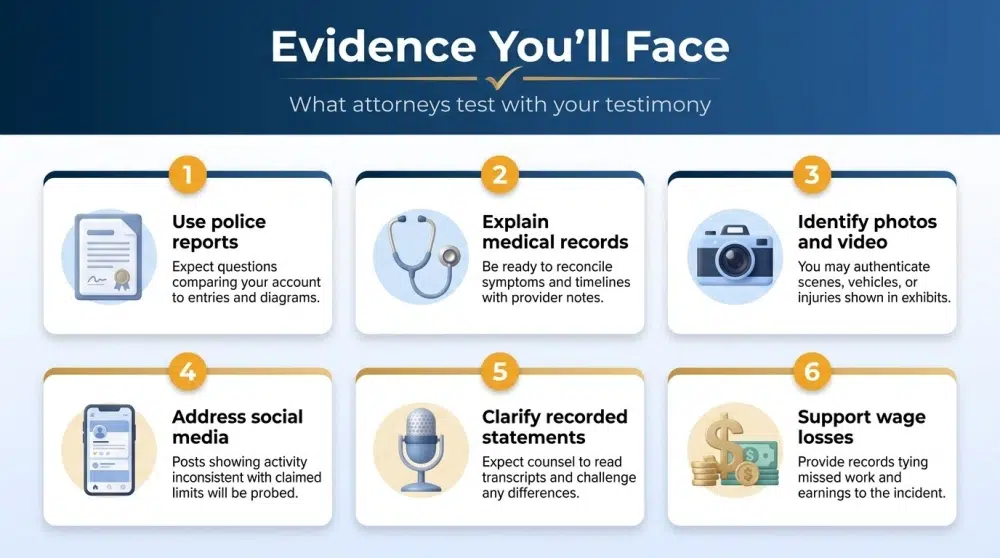
| Evidence Type | How It May Arise in Deposition |
|---|---|
| Police or incident report | Attorney may ask deponent to confirm, dispute, or explain facts stated in the report |
| Medical records | Used to test consistency between deponent’s testimony and documented symptoms or history |
| Photographs and video | Marked as exhibits; deponent asked to identify vehicles, injuries, or scene conditions |
| Social media posts | Attorney displays screenshots and asks deponent to explain context or contradictions |
| Prior recorded statements | Read aloud and compared to current deposition testimony |
| Employment and wage records | Used to calculate claimed lost wages; inconsistencies in self-reported income may surface |
| Vehicle black-box data (if obtained) | Speed, braking, and impact data may be presented to challenge or confirm testimony about the event |
| Surveillance footage | If obtained through discovery, may be displayed to test testimony about physical limitations or the incident itself |
Evidence does not prove liability on its own. Each piece of evidence must be placed in context, weighed against other evidence, and evaluated by the fact-finder. The deposition is the place where the parties test the strength and consistency of the evidence before trial.
How Deposition Testimony Connects to Damages
A deposition does not produce a verdict, but it directly shapes the damages presentation at trial or in settlement negotiations. The categories of damages potentially available in a California personal injury case include:
- Past medical expenses – bills for treatment already received
- Future medical expenses – projected costs of future care, surgery, or rehabilitation
- Lost earnings – income lost because of the injury
- Loss of earning capacity – reduced ability to earn income in the future
- Physical pain and suffering – the physical discomfort caused by the injury
- Mental anguish – emotional distress, anxiety, or psychological harm
- Physical impairment – reduction in physical function
- Disfigurement – visible scarring or disfigurement
- Loss of enjoyment of life – inability to engage in activities previously enjoyed
- Wrongful death damages – where the injury proves fatal, surviving family members may have separate claims; our Irvine wrongful death lawyers handle those cases
Whether and to what extent any of these categories applies depends on the facts of the specific case and applicable California law. The deposition testimony of the plaintiff, treating physicians, and damages experts all contribute to building or defending the damages case.
Key California Deadlines Related to Depositions
Several timing rules govern the deposition process in California civil litigation. Missing a deadline can affect the right to conduct or respond to a deposition.
| Deadline | California Authority | General Rule |
|---|---|---|
| Statute of limitations (personal injury) | Cal. Code Civ. Proc. § 335.1 | Generally two years from the date of injury to file suit |
| Notice of deposition | Cal. Code Civ. Proc. § 2025.270 | Must be served at least 10 calendar days before the deposition date for a party; 20 days for a non-party consumer or employee |
| Seven-hour time limit per deposition | Cal. Code Civ. Proc. § 2025.290 | Presumptive maximum; extensions by stipulation or court order |
| Transcript review period | Cal. Code Civ. Proc. § 2025.520 | 35 days after service of the certified transcript to submit written changes |
| Motion for protective order | Cal. Code Civ. Proc. § 2025.420 | Must generally be filed before the deposition date or promptly upon good cause |
Deadlines related to government entity claims, claims involving minors, and specialized case types may differ. The two-year personal injury statute of limitations is a hard deadline; missing it generally forecloses the right to pursue a civil claim in California. [8] An attorney should review all applicable deadlines at the outset of any case.
Plaintiff and Defense Perspectives on Depositions
Both sides have interests in the deposition process that can conflict. Understanding each perspective helps illustrate why preparation matters for everyone involved.
From the plaintiff’s perspective, the deposition is both an opportunity and a risk. A well-prepared plaintiff can describe their injuries clearly, provide a consistent and credible account of the incident, and establish the full scope of how the injury has affected their daily life. The risk is that an inconsistent or incomplete account can undermine an otherwise strong case. Car accident lawyers in Irvine who represent injury victims spend significant pre-deposition time reviewing all medical records, prior statements, and evidence with clients to reduce that risk.
From the defense perspective, the deposition of the plaintiff is one of the primary tools for identifying weaknesses in the damages claim, locating inconsistencies with prior statements, and testing whether the plaintiff’s description of their limitations is consistent with other evidence. Defense attorneys representing insurers or corporate defendants typically have extensive deposition experience and use structured questioning to develop a complete record.
Both sides may also depose expert witnesses, whose testimony can be extensive and highly technical. Expert depositions in California personal injury cases may cover accident reconstruction, biomechanics, life care planning, vocational rehabilitation, or the standard of care in premises liability or product liability cases. The personal injury lawyers on our Irvine personal injury team handle cases involving all of these deposition types.
What Should You Do If You Have a Deposition Coming Up?
A deposition in a California personal injury case is not something to approach without preparation. The transcript becomes part of the permanent record of the case. The following steps apply to anyone who has been served with a deposition notice in an Orange County or broader Southern California personal injury matter:
- Review all prior statements. Gather any recorded statements made to insurers, intake forms completed at medical providers, and any written discovery responses already submitted. Identify every statement that addresses the incident, your injuries, or your limitations.
- Review your medical records. Understand what each treating provider documented. Know whether any records reference prior conditions in the same area of the body.
- Audit your social media. Review what you have posted publicly since the incident. Be aware that public posts may be displayed at deposition.
- Understand the question arcs. The background, incident, prior injury, and current limitations areas are predictable. Thinking through your truthful answers in each area before the deposition reduces surprises.
- Request the transcript review opportunity. Before the deposition ends, request the right to review the transcript before it is certified. This preserves your ability to submit corrections within the 35-day window under California Code of Civil Procedure section 2025.520. [7]

Talk With a GoSuits Attorney
A deposition creates a permanent record that can shape the outcome of your California personal injury claim. If you have been injured in an accident in Irvine, Newport Beach, Santa Ana, or anywhere in Orange County, a GoSuits injury attorney can review the circumstances of your case and explain your options before any sworn testimony is taken.
Related California Personal Injury Resources
- Irvine Personal Injury Lawyers – Our Irvine personal injury team handles claims across Orange County.
- Car Accident Lawyers – Irvine – Most personal injury depositions arise from vehicle collision cases; our Irvine car accident lawyers are familiar with the courts and venues serving Orange County.
- Irvine Wrongful Death Lawyers – When a personal injury results in a fatality, the deposition process extends to wrongful death claims and the surviving family members who may pursue them.
- How to Prepare for a Car Accident Deposition – Step-by-step guidance on the preparation process that precedes the deposition day.
- California Personal Injury Lawyers – Statewide legal resources for California injury victims.
References & Legal Authorities
- California Code of Civil Procedure § 2025.010 – Civil Discovery Act, Chapter 9: Oral Deposition Inside California – California Legislative Information
- California Code of Civil Procedure § 2025.290 – Seven-Hour Deposition Time Limit – California Legislative Information
- California Code of Civil Procedure § 2025.310 – Remote Electronic Appearance at Deposition – California Legislative Information
- California Penal Code § 118 – Perjury Defined – California Legislative Information
- California Code of Civil Procedure § 2025.460 – Objections at Deposition; Continuation of Examination – California Legislative Information
- California Code of Civil Procedure § 2017.010 – Scope of Discovery – California Legislative Information
- California Code of Civil Procedure § 2025.520 – Transcript Review and Correction; 35-Day Period – California Legislative Information
- California Code of Civil Procedure § 335.1 – Two-Year Statute of Limitations for Personal Injury – California Legislative Information
- Federal Rule of Civil Procedure 30 – Depositions by Oral Examination – Cornell Law School Legal Information Institute
- California Courts Official Website – Judicial Council of California