A time-limited demand in California is a pre-litigation offer to settle a personal injury, property damage, bodily injury, or wrongful death claim against a tortfeasor within the insurer’s available policy limits, conditioned on acceptance within a specified deadline. Under Code of Civil Procedure sections 999 through 999.5, effective January 1, 2023, a claimant who sends a conforming demand creates a statutory framework that governs exactly how an insurer must respond. If an insurer receives a properly formed demand and fails to accept it, that failure and the written explanation the insurer must provide becomes relevant evidence in any subsequent lawsuit seeking damages that exceed the policy limits. A demand that does not satisfy every content and delivery requirement of the statute may not carry that same consequence.
Legal Snapshot
- Legal Topic: Time-Limited Policy Limit Demands (Pre-Litigation Settlement Demands)
- Jurisdiction: California
- Primary Authority: Cal. Code of Civil Procedure §§ 999–999.5 (Stats. 2022, Ch. 719 [SB 1155])
- Effective Date: Applies to demands transmitted on or after January 1, 2023
- Covered Claim Types: Personal injury, property damage, bodily injury, wrongful death under automobile, motor vehicle, homeowner, or commercial premises liability insurance policies
- Date Legal Authority Last Reviewed: July 2025
What Is a Time-Limited Demand Under California Law?
Section 999 defines a time-limited demand as an offer made before a complaint or arbitration demand is filed. The offer must come from a claimant or on the claimant’s behalf and must be directed to a tortfeasor who has liability insurance. Its purpose is to settle the claim within the insurer’s limit of liability, and it must specify a deadline by which the insurer must accept.[1]
The statute also defines extracontractual damages as any amount exceeding the total available policy limits across all applicable liability insurance policies covering the claim. That definition matters because the entire framework of sections 999 through 999.5 is designed to preserve, or foreclose, arguments about extracontractual exposure depending on whether the demand process was followed correctly by both sides.
California’s public policy, as declared in section 999(a), is to encourage prompt civil settlements as beneficial to claimants, policyholders, and insurers alike. The statutory scheme tries to make that encouragement concrete by attaching procedural consequences to non-conforming demands and non-responsive insurers.
What California Law Requires of a Conforming Demand
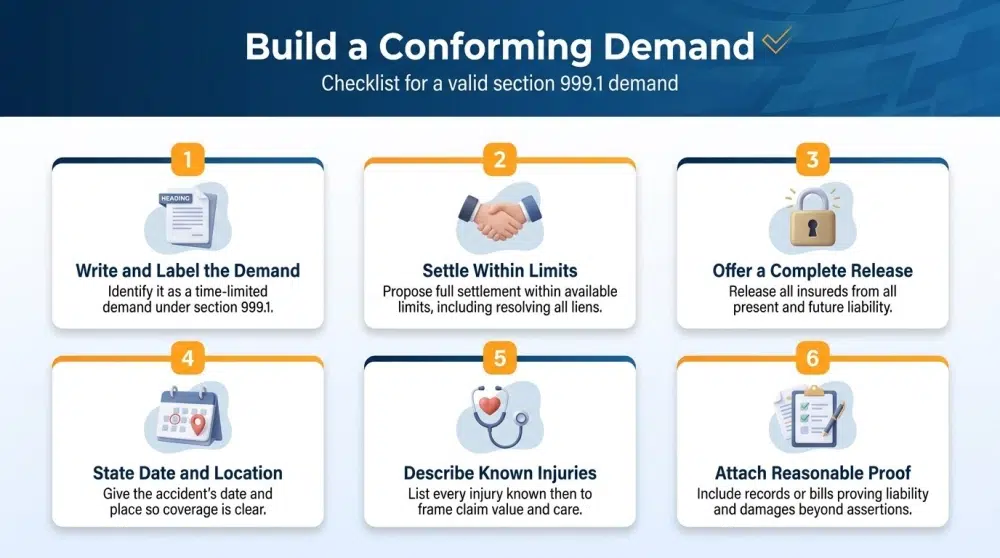
Section 999.1 sets out the requirements for a time-limited demand to be considered conforming. Every element listed below must be present. A demand missing any one of them may not have the same legal force when extracontractual damages are later alleged.[2]
Written Form and Labeling
The demand must be in writing and must either be labeled as a “time-limited demand” or explicitly reference section 999.1. An informal letter or email that offers to settle within policy limits but does not identify itself as a statutory time-limited demand does not automatically qualify.
Minimum Response Window
The claimant must allow the insurer enough time to evaluate and respond. Under section 999.1(a):
- 30 days if transmitted by email, facsimile, or certified mail
- 33 days if transmitted by regular mail
The window runs from the date of transmission. A demand that gives the insurer fewer than the required number of days does not satisfy this element.
Clear Settlement Offer Within Policy Limits
The demand must contain a clear and unequivocal offer to settle all claims within policy limits, including satisfaction of all liens. An offer that is conditional in ways beyond what the statute permits, or that demands more than available policy limits, does not qualify.
Offer of a Complete Release
The demand must offer a complete release from the claimant for the liability insurer’s insureds from all present and future liability for the occurrence, not merely a partial release of some claims.
Date and Location of the Loss
The demand must state the date and location of the accident, incident, or event giving rise to the claim.
Claim Number
If the claim number is known at the time the demand is transmitted, it must be included.
Description of All Known Injuries
The claimant must describe all injuries sustained that are known at the time of the demand.
Reasonable Proof Supporting the Claim
Section 999.1(g) requires “reasonable proof, which may include, if applicable, medical records or bills, sufficient to support the claim.” The demand must accompany substantiating documentation, not just a bare assertion of injuries and damages.
How the Demand Must Be Delivered
Section 999.2 governs where a time-limited demand must be sent. A claimant must direct the demand to one of two places:[3]
- The email address or physical address designated by the liability insurer for receipt of time-limited demands under this chapter, if the insurer has provided that address to the California Department of Insurance (DOI) and the DOI has made it publicly available on its website; or
- The insurance representative assigned to handle the claim, if that person’s contact information is known.
The DOI is required to post these designated addresses on its website. Sending the demand to the wrong address even if it eventually reaches someone at the insurance company, may undermine the claimant’s ability to rely on the statutory framework if the insurer later disputes proper service.
Orange County claimants and their attorneys handling cases through the Orange County Superior Court’s Central Justice Center in Santa Ana should be aware that delivery failures are a common point of insurer resistance after a demand deadline passes. Confirming the correct statutory address before transmitting is essential.
How an Insurer Must Respond to a Conforming Demand
Section 999.3 addresses the insurer’s obligations once a time-limited demand is received.[4]
Acceptance
An insurer accepts a time-limited demand by providing written acceptance of all material terms outlined in section 999.1 in their entirety. A conditional acceptance or an acceptance that modifies any material term is not a valid acceptance under the statute.
Seeking Clarification Is Not Automatically a Counteroffer
Section 999.3(b) protects claimants from a common insurer tactic: treating any question about the demand as a rejection. Under the statute, an attempt to seek clarification or additional information, or a request for an extension due to the need for further investigation made during the response period does not, in itself, constitute a counteroffer or rejection of the demand. However, an insurer that asks for more time should do so carefully and in writing, because the statute does not automatically extend the deadline; the extension must be agreed to by the parties.
If the Insurer Does Not Accept
Section 999.3(c) imposes an important affirmative obligation on an insurer that decides not to accept. The insurer must:
- Notify the claimant in writing of its decision not to accept
- State the basis for that decision
- Send that notification before the demand deadline expires (including any agreed extension)
This written notification “shall be relevant in any lawsuit alleging extracontractual damages against the tortfeasor’s liability insurer.” That language is significant: the insurer’s stated reasons for declining become part of the evidentiary record if litigation later seeks damages above policy limits.
What Claims This Statute Covers and What It Does Not
Section 999.5 defines the scope of the entire chapter. It applies only to causes of action and claims covered under:[5]
- Automobile or motor vehicle liability insurance
- Homeowner’s liability insurance
- Commercial premises liability insurance
Coverage must be for property damage, personal or bodily injury, or wrongful death claims.
The statute expressly does not apply to professional liability, product liability, workers’ compensation, general liability policies not falling within the listed categories, or other types of insurance not enumerated above. A claimant who sends what appears to be a statutory time-limited demand on a claim covered by a general commercial general liability policy issued to a business, for example, may not have the benefit of the section 999.3(c) notification requirement unless the policy falls within a covered category.
Section 999.5(b) also makes clear that apart from what the chapter specifically provides, existing law governing claims, damages, and defenses in extracontractual litigation is not altered. The chapter adds procedural structure; it does not create new substantive rights not otherwise recognized by California law.
How These Rules Work in Practice
A driver stopped at a red light on the I-405 near the Irvine Spectrum is rear-ended by a driver insured under a standard automobile liability policy. The injured person’s attorney transmits a time-limited demand by email to the address listed on the DOI website for that insurer. The demand is labeled as a time-limited demand under CCP § 999.1, includes 31 days to respond, attaches emergency room records and bills, describes the injuries, provides the date and location of the crash and the claim number, and offers a complete release.
The insurer responds on day 28 asking for additional medical records without requesting an extension. On day 31, the deadline expires and the insurer has not sent written acceptance or written declination with stated reasons. Under section 999.3(c), the insurer failed to comply. That failure and the absence of a written explanation become relevant evidence in any subsequent extracontractual damages claim.
The same analysis applies to a residential accident covered under a homeowner’s policy a common scenario for claims arising from pools, staircases, or driveways in established Irvine neighborhoods served by the Orange County Superior Court.
Why a Non-Conforming Demand May Not Create Extracontractual Exposure
The statute’s requirements exist in both directions. A claimant who sends a demand that does not satisfy section 999.1 perhaps one that omits the claim number when it was known, provides fewer than the required response days, or fails to include reasonable proof cannot necessarily invoke the protections of section 999.3(c) if the insurer declines without a written explanation.
For this reason, an insurer who receives what appears to be a time-limited demand will often evaluate whether every element of section 999.1 is present before deciding whether the statutory obligation to provide a written declination has been triggered. A claimant and their attorney must pay careful attention to every checkbox in the statute before transmitting.
Personal injury lawyers routinely review whether a demand letter qualifies as a statutory time-limited demand under section 999.1 before advising a client on litigation strategy, precisely because the answer shapes the insurer’s obligations and the claimant’s evidentiary position going forward.
How This Law Changed Insurer Exposure Compared to Prior Practice
Before sections 999 through 999.5 took effect, California’s rules governing time-limited demands were largely creatures of case law developed under the insurer’s duty of good faith and fair dealing. Whether an insurer acted reasonably in declining a settlement demand involved fact-specific inquiries that courts and juries evaluated with limited statutory guidance.
SB 1155 (2022) introduced a statutory floor. By specifying exactly what a conforming demand must contain, requiring a minimum response window, requiring a written explanation of any declination, and declaring that declination notice “shall be relevant in any lawsuit alleging extracontractual damages,” the Legislature gave both sides clearer ground rules. Insurers that follow those rules retain more defensible positions. Insurers that ignore them, by failing to send a written, timely declination with stated reasons hand claimants concrete evidentiary material for use in extracontractual litigation.[6]
The law applies only to demands transmitted on or after January 1, 2023. Older demands sent before that date are governed by pre-existing case law, not the statute.
Deadlines and Timing Considerations
Several time-sensitive rules apply throughout this process:
| Deadline or Rule | Requirement |
|---|---|
| Minimum demand window (email, fax, certified mail) | 30 days from transmission |
| Minimum demand window (regular mail) | 33 days from transmission |
| Insurer’s declination notice deadline | Before demand expires (including any agreed extension) |
| Statute effective for demands | Transmitted on or after January 1, 2023 |
| California statute of limitations (personal injury) | Generally 2 years from injury – [DEADLINE REQUIRES LEGAL VERIFICATION for specific facts] |
The statute of limitations for the underlying personal injury or wrongful death claim is separate from, and unaffected by, the time-limited demand process. Sending a demand does not toll the statute of limitations. A claimant who sends a demand and waits for a response must track the litigation deadline independently and file suit if the statutory period is approaching, regardless of whether the demand process has concluded.
What Evidence May Matter in Extracontractual Litigation
If a case proceeds to litigation seeking damages above policy limits, the following categories of evidence are likely to matter in evaluating whether the insurer complied with its obligations under the statute and under general principles of good faith:
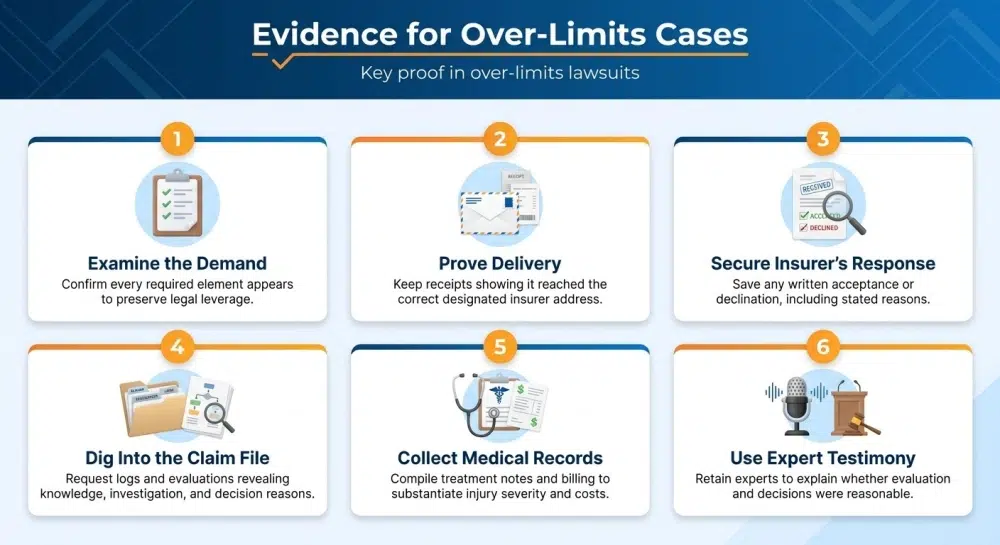
- The demand itself – whether it contained all section 999.1 elements
- Proof of delivery – confirmation that the demand reached the correct statutory address within the timeframe
- The insurer’s written response or non-response – particularly any written declination and its stated reasons under section 999.3(c)
- Communications during the response window – requests for clarification or extension, and how they were handled
- The insurer’s claim file – documents showing what the insurer knew, when it knew it, and what investigation it conducted
- Medical records and billing records – supporting the claimed damages
- Expert testimony – on the reasonableness of the insurer’s evaluation and decision
None of this evidence automatically establishes extracontractual liability. The statute says the declination notice “shall be relevant” not that it creates liability by itself. Whether the insurer’s conduct meets the threshold for extracontractual damages depends on the full factual and legal record, evaluated under California’s existing framework for insurer bad faith and the duty of good faith and fair dealing.
What Should I Do Next?
If you have been injured in an automobile accident, a premises incident, or another event that may give rise to a personal injury claim in California, the timing and structure of any pre-litigation settlement demand can significantly affect your ability to pursue compensation beyond available policy limits if the insurer fails to settle reasonably. Personal injury claims can involve medical evidence, insurance coverage questions, lien resolution, liability disputes, and strict procedural rules. A GoSuits personal injury attorney can review your specific circumstances and explain your options under current California law, including whether and how to structure a time-limited demand that satisfies every element of Code of Civil Procedure section 999.1.
Schedule a free consultation with our Irvine personal injury team today.
Related California Personal Injury Resources
- How to Build an Injury Demand Package in California
- CCP § 998 Offers to Compromise – California
- California Policy Limits Disclosure: Insurer Requirements
- How to Prove a Bad Faith Insurance Claim in California
- Dealing With Insurance Companies After an Accident in California
Talk With a GoSuits Attorney
Personal injury cases are rarely just about the injury. You’ve got medical proof to gather, insurance coverage disputes to fight through, liens to sort out, liability questions to pin down, and procedural rules that can genuinely change what kind of compensation is on the table. If you were hurt in an Irvine car crash, a premises incident in Orange County, or another accident that falls under auto or premises liability coverage, a GoSuits attorney can look at your facts and explain your options under California law. That includes talking through whether a properly built time-limited demand could really matter in your situation.
Our Irvine personal injury team serves clients throughout Orange County. Contact us to schedule a free consultation.
This article provides general legal information about California law and is not legal advice for any specific situation. Laws change; consult a licensed California attorney for guidance on your particular circumstances.
References
- Cal. Code of Civil Procedure § 999 – Definitions; Time-Limited Demand – California Legislative Information
- Cal. Code of Civil Procedure § 999.1 – Required Contents of a Time-Limited Demand – California Legislative Information
- Cal. Code of Civil Procedure § 999.2 – Service Requirements for Time-Limited Demands – California Legislative Information
- Cal. Code of Civil Procedure § 999.3 – Insurer Acceptance and Response Obligations – California Legislative Information
- Cal. Code of Civil Procedure § 999.5 – Scope and Application of Chapter – California Legislative Information
- Cal. Code of Civil Procedure §§ 999–999.5 (Stats. 2022, Ch. 719, Sec. 1 [SB 1155]) – California Legislative Information
- California Legislative Information – Official California Codes Online
- California Rules of Court – California Courts (courts.ca.gov)