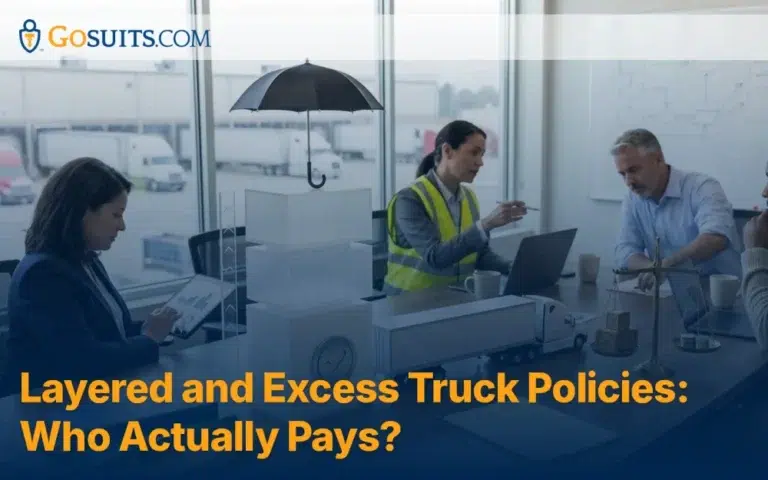
When a commercial truck crash seriously injures someone on I-405 or SR-73 near Irvine, the first question at the scene is “who is responsible.” The more financially significant question quickly becomes “which insurance policy, or policies, actually fund a recovery, and up to how much?” Federal law sets minimum financial responsibility levels for interstate motor carriers, but those minimums are often far below the value of a catastrophic injury. Real-world trucking claims regularly involve a stack of insurance layers, a federally mandated MCS-90 endorsement with a surety-like obligation, and additional coverage held by freight brokers, shippers, trailer owners, maintenance contractors, and staffing agencies. Identifying every layer early, before evidence disappears and before any entity files its own coverage defenses, is some of the most time-sensitive work in truck crash litigation.
Legal Snapshot
- Legal Topic: Commercial Trucking Insurance Layers and MCS-90 Endorsement
- Case Stage: Pre-litigation / Early investigation
- Primary Legal Issue: Federal financial responsibility requirements; excess and umbrella stacking; third-party liability exposure
- Primary Authority: 49 U.S.C. § 13906; 49 CFR Part 387 (FMCSA)
- Supplementary Authority: Cal. Civ. Code § 1431.2 (Prop. 51); Cal. Civ. Proc. Code § 335.1
- Jurisdiction: California (Irvine / Orange County); Federal interstate motor carrier regulations
- Date Legal Authority Last Reviewed: July 2026
What Are the Federal Minimum Financial Responsibility Levels for Interstate Motor Carriers, and Why Do They Fall Short?
Congress required interstate motor carriers to maintain minimum levels of financial responsibility as a condition of operating authority. The Federal Motor Carrier Safety Administration implements this requirement under 49 U.S.C. § 13906, and the specific dollar minimums appear in the FMCSA’s regulations at 49 CFR § 387.9. [1] [2]
Under that schedule, the minimum for a for-hire carrier transporting non-hazardous property in interstate or foreign commerce with a gross vehicle weight rating of 10,001 pounds or more is $750,000. Carriers transporting certain hazardous materials in bulk face minimums of $1,000,000 or $5,000,000 depending on the substance. [2]
Those figures were set in 1985 and have not been adjusted for inflation. A single catastrophic injury claim involving spinal cord damage, traumatic brain injury, or wrongful death routinely produces economic losses alone that dwarf the $750,000 floor when future medical care, lost earning capacity over a working lifetime, and non-economic damages are aggregated. The practical result is that injured people relying solely on the carrier’s primary policy are often undercompensated unless the investigation surfaces excess layers, umbrella policies, and coverage held by other parties in the supply chain.
How Does Coverage Stack: Primary Commercial Auto, Excess and Umbrella Layers, and Self-Insured Retentions?
Most carriers operate with a layered insurance program. Understanding how the layers interact is fundamental to evaluating the total available recovery. personal injury lawyers who handle truck claims treat layer identification as urgent early work rather than something to address after liability is established.
Primary Commercial Auto Layer
The primary commercial auto liability policy is the first to respond when a carrier is found liable for bodily injury or property damage. It applies up to its per-occurrence limit before any excess or umbrella policy is triggered. For an interstate motor carrier, this policy must include the MCS-90 endorsement discussed in the next section, and it must be filed with the FMCSA or state regulatory authority as evidence that financial responsibility requirements are met. [3]
Primary limits vary widely by carrier size, commodity, and route. A regional short-haul carrier may carry $1 million primary. A large carrier or one hauling regulated materials may carry $5 million or more at the primary layer. Verifying the actual limit requires requesting the declarations page and the MCS-90 endorsement, not relying on a certificate of insurance that often omits key terms.
Self-Insured Retentions
Large carriers sometimes satisfy part or all of their federal financial responsibility obligation through a self-insurance program rather than a traditional insurance policy. Under 49 CFR § 387.309, a carrier can apply to the FMCSA to become a self-insurer by demonstrating sufficient financial capacity. [4] Self-insured carriers retain the first dollars of any claim themselves, which means the entity controlling the claim in early stages is the same entity whose driver caused the crash. That creates obvious incentives to minimize early investigation. Recognizing a self-insured retention early helps a claimant understand why rapid preservation letters are especially important and why independent evidence gathering cannot wait.
Excess Liability Layers
Above the primary layer, carriers typically purchase excess liability policies that apply once the primary limit is exhausted. A carrier might hold $750,000 or $1 million primary, then a $4 million excess layer, then a $5 million second excess layer. Each policy has its own terms, conditions, and potential coverage defenses. Excess policies sometimes contain exclusions that do not appear in the primary layer, and they may have different notice requirements. Failure to put an excess insurer on timely notice of a claim can become a coverage defense, which is another reason why early comprehensive notice is essential.
Commercial Umbrella Policies
Umbrella policies provide broader protection than a pure excess policy in that they may cover some gaps between the primary and excess layers and may respond to claims not reached by the primary. Umbrella policies generally follow the form of the underlying primary policy but can have unique conditions. In a serious truck crash, the umbrella layer may hold the most substantial available limits and is often where the most contentious coverage disputes arise.
An Example of How the Stack Works
Example (hypothetical for illustration only): A carrier holds a $1 million primary commercial auto policy, a $4 million excess policy triggered when the primary is exhausted, and a $5 million umbrella. A passenger suffers catastrophic injuries on I-405 near the Irvine Spectrum interchange. A jury returns a verdict of $7 million. The primary pays its $1 million limit. The excess pays up to $4 million of the remaining $6 million, bringing total payments to $5 million. The umbrella responds to part or all of the remaining balance depending on its terms. Without identifying both the excess and umbrella layers during discovery, the plaintiff might never reach those funds.
What Is the MCS-90 Endorsement, and Why Is It a Surety-Style Obligation Rather Than True Coverage for the Insured?
The MCS-90 endorsement is one of the most frequently misunderstood instruments in transportation litigation. Its form is prescribed by the FMCSA under 49 CFR § 387.15, and it must be attached to an interstate motor carrier’s automobile liability insurance policy. [3]
What the MCS-90 Does
The MCS-90 does not create a separate insurance policy and does not expand the scope of coverage the insurer would otherwise owe the carrier under the underlying policy. What it does is create an obligation running from the insurer directly to the public. Specifically, the endorsement provides that if a judgment is entered against the carrier for liability arising from the carrier’s transportation operations involving a commercial motor vehicle, the insurer will pay that judgment up to the applicable financial responsibility minimum, regardless of any policy exclusion or condition that might otherwise relieve the insurer of its obligation. [3]
Courts have described the MCS-90 as functioning in a manner analogous to a surety bond. If the carrier’s policy would otherwise not respond, perhaps because the vehicle involved was not listed on the policy, because the driver was excluded, or because a policy condition was violated, the MCS-90 still compels payment to the injured third party up to the applicable minimum. The insurer can then seek reimbursement from the carrier as the principal.
What the MCS-90 Does Not Do
Because the MCS-90 is a surety-style obligation to the public rather than true first-party coverage for the carrier, several important limitations apply. First, the MCS-90 only covers the federal minimum amounts, currently $750,000 for non-hazardous property carriers. It does not increase the carrier’s total policy limits, and if the policy limit already exceeds the minimum, the MCS-90 does not add anything beyond what the policy already provides. Second, the endorsement does not protect the carrier itself. The insurer that pays a judgment under MCS-90 has a right of reimbursement against the carrier if the underlying policy would not have covered the claim. Third, the MCS-90 does not substitute for a policy; it modifies an existing policy to make its financial responsibility obligation non-avoidable by the insurer as to the public. [3]
Why MCS-90 Identification Matters Early
From a plaintiff’s perspective, confirming that the carrier had a valid MCS-90 endorsement in effect at the time of the crash is foundational. The endorsement requires that coverage remain continuously in effect until terminated, and cancellation requires advance notice to the FMCSA. [3] A carrier that operated without a valid MCS-90 on file may face regulatory consequences, and a carrier that allowed its coverage to lapse may have no financial responsibility at all, which shifts the focus to other available sources such as the carrier’s surety bond, any applicable excess or umbrella policies, or the freight broker’s or shipper’s own insurance.
What Additional Parties May Carry Their Own Policies, and How Do Those Layers Interact?
In a typical brokered load, several entities besides the motor carrier may hold insurance relevant to a crash claim. Identifying all of them early, before the litigation is well underway, directly affects total available recovery and the negotiating leverage on each defendant.
The Freight Broker
Freight brokers are required by federal law to maintain a surety bond or trust fund in the amount of $75,000 as a condition of operating authority. 49 U.S.C. § 13906. [5] That bond is not liability insurance. It serves to pay shippers and carriers for property-related losses, not bodily injury claims. However, freight brokers often carry separate commercial general liability policies and sometimes professional liability or errors and omissions policies. Some brokers carry contingent auto liability policies designed to respond when the motor carrier’s insurance does not. Determining which policies a broker holds requires discovery or a pre-litigation demand for policy information under California Insurance Code § 11580, which allows certain injured parties to compel disclosure of applicable policy limits. [6]
The availability of a direct claim against the broker depends on the legal theory. As covered in our related knowledge-base article on broker negligence and whether you can sue the trucking broker, the Ninth Circuit generally permits negligent selection and negligent hiring claims against brokers under California law, subject to the federal FAAAA preemption analysis. If broker negligence claims survive, the broker’s own CGL and contingent auto policies become available sources.
The Shipper
The entity that arranged the load, packaged the cargo, or specified loading instructions may bear liability if its actions contributed to the crash. Improper loading that causes cargo shift, overloading that strains brakes, or unsafe packing that creates a hazard on unloading can each generate claims against the shipper. Shippers typically hold commercial general liability policies and sometimes cargo legal liability policies. Determining whether the shipper’s policy covers third-party bodily injury arising from transportation-related conduct requires reviewing the policy terms, including any transportation exclusions.
The Trailer Owner
It is common for the tractor and trailer to be owned by different entities. A carrier may pull a trailer owned by the shipper, a trailer leasing company, or an independent equipment provider. If the trailer had a defect, a braking system failure, or an equipment problem that contributed to the crash, the trailer owner may face product liability or negligent maintenance claims. The trailer owner’s general liability or equipment floater policy would be the relevant insurance source. Identifying the trailer’s ownership requires examining the registration, the lease agreement between the carrier and the trailer owner, and any interchange agreement governing the carrier’s right to use the equipment.
The Maintenance Contractor
Motor carriers are required to systematically inspect, repair, and maintain their commercial motor vehicles under 49 CFR Part 396. [7] When a carrier outsources maintenance to a third party, that maintenance contractor may share liability for brake failures, tire failures, or other mechanical defects. Maintenance contractors typically carry commercial general liability policies. Those policies may include completed operations coverage that responds to claims arising from work performed before the crash. Identifying maintenance contractors requires reviewing the carrier’s maintenance records, driver vehicle inspection reports, and any repair invoices in the carrier’s files.
The Staffing Agency
Some carriers employ drivers through staffing or leasing agencies rather than directly. When the driver is a leased employee, questions arise about which entity is the employer and which bears employer liability for negligent hiring, training, or supervision. Staffing agencies often carry workers’ compensation insurance and employers’ liability policies. Depending on the contractual arrangement and how control over the driver was allocated, the staffing agency may also face third-party liability claims. Identifying a staffing relationship requires reviewing the driver qualification file, the carrier’s operating authority filings, and any driver lease or services agreement between the agency and the carrier.
How Does California’s Proposition 51 Apportion Liability Among Multiple Defendants?
When a truck crash claim in California involves multiple defendants, such as the driver, the carrier, the broker, the shipper, and the trailer owner, the apportionment of liability among them follows California’s comparative fault framework as modified by Proposition 51, codified at California Civil Code § 1431.2. [8]
The Proposition 51 Rule
Proposition 51, enacted by California voters in 1986 and codified at Civil Code § 1431.2, divides liability differently for economic and non-economic damages. Each defendant is jointly and severally liable for all economic damages. That means any one defendant can be required to pay the full amount of economic losses, regardless of that defendant’s percentage of fault, and can then seek contribution from other defendants. For non-economic damages such as pain and suffering, disfigurement, and loss of enjoyment of life, each defendant is severally liable only for their own proportionate share. A defendant found 20 percent at fault pays only 20 percent of the non-economic award, even if other defendants are judgment-proof or uninsured. [8]
Practical Effect on Multi-Defendant Truck Cases
In a catastrophic truck crash with multiple defendants, the economic damages often constitute the largest share of a verdict when future medical care and lost earning capacity are included. The joint and several rule for economic damages means that a financially sound defendant such as a large motor carrier or a well-capitalized shipper bears the risk of paying economic damages attributable to a financially insolvent co-defendant such as a small broker or uninsured trailer owner. That exposure motivates well-capitalized defendants to aggressively defend both liability and damages and to point to the fault of other parties at trial. Understanding Proposition 51 helps explain why defendants in multi-party truck cases almost always designate each other and sometimes the plaintiff as partially responsible.
Interaction with Policy Limits
Even if a defendant has joint and several liability for all economic damages under Proposition 51, that defendant can only pay up to its policy limits. If the total verdict exceeds the combined available insurance of all defendants, the plaintiff faces a collection problem. This is why total available insurance across all layers and all parties, not just the primary carrier policy, is the central focus of early investigation.
Why Is Policy Layer Identification Early Work Rather Than Late Work?
Experienced truck accident lawyers treat layer identification as a first-week task, not something to address after a liability verdict. Several reasons make early identification critical.
Evidence Preservation and Litigation Hold
Electronic logging device data, engine control module downloads, onboard telematics, and dashcam footage can be overwritten or recycled by motor carriers within weeks. A preservation letter that covers not just the carrier but also the broker, shipper, and trailer owner ensures that each party’s relevant records are held. Knowing which entities to notify requires knowing who the parties are, which in turn requires early investigation into the contractual chain of custody for the load.
Notice Requirements for Excess and Umbrella Policies
Excess and umbrella policies typically contain provisions requiring prompt notice of any occurrence or claim that may exhaust the primary layer. Failure to provide timely notice can become a coverage defense available to the excess or umbrella insurer. If the primary policy has a $750,000 limit and the case clearly has seven-figure potential, notice to excess carriers should go out immediately, before discovery even begins.
Discovery of Policy Information in California
California Insurance Code § 11580 requires that every policy of automobile liability insurance include a provision making it directly enforceable by a judgment creditor. It also supports a right to demand policy limit information from insurers when a claim has been made. In addition, California’s disclosure rules allow pre-litigation discovery of insurance policy information in certain circumstances, and once litigation commences, Federal Rule of Civil Procedure 26(a)(1)(A)(iv) and the California Code of Civil Procedure both require disclosure of applicable insurance agreements in discovery. [6] [9]
Obtaining the full insurance program, including every layer, every endorsement, and every applicable excess or umbrella policy, requires serving specific document requests early and following up aggressively when productions are incomplete. Carriers and their insurers have financial incentives to produce minimal initial disclosures, and the obligation to supplement responses means that ongoing pressure is required.
Statute of Limitations and Deadlines
In California, the general statute of limitations for personal injury is two years from the date of injury under California Code of Civil Procedure § 335.1. [10] Wrongful death claims are also generally subject to a two-year period. If a government entity, such as Caltrans or a county road department, may share liability for a dangerous roadway condition on I-5 or I-405 near Irvine, the government claim must be presented to the public entity within six months under California Government Code § 911.2. [11] These deadlines apply regardless of whether the insurance investigation is complete, making early action essential on multiple tracks simultaneously.
What Evidence Is Required to Identify and Reach Each Insurance Layer?
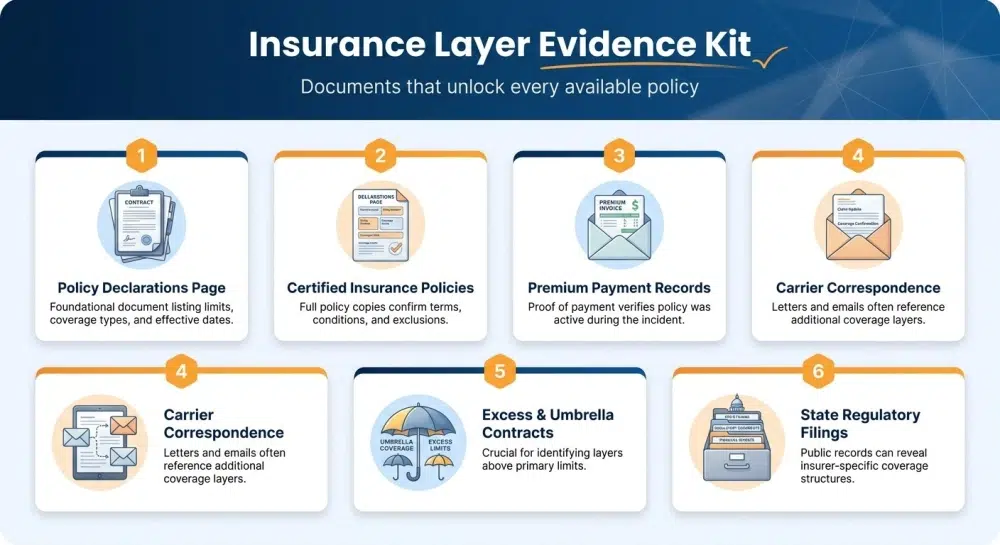
Reaching each layer of a trucking insurance program requires specific evidence, often in the possession of the carrier, broker, shipper, or insurer. The following categories of evidence are commonly central to layer identification and coverage claims.
- Certificate of Insurance and Policy Declarations: The certificate identifies the primary insurer and limit, but frequently omits excess and umbrella layers. Policy declarations pages, obtained through discovery or direct demand, show the actual structure of the program.
- MCS-90 Endorsement: The FMCSA maintains a public database of active authority holders and their registered insurance filings. Confirming that the MCS-90 was on file and in effect on the date of the crash is foundational. [3]
- Broker-Carrier Agreement: This contract specifies which party bears insurance responsibility, whether the carrier or broker must name the other as additional insured, and whether the carrier’s insurance is the exclusive source or whether the broker maintains its own contingent policy.
- Shipper Transportation Contract: Contracts between shippers and carriers or brokers often contain indemnification provisions and insurance requirements that define which party’s policy responds first and how limits interact.
- Equipment Lease or Interchange Agreement: If a trailer owner is a separate entity, the interchange or lease agreement specifies which party’s insurance covers the trailer when it is being operated by the carrier.
- Driver Qualification File and Staffing Agreement: If the driver was a leased employee of a staffing agency, the staffing agreement and the driver qualification file maintained by both the carrier and the agency are essential to determine which entity had control and bears employer liability.
- Maintenance Records and Service Agreements: If mechanical failure contributed to the crash, the maintenance contractor’s service agreement and the carrier’s maintenance logs identify the contractor and help establish scope of work and responsibility for the defect.
- FMCSA Registration and Authority Records: The FMCSA’s Safety Measurement System and SAFER (Safety and Fitness Electronic Records) database contain carrier registration, authority status, and insurance filing information that is publicly accessible and should be obtained within days of a crash. [12]
What Damages May Be Available in a California Truck Crash Case Involving Multiple Insurance Layers?
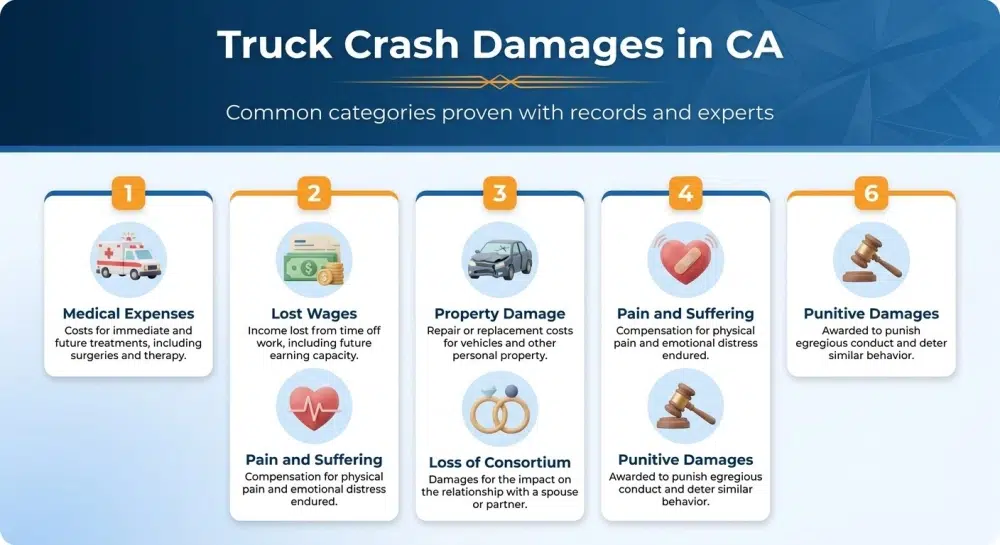
When every available insurance layer has been identified and reached through litigation, the types of damages available under California law include the following categories, subject to proof and applicable limits.
- Past and future medical expenses: Hospital, surgical, rehabilitation, home health care, and life care planning costs supported by medical records and expert testimony.
- Lost wages and lost earning capacity: Past income loss and the present value of future earning capacity diminished by injury, calculated using vocational and economic expert testimony.
- Physical pain and mental suffering: Non-economic damages for the subjective experience of injury, subject to the Proposition 51 several liability rule for apportionment among defendants. [8]
- Physical impairment and disfigurement: Separate categories of non-economic damage under California law.
- Property damage: Vehicle repair or replacement and related out-of-pocket costs.
- Wrongful death and survival damages: When a crash is fatal, specified beneficiaries may bring a wrongful death action for their own losses, and the estate may pursue a survival action for damages the decedent could have recovered. The truck accident lawyers at GoSuits handle both types of claims and can explain how wrongful death claims interact with available insurance layers in any specific situation. Those injured or bereaved in a crash on the I-405 or SR-73 can reach our Irvine wrongful death attorneys for a free consultation.
- Punitive damages: Available when conduct is found to constitute malice, oppression, or fraud under California Civil Code § 3294. Standard commercial trucking negligence does not meet this threshold, but egregious conduct such as knowingly using a driver with a history of violations or falsifying logs may support a punitive claim in appropriate cases.
How Should You Act Immediately After a Truck Crash in the Irvine Area?
The complexity of trucking insurance programs means that the first hours after a crash in Irvine, on I-5, I-405, SR-133, SR-241, or SR-73 are the most consequential for the eventual claim. Stop-and-go traffic near the Irvine Spectrum corridor and merge conflicts on SR-55 create conditions where rear-end and lane-change collisions involving commercial trucks occur regularly.
- Call 911 and seek medical care immediately. Medical records establish both injury and timing.
- Photograph the scene, vehicles, cargo, skid marks, lane markings, and any posted signage. Note any cameras on structures or business premises that may have captured the collision.
- Obtain the carrier’s USDOT number and MC number from the truck. These identifiers allow FMCSA records to be pulled within hours.
- Identify any bill of lading, load confirmation, or broker paperwork visible on the truck. This documentation begins to map the chain of custody for the load.
- Preserve your own contemporaneous record. A written account of what you observed, prepared as soon as possible after the crash, is valuable if your memory is later challenged.
- Do not give a recorded statement to any insurer without legal counsel. Insurers conduct early recorded statements to create inconsistencies that can be used to limit or defeat claims.
Truck crash claims involving layered insurance programs require immediate action on multiple fronts simultaneously. A free consultation with the Irvine personal injury team at GoSuits can help you understand which layers may apply to your situation, what information needs to be preserved, and how the investigation should proceed. If you or a family member was injured by a commercial truck anywhere in Orange County, schedule a free consultation today.
Talk With a GoSuits Irvine Truck Accident Attorney
GoSuits represents personal injury clients throughout California, including Irvine and the broader Orange County area that includes Santa Ana, Newport Beach, and Costa Mesa. Our truck accident lawyers are familiar with the commercial vehicle corridors in Southern California and the insurance structures that commercial carriers use. We handle every step of layer identification, from FMCSA records requests and carrier insurance filings to discovery of broker agreements, shipper contracts, trailer leases, maintenance records, and staffing agreements. We use proprietary case management technology to streamline discovery, organize evidence, and keep cases moving without the delays that allow evidence to be lost or destroyed.
Direct access to your attorney. Not a paralegal, not a case manager, the actual lawyer working your file. We treat every case like it might end up in front of a jury, and that mindset probably does more for negotiations than anything else. If a case really does have to be tried, we’re ready. Poke around our prior cases page if you want to see what we’ve handled, meet our attorneys , and read about our firm . Consultations don’t cost anything. Truck crash cases are contingency, so no fees unless we recover for you.
If you were injured by a commercial truck on I-5, I-405, SR-73, or any other Orange County highway, do not wait. Insurance carriers mobilize their own investigation teams immediately. Contact our Irvine truck accident lawyers today and let us begin the layer identification process on your behalf.
References and Resources
- 49 U.S.C. § 13906, Financial Responsibility Required of Motor Carriers – Cornell Law School Legal Information Institute
- 49 CFR § 387.9, Financial Responsibility Minimum Levels – Cornell Law School Legal Information Institute
- 49 CFR § 387.15, Forms – MCS-90 Endorsement Requirements – Cornell Law School Legal Information Institute
- 49 CFR Part 387, Minimum Levels of Financial Responsibility for Motor Carriers – Cornell Law School Legal Information Institute
- 49 U.S.C. § 13906(b), Broker Bond or Trust Fund Requirements – Cornell Law School Legal Information Institute
- California Insurance Code § 11580, Third-Party Judgment Creditor Rights – California Legislative Information
- 49 CFR Part 396, Inspection, Repair, and Maintenance of Commercial Motor Vehicles – Cornell Law School Legal Information Institute
- California Civil Code § 1431.2, Proposition 51 Several Liability for Non-Economic Damages – California Legislative Information
- Federal Rule of Civil Procedure 26(a)(1)(A)(iv), Required Disclosure of Insurance Agreements – Cornell Law School Legal Information Institute
- California Code of Civil Procedure § 335.1, Two-Year Personal Injury Statute of Limitations – California Legislative Information
- California Government Code § 911.2, Government Claim Six-Month Presentation Deadline – California Legislative Information
- Large Truck and Bus Crash Facts 2021 – Federal Motor Carrier Safety Administration