How Is a Mild Brain Injury Proven When Scans Look Normal?
A mild traumatic brain injury (mTBI) can be proven in a California personal injury claim even when CT scans and standard MRI images return completely normal results. Standard imaging is designed to detect gross structural damage, not the microscopic axonal disruption that causes most mTBI symptoms. California courts apply a preponderance of the evidence standard, which means the burden is met by showing it is more likely than not that the injury occurred and is connected to the defendant’s conduct. A combination of clinical diagnosis, neuropsychological performance testing, documented symptoms, and testimony from people who knew the injured person before and after the incident can satisfy that standard without a single visible abnormality on any scan.
Legal Snapshot
- Legal Topic: Proving mild traumatic brain injury in a California civil claim
- Jurisdiction: California (State Law — Civil)
- Primary Legal Issue: Causation and damages; evidentiary sufficiency for mTBI with normal imaging
- Burden of Proof: Preponderance of the evidence (California Code of Civil Procedure)
- Statute of Limitations: Two years from the date of injury (Cal. Code Civ. Proc. § 335.1) [1]
- Primary Court: Orange County Superior Court; Central Justice Center, Santa Ana
- Key Authority: Cal. Code Civ. Proc. §§ 335.1, 2032; Cal. Evid. Code § 801 (expert testimony) [2]
- Date Authority Reviewed: 2025
Why do CT scans and standard MRIs miss mild traumatic brain injury?
CT scans are optimized for speed and for detecting the conditions that require immediate intervention: skull fractures, large hemorrhages, significant cerebral edema, and mass effect. For those purposes they perform reliably. The cellular damage underlying most mild TBI cases is a different matter entirely.
When the head accelerates and then decelerates rapidly, as happens in a rear-end collision on the SR-73 Toll Road or a broadside impact near the Irvine Spectrum, long axonal fibers are stretched and twisted at a microscopic level. Ion channels misfire, calcium floods into cells, and neurotransmitter regulation is disrupted. None of this creates the visible structural changes a CT is designed to find. The result is a scan labeled “no acute intracranial abnormality” while the injured person walks out of the emergency department with headaches, cognitive fog, and sleep disturbance. [3]
Standard MRI sequences used in most emergency department protocols share the same limitation. They depict anatomy with excellent soft-tissue detail but still show structure, not function. Diffuse axonal injury, which the Centers for Disease Control and Prevention describes as involving chemical changes and stretching of brain cells, spreads micro-damage across white matter tracts in patterns that a conventional 1.5-Tesla MRI typically cannot resolve. [3] Research published through the National Library of Medicine’s clinical reference database notes that approximately 80 percent of all traumatic brain injury cases are classified as mild, and most of them produce normal-appearing conventional imaging. [4]
The practical significance is this: a normal CT or standard MRI is not the same as a “clean bill of health” for brain function. It rules out gross structural damage. It does not rule out a concussion, does not rule out diffuse axonal injury, and does not rule out the functional deficits that follow. California injury claims fail or succeed on that distinction.
What does diffusion tensor imaging actually show that a standard MRI does not?
Diffusion tensor imaging (DTI) is a specialized MRI sequence that measures water diffusion along white matter tracts rather than tissue anatomy. Healthy axons have an ordered internal structure, and water molecules move efficiently along their length. When those axons are disrupted, the organized movement breaks down and water diffuses more randomly. DTI captures this shift through a value called fractional anisotropy. Lower fractional anisotropy in a region corresponds to disrupted fiber organization, and this can appear on DTI even when a conventional MRI of the same brain shows nothing unusual. [4]
Other advanced modalities are used in clinical and research settings to detect functional changes after mTBI. Functional MRI (fMRI) examines brain activation patterns during cognitive tasks and can differentiate mTBI patients from control groups based on altered network connectivity. Single Photon Emission Computed Tomography (SPECT) imaging measures cerebral blood flow and can reveal hypoperfusion in regions that appear structurally intact on conventional scans. [4]
| Imaging Type | Primary Target | Detects mTBI Axonal Injury? | Typical ER Availability |
|---|---|---|---|
| CT scan | Hemorrhage, fracture, edema, mass effect | No | Universal |
| Standard MRI (1.5T) | Soft-tissue anatomy, gross lesions | Rarely | Most hospitals |
| DTI (3T MRI) | White matter tract integrity, fractional anisotropy | Often, when injury is present | Specialized centers only |
| fMRI | Neural network activation during tasks | Research context; growing clinical use | Research/specialty only |
| SPECT | Cerebral blood flow patterns | Can show hypoperfusion | Specialized centers only |
The admissibility of DTI findings in a California civil case depends on whether the ordering physician can articulate a methodologically sound basis for the interpretation under the standard governing expert testimony in California courts. [2] Advanced imaging is most useful as corroborating evidence when neuropsychological performance testing already documents deficits, because the two sources of evidence point in the same direction independently and are difficult to dismiss collectively. Brain injury lawyers in Irvine who regularly handle these claims understand which combinations of evidence carry the most weight with Orange County juries.
What does neuropsychological testing actually measure, and why does it matter in a California injury claim?
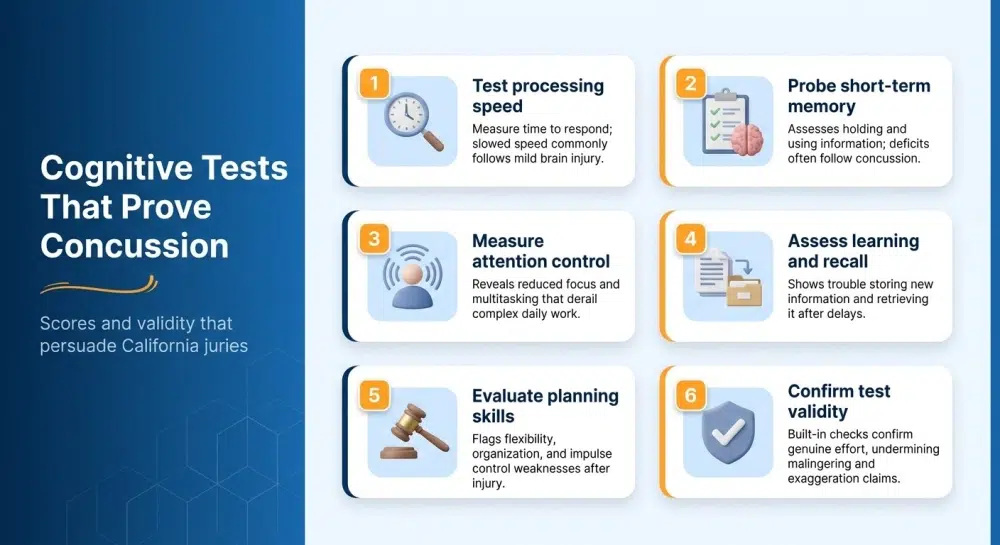
Neuropsychological testing is a structured battery of standardized performance tasks administered by a licensed neuropsychologist. It does not rely on self-report. It produces scores on specific cognitive domains by measuring how a person actually performs under controlled, timed conditions and then compares those scores against population norms adjusted for age, education level, and demographic factors.
The domains most commonly assessed in mTBI cases include:
- Processing speed: How quickly the brain takes in information and formulates a response. Instruments such as the Symbol Digit Modalities Test and the Trail Making Test Part A measure this directly. Slowed processing speed is one of the most consistently documented deficits following mTBI. [4]
- Working memory: The ability to hold information in mind and manipulate it in real time. Digit span tasks and the Working Memory Index from standardized intelligence batteries probe this domain. Working memory is among the most reliably affected functions in mild TBI. [4]
- Sustained and divided attention: The capacity to hold focus over time and to manage more than one stream of information simultaneously. Deficits here typically surface first at work, where a person who previously handled multitasking without difficulty starts dropping threads or losing track of conversations.
- Verbal and visual memory encoding and retrieval: Tests such as the California Verbal Learning Test measure whether new information is being registered and stored normally, and whether it can be retrieved accurately after a delay.
- Executive function: Higher-level cognitive control, including planning, cognitive flexibility, impulse inhibition, and problem-solving. The frontal and temporal lobes are the regions most commonly affected by acceleration/deceleration injury, and executive function deficits often accompany frontal involvement. [4]
A critical component that makes neuropsychological findings persuasive in California litigation is validity testing. Performance validity tests and symptom validity tests, administered throughout the battery, measure whether the person being tested is performing at their genuine level of ability. When a plaintiff’s scores pass validity testing consistently across the entire battery, the documented deficits cannot be attributed to poor effort or deliberate exaggeration. For plaintiffs and defendants alike, that distinction is what separates neuropsychological evidence that carries weight at the Orange County Superior Court from evidence that does not.
A software engineer is rear-ended on the I-405 near the 73 interchange. She is discharged from a Newport Beach emergency department with a normal CT. Six weeks later she cannot finish code reviews she previously completed without difficulty. Her employer notes repeated errors in documentation that were not present before the collision. A neuropsychological battery administered two months post-injury shows processing speed at the 14th percentile and working memory at the 18th percentile, both well below her educational background’s expected range, with all validity indicators passed. This performance profile is consistent with mTBI and would be difficult for a defense expert to dismiss as pure exaggeration. The scenario is hypothetical and does not represent an actual GoSuits case.
How do accounts from family members, coworkers, and instructors establish measurable change from baseline?
Neuropsychological test scores capture how a person performs on a given day in a clinical setting. What they do not always capture is the functional erosion that plays out at home and at work over weeks and months. Collateral testimony from people who interact with the injured person regularly fills that gap, and it is admissible lay opinion in California courts. [5]
A spouse or domestic partner who lives with the injured person has a longitudinal view no clinician can replicate in a 90-minute evaluation. Useful collateral testimony from a household member includes:
- Personality and mood changes that appeared within days or weeks of the incident, including uncharacteristic irritability, emotional lability, social withdrawal, or loss of patience
- Memory failures that are concrete and specific: forgetting conversations that happened an hour earlier, losing track of whether routine tasks were completed, repeatedly misplacing objects that were never an issue before
- Sleep disturbance, including difficulty falling asleep, frequent waking, or excessive daytime fatigue that is observable, not just self-reported
- Headache frequency and severity as observed rather than described, such as a partner noting the person goes to a darkened room multiple times per week when that was not a prior pattern
- Light and noise sensitivity visible as squinting in ordinary indoor lighting or distress at noise levels previously tolerated without complaint
Coworkers and supervisors offer a parallel but equally concrete picture. A salesperson who closed deals fluently before a crash but now loses the thread in client presentations is showing a functional deficit. An instructor or student who observes declining comprehension or class participation compared to prior performance adds another independent data point. Supervisors should document changes contemporaneously in performance notes. Colleagues should preserve emails, project timelines, and other artifacts that reflect before-and-after output quality.
When this testimony points in the same direction as neuropsychological performance data and treating physician notes, the convergence from multiple independent sources is the foundation of a persuasive mTBI case in California. Personal injury lawyers who handle brain injury claims in Irvine know that no single piece of evidence makes these cases; the layered structure does.
What should a symptom and activity diary record, and why does that detail matter?
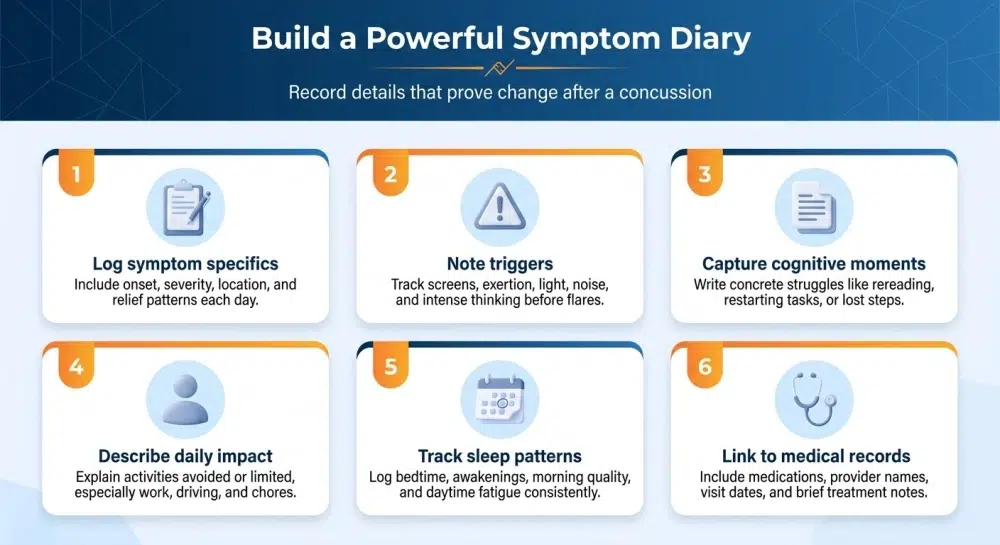
A symptom diary is a daily written record kept by the injured person, or by a family member when the person’s cognitive state makes self-monitoring unreliable. Its primary legal value is that it creates a contemporaneous record that predates litigation and therefore carries substantially more credibility than retrospective descriptions assembled later for an attorney or at deposition.
Effective diary entries go beyond “headache today.” Entries that provide real evidentiary value record:
- Specific symptoms with severity and timing. Not simply “headache” but “headache began around 8 a.m., rated 7 out of 10, located behind both eyes, resolved partially by early afternoon with rest in a dark room.”
- Triggers and aggravating factors. Screen exposure, physical exertion, bright light, loud environments, and concentrated mental effort are common triggers for post-concussion symptoms. Noting what preceded a flare ties the symptom pattern to the underlying injury mechanism.
- Specific cognitive events. “Spent 40 minutes reading a two-page report I would normally finish in 10 minutes; had to start over three times” is more useful than “memory problems.” Specificity is what distinguishes a diary that influences a claim from one that does not.
- Functional impact on daily life. “Could not drive on the I-5 today because managing merge traffic required sustained attention I could not maintain” is a real-world functional description that a jury can understand and evaluate.
- A sleep log. Time to sleep, number of nighttime awakenings, quality on waking, and daytime fatigue level provide an objective-sounding record of one of the most commonly disrupted functions after mTBI.
- Medications taken and their effect, without editorializing about whether they “worked.”
- Medical appointments. Date, provider name, and a summary of what was discussed or prescribed. This ties the diary record directly to the contemporaneous medical chart.
A diary that runs continuously from the days immediately following the incident through the full course of treatment gives treating physicians and consulting neuropsychologists a timeline they can evaluate against expected mTBI symptom trajectories. It also forecloses a defense argument that complaints appeared only after an attorney was retained.
How is post-concussion syndrome diagnosed and tracked in a California civil claim?
Post-concussion syndrome refers to a cluster of symptoms that persists substantially beyond the expected recovery window after a mild TBI. Most adults with a single uncomplicated concussion improve within two to four weeks. [3] When symptoms persist significantly longer, the condition is often described as post-concussion syndrome or persistent post-concussion symptoms. The symptom domains include:
- Physical: Headache (the most commonly reported symptom after concussion [4]), dizziness, fatigue, visual disturbance, sensitivity to light and noise
- Cognitive: Slowed thinking, word-finding difficulty, impaired concentration, memory gaps
- Emotional and behavioral: Irritability, anxiety, depression, emotional lability, social withdrawal. Research notes that frontal lobe involvement from TBI can produce emotional lability and altered social judgment in a meaningful percentage of patients. [4]
- Sleep: Insomnia, hypersomnia, or non-restorative sleep that the person did not experience before the incident
For a California civil claim, documenting post-concussion syndrome rests on several categories of evidence working in combination. First, consistent medical records showing the same symptoms were reported at multiple appointments over time, with functional assessments at each visit rather than just subjective complaint notation. Second, neuropsychological testing administered at appropriate intervals, which can track whether deficits are improving, stable, or worsening over the claims period. Third, collateral witness testimony from people in regular contact with the claimant. Fourth, a contemporaneous symptom diary as described above.
Orange County sees a significant volume of vehicle-related injuries on corridors like the I-405, SR-55, and the SR-73 Toll Road. Stop-and-go traffic patterns on these routes create conditions where rear-end collisions are common, and many of those collisions produce mTBI that is initially invisible on standard imaging. Connecting with brain injury lawyers in Irvine early in the recovery process protects the evidentiary record before time and routine medical discharge erode it.
How do defense arguments about malingering, pre-existing conditions, and secondary gain get addressed?
Defense strategies in mTBI cases with normal imaging typically cluster around three lines of argument. Understanding them helps explain why the evidentiary structure described above matters.
Malingering and poor effort
The defense will argue that symptoms are exaggerated or fabricated for litigation advantage. This is where neuropsychological validity testing becomes decisive. When a plaintiff passes performance validity tests consistently across an entire battery, that argument loses traction. The validity data demonstrates that the scores reflect genuine performance, not deliberate underperformance. A neuropsychologist who can explain this distinction to an Orange County jury under California Evidence Code section 801 can effectively rebut a malingering claim with objective data. [2]

Pre-existing conditions
The defense may argue that headaches, anxiety, depression, or cognitive difficulties existed before the collision and are not attributable to it. California follows the “eggshell plaintiff” doctrine, under which a defendant takes the plaintiff as they find them, including all pre-existing vulnerabilities. A pre-existing condition does not bar recovery; it complicates causation. The more thoroughly the treating record documents the pre-incident baseline and the post-incident change, the stronger the causation evidence. If a plaintiff had occasional mild headaches before the crash but now experiences daily severe headaches and cognitive slowing that were not previously present, that qualitative change can be documented and distinguished from the prior condition. [6]
Secondary gain and symptom motivation
The defense may suggest that the injured person has a financial motive to maintain or amplify symptoms. The most effective response is a consistent record: consistent complaints to treating providers who had no reason to expect litigation, a contemporaneous diary, consistent performance on neuropsychological testing across different sessions and evaluators, and consistent reports from collateral witnesses who are not parties to the case. Consistency across multiple independent sources is difficult to attribute to motivated exaggeration.
How does California civil law treat a brain injury claim when imaging is normal?
California applies a preponderance of the evidence standard in civil cases. A plaintiff must show it is more likely than not that the defendant’s negligence caused the injury and resulting damages. There is no statutory requirement that physical injury be visible on imaging, and California courts have consistently adjudicated claims where functional testing and clinical diagnosis supported a TBI finding in the absence of conventional imaging abnormalities.
The California Evidence Code governs what expert testimony may reach a jury. Under section 801, a qualified expert may offer opinion testimony on a subject sufficiently beyond common experience when the opinion is based on matter that experts in the field reasonably rely upon. [2] A licensed neuropsychologist who administered a validated battery, applied established norms, and properly ruled out confounding factors meets that threshold. A radiologist with expertise in traumatic injury interpreting DTI findings may offer opinion testimony on the same basis.
California also applies the “eggshell plaintiff” doctrine as a well-established rule of causation: a defendant is liable for all damages that flow from the plaintiff’s injury, even if the injury is more severe than it would have been in a person without the plaintiff’s pre-existing vulnerabilities. [6]
California’s comparative fault system is pure comparative negligence, meaning a plaintiff may recover damages even if they are found partially at fault, with recovery reduced proportionally by their percentage of fault. [7] This is worth understanding for any mTBI case that also involves disputed circumstances of the incident itself, particularly multi-vehicle collisions on busy Orange County freeways.
Lawsuits arising from incidents in Orange County are filed at the Orange County Superior Court. The Central Justice Center in Santa Ana is the primary filing location for civil cases, including personal injury claims for Irvine-area incidents. Personal injury lawyers handling these claims are familiar with filing procedures, local court rules, and the practical timelines specific to Orange County civil litigation.
What damages may be available in a California mTBI claim?
The categories of damages potentially available in a California personal injury claim involving mild traumatic brain injury include:
- Past medical expenses: Emergency department visits, imaging, neurology consultations, neuropsychological evaluation, physical therapy, medications, and any other treatment costs incurred from the date of injury through the date of resolution
- Future medical expenses: Projected costs of ongoing care, additional neuropsychological evaluation, therapy, or medication, established through expert life care planning when the injury warrants it
- Lost income: Wages, salary, or self-employment income lost during recovery as a result of the injury, documented through employment records and tax documentation
- Loss of earning capacity: Where the injury produces lasting cognitive deficits that impair the person’s ability to perform at their prior level or advance in their career, a vocational rehabilitation expert and economic expert can quantify this category of loss
- Physical pain and suffering: Compensation for physical discomfort, including headaches, dizziness, and the physical symptoms of post-concussion syndrome
- Mental anguish and emotional distress: Compensation for anxiety, depression, emotional lability, and the psychological impact of cognitive impairment on daily life and sense of self
- Physical impairment: Where the cognitive deficits limit the person’s ability to engage in activities they previously performed without difficulty, including work, recreation, or self-care
- Loss of enjoyment of life: Compensation for the diminished ability to participate in activities that gave the person’s life meaning and pleasure before the injury
Recoverability of each category depends on the applicable law, the specific facts of the case, the strength of the evidence, and any comparative fault findings. No specific outcome can be guaranteed, and individual results vary significantly based on case circumstances.
How long do I have to file a California brain injury claim?
California Statute of Limitations for Personal Injury: Under California Code of Civil Procedure section 335.1, the standard limitations period for a personal injury claim is two years from the date of the injury. [1] Missing this deadline extinguishes the right to file a civil lawsuit, regardless of how strong the underlying evidence is. Exceptions exist for specific circumstances, including claims against government entities, which require substantially shorter notice periods and have different procedural requirements. [DEADLINE REQUIRES LEGAL VERIFICATION for specific fact patterns involving government defendants or delayed discovery.]
If the injury occurred on a public roadway maintained by a government agency, the Government Claims Act imposes a claim presentation deadline of six months from the accrual of the cause of action before a lawsuit may be filed. [8] This six-month window is significantly shorter than the general personal injury statute of limitations, and missing it can bar recovery against public entity defendants entirely.
The practical shelf life of evidence is often shorter than the legal deadline. Vehicle data from event data recorders is overwritten. Traffic camera and intersection surveillance footage is typically retained for only days to weeks. Witness memories fade. Connecting with car accident lawyers in Irvine or brain injury attorneys promptly after an incident preserves options that closing quickly disappear.
An injury claim involving a mild TBI with disputed causation, insurance coverage issues, and disputed damages requires legal guidance specific to the circumstances of that claim. The information in this article is general legal information, not legal advice for any individual situation.
Have Questions About a Brain Injury Claim in Irvine?
A mild TBI claim involves overlapping medical, evidentiary, and legal questions that interact differently depending on the specific facts. A GoSuits personal injury attorney can review the circumstances of your situation and explain your options without cost or obligation.
Frequently Asked Questions
Yes. A CT scan is designed to detect structural findings such as hemorrhage, fractures, and edema. The cellular damage underlying most mild TBI cases falls below what CT can resolve. A normal result means no gross structural damage was found. It does not rule out axonal injury, neurochemical disruption, or the functional deficits that follow. For practical guidance on what to do immediately after a crash in the Orange County area, the information at Orange County car accident claims covers early documentation steps.
Most adults with a single uncomplicated concussion improve within two to four weeks. When symptoms persist significantly beyond that window, the condition is generally described as post-concussion syndrome. Some individuals experience symptoms for months. Recovery depends on injury severity, prior history of head injury, compliance with rest and activity restrictions, and the timeliness of treatment. Sleep disturbance, continued screen exposure, and premature return to demanding physical or cognitive activity can all slow recovery.
A standard clinical visit documents self-reported symptoms. Neuropsychological testing measures how the brain actually performs on standardized tasks, compared against population norms. It can detect processing speed, memory, and executive function deficits that a routine physical examination cannot detect. Critically, the testing includes validity measures that distinguish genuine cognitive deficits from poor effort, which is why neuropsychological findings carry weight with insurers, defense counsel, and juries in California personal injury cases. For context on how evidence is gathered after serious Orange County collisions, see the account at the Huntington Beach multi-vehicle crash and how documentation begins at the scene.
No. DTI can corroborate other evidence, but it is not a legal prerequisite for recovery. Many California mTBI claims have been resolved on the basis of clinical diagnosis, neuropsychological performance findings, consistent treating records, and collateral testimony, without any advanced imaging. DTI is most useful when neuropsychological deficits are significant and the defense is aggressively arguing that no injury occurred at the structural level.
Seek medical evaluation immediately, even if you feel reasonably well at the scene. Symptoms of mTBI do not always appear at the time of impact; they can emerge over the following 24 to 72 hours. Tell the treating provider about every symptom, including ones that seem minor. Start a symptom diary the same day or the day after the crash. Avoid screen-heavy activities, alcohol, and strenuous physical or concentrated mental effort until a physician advises otherwise. Preserve all records from the scene: photographs, witness contact information, and any dashcam or surveillance footage. The account of a serious Newport Beach crash at the SR-73 wrong-way collision illustrates how quickly evidence becomes critical in the aftermath of an Orange County incident.
No. California’s eggshell plaintiff doctrine holds that a defendant takes the plaintiff as they find them, including pre-existing vulnerabilities, prior injuries, and ongoing conditions. A pre-existing condition does not bar recovery. It does, however, require thorough documentation of the baseline state before the incident and the documented change that followed. Without that before-and-after picture, causation becomes harder to establish. This is one reason why contemporaneous medical records and collateral testimony matter even when a prior condition exists.
California follows pure comparative negligence, meaning a plaintiff may recover even if found partially at fault, with the recovery reduced proportionally by their percentage of fault. If a jury finds the plaintiff 30 percent at fault and awards $300,000, the plaintiff recovers $210,000. This differs from states with contributory negligence bars. In disputed-fault situations involving rear-end collisions or multi-vehicle incidents on Orange County freeways, understanding how comparative fault is calculated is an important part of evaluating the claim.
Related California Personal Injury Resources
- Irvine Personal Injury Lawyers
- Brain Injury Lawyers in Irvine
- Irvine Car Accident Lawyers
- Traumatic Brain Injury and CTE Awareness
- How Long Do You Have to Sue for Personal Injury in California?
- What Are the Different Types of Personal Injury Damages?
- California Personal Injury Lawyers

Talk With a GoSuits Personal Injury Attorney
A brain injury claim that involves disputed imaging, insurance coverage issues, and causation arguments requires careful construction of an evidentiary record from the earliest possible point. If you sustained a head injury in a collision anywhere in Orange County, including in stop-and-go traffic on the I-405, a merge-related impact near Irvine Spectrum, or a broadside crash at a busy intersection in Anaheim, Costa Mesa, or Santa Ana, a GoSuits personal injury attorney can review the facts of your situation.
You can review our prior cases, learn about our attorneys, read more about GoSuits, and explore the full range of practice areas we handle in California. A free consultation carries no obligation and no cost.
Schedule Your Free Consultation
References
- California Code of Civil Procedure § 335.1 — Two-Year Statute of Limitations for Personal Injury — California Legislative Information
- California Evidence Code § 801 — Expert Testimony Opinion Basis — California Legislative Information
- About Traumatic Brain Injury — Centers for Disease Control and Prevention (CDC)
- Traumatic Brain Injury — Georges A., Das J.M. — StatPearls, National Library of Medicine (NCBI Bookshelf)
- California Evidence Code § 800 — Lay Witness Opinion Testimony — California Legislative Information
- Eggshell Plaintiff Doctrine — Legal Information Institute, Cornell Law School
- Comparative Negligence — Legal Information Institute, Cornell Law School
- California Government Code § 911.2 — Government Claims Act Presentation Deadline — California Legislative Information
- California Courts — Official Website of the California Judicial Branch
- Traumatic Brain Injury & Concussion — Centers for Disease Control and Prevention