Lost earning capacity and lost wages are two separate economic damages in a California personal injury claim, and mixing them up is one of the most common mistakes that costs injured people money. Lost wages are the paychecks you already missed while you were unable to work. Lost earning capacity is the reduction in your ability to earn in the future because of permanent or lasting physical limitations caused by the injury. California Civil Code section 3283 expressly allows recovery for detriment that is reasonably certain to result in the future, which is the statutory foundation for earning capacity claims.[1] The dollar amount is not guesswork: it is built from a treating physician’s functional restrictions, a vocational expert’s labour-market analysis, and a forensic economist’s projection that accounts for worklife expectancy, wage growth, fringe benefits, and a reduction to present cash value. Defendants respond with targeted arguments about mitigation, retraining, remote work, and pre-injury earnings volatility. Understanding how each piece fits together matters whether you were injured in a rear-end crash on the SR-73 Toll Road in Orange County, a warehouse fall in Santa Ana, or a rideshare collision near the Irvine Spectrum.
Legal Snapshot
- Legal Topic: Lost Earning Capacity / Diminished Earning Capacity
- Jurisdiction: California (Orange County / Irvine)
- Case Stage: Damages / Pre-trial and trial
- Primary Legal Issue: Proof and calculation of future economic loss in a personal injury case
- Primary Authority: Cal. Civ. Code §§ 3281, 3283; Cal. Code Civ. Proc. § 335.1; CACI No. 3903C (Loss of Earning Capacity) [2]
- Related Authority: Jones & Laughlin Steel Corp. v. Pfeifer, 462 U.S. 523 (1983) (present-value methodology);[3] Fed. R. Evid. 702 (expert reliability, applied in federal courts and analogous California standard)
- Date Legal Authority Last Reviewed: 2025
Lost Wages vs. Lost Earning Capacity: Why the Distinction Matters
Lost wages are a backward-looking calculation. They measure what you would have earned between the date of injury and the date you returned to work (or reached maximum medical improvement), had the injury not occurred. They are largely arithmetic: multiply your verified hourly or salary rate by the hours missed, add documented overtime, tips, bonuses, and fringe benefits. Medical records connect the absence to the injury, and employer letters or payroll records confirm the rate and the time away.
Lost earning capacity is forward-looking and fundamentally different. It does not measure income you once had; it measures the ability to earn that the injury has permanently reduced. A person who was unemployed at the time of injury can still claim lost earning capacity if the injury impairs future employability. A person who has returned to work can still claim it if the injury forces them into a lower-paying occupation or limits advancement. What the claim requires is evidence that the injury probably will reduce future earnings over some meaningful period of time.
California Civil Code section 3281 defines recoverable damages as “detriment proximately caused” by a wrongful act or omission. Section 3283 extends that to detriment “certain to result in the future.”[1] California Jury Instruction CACI No. 3903C is the pattern instruction used at trial for loss of earning capacity. It asks the jury to consider what the plaintiff reasonably could have been expected to earn but for the injury, compared to what the plaintiff can now earn, and to award the difference discounted to present value.[2] The word “capacity” is deliberate: juries are not restricted to the plaintiff’s last paycheck.
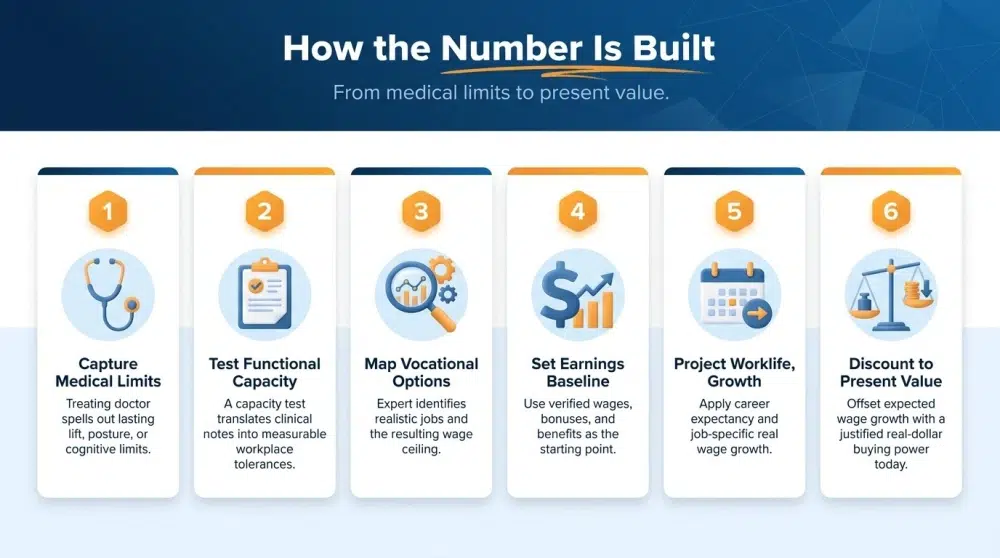
How the Number Is Actually Built: Four Interlocking Layers
A well-constructed California earning-capacity claim rests on four sequential layers of evidence. Each layer feeds the next.
Layer 1: Medical Evidence and Functional Restrictions
The foundation is a treating physician’s determination of permanent or long-term functional limitations. Imaging, operative reports, physical therapy notes, and formal functional capacity evaluations (FCEs) quantify what the person can and cannot do physically: maximum lifting weight, tolerable sitting and standing duration, permissible repetitive motions, cognitive load limits if a brain injury is involved. Without specific, documented restrictions, a vocational or economic opinion floats on speculation and will be vulnerable to a Daubert-style challenge under California Evidence Code section 801 or its federal analog under Federal Rule of Evidence 702.
The physician’s prognosis matters as much as the current diagnosis. Courts want to know whether limitations are expected to persist, worsen, or plateau. If degenerative progression is expected, the economic projection must account for that trajectory over the plaintiff’s worklife.
Layer 2: Functional Capacity Evaluation
An FCE is a structured battery of standardised tests administered by an occupational therapist or physical therapist. It objectively measures real-world work capacity: material handling (lift, carry, push, pull), positional tolerances (sit, stand, bend, kneel), and fine-motor dexterity. The FCE bridges the gap between a physician’s narrative restrictions and the specific physical demands of an occupation. Defence teams frequently hire their own FCE providers, and inconsistencies between competing evaluations become important at trial.
Layer 3: Vocational Expert’s Labour Market Analysis
The vocational rehabilitation expert takes the medical restrictions and FCE findings and translates them into labour-market consequences. The analysis identifies the plaintiff’s transferable skills from education, training, and work history; then maps those skills against the occupations the plaintiff can no longer perform versus occupations that remain accessible. The expert consults U.S. Bureau of Labor Statistics Occupational Employment and Wage Statistics (OEWS) data,[4] the Dictionary of Occupational Titles, and O*NET’s physical demand classifications to establish the wage differential between the plaintiff’s pre-injury occupation and the realistic post-injury ceiling.
The vocational expert also addresses accommodation feasibility. An argument that the plaintiff could perform a modified version of the original role with reasonable ADA accommodations must be grounded in what the specific employer’s workplace actually offers and what rehabilitation literature says about job retention after similar injuries. Blanket assertions that “remote work is available” are rebutted when the job required hands-on physical presence or when the plaintiff’s regional labour market has limited remote opportunities in that occupation.
For car accident claims, rideshare crashes, and other personal injury matters in Orange County, personal injury lawyers who bring in an early vocational evaluation give injured people a documentary foundation that is much harder for an insurer to dismiss in pre-litigation negotiations or at mediation in Santa Ana’s Central Justice Center.
Layer 4: Forensic Economist’s Projection to Present Cash Value
The forensic economist converts the vocational expert’s wage-differential finding into a lifetime dollar figure adjusted to present value. The projection involves five components:
- Annual earnings base: Pre-injury earnings verified through tax returns (W-2s, Schedule C), pay stubs, and employer records, with separate treatment of base salary, overtime, commissions, bonuses, and fringe benefits including retirement contributions.
- Annual wage growth rate: Historical real wage growth for the relevant occupation and industry, sourced from BLS Employment Cost Index or sector-specific data rather than general inflation.
- Worklife expectancy: Actuarial tables published by the U.S. Bureau of Labor Statistics, adjusted for the plaintiff’s age, education, and pre-injury labour force attachment. The most commonly cited source is the Skoog-Ciecka worklife expectancy tables, which account for the probability that a person of a given age and education level will actually remain in the workforce.
- Fringe benefits: Employer-paid health insurance, retirement matching, paid leave, and other non-cash compensation that the injury disrupts. These are often expressed as a percentage of base wages using BLS Employer Costs for Employee Compensation data.[4]
- Discount to present value: A lump sum paid today must account for the time value of money. The U.S. Supreme Court addressed the correct methodology in Jones & Laughlin Steel Corp. v. Pfeifer, 462 U.S. 523 (1983), approving a real-interest-rate approach that offsets wage growth against the discount rate.[3] California does not mandate a specific discount rate, but courts expect economists to state and justify their methodology explicitly.
A Hypothetical to Illustrate the Framework
The following is a hypothetical scenario for educational purposes only. It is not a description of an actual GoSuits case or any real event.
Consider a 38-year-old licensed respiratory therapist who is injured in a multi-vehicle collision on the I-405 in Orange County. The treating spine surgeon documents a permanent 25-pound lifting restriction and a prohibition on repetitive bending. An FCE confirms those limits. The vocational expert reviews the U.S. Department of Labor’s O*NET profile for Respiratory Therapists (29-1126.00), which classifies the role as “medium” physical demand, and concludes that the plaintiff can no longer safely work in a clinical respiratory therapy role. The expert identifies Medical Records Technician (medium-to-light, 29-2072.00) as the most comparable accessible occupation, at roughly 35% lower annual compensation. The forensic economist projects that differential forward over a 22-year expected worklife using a 1.5% real wage growth assumption and a 1.5% real discount rate, adds the present value of lost retirement matching and health insurance contributions, and produces a total diminished earning capacity figure. That figure is what counsel presents in the demand package and at trial in the Orange County Superior Court’s Central Justice Center in Santa Ana.
How Equity Compensation and Bonus Income Are Handled
Standard wage calculations undercount true compensation when the plaintiff received stock options, restricted stock units (RSUs), performance bonuses, or profit-sharing distributions. These forms of compensation require special treatment for two reasons: they are irregular, and their future value is not certain.
Courts have accepted the inclusion of equity compensation in an earning-capacity calculation when the plaintiff can demonstrate a consistent historical pattern of receipt. A plaintiff who received RSUs annually over the prior four years and was on track for continued grants has a stronger foundation than one who received a single discretionary bonus. Forensic economists typically base the projection on an average of the past three to five years of equity grants and vesting, reported on Form W-2 or Schedule D, and apply the same wage-growth and discount methodology as base salary.
For bonus income, the analysis examines whether the bonus was discretionary or formula-driven (commission, profit-share, production metric). Formula-driven bonuses can be projected with reasonable confidence from historical data. Discretionary bonuses require additional evidence of the employer’s historical bonus practices and the plaintiff’s standing relative to peers. Defence economists often argue that bonuses are speculative; plaintiff economists respond by documenting the employer’s pay practices, the plaintiff’s performance reviews, and industry norms sourced from published compensation surveys.
Self-employment income presents the most complex calculation. Net business income must be separated from returns on capital investment. A sole proprietor who operates a landscaping business on the Irvine commercial corridor loses both personal earning capacity (the labour component) and, potentially, business value (the capital component). The personal injury claim captures the former; a separate damages theory may be needed for the latter. Tax returns (Form 1040 with Schedule C), profit-and-loss statements, and bookkeeping records are the evidentiary starting point. Economists apply a market wage for the owner’s labour role, subtract that from total net income to identify the true return-on-capital component, and project only the labour-equivalent forward.
The Defence Arguments That Most Often Reduce the Number
California follows pure comparative fault, which means a plaintiff’s own negligence reduces but does not eliminate recovery. Beyond comparative fault, defence teams deploy several targeted arguments against earning capacity claims.
Failure to Mitigate
California Civil Code section 3300 and general common-law principles require plaintiffs to take reasonable steps to mitigate damages. In the earning capacity context, the defence argues that the plaintiff could have returned to work in a lower-demand role, pursued vocational retraining, or accepted light-duty assignments within medical restrictions. To blunt this argument, plaintiff counsel documents the job-search or retraining efforts the plaintiff undertook (or the medical reason those efforts were not possible) and retains a vocational expert to opine that the plaintiff’s search was reasonable and diligent given the restrictions.

Retraining and Remote Work
Classic defence move. They’ll argue retraining fixes it. Community college program, online cert, one to three years, and suddenly the plaintiff is back to earning what they used to. Problem solved, damage period slashed. But it’s rarely that simple. The rebuttal has to look at the specific plaintiff — how old they are, what education they already have, whether retraining realistically works for someone in their position. And I think a lot of adjusters quietly know this: retraining gets more expensive and less likely to succeed as people age, and nobody factors in the income forgone during the training itself. Then there’s the question that actually matters. Does the new credential lead to a real job in the local Orange County market, or just a nice-looking certificate? The remote work pitch has the same holes. The defence needs actual evidence — remote jobs in that occupation existing in meaningful numbers around here, the plaintiff’s physical restrictions not ruling out computer work, and the existing skills matching what remote employers want. Usually at least one piece breaks.
Pre-injury Earnings Volatility
Irregular earnings are where things get messy. Think gig workers, seasonal employees, commission-based salespeople, anyone sitting on startup equity. The defence pounces on that, and honestly it’s one of their stronger moves. If the plaintiff’s economist leans on the single best year, that baseline looks inflated and a defence economist will tear it apart. The counter-move is boring but effective: pull five or more years of tax returns and show the pattern. Either a clear growth trend or a stable floor. That way the jury can tell the difference between a career on the rise that just happens to look choppy year to year, and someone whose income genuinely bounces around with no direction.
Pre-existing Conditions
Here’s a defence angle that catches a lot of people off guard. If you had any kind of prior injury, chronic condition, or existing limitation before the accident, the defence will absolutely argue some of what you’re going through now predates the crash. California’s Eggshell Plaintiff doctrine is on your side, kind of. The defendant takes the plaintiff as found, so a vulnerable person can still recover full damages. But — and this is the part people miss — the rule doesn’t relieve you of proving the accident caused measurable incremental harm on top of your baseline. Pre-accident medical records matter enormously. So do IME comparisons. And FCEs that cleanly separate the new impairment from what was already there are probably the single most useful piece of evidence you can put in front of a jury.
Expert Methodology Challenges
Defendants move to exclude or limit vocational and economic testimony under California Evidence Code section 801 (requiring that opinions be based on reliable foundations) or, in federal court, under Federal Rule of Evidence 702.[5] Common challenges include: the vocational expert used an occupational classification that does not accurately describe the plaintiff’s actual job duties; the economist used a discount rate inconsistent with published economic literature; the economist failed to account for personal consumption in a wrongful-death derivative claim; or the expert’s data sources are outdated. Well-prepared experts document their methodology transparently so the trial judge can evaluate reliability.
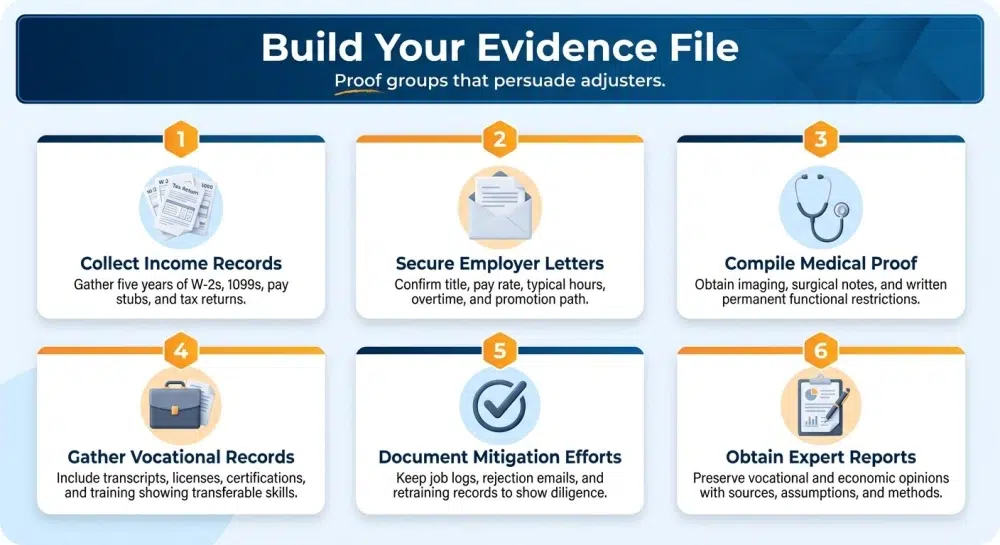
Evidence That Matters for an Earning Capacity Claim in California
The following categories of evidence are commonly relevant. The value of each depends on the facts of the specific case, and not all categories apply to every claim.
- Income records: W-2s, Form 1099-NEC or 1099-K, pay stubs, payroll summaries, direct deposit statements, and tax returns for at least the prior five years. IRS guidance on each form type is available directly from the agency.[6]
- Employer documentation: Letters confirming pre-injury title, rate, typical hours, available overtime, and promotion trajectory; performance reviews showing standing relative to peers.
- Medical records: Imaging reports, operative notes, functional capacity evaluations, and treating physician letters specifying permanent restrictions in terms of physical demand categories used by the Dictionary of Occupational Titles.
- Vocational records: Prior education transcripts, professional licences, certifications, and training records that establish the skill set the injury has disrupted.
- Mitigation evidence: Job application logs, rejection letters, correspondence with vocational rehabilitation counsellors, documentation of retraining attempts, and records of light-duty or modified work offers accepted or declined.
- Business records (self-employed): Profit-and-loss statements, accounts receivable aging, client contracts, booking calendars, point-of-sale reports, and merchant account statements.
- Expert reports: Written reports from the vocational and forensic economic experts setting out methodology, data sources, assumptions, and conclusions. These are mandatory disclosures in California civil discovery.
For California personal injury cases involving both economic and non-economic damages, building the economic damage file early in the case protects against spoliation of employer records and allows the vocational expert time to conduct a thorough labour-market analysis before any applicable discovery cut-off.
Potential Damages and Remedies
Recoverability of each category depends on the facts of the case, applicable law, and the evidence presented. The following are legally recognised categories under California law.
| Damage Category | What It Covers | Key Proof |
|---|---|---|
| Past Lost Wages | Earnings actually missed from date of injury to MMI or trial | Pay stubs, employer letter, medical work excuse |
| Lost Earning Capacity (future) | Reduction in ability to earn over remaining worklife | FCE, vocational report, economic projection |
| Lost Fringe Benefits | Employer-paid insurance, retirement match, paid leave | Benefits statements, BLS ECEC data |
| Medical Expenses (past) | Bills paid or incurred for treatment to date | Medical bills, EOBs, Howell analysis |
| Future Medical Expenses | Reasonably certain future care costs | Life-care plan, treating physician opinion |
| Pain and Suffering | Physical and mental anguish, non-economic harm | Medical records, journal, lay and expert testimony |
| Physical Impairment/Disfigurement | Permanent functional loss or appearance change | Medical records, photographs, physician testimony |
In wrongful death cases under California Code of Civil Procedure section 377.60, eligible heirs may recover the decedent’s projected lost financial support, calculated using the same economic methodology described above but net of the decedent’s personal consumption.[7] Our Irvine wrongful death attorneys handle these companion claims when a fatal crash also involves surviving family members seeking compensation. Families in Huntington Beach, Newport Beach, Costa Mesa, and surrounding Orange County communities can contact our team through the Irvine office for a free consultation.
How Insurance Adjusters Approach Earning Capacity Claims
Adjusters move early on these. By design. The earning capacity portion of a claim is where real money lives, and the playbook for shrinking it is pretty standard. Pay stubs from the last few months only, ignoring any upward trend in earnings. Equity compensation and benefits conveniently left out of the lost-wages math. A “light duty” argument tossed in without anyone bothering to actually read the medical restrictions. And the one I think catches most people — a global settlement offer that lands before you’ve had a chance to retain a vocational expert or forensic economist. Take that offer and the real valuation of your future earnings never gets built.
California’s Unruh Insurance Fair Claims Settlement Practices Regulations require insurers to acknowledge claims promptly, investigate thoroughly, and not misrepresent policy provisions.[8] An insurer that systematically undervalues earning capacity claims based on a policy of disregarding economic expert opinions may face bad-faith exposure.
Orange County’s busiest roads produce most of the serious injury claims we see — stop-and-go traffic on the I-405, merge-related collisions around the SR-55/I-405 interchange, rear-end crashes near the Irvine Spectrum commercial district. And something people don’t realise early enough: your employer-sponsored disability policy, whatever it covers or doesn’t, actually changes how the personal injury claim is structured. The collateral source rule helps, kind of. The general idea is that defendants can’t reduce your damages award by the amount you’ve already collected from independent insurance. But California has modified the rule in certain contexts, which means the clean version of it doesn’t always apply. An attorney who handles Irvine personal injury claims can explain where you actually land.
Car accident lawyers in Irvine who handle serious injury cases regularly present earning capacity claims to adjusters and, where necessary, to juries at the Orange County Superior Court in Santa Ana. Early retention of qualified vocational and economic experts materially changes the settlement conversation.
How Long Do You Have to File in California?
The general statute of limitations for personal injury in California is two years from the date of injury under California Code of Civil Procedure section 335.1.[9] Missing this deadline ordinarily bars the claim entirely, regardless of how strong the earning capacity evidence is.
Several exceptions can alter the deadline. Discovery of latent injuries may toll the period. Injuries to minors are governed by different rules. Claims against a public entity including a city, county, or state agency require a government tort claim filed within six months of the date of injury under the California Government Claims Act, which is a separate and shorter deadline that runs before you can file a lawsuit.[10]
If you were injured in an accident in Orange County, do not wait to speak with an attorney about deadlines. A two-year period sounds long but shortens quickly once treatment, investigation, and expert retention are factored in.
[DEADLINE REQUIRES LEGAL VERIFICATION – confirm applicable deadline based on specific facts, identity of defendants, and date of injury with a licensed California attorney.]
What to Do Next If You Have an Earning Capacity Claim in California
- Preserve income documentation now. Gather W-2s, tax returns, pay stubs, and employer letters for the past five years. If you are self-employed, organise your profit-and-loss statements, invoices, and bank records.
- Document your restrictions in detail. Ask your treating physician to put functional limits in writing using occupational terminology (lifting limits, positional tolerances, cognitive restrictions). Vague language like “light duty” is far weaker than “no lifting over 20 pounds; no sitting more than 30 minutes continuously.”
- Track your work-related changes. Keep a log of job duties you can no longer perform, accommodations you have requested, work you have turned down, and any retraining you have explored.
- Request a functional capacity evaluation. Discuss with your treating physician whether an FCE is appropriate. The results will anchor the vocational expert’s opinion.
- Do not give a recorded statement to the opposing insurer about your income or work capacity without speaking to an attorney first.
- Consult a California personal injury attorney promptly. Earning capacity cases require expert coordination that takes time. The earlier an attorney can review your medical records and income history, the better positioned the case will be.
A personal injury claim involving permanent work limitations can touch every major financial decision your family makes for decades. If you or someone you love was seriously injured in an Irvine-area accident and you have questions about what your diminished earning capacity may be worth, a GoSuits attorney can review the circumstances of your case and explain your options. Schedule a free consultation at any time our team is available 24 hours a day, seven days a week.

Related California Personal Injury Resources
- Irvine Personal Injury Lawyers: Irvine Personal Injury and Accident Lawyers
- Car Accident Claims in Irvine: Irvine Car Accident Lawyers
- Wrongful Death in Irvine: Irvine Wrongful Death Lawyers
- California Personal Injury: California Personal Injury Lawyers
- Pain and Suffering Damages: Pain and Suffering Damages in California
- Settling Before Maximum Medical Improvement: Settling Before MMI in California
- Comparative Negligence in California: California Comparative Negligence Car Accident Guide
Talk With a GoSuits Attorney
Lost earning capacity claims in California involve multiple expert disciplines, layered evidentiary requirements, and defence strategies designed to reduce or eliminate the number. An injury claim that affects your ability to work for years or decades deserves thorough, evidence-driven preparation.
GoSuits represents injured people across the Irvine and Orange County area in serious personal injury and wrongful death cases. If a crash, workplace incident, or other negligent act has changed what you can earn, a GoSuits attorney can review the facts of your case and explain what types of expert evidence may be relevant. Our team serves clients in Irvine, Newport Beach, Huntington Beach, Costa Mesa, Santa Ana, Fullerton, and throughout Orange County.
There is no fee unless we recover for you. Reach our team 24 hours a day, seven days a week. Schedule your free case evaluation today.
Prior cases: GoSuits Prior Case Results | Our attorneys: Meet Our Attorneys | About GoSuits: About Us | All practice areas: Practice Areas
References and Authoritative Sources
- California Civil Code § 3283 – Damages for Future Detriment – California Legislative Information
- California Civil Jury Instructions (CACI) – Judicial Council of California, including CACI No. 3903C (Loss of Earning Capacity)
- Jones & Laughlin Steel Corp. v. Pfeifer, 462 U.S. 523 (1983) – LII / Legal Information Institute, Cornell Law School
- Occupational Employment and Wage Statistics (OEWS) – U.S. Bureau of Labor Statistics
- Federal Rule of Evidence 702 – Testimony by Expert Witnesses – LII / Legal Information Institute, Cornell Law School
- About Form 1099-NEC, Nonemployee Compensation – Internal Revenue Service
- California Code of Civil Procedure § 377.60 – Wrongful Death Beneficiaries – California Legislative Information
- California Insurance Code § 790.03 – Unfair Claims Settlement Practices – California Legislative Information
- California Code of Civil Procedure § 335.1 – Two-Year Limitation for Personal Injury – California Legislative Information
- California Government Claims Act (Gov. Code §§ 810 et seq.) – California Legislative Information