
When you file a personal injury claim in Texas, your medical records become one of the most important categories of evidence in the case. The defence has a legitimate interest in verifying your injuries, but that interest does not give opposing counsel unlimited access to every health record you have ever generated. Two overlapping legal frameworks govern what gets disclosed, to whom, and under what conditions: the federal Health Insurance Portability and Accountability Act (HIPAA) and the Texas Medical Records Privacy Act, codified at Chapter 181 of the Texas Health and Safety Code. Understanding how those frameworks interact, and where Texas courts draw the line, can make a meaningful difference in how your case proceeds.
Legal Snapshot
- Legal Topic: Medical records privacy and disclosure in Texas personal injury litigation
- Case Stage: Pre-litigation, discovery, and trial
- Primary Legal Issue: Scope of HIPAA authorisation; proportionality of medical records discovery under Texas Rules of Civil Procedure
- Primary Authority: 45 C.F.R. §164.508 (HIPAA authorisation); Tex. Health & Safety Code Ch. 181 (Texas Medical Records Privacy Act); Tex. R. Civ. P. 192.3(c); Tex. R. Civ. P. 176.6
- Date Legal Authority Last Reviewed: July 2025
What Does a HIPAA Authorisation Actually Open?
HIPAA’s Privacy Rule, implemented at 45 C.F.R. Part 164, restricts the disclosure of “protected health information” (PHI) by covered entities, which include most hospitals, clinics, and insurance companies. [1] A covered entity may disclose PHI without your consent in limited circumstances, but for litigation purposes the usual mechanism is a signed patient authorisation under 45 C.F.R. §164.508.
A valid HIPAA authorisation must specifically describe: (1) the information to be used or disclosed, (2) the name of the person or entity authorised to make the disclosure, (3) the name of the recipient, (4) the purpose of the disclosure, (5) an expiration date or event, and (6) the individual’s right to revoke. [2] When opposing counsel in a Dallas personal injury lawsuit presents a HIPAA authorisation for you to sign, each of those fields matters.
The critical point that many injured people do not realise is that a HIPAA authorisation does not, by itself, define how much of your history may be demanded. HIPAA only tells the provider it is lawful to release the information once the authorisation is in place. Whether the defence is actually entitled to that information as a matter of discovery remains governed by Texas procedural law. Put differently, signing a HIPAA authorisation is not a blank cheque; it is a permission slip whose scope can still be contested in court.
HIPAA also contains a specific provision addressing litigation. Under 45 C.F.R. §164.512(e), a covered entity may disclose PHI in judicial proceedings in response to a court order, a subpoena accompanied by satisfactory assurance of notice, or a qualified protective order. [3] This means that even without your signed authorisation, a court can compel disclosure if proper procedural steps are followed.
What Does the Texas Medical Records Privacy Act Add?
Texas enacted Chapter 181 of the Health and Safety Code as a state-level analogue to HIPAA, often referred to as the Texas Medical Records Privacy Act. [4] Texas law is generally stricter than the federal floor in several respects.
Under Tex. Health & Safety Code §181.002, the definitions of “covered entity” are broader in Texas than under federal HIPAA, capturing some entities that the federal rule would not reach. Section 181.101 prohibits covered entities from disclosing protected health information except as authorised by the patient or as otherwise permitted under the chapter or other law. Section 181.154 specifically governs electronic health records and imposes additional requirements on electronic disclosures.
For personal injury plaintiffs, the practical effect is layered protection: a healthcare provider receiving a records request in a Dallas-area litigation must satisfy both federal HIPAA standards and the Texas statutory standards before releasing records. If the two regimes conflict, the more protective rule applies to the extent it is not preempted. However, where a Texas court has entered a valid discovery order under the Texas Rules of Civil Procedure, that order can override the statutory protections in the same way a federal court order can override HIPAA’s default restrictions. [5]
How Far Back Can the Defence Reach?
This is often the most contested discovery battleground in a personal injury case. The defence will argue that your entire medical history is relevant because pre-existing conditions may have caused or contributed to your current complaints. Texas law provides a framework for resolving that dispute.
Texas Rule of Civil Procedure 192.3(c) states that a party may obtain discovery of any matter relevant to the subject matter of the action, not just admissible at trial, if it appears reasonably calculated to lead to the discovery of admissible evidence. [6] Courts have applied this standard to hold that a plaintiff who places their physical condition at issue in a lawsuit necessarily opens that condition to discovery. The threshold question, however, is what records are actually relevant to the condition at issue.
Texas courts have recognised that an unlimited time horizon for medical records is not automatically appropriate. A request covering all records from the beginning of a plaintiff’s life may be overbroad and disproportionate to the needs of the case. [7] Proportionality is now an explicit consideration under the Texas Rules after amendments tracking the federal discovery reforms. Courts in Dallas County District Court and throughout the state have issued protective orders narrowing the temporal scope of records requests when the defence cannot articulate a specific, non-speculative basis for reaching back further.
The practical result is that the defence can usually reach records covering the same body parts or conditions that the plaintiff claims were injured, going back a reasonable period before the incident. They generally cannot demand records for entirely unrelated body systems without articulating how those records are relevant. A court at the George L. Allen Sr. Courts Building in Dallas can enter a protective order limiting production if the request is overbroad.
What Legal Rules Apply to Discovery of Medical Records?
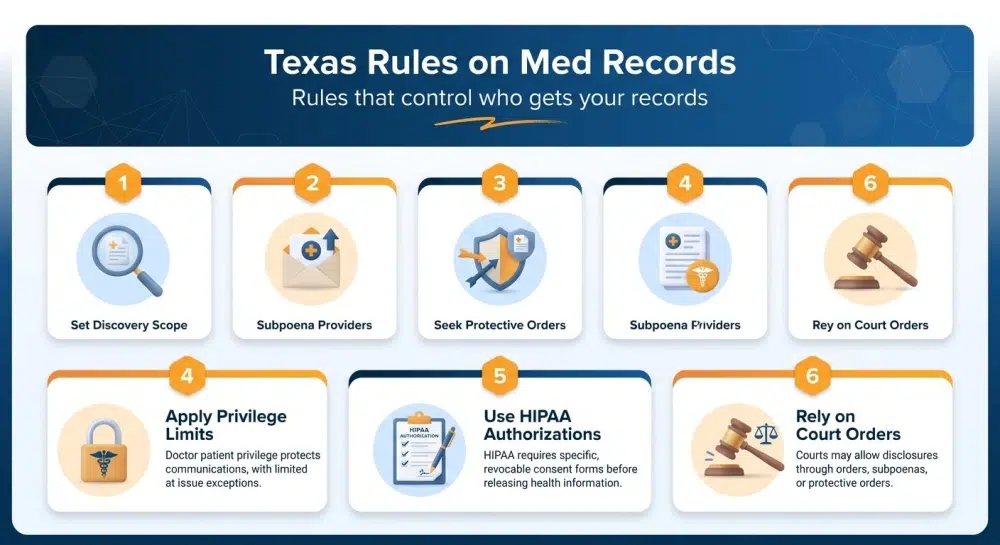
Several Texas procedural rules specifically address how medical records must be handled in litigation.
| Authority | What It Governs | Jurisdiction |
|---|---|---|
| Tex. R. Civ. P. 192.3(c) | Scope of discovery; relevance and proportionality standard | Texas state courts |
| Tex. R. Civ. P. 176 | Subpoenas; compelling production from third parties, including healthcare providers | Texas state courts |
| Tex. R. Civ. P. 192.6 | Protective orders; courts may limit discovery to protect a party from annoyance, embarrassment, oppression, or undue burden | Texas state courts |
| Tex. R. Evid. 509 | Physician-patient privilege and its exceptions in civil proceedings | Texas state courts |
| 45 C.F.R. §164.508 | HIPAA authorisation requirements for disclosure | Federal; applicable to covered entities nationwide |
| 45 C.F.R. §164.512(e) | Disclosures in judicial and administrative proceedings | Federal; applicable to covered entities nationwide |
| Tex. Health & Safety Code Ch. 181 | Texas Medical Records Privacy Act; state-level protections for health information | Texas state law |
| Tex. R. Civ. P. 196.4 | Electronic or magnetic data requests, including electronically stored medical records | Texas state courts |
Texas Rule of Evidence 509 deserves special attention. It creates a physician-patient privilege in civil cases, meaning that communications between a patient and a healthcare provider are protected from disclosure unless an exception applies. [8] The most significant exception for personal injury cases is the one that arises when the patient puts his or her physical condition at issue. By bringing a claim for bodily injury, a Texas plaintiff is generally deemed to have waived the physician-patient privilege with respect to the medical conditions relevant to the claimed injuries. The waiver is not total; it is limited to the conditions actually placed at issue, and courts retain the authority to enforce that limitation through protective orders.
What Is a Protective Order in Medical Records Discovery?
A protective order under Texas Rule of Civil Procedure 192.6 is a court order that modifies, limits, or entirely restricts what the discovering party can demand or do with the information once obtained. In the context of medical records, protective orders serve several functions.
First, they can narrow the temporal scope of a records request. If the defence asks for all records going back thirty years but the plaintiff’s claim involves an injury that occurred three years ago, the court may enter an order limiting production to records from the past five to seven years, or to the treating providers who treated the claimed body parts.
Second, protective orders can restrict what the defence does with the records once received. An “attorneys’ eyes only” designation, while less common in personal injury cases than in commercial litigation, can be employed when records contain particularly sensitive categories of information, such as mental health treatment, HIV status, or substance abuse treatment, which carry heightened statutory protections under both federal and Texas law. [9]
Third, a protective order can require that records produced in discovery be used only for purposes of the current litigation, reducing the risk that sensitive health information will be used outside the case. This type of order is especially important to request before records are produced, because it is much harder to “unring the bell” once sensitive information has already been distributed.
An experienced personal injury attorney can move for a protective order before records are produced. The motion requires showing good cause, meaning that the harm from disclosure outweighs the discovering party’s legitimate need. Courts in Dallas and throughout Texas regularly grant such orders where the requested records are overbroad, concern particularly sensitive conditions, or would cause embarrassment or oppression disproportionate to their relevance.
Who Specifically Has Access to Your Records in Litigation?
Understanding which parties actually see your medical records at each stage of a case helps you understand what privacy protections matter most and when to assert them.
Before a Lawsuit Is Filed
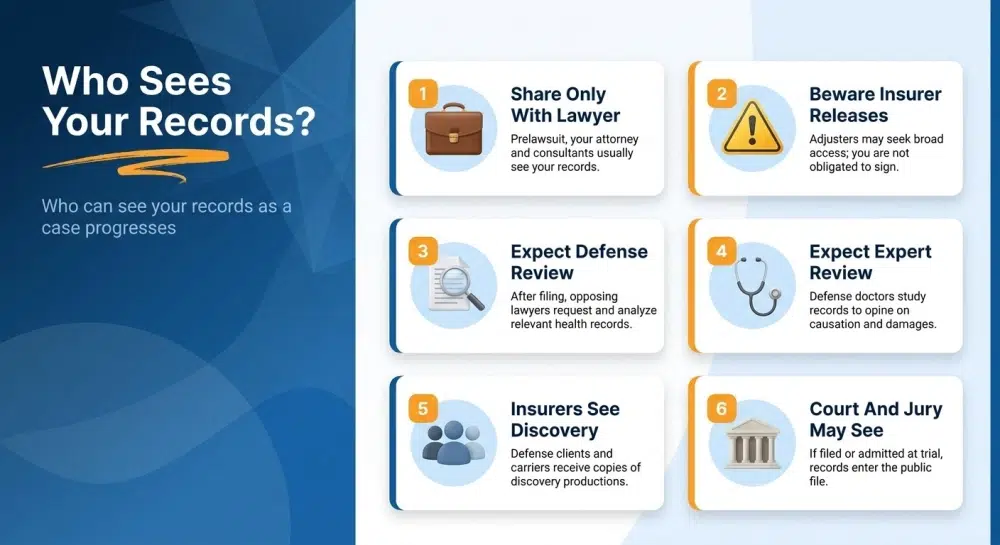
During the pre-litigation phase, your records are typically shared only with your own attorney and any retained consulting medical professionals. If you make a claim directly with the at-fault party’s insurer, the adjuster may ask you to sign a medical authorisation. You are generally not obligated to sign an open-ended authorisation simply because an insurer requests it; the scope of any pre-litigation disclosure is worth discussing with counsel before you sign anything. Personal injury lawyers advising injured clients in Dallas routinely caution that signing an overly broad authorisation at this stage can compromise the claim.

After a Lawsuit Is Filed
Once a civil action is filed in Dallas County District Court, the case becomes subject to the Texas Rules of Civil Procedure. Both sides may serve requests for production, interrogatories, and subpoenas on healthcare providers. The following parties may ultimately have access to some portion of your records, depending on what the court allows:
- Defence counsel and their legal staff
- Retained medical experts for the defence, who review records to offer opinions on causation and damages
- The named parties and their insurers
- Court personnel, to the extent records are filed with the court
- The jury, if records are admitted into evidence at trial
Your own attorney controls how your records are used on the plaintiff’s side and will make strategic decisions about which records to introduce and which to keep outside the courtroom.
What Becomes Public When a Case Is Filed in Texas?
This is one of the most important and often misunderstood aspects of personal injury litigation. When a lawsuit is filed in a Texas district court, the pleadings themselves become part of the public record. The petition will typically allege the nature of the injuries and may reference specific conditions or treatment. However, the underlying medical records do not automatically become public simply because a lawsuit is filed.
Medical records produced during discovery are generally not filed with the court unless a party chooses to attach them to a motion, brief, or other filing, or unless they are admitted as exhibits at trial. Texas courts do not maintain a publicly searchable database of all exhibits or discovery productions the way some federal courts maintain ECF/PACER repositories.
If a trial occurs and medical records are admitted into evidence, they become part of the trial record and may be accessible to the public. Juries hear and see the evidence presented in open court, which can include medical testimony and records.
Parties who wish to keep sensitive medical information out of the public record have several options. They can move to seal specific court filings, move to designate records as confidential under a protective order, or attempt to resolve the case before trial so that the records never enter the open courtroom record. Courts consider sealing motions carefully, as Texas has a strong presumption of open court records. [10] Sealing is generally more available when the records contain particularly sensitive information whose disclosure would cause specific, articulable harm.
What Happens to Medical Records After a Case Closes?
When a Texas personal injury case resolves, whether by settlement, judgment, or dismissal, the fate of the medical records depends on several factors.
Under a settlement agreement, the parties typically agree on terms governing the return or destruction of documents produced in discovery, or those terms may be established by an earlier protective order. Many protective orders include provisions requiring that confidentially designated materials be returned or destroyed after the case concludes, though attorneys are generally permitted to retain copies in their client files for their own records.
Records that were filed with the court as part of a motion or admitted into evidence at trial remain part of the court file, which is retained according to the retention schedule established by Texas court rules and the Office of Court Administration. [11] Court records are generally preserved for specified periods depending on the case type, and they remain subject to the access rules that applied while the case was active, including any sealing orders.
Your own healthcare providers retain your medical records independently of the litigation. Under Texas law, healthcare providers must generally retain adult patient medical records for at least ten years from the date of the last treatment. [12] The litigation does not change your providers’ retention obligations.
What Constitutes Evidence in a Texas Medical Records Dispute?
When the scope of medical records disclosure is contested in a Texas personal injury case, the following categories of materials may be relevant to a court’s ruling on a protective order or motion to compel:
- The plaintiff’s pleadings: which body parts and conditions are alleged to be injured; these define the scope of the waiver
- Treating physician records: relevant to establishing the nature, extent, and causation of the claimed injuries
- Prior medical records: relevant when the defence argues a pre-existing condition accounts for the plaintiff’s current complaints
- Prescription and pharmacy records: may document prior treatment for similar conditions
- Expert medical reports: both plaintiff and defence experts will review records and form opinions on causation and impairment
- The HIPAA authorisation language itself: courts may review whether the authorisation’s scope was exceeded
- Any prior protective orders: define what the defence may and may not do with materials already produced
The well-established car accident lawyers in Dallas who handle injury claims understand that medical evidence does not automatically prove liability. Evidence of injury must be connected to causation through admissible proof.
What Damages May Be Available in a Texas Personal Injury Claim?
The medical records discussed throughout this article are central to proving and quantifying the categories of damages Texas law recognises in personal injury cases. These categories include, but are not limited to:
- Past and future medical expenses
- Physical pain and suffering
- Mental anguish
- Physical impairment
- Disfigurement
- Lost wages and loss of earning capacity
Texas law does not impose a statutory cap on compensatory damages in most personal injury cases, though caps do apply in specific contexts such as certain healthcare liability claims. The recoverability and amount of any particular element of damages depend on the specific facts of each case, the evidence presented, and applicable law. No specific outcome can be promised or predicted.
Wrongful death claims, which may arise when a person dies as a result of another’s negligence, involve additional statutory damage categories under the Texas Wrongful Death Act, Tex. Civ. Prac. & Rem. Code §71.001 et seq. In those claims, medical and hospital records from the final period of treatment become particularly significant evidence.
How Long Do You Have to Act in Texas?
Texas imposes a general two-year statute of limitations on personal injury claims. Under Tex. Civ. Prac. & Rem. Code §16.003, an injured person must generally file suit within two years of the date the cause of action accrues, which is typically the date of the injury. [13] Exceptions exist for claims involving minors, certain discovery rules, and claims against governmental entities.
Claims against governmental entities in Texas are subject to the Texas Tort Claims Act and require notice to the entity within six months of the incident in some circumstances. That deadline is much shorter than the general two-year limitation and can bar a claim entirely if missed. [14]
These deadlines are strictly enforced in Texas. If you have questions about whether a deadline applies to your situation, that question requires a legal determination based on the specific facts of your case and should be directed to a licensed Texas attorney without delay. [DEADLINE REQUIRES LEGAL VERIFICATION for claims against governmental entities and any potential discovery rule exceptions.]
Understanding the personal injury claim process in Texas, including when records are sought and how courts handle disputes over their scope, is addressed in more depth in our knowledge-base article on the personal injury claims process in Texas courts.
What Should You Do Next?
If you have been injured and are concerned about how your medical records will be handled in a claim, several practical steps can protect your interests.
- Do not sign any medical authorisation without reviewing it carefully. An authorisation sent by an insurer or opposing counsel may be broader than necessary. Before signing, understand exactly which providers and which time periods are covered.
- Gather and preserve your own records. You have the right to request copies of your own medical records from every provider who has treated you. Reviewing your records allows you and your attorney to understand what is in them before the defence sees them.
- Discuss the scope of any prior conditions with your attorney. If you have a relevant prior condition, your attorney needs to know about it to manage it proactively. Courts and juries generally respond better to forthright disclosure managed by counsel than to surprises that emerge during the defence’s review.
- Ask your attorney about protective orders. If your records include particularly sensitive categories of information, such as mental health treatment or conditions unrelated to your claimed injuries, a protective order may be appropriate before records are produced.
- Document your post-injury treatment promptly. Gaps in treatment can be used by the defence to argue that your injuries were not as serious as claimed, or that an intervening cause contributed to your condition.
An injury claim involving disputes over medical records can become legally complex. If you were injured in Dallas or anywhere in Texas and have questions about how your records may be used, our Dallas personal injury lawyers can review the circumstances of your case and explain your options without obligation.

Related Texas Personal Injury Resources
- personal injury lawyers – GoSuits serves injured people throughout Texas with a focus on helping clients understand their rights
- The Personal Injury Claims Process in Texas Courts – a step-by-step overview of how a civil claim proceeds from filing through resolution
- Statute of limitations rules under Tex. Civ. Prac. & Rem. Code §16.003 – deadlines that govern how long you have to bring a claim
- Texas Rule of Evidence 509 – physician-patient privilege and its exceptions in civil proceedings
- Texas Medical Records Privacy Act – Chapter 181 of the Texas Health and Safety Code
Medical records, privacy protections, proportionality disputes, and strict filing deadlines can all affect the outcome of a Texas personal injury claim. If you were injured in Dallas or anywhere in Texas and have questions about how your health information may be used, a GoSuits personal injury attorney can review the circumstances of your case in a free consultation and explain your options.
Heads up on the fine print. What you just read is general information, nothing more. It isn’t legal advice. Reading it doesn’t make us your attorneys. Laws change, and the way those laws apply tends to hinge on the specific facts of your situation. If you’ve got a real legal question, go talk to a lawyer licensed in your state. And one more thing. Past outcomes in other cases don’t predict what’ll happen in yours.
References and Legal Authorities
- HIPAA Privacy Rule – U.S. Department of Health and Human Services
- 45 C.F.R. §164.508 – Uses and Disclosures for Which an Authorization Is Required – Electronic Code of Federal Regulations
- 45 C.F.R. §164.512 – Uses and Disclosures for Which an Authorization or Opportunity to Agree or Object Is Not Required – Electronic Code of Federal Regulations
- Texas Health and Safety Code Chapter 181 – Texas Medical Records Privacy Act – Texas Legislature Online
- 45 C.F.R. §160.203 – General Rule and Exceptions for Preemption – Legal Information Institute, Cornell Law School
- Texas Rules of Civil Procedure Rule 192.3 – Texas Courts Online
- In re Waste Management of Texas, Inc., No. 13-11-00197-CV (Tex. App.-Corpus Christi 2011) – CourtListener (discussing scope and limits of medical records discovery)
- Texas Rules of Evidence Rule 509 – Physician-Patient Privilege – Texas Courts Online
- HIPAA and Mental Health – U.S. Department of Health and Human Services
- Texas Rules of Civil Procedure Rule 76a – Sealing Court Records – Texas Courts Online
- Records Retention Schedule for Trial Courts – Office of Court Administration, Texas
- 22 Tex. Admin. Code §165.1 – Medical Records; Retention of Medical Records – Texas Health and Human Services
- Texas Civil Practice and Remedies Code §16.003 – Two-Year Limitations Period – Texas Legislature Online
- Texas Civil Practice and Remedies Code Chapter 101 – Texas Tort Claims Act – Texas Legislature Online