
Sometimes, but only if the claim is complete enough to evaluate. A first insurance settlement offer may be reasonable in some cases, such as when treatment has ended, the damages are fully documented, and the available insurance coverage is known. In many other situations, however, it may be too early to determine whether the offer fairly reflects the value of the claim.
In Illinois, accepting a settlement usually requires signing a release that can permanently resolve some or all claims against the released parties, making the timing of that decision especially important.
Facing medical bills, missed work, and pressure to move forward after an accident can make an early settlement offer difficult to evaluate. The answer depends on the nature of the injuries, the available evidence, applicable insurance coverage, any unresolved future losses, and the legal effect of the documents presented for signature.
Key Takeaways:
- A first settlement offer is not automatically too low or automatically fair. It should be evaluated against the available evidence and the full value of the claim.
- A settlement release is generally binding, and Illinois courts set aside signed releases only in limited circumstances recognized by law.
- For certain first-party claims, Illinois regulations require a written explanation when an insurer offers less than the amount claimed, along with the required Notice of Availability of the Illinois Department of Insurance (50 Ill. Adm. Code § 919.50).
- Illinois regulations also restrict statements implying that a liability claimant’s rights will be impaired unless the insurer’s forms are completed within a carrier-set period, except for notice concerning an applicable statute of limitations (50 Ill. Adm. Code § 919.90).
- Accepting a settlement without considering other available insurance, including a potential underinsured motorist (UIM) claim, may affect additional recovery options in some situations under 215 ILCS 5/143a-2.
- The amount a claimant ultimately receives may differ from the settlement amount because liens, reimbursement rights, attorney’s fees (when applicable), and other obligations may affect the net recovery.
- A minor’s personal injury settlement generally requires court involvement in Illinois. A separate affidavit procedure may apply under 755 ILCS 5/25-2 when the ward’s personal estate does not exceed $10,000 and the statute’s other requirements are satisfied.
- The appropriate response to a first settlement offer depends on the facts, the available evidence, the applicable law, and the specific terms of the proposed settlement agreement.

What is a first settlement offer, and where does it come from?
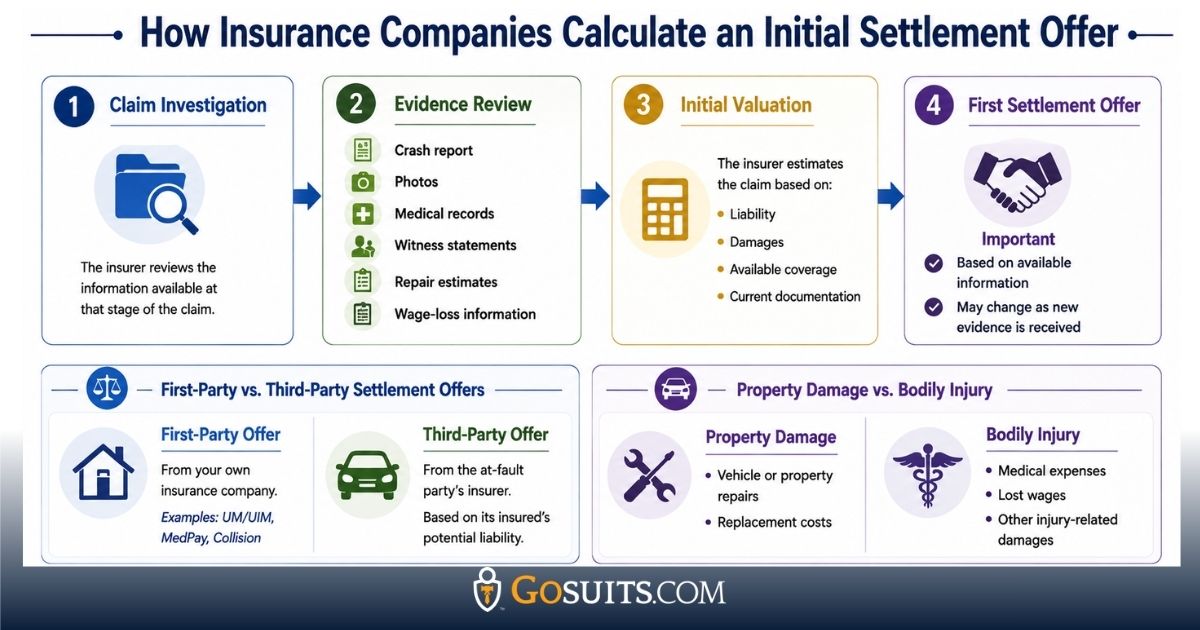
A first settlement offer is the insurance company’s initial valuation of a claim based on the information available during its investigation. It reflects the insurer’s current assessment of liability, damages, available coverage, and supporting documentation. As additional evidence becomes available, the insurer’s evaluation may change.
When preparing an initial offer, an insurer may review the crash report, photographs of the accident scene and vehicle damage, witness statements, a recorded statement (if one was provided), medical records and bills received to date, wage-loss documentation, repair estimates, and other available evidence. The offer is based on the information known at that stage of the claim rather than evidence that may be obtained later.
It is also important to understand the difference between first-party and third-party settlement offers:
First-party settlement offer: Made by your own insurance company, such as for uninsured or underinsured motorist (UM/UIM) coverage, Medical Payments (MedPay) coverage, or collision coverage. These claims are governed by your insurance policy, applicable Illinois law, and the policy’s contractual terms.
Third-party settlement offer: Made by the insurance company representing the person or entity allegedly responsible for the accident. Although the insurer may negotiate the claim, it does not insure you and evaluates the claim based on its insured’s potential legal liability.
It is equally important to distinguish between property damage and bodily injury settlement offers:
Property damage offer: Covers losses related to repairing or replacing a damaged vehicle or other property.
Bodily injury offer: Addresses losses resulting from physical injuries, including medical expenses, lost wages, pain and suffering, and other damages permitted under Illinois law.
Because these claims often progress on different timelines, they may be resolved separately.
Insurance companies sometimes make early settlement offers for practical reasons. Liability may appear relatively clear, the available documentation may be sufficient for an initial evaluation, or the claim may involve only property damage or relatively minor injuries. An insurer may also decide that settlement discussions can begin based on the information currently available.
An early offer does not necessarily mean the claim has been fully evaluated or that the offer is reasonable or unreasonable. Whether it can be fairly assessed depends on the facts, evidence, and damages that have been established at that point in the claim.
What a Property Damage Release Does and Does Not Cover
A property damage release generally resolves only the property damage portion of a claim, such as vehicle repairs or replacement, and ordinarily does not release a separate bodily injury claim. However, not every release is limited in this way.
Some settlement agreements contain broad language releasing all claims, including both known and unknown bodily injury claims arising from the accident. Others identify additional released parties or include indemnification, confidentiality, or other provisions that may affect the claimant’s rights.
For that reason, the title of the document alone should not determine its effect. The specific language of the release controls which claims and parties are being released. Reviewing the entire agreement before signing can help prevent unintentionally resolving claims that were not meant to be settled.
When might a first offer actually be reasonable?
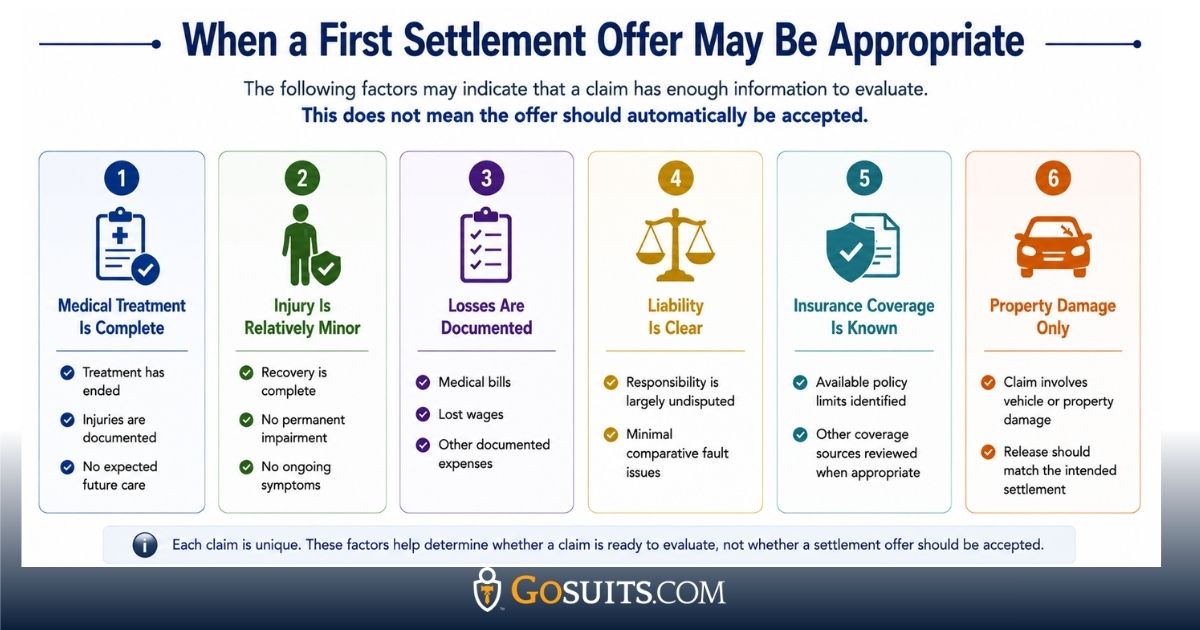
A first settlement offer may be reasonable when the claim is complete enough to evaluate and the available evidence supports the amount offered. The fact that an offer is made early does not automatically mean it is too low. In some cases, the insurer has sufficient information to value the claim, while in others, important facts or damages remain uncertain.
A first offer may be easier to evaluate under circumstances such as:
– Medical treatment is complete. The injury has stabilized, treatment has ended, and the medical records document the full extent of the injury without anticipated future care.
– The injury is relatively minor. The claimant has recovered without permanent impairment, ongoing symptoms, or reasonably certain future medical expenses.
– Economic losses are fully documented. Medical bills, lost wages, and other out-of-pocket expenses have been identified and supported by records.
– Liability is clear. There is little or no dispute about who caused the accident, and there is no significant comparative-fault issue that could reduce recovery under 735 ILCS 5/2-1116.
– The available insurance limits are known. In some cases, an offer at or near the applicable liability policy limits may reflect the practical ceiling of that particular claim against that insurer. However, additional insurance policies, other potentially responsible parties, or underinsured motorist (UIM) coverage may still require investigation.
– The claim involves only property damage. When the dispute is limited to vehicle repairs or valuation and the parties agree on the amount of the loss, an early property-damage settlement may be appropriate. Before signing any documents, however, the claimant should confirm that the release applies only to the property-damage claim and does not also release bodily injury claims unless that is intended.
These factors do not mean a first offer should automatically be accepted. Instead, they indicate that the claim may be complete enough to evaluate.
Whether the offer fairly reflects the documented damages, available insurance coverage, applicable liens, and the terms of the proposed release depends on the specific facts of the individual claim, which is why our Chicago personal injury attorneys evaluate each case based on its own evidence and legal issues.
When can’t a first offer be evaluated yet?
A first settlement offer often cannot be evaluated fairly when the full value of the claim is still unknown. If medical treatment is ongoing, important evidence has not yet been collected, or the available insurance coverage has not been fully investigated, the offer is being compared against a damages figure that may still change.
The following framework helps show when the information needed to evaluate an offer may be substantially complete and when important questions remain unresolved.
Can This Offer Be Evaluated Yet? |
||
|---|---|---|
| Factor | Points Toward “Evaluable Now” | Points Toward “Not Yet” |
| Treatment Status | Treatment Complete and Released From Care | Treatment Ongoing or Referral Pending |
| Prognosis | No Lasting Effects Expected | Permanence or Future Care Remains Unclear |
| Economic Losses | Bills and Wage Loss Fully Documented | Losses Still Accruing or Undocumented |
| Liability | Largely Undisputed | Disputed or Evidence Still Being Gathered (735 ILCS 5/2-1116) |
| Available Coverage | Limits Confirmed; Offer at or Near Available Limits | Limits Unknown; Other Policies or Parties May Exist |
| Liens and Reimbursement | Identified and Payoff Information Available | Liens or Reimbursement Rights Remain Unknown |
| Other Claims Affected | No Other Identified Claim Affected | Possible UM/UIM Claim or Other Coverage Remains Under Review (215 ILCS 5/143a-2) |
| Claimant | Adult Acting on Their Own Behalf | Minor or Person Whose Settlement May Require Court Approval (755 ILCS 5/19-8) |
This is a general framework for organizing the question, not an assessment of any individual claim.
Some uncertainties deserve particular attention. Pending imaging or specialist evaluations may change the medical picture, while future treatment, work restrictions, lost earning capacity, or other losses may not yet be quantifiable. Liability may also remain unsettled while witness statements, video, crash reports, or other evidence is still being gathered. Additional insurance policies or potentially responsible parties may not yet have been identified.
The proposed release is another part of the evaluation. Its language determines which claims and parties are being released, and a settlement involving an at-fault driver may also affect a potential underinsured motorist claim. The interaction between a tentative settlement and UIM coverage is subject to Illinois law, including 215 ILCS 5/143a-2, as well as applicable policy terms.
A settlement offer can only be evaluated against the value of the claim. When medical treatment, future care, lost income, liability, available coverage, or reimbursement obligations remain uncertain, that value may also remain uncertain. In that situation, whether the offer is fair may not yet be an answerable question.
What does Illinois law require of the insurance company?
Illinois law regulates how insurers handle claims and communicate certain settlement decisions. Some requirements differ depending on whether the claim is a first-party claim under the claimant’s own policy or a third-party claim against another driver’s insurer.
These rules are primarily enforced by the Illinois Department of Insurance and establish standards for claim handling. However, they do not automatically create a private right to recover damages if a regulation is violated.
The following table summarizes several of the Illinois requirements that may apply during the settlement process.
Illinois Insurance Claim Handling Requirements |
||
|---|---|---|
| Requirement | Authority | What It Means in Practice |
| Affirm or deny liability within a reasonable time and offer payment once liability and the undisputed amount are determined | 50 Ill. Adm. Code § 919.50(a) | Once the insurer determines liability and the amount that is not in dispute, it generally must communicate its decision and issue payment within the time required by the regulation. |
| Provide a written explanation of certain first-party claim decisions | 50 Ill. Adm. Code § 919.50(a)(1) | When a first-party settlement offer is less than the amount claimed, or when a covered first-party claim is denied, the insurer generally must provide a reasonable written explanation and include a Notice of Availability from the Illinois Department of Insurance. Different requirements apply to third-party claims. |
| Restrictions on Describing Payments as “Final” or “a Release” | 50 Ill. Adm. Code § 919.60(a) | An insurer generally may not label a payment as “final” or “a release” except in the circumstances permitted by the regulation. Claimants should still review any accompanying release documents carefully before signing them. |
| Restrictions on Statements About Signing Claim Forms | 50 Ill. Adm. Code § 919.90(b) | An insurer generally may not state that a claimant’s rights will be impaired if claim forms or releases are not signed within a deadline set by the insurer, except when providing notice about an applicable statute of limitations. |
| Restrictions on Directing Liability Claimants to Their Own Insurance | 50 Ill. Adm. Code § 919.90(c) | Where liability is reasonably clear, the regulation generally prohibits an insurer from advising a third-party liability claimant to pursue payment under their own policy instead. |
| Illinois Insurance Code Standards for Claim Handling | 215 ILCS 5/154.6 | Illinois law identifies a number of improper claims practices. These standards are enforced by the Illinois Department of Insurance and do not, by themselves, create an automatic private cause of action for damages. |
The Illinois Administrative Code provisions discussed above were amended effective January 17, 2025. Because insurance regulations may change over time, claimants should refer to the current version of the regulations when reviewing their rights and obligations.
If a claimant believes an insurer has not complied with Illinois claim-handling requirements, the Illinois Department of Insurance provides information about its consumer complaint process. Whether a particular regulation has been violated depends on the specific facts of the claim, and a regulatory issue does not automatically determine the outcome of a settlement dispute.
How do you evaluate an offer before responding?
A settlement offer can only be evaluated by comparing it against the documented value of the claim, the available insurance coverage, and what the claimant may actually receive after applicable liens and reimbursement obligations. Looking at the offer amount alone rarely provides enough information to determine whether it reasonably reflects the claim.
Before responding to an offer, consider the following questions.
| Question | Why It Matters |
|---|---|
| Is the injury picture complete? | An offer is easier to evaluate after treatment is complete or the prognosis, permanent effects, and any reasonably certain future medical care are understood. |
| Are the economic losses fully documented? | Medical bills, treatment records, lost earnings, out-of-pocket expenses, and other documented losses provide the foundation for evaluating an offer. |
| What insurance coverage is available? | Confirm the applicable policy limits and determine whether additional policies or responsible parties may provide coverage. An offer that approaches the available liability limits presents a different situation than one made before coverage has been fully investigated. |
| Is liability or comparative fault disputed? | Under 735 ILCS 5/2-1116, a claimant’s percentage of fault may reduce recoverable damages or bar recovery if it exceeds 50%. Liability disputes may therefore affect settlement value. |
| Will liens or reimbursement rights affect the recovery? | Healthcare provider liens, workers’ compensation reimbursement, Medicare, Medicaid, and private health plan reimbursement rights may reduce the amount ultimately received after settlement. |
| Could another claim be affected? | Accepting a settlement and signing a release may affect a potential uninsured or underinsured motorist claim if statutory or policy notice requirements apply, including the advance-notice provisions in 215 ILCS 5/143a-2. |
| What does the release actually say? | Review exactly which parties are being released, whether the release covers known and unknown injuries, whether it contains indemnification or confidentiality provisions, and whether it resolves all claims or only specific ones. |
| What deadlines are still running? | Negotiations do not stop statutory or contractual deadlines. A personal injury action is generally subject to 735 ILCS 5/13-202, while insurance policies may impose separate notice, suit, or arbitration requirements. |
Important: The amount offered is only one part of the evaluation. A settlement should be considered alongside the available evidence, applicable insurance coverage, comparative fault issues, future damages, potential liens, the terms of the proposed release, and any remaining legal or contractual deadlines. The same dollar amount may be reasonable in one claim and inadequate in another because the underlying facts are different.
Why the Gross Offer and Net Recovery Are Different
The settlement amount on an offer is not necessarily the amount ultimately available to the claimant. Depending on the case, attorney’s fees and case costs, healthcare liens, workers’ compensation reimbursement rights, Medicare or Medicaid interests, and private health-plan reimbursement rights may need to be addressed. Identifying those obligations can therefore be part of evaluating an offer rather than something considered only after acceptance.
Gross Offer Versus What Is Left |
|||
|---|---|---|---|
| Step | What It Is | Illinois Authority or Source | Why It Changes the Number |
| Gross Offer | Amount Proposed to Settle the Claim | Settlement Documents | Starting Figure Before Applicable Deductions or Reimbursement Obligations |
| Attorney’s Fees and Costs, If Represented | Fees and Case Expenses Governed by the Representation Agreement and Applicable Law | Written Representation Agreement and Applicable Law | May Affect the Amount Ultimately Distributed |
| Healthcare Provider Liens | Qualifying Liens for Healthcare Services | 770 ILCS 23/10 | Liens Under the Act Are Subject to Statutory Limitations and May Need to Be Resolved From the Recovery |
| Workers’ Compensation Reimbursement | Employer Reimbursement Rights Where Workers’ Compensation Benefits Were Paid | 820 ILCS 305/5(b) | A Third-Party Recovery May Be Subject to an Employer’s Statutory Reimbursement Interest |
| Medicare, Medicaid, and HFS | Government Reimbursement Interests Where Applicable | Applicable Federal and Illinois Law | Qualifying Reimbursement Obligations May Need to Be Resolved |
| Private Health Plan Subrogation | Contractual or Statutory Reimbursement Rights | Applicable Plan and Law | Some Health Plans May Assert Reimbursement Rights Against a Recovery |
| Net to Claimant | Amount Remaining After Applicable Obligations Are Resolved | Case-Specific | May Differ Materially From the Gross Settlement Figure |
Illustration of categories that may affect a net recovery. It is not an estimate of any individual case’s value and does not reflect any past result.
What happens if you counter instead of accepting?
Making a counteroffer keeps the claim unresolved while negotiations continue. Declining an initial offer does not, by itself, end the underlying claim or forfeit the claimant’s legal rights, although applicable filing and contractual deadlines continue to run. Whether an earlier settlement offer remains available depends on the communications between the parties and ordinary settlement principles, and the insurer may revise or withdraw its position during negotiations.
A counteroffer is typically supported by additional documentation rather than simply requesting a higher amount. A demand or counter package may include updated medical records, medical bills, wage-loss documentation, photographs, and other evidence supporting liability or damages. Additional documentation gives the insurer an opportunity to reassess the claim based on a more complete record.
If an insurer says an offer will expire by a certain date, remember that 50 Ill. Adm. Code 919.90(b) generally prohibits an insurer from implying that a liability claimant’s legal rights will be lost simply because the insurer’s forms are not signed by its deadline, except when providing notice of an applicable statute of limitations.
Negotiations also do not stop legal deadlines. Many Illinois personal injury actions remain subject to the general two-year limitations period under 735 ILCS 5/13-202, although different deadlines may apply depending on the claim.
Filing a lawsuit does not end settlement discussions either. Many cases continue to settle after litigation begins, including during discovery, before trial, or while an appeal is pending. To learn more about each stage of the litigation process, see What to Expect During a Personal Injury Lawsuit.
What happens after you accept?
Accepting a settlement begins the process of finalizing the claim through signed documents and payment. Once the required release becomes effective, the claims covered by that release are generally resolved and cannot be pursued again against the released parties.
The settlement release identifies who is being released and which claims are resolved. Many releases also state that they cover both known and unknown injuries arising from the incident, so reviewing the release language carefully before signing is important.
A release can contain terms beyond the settlement amount. Important provisions may include:
- Released Parties: Identifies every person or entity whose potential liability is being resolved.
- Scope of Claims: States whether the agreement covers specific claims or all claims arising from the incident.
- Known and Unknown Injuries: May extend the release to injuries or consequences that are not fully known when the agreement is signed.
- Indemnification or Hold-Harmless Provisions: May allocate responsibility for certain liens, reimbursement demands, or later claims.
- Confidentiality: May restrict disclosure of specified settlement information.
The effect of any provision depends on the actual language of the agreement and applicable law.
Illinois’s settlement-payment statute, 735 ILCS 5/2-2301, establishes specific release and payment procedures for covered personal injury, property damage, wrongful death, and tort settlements. For settlements within the statute, the settling defendant generally must tender the release within 14 days after written confirmation of the settlement. The defendant generally must then pay the sums due within 30 days after the plaintiff tenders the executed release and the applicable documents required by the statute. If timely payment is not made, the statute provides a procedure for seeking judgment for the amount in the executed release, plus applicable costs and interest. Section 2-2301 also contains exclusions and special provisions concerning liens and other third-party recovery interests.
After a settlement is accepted, payment may still be delayed while healthcare liens, workers’ compensation reimbursement claims, Medicare or Medicaid interests, and other reimbursement obligations are resolved before the final net amount is distributed.
Typical Post-Acceptance Settlement Sequence |
|||
|---|---|---|---|
| Step | Typical Timing | Authority | Purpose |
| Settlement Confirmed in Writing | Upon Agreement | 735 ILCS 5/2-2301 | Confirms the Parties’ Settlement |
| Release Tendered | Within 14 Days of Written Confirmation for Settlements Within the Statute | 735 ILCS 5/2-2301(a) | Defendant Provides the Settlement Release |
| Executed Release Returned | Varies | 735 ILCS 5/2-2301 | Plaintiff Returns the Signed Release and Required Documents |
| Payment Issued | Within 30 Days After Plaintiff’s Tender of the Executed Release and Applicable Documents | 735 ILCS 5/2-2301(d) | Settling Defendant Pays All Sums Due |
| Liens and Reimbursement Resolved | As Applicable | 770 ILCS 23/10 and Other Applicable Law | Outstanding Reimbursement Claims Are Addressed Before Final Distribution |
Note: These statutory timelines apply to settlements within 735 ILCS 5/2-2301. The statute contains specified exclusions, and the parties may agree otherwise as permitted by the statute.
Can you reopen a claim after accepting?
Generally, no. Once a valid settlement agreement and release become effective, reopening the claim is difficult. Illinois courts may set aside a release only in limited circumstances, such as fraud, misrepresentation, duress, mutual mistake of fact, incapacity, or lack of authority.
A later realization that a known injury was more serious than expected generally is not enough to reopen a settlement, particularly when the release states that it covers both known and unknown injuries.
If a final judgment has already been entered, 735 ILCS 5/2-1401 provides a procedure for seeking relief from that judgment under limited circumstances. However, the statute imposes strict legal requirements, and it should not be viewed as a routine method for undoing a settlement.
Special Situations That Change the Analysis
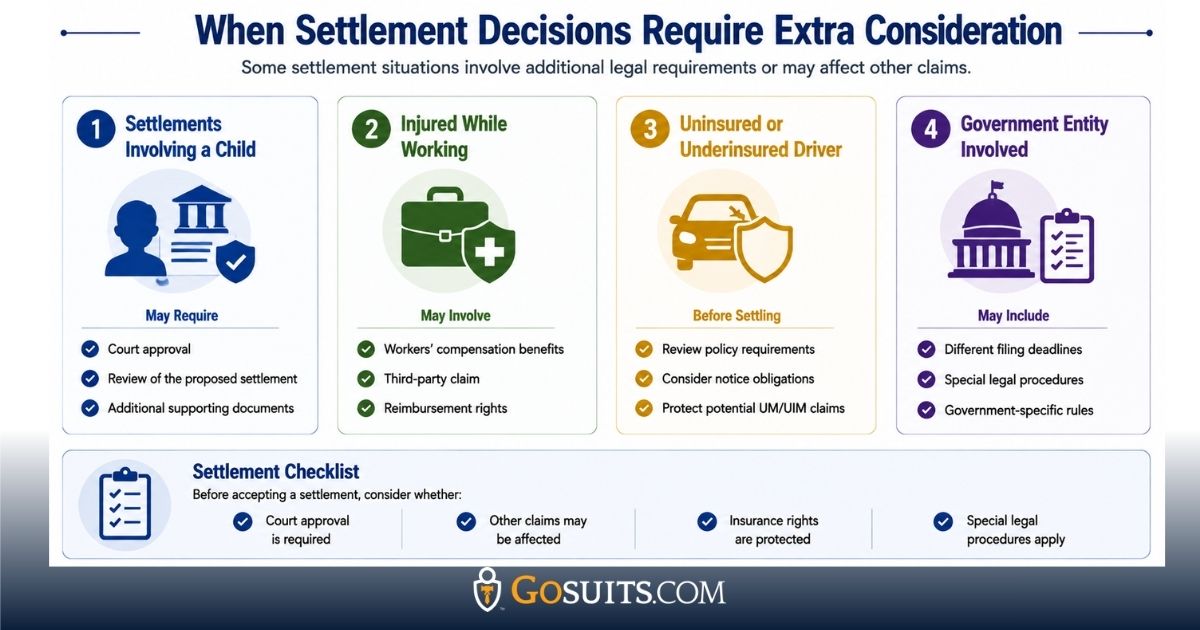
Some settlement decisions involve additional legal requirements or may affect other claims. In these situations, accepting a settlement requires more than simply agreeing on a dollar amount because court approval, reimbursement rights, or separate insurance claims may also need to be considered.
Settlements Involving a Child
Illinois generally requires court involvement before a minor’s personal injury claim can be settled. A parent cannot settle or release a child’s claim solely because of the parent-child relationship. Under 755 ILCS 5/19-8, a representative may compromise a ward’s claim with leave of court and on the terms the court directs. Illinois law also provides a separate affidavit procedure under 755 ILCS 5/25-2 when a ward’s personal estate does not exceed $10,000 and the statute’s other requirements are satisfied. That provision concerns when appointment of a representative may be unnecessary and should not be treated as a general rule allowing parents to settle minor injury claims without court involvement.
In Cook County, the court may also review attorney’s fees, expenses, and applicable liens. A physician’s statement describing the child’s injury and current medical condition is commonly required as part of the approval process.
If You Were Working at the Time
If the injury occurred while you were performing job duties, workers’ compensation benefits may be available regardless of fault. A separate claim against another responsible party may also exist.
When workers’ compensation benefits have been paid, the employer may have reimbursement rights under 820 ILCS 305/5(b) that can affect the amount ultimately received from a third-party settlement. These claims often require coordination before a settlement is finalized.
If an Uninsured or Underinsured Driver Is Involved
A settlement with an at-fault driver can affect a potential underinsured motorist (UIM) claim. Under 215 ILCS 5/143a-2, advance written notice of a tentative settlement affects the UIM insurer’s subrogation rights and gives the insurer 30 days after receiving that notice to advance an amount equal to the tentative settlement. Release language, policy requirements, and Illinois case law can therefore matter before the at-fault party is released.
The statute also provides that settling the bodily injury claim for less than the applicable liability limits does not, by itself, prevent a claimant from making a UIM claim. For more information, see our article on claims involving an uninsured or underinsured driver.
If a Government Entity Is Involved
Claims involving the State, a municipality, or another public entity may be subject to different procedural rules and deadlines. For covered injury claims against a local public entity or employee, 745 ILCS 10/8-101 generally establishes a one-year limitations period, subject to the statute’s separate provisions and other applicable law. Claims involving the State or other government defendants may be governed by different requirements. The settlement procedures in 735 ILCS 5/2-2301 also do not apply to every government-related case, so the applicable rules depend on the specific defendant and claim.
Sources:
- Illinois General Assembly — 215 ILCS 5/143a-2, Uninsured and Underinsured Motorist Coverage
- Illinois General Assembly — 215 ILCS 5/154.6, Acts Constituting Improper Claims Practice
- Illinois General Assembly — 215 ILCS 5/155, Attorney Fees and Vexatious and Unreasonable Conduct
- Illinois General Assembly — 735 ILCS 5/2-1116, Limitation on Recovery in Tort Actions
- Illinois General Assembly — 735 ILCS 5/2-1401, Relief From Judgments
- Illinois General Assembly — 735 ILCS 5/2-2301, Settlement of Claims; Payment
- Illinois General Assembly — 735 ILCS 5/13-202, Personal Injury Limitations Period
- Illinois General Assembly — 745 ILCS 10/8-101, Limitations for Actions Against Local Public Entities and Employees
- Illinois General Assembly — 755 ILCS 5/19-8, Compromising a Ward’s Claim
- Illinois General Assembly — 755 ILCS 5/25-2, When Appointment of Representative of Ward Is Unnecessary
- Illinois General Assembly — 770 ILCS 23/10, Health Care Services Lien Act
- Illinois General Assembly — 820 ILCS 305/5, Workers’ Compensation Third-Party Liability and Reimbursement
- Illinois Administrative Code — 50 Ill. Adm. Code Part 919, Improper Claims Practice
Frequently Asked Questions
Should you accept the first insurance settlement offer?
Sometimes. An early offer may be reasonable if treatment is complete, damages are documented, and liability and available insurance limits are clear. If treatment is still ongoing, the claim may not yet be fully valued, and signing a release can make it difficult to pursue additional compensation later.
How do I know if a settlement offer is fair?
Compare the offer with your documented damages, available insurance coverage, any comparative-fault issues, and the amount you may actually receive after liens and reimbursement rights. The offer amount alone does not determine whether it is fair.
Can I reopen my claim after accepting a settlement?
Generally, no. Illinois courts set aside settlement releases only in limited circumstances, such as fraud, duress, mutual mistake of fact, or lack of authority. Discovering that a known injury is more serious than expected is usually not enough.
Can the insurance company make an offer expire?
An insurer may set a response deadline, but that is different from the legal deadline for filing a claim or lawsuit. Under 50 Ill. Adm. Code 919.90(b), insurers generally may not imply that your legal rights will be lost simply because you do not meet the insurer’s own deadline.
Does the insurance company have to explain a low settlement offer?
For many first-party claims, yes. 50 Ill. Adm. Code 919.50(a)(1) generally requires a written explanation when an offer is less than the amount claimed, together with a Notice of Availability from the Illinois Department of Insurance.
How long do I have to decide whether to accept a settlement offer?
There is no universal response deadline in Illinois. However, the applicable statute of limitations and any contractual insurance deadlines continue to run while negotiations are ongoing.
What happens after I accept a settlement?
Accepting a settlement generally begins the release and payment process. For settlements within 735 ILCS 5/2-2301, Illinois law generally requires the settling defendant to tender the release within 14 days after written confirmation of the settlement and to pay the sums due within 30 days after the plaintiff tenders the executed release and applicable documents. Liens and reimbursement interests may also need to be addressed before final distribution.
Can I settle my child's injury claim myself?
Generally, no. Illinois law generally requires court involvement before a minor’s personal injury claim can be settled. Illinois also provides a limited affidavit procedure under 755 ILCS 5/25-2 when a ward’s personal estate does not exceed $10,000 and the statute’s other requirements are met.
Can accepting a settlement affect another insurance claim?
Yes, potentially. A settlement with an at-fault driver can affect a potential UIM claim. Under 215 ILCS 5/143a-2, advance written notice of a tentative settlement affects the UIM insurer’s subrogation rights, so the applicable policy terms, release language, and notice requirements should be considered before the at-fault party is released.
What if the insurance company will not increase its offer?
The available options depend partly on whether the claim involves the claimant’s own insurer or another party’s insurer. In an action involving an insurer’s liability under its own policy, 215 ILCS 5/155 allows a court to award specified additional relief when the insurer’s action or delay is found to be vexatious and unreasonable. That provision does not put a third-party claimant negotiating with an at-fault party’s insurer in the same position. Consumers may also submit qualifying insurance complaints to the Illinois Department of Insurance.