A pre-existing condition does not automatically prevent recovery in an Illinois personal injury claim. Illinois law generally does not allow damages to be reduced simply because an injured person was more susceptible to harm because of an existing condition. What a prior condition can change is the evidence needed to show what the accident actually caused or made worse.
It is common to worry that an old injury, diagnosis, or treatment history will undermine a new claim. In practice, the focus is usually on the medical record before and after the accident, including prior symptoms, treatment history, diagnostic findings, and any documented change in condition.
Key Takeaways:
- A pre-existing condition does not automatically bar or reduce an Illinois personal injury claim. The key question is what the new accident caused or aggravated.
- Illinois follows the eggshell plaintiff principle, meaning an injured person is not penalized simply because an existing condition made them more susceptible to harm.
- Prior medical history can matter, but an old injury involving the same body part is not automatically enough to establish that current symptoms came from the earlier condition.
- Medical records are central to proving aggravation. Treatment history, symptom changes, diagnostic findings, treatment gaps, and medical opinions can help establish the before-and-after picture.
- Access to prior medical records is not necessarily unlimited. In litigation, relevance and the medical conditions placed at issue help determine the permissible scope.
- When the same body part was injured in two separate accidents, the issue may involve apportionment between the events rather than a straightforward pre-existing-condition analysis.
- Comparative fault and pre-existing conditions are different issues. Comparative fault concerns responsibility for causing the accident, while a pre-existing condition concerns medical causation and damages.

What Counts as a “Pre-Existing Condition” in an Injury Claim?
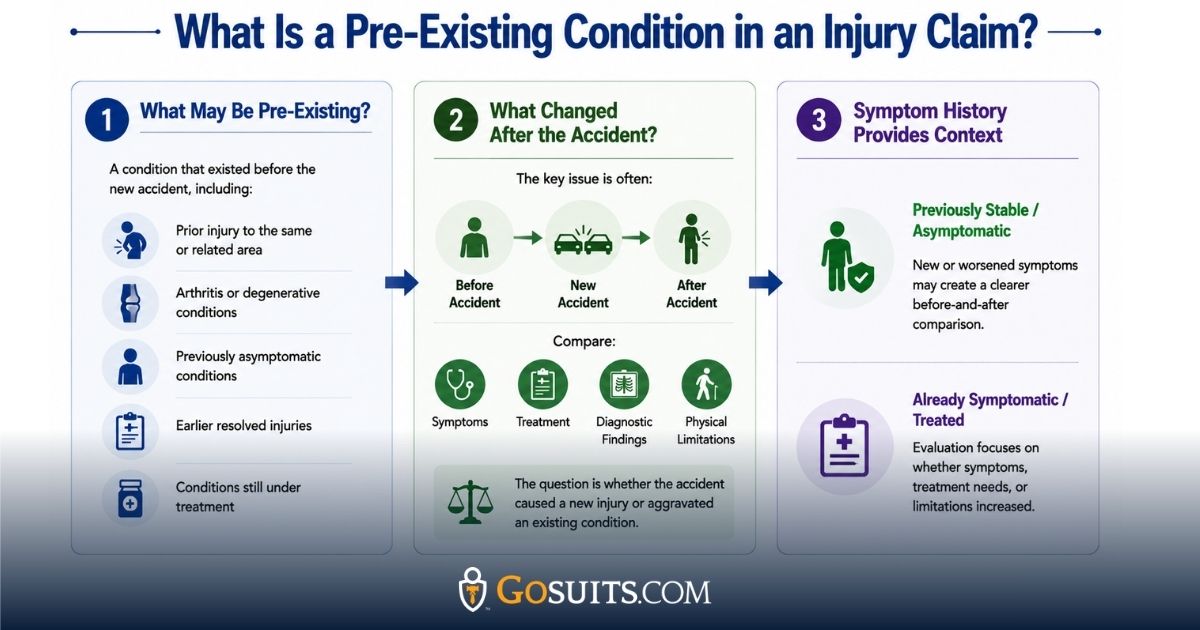
A pre-existing condition is an injury, illness, or medical condition that existed before the accident involved in the current Chicago car accident claim.
The condition does not have to involve the exact same diagnosis or have been causing symptoms immediately before the accident, but its significance to the claim depends on whether it is relevant to the injuries and damages at issue.
Depending on the circumstances, a pre-existing condition may include:
- A previously diagnosed injury involving the same or a related area
- A degenerative or chronic condition, such as arthritis, degenerative disc disease, or osteoporosis
- A condition that existed but was asymptomatic before the accident
- An earlier injury that had resolved before the new accident
- A condition that was still being treated when the accident occurred
An important distinction is how the prior condition relates to the new injury. In a classic eggshell-plaintiff situation, an existing condition makes someone more susceptible to injury. A defendant is not relieved of liability merely because a pre-existing condition made the claimant more vulnerable, but damages still depend on what the accident caused or aggravated.
A different and common dispute arises when the claimant already had an injury or symptoms involving the same area. In that situation, the central question is usually not whether the prior condition existed, but what changed because of the new accident. Medical records, treatment history, diagnostic findings, and medical opinions may help distinguish the prior condition from a new injury or aggravation.
Does it matter whether the condition was symptomatic before the crash?
Yes, but primarily because symptom history affects the causation evidence, not whether a person may pursue a claim.
A condition that was asymptomatic, stable, or no longer requiring treatment before the crash may provide a clearer before-and-after comparison if symptoms appear or worsen afterward.
A documented period without treatment may also provide additional evidence of the person’s condition before the accident.
When the same condition was already symptomatic and actively being treated, the analysis may be more complicated. The dispute may focus on whether the accident increased the symptoms, changed the person’s treatment needs, or caused additional limitations.
In either situation, the existence of a pre-existing condition does not by itself resolve the claim. The relevant question is what injury or aggravation can be attributed to the new accident based on the available evidence.
Does Illinois law let an insurance company reduce a settlement because of a prior injury?
Not simply because a prior injury or medical condition exists. Under Illinois law, a pre-existing condition does not by itself justify reducing damages for harm caused or aggravated by a new accident. The central issue is causation: what injury or worsening of an existing condition can be attributed to the new occurrence.
Illinois Pattern Jury Instruction IPI Civil 30.21 reflects this principle. When supported by the evidence and liability is established, jurors are instructed not to deny or limit damages resulting from the occurrence merely because the injury involved an aggravation of a pre-existing condition or because an existing condition made the plaintiff more susceptible to injury.
This principle is often described as the eggshell plaintiff rule. It does not mean that the responsible party becomes liable for medical problems that existed independently of the accident. Instead, the claimant still must establish what harm resulted from the occurrence.
The current Illinois damages instructions treat aggravation as part of the overall injury analysis rather than as a separate category of damages.
During settlement negotiations, an insurer may raise a prior condition when evaluating whether the accident caused the current symptoms or changed an existing condition. If experts the dispute later reaches trial, Illinois imposes additional evidentiary requirements.
Under Voykin v. Estate of DeBoer, a defendant seeking to introduce evidence of a prior injury or medical condition generally must establish its relevance through expert evidence, unless the relationship is one a layperson can readily evaluate without expert assistance.
The practical question is therefore not simply whether a prior condition existed. It is what changed after the accident and what medical and other evidence connects that change to the occurrence.
How do you prove an accident aggravated a pre-existing condition?
Establishing that an accident aggravated a pre-existing condition generally depends on medical and other evidence comparing the claimant’s condition before and after the accident. A prior diagnosis alone does not determine causation. The evidence must help establish what, if anything, the accident changed.
Evidence relevant to that comparison may include:
Pre-accident treatment history: Records may show whether the condition was actively treated, stable, resolved, or had not recently required treatment.
Pre-accident symptoms and functioning: The most recent relevant records can help establish the claimant’s condition before the accident.
Post-accident changes: Medical records may document new or worsened symptoms, functional limitations, treatment needs, or clinical findings.
Medical causation evidence: Depending on the condition and the causation question, a treating physician or other qualified medical witness may address whether the accident caused a new injury or aggravated an existing condition.
Diagnostic comparisons: When comparable pre- and post-accident studies exist, imaging, examinations, or other diagnostic findings may help evaluate whether a relevant change occurred.
Illinois law does not create a single checklist for proving aggravation. The significance of each piece of evidence depends on the claimed injury, prior medical history, and whether the evidence establishes a meaningful connection between the accident and the claimed change in condition. Our Chicago personal injury attorneys handle claims in which prior medical history and current injury evidence must be evaluated together.
Evidence Used to Evaluate an Aggravation Claim
The following factors can help organize the before-and-after comparison, but none independently establishes or defeats causation.
Key Evidence in a Pre-Existing Condition Claim |
||
|---|---|---|
| Factor | May Support the Before-and-After Comparison | May Make the Comparison More Complex |
| Treatment Before the Crash | Records describe the condition as stable, resolved, or not requiring recent treatment | Active treatment for similar symptoms immediately before the crash |
| Symptoms Before the Crash | Condition was documented as asymptomatic, stable, or improved | Similar symptoms were already significant or worsening |
| Post-Crash Timeline | Medical records document new or worsened symptoms after the crash | The record does not clearly establish when the claimed change occurred |
| Diagnostic Comparison | Comparable studies may document changes that can be evaluated with the other medical evidence | No comparable pre-accident study or baseline is available |
| Medical Opinion | A qualified medical witness addresses whether the accident caused or aggravated the condition | The medical evidence does not address the relationship between the prior condition and claimed injury |
| Source of Prior Injury | An underlying condition is evaluated against the effects of the new accident | A separate earlier accident affected the same area and may raise additional causation or apportionment questions |
These factors illustrate how evidence may inform the before-and-after analysis of a pre-existing condition. Their significance depends on the facts and medical evidence in each case.
Ultimately, the question is not simply whether a medical condition existed before the accident. The issue is whether the evidence establishes that the accident caused a new injury or aggravated the prior condition, and what portion of the claimed harm is attributable to that change.
Can the insurance company use my old medical records against me?
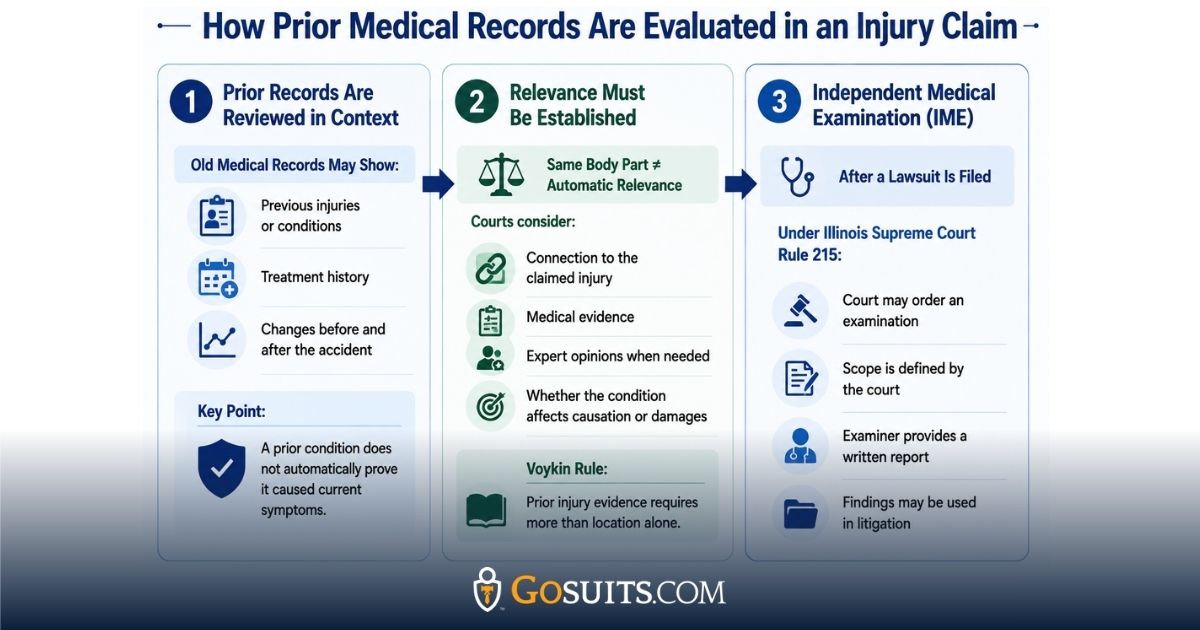
Prior medical records may be considered when they are relevant to the injuries claimed, but the existence of an old injury does not automatically establish that it caused the current symptoms. It is also important to distinguish an insurer’s pre-suit claim investigation from the evidentiary rules that apply after a lawsuit has been filed.
In Voykin v. Estate of DeBoer, 192 Ill. 2d 49 (2000), the Illinois Supreme Court rejected the former “same part of the body” rule. Under that older approach, a previous injury could be treated as relevant largely because it involved the same body area as the current injury. The court held that this was not enough.
When a defendant seeks to introduce prior-injury evidence in court, the defendant generally must present expert evidence showing why the prior condition is relevant to causation, damages, or another material issue. An exception may apply when the relationship between the old and new injuries is straightforward enough for a layperson to evaluate without expert assistance. This means that a prior back, knee, or neck problem is not automatically relevant merely because the current claim involves the same area.
Before a lawsuit is filed, an insurance adjuster may review prior records that are provided or properly obtained and may raise questions about causation during settlement negotiations. However, those negotiating positions should not be confused with the rules governing what evidence can ultimately be admitted in court.
Illinois law also does not treat filing a personal injury lawsuit as permission for unrestricted access to a claimant’s entire lifetime medical history. 735 ILCS 5/8-802 addresses physician-patient privilege when a physical or mental condition has been placed at issue, while Kunkel v. Walton, 179 Ill. 2d 519 (1997) confirms that medical discovery remains subject to relevance. Records unrelated to the injuries or conditions genuinely at issue are not automatically discoverable simply because a personal injury action was filed.
What the Insurer Can and Cannot Do With Prior Medical History |
||
|---|---|---|
| Requirement | Authority | What It Means in Practice |
| Medical Discovery Is Limited to Relevant Matters Placed at Issue | Kunkel v. Walton, 179 Ill. 2d 519 (1997); 735 ILCS 5/8-802 | Filing a lawsuit does not automatically make unrelated lifetime medical history discoverable. |
| Prior-Injury Evidence Generally Requires a Relevant Connection | Voykin v. Estate of DeBoer, 192 Ill. 2d 49 (2000) | The same body part alone does not establish relevance. Expert evidence is generally required unless the relationship can readily be evaluated without expert assistance. |
| A Court-Ordered Physical or Mental Examination Requires the Condition to Be in Controversy | Illinois Supreme Court Rule 215 | This procedure applies in litigation and is governed by the court’s order. |
| The Examiner Must Provide the Required Report | Illinois Supreme Court Rule 215 | The rule establishes requirements governing the examiner’s report and its disclosure. |

What is an independent medical examination (IME)?
Once a lawsuit has been filed, Illinois Supreme Court Rule 215 provides a procedure for a physical or mental examination when a party’s physical or mental condition is in controversy. The party seeking the examination must provide reasonable notice specifying the examiner and the time, place, conditions, and scope of the examination. If the person to be examined objects, the court may determine whether the examination should proceed and on what terms.
The examiner must prepare and deliver a written report within 21 days after completing the examination, unless the court grants an extension or modification. The report must state the examiner’s findings, test results, diagnosis, and conclusions. If the examiner will testify at trial, the examiner must also be disclosed as a controlled expert witness under the applicable Illinois discovery rules.
A Rule 215 examination is part of a filed court action and is one step that may arise in how an Illinois lawsuit progresses. It is different from a pre-suit insurer request for records, an authorization, or an examination requested under an insurance policy. The authority and obligations surrounding those pre-suit requests depend on the type of claim, the applicable policy, and the circumstances.
What If the Same Body Part Was Hurt in an Earlier, Different Accident?
When the same body part was injured in two separate accidents, the issue may become one of separating the injuries and damages attributable to each event rather than applying a simple pre-existing-condition analysis. The central question is whether the evidence provides a reasonable basis for identifying what the earlier accident caused and what the later accident added or aggravated.
Illinois courts have made clear that two injuries affecting the same body part do not automatically become one indivisible injury. In Sakellariadis v. Campbell, the Illinois Appellate Court considered injuries from two separate motor vehicle accidents and held that the fact that both crashes affected overlapping body areas did not prevent the jury from apportioning damages between them. The court relied on medical testimony and other evidence that allowed a reasonable, even if approximate, division.
The court also relied on Yanan v. Ewing for the principle that when a later negligent act aggravates an injury caused by an earlier wrongdoer, the later event may constitute a separate tort. In that situation, the later tortfeasor may be responsible for the aggravation or additional harm rather than automatically for the original injury.
The table below highlights the key differences between aggravating a pre-existing condition and sustaining an injury in an earlier, separate accident.
Aggravation vs. Injury From an Earlier Accident |
||
|---|---|---|
| Aggravation of a Pre-Existing Condition | Injury From an Earlier, Separate Accident | |
| What It Involves | A chronic condition, prior diagnosis, or vulnerability that existed before the current accident | A distinct earlier event that injured the same body part |
| Central Question | What injury or worsening did the current accident cause? | What harm can reasonably be attributed to each separate accident? |
| Evidence That May Matter | Pre- and post-accident records, symptoms, diagnostic findings, and medical opinions | Records from both accidents, treatment timelines, recovery between events, diagnostic comparisons, and medical opinions |
| Possible Allocation | Focuses on the aggravation or additional harm caused by the current event | Damages may be apportioned between the accidents when the evidence provides a reasonable basis for doing so |
Aggravation and successive-accident cases can involve similar medical evidence but different causation and allocation questions.
The important point is that an earlier accident involving the same body part does not automatically make all later symptoms attributable to one event. The fact finder may consider medical records, testimony, and other evidence to determine what each accident contributed, and an exact mathematical division is not always required if the evidence supports a reasonable apportionment.
How does a pre-existing condition affect a settlement negotiation?
A pre-existing condition can affect settlement negotiations because it raises a causation question about what the accident actually changed. The same evidentiary principles that may apply at trial can influence negotiations, but the pre-suit process is generally less formal.
An adjuster may raise prior injuries or treatment when evaluating whether current symptoms were caused or aggravated by the accident. However, the existence of an earlier condition alone does not establish that it caused the current symptoms. The relationship between the prior condition and the claimed injury remains important.
For this reason, the before-and-after medical record often becomes central. Prior treatment, treatment gaps, symptom history, post-accident findings, diagnostic comparisons, and medical opinions may help establish what changed after the accident.
Before a lawsuit is filed, insurers may also request medical records through voluntary medical authorizations, rather than court-ordered discovery. The scope of those requests may therefore be addressed during the claims process. Once litigation begins, medical discovery is governed more formally by Illinois law and court rules.
Ultimately, a pre-existing condition does not determine the outcome of negotiations. It changes the evidence needed to evaluate which injuries and damages can be connected to the new accident when evaluating a settlement offer.
Is a pre-existing condition the same thing as comparative fault?
No. Comparative fault and a pre-existing condition address different issues in an Illinois injury claim. Comparative fault concerns the claimant’s responsibility for causing the accident, while a pre-existing condition concerns medical causation and what harm the accident caused or aggravated.
Under 735 ILCS 5/2-1116, damages are reduced according to the claimant’s percentage of contributory fault. If the claimant is more than 50% at fault for the injury or damage, recovery is barred.
A pre-existing condition does not assign fault for causing the accident. Instead, it may create a separate question about whether particular symptoms, treatment, or limitations resulted from the new accident or were already present.
In short, comparative fault addresses responsibility for the accident, while a pre-existing condition addresses the medical consequences of it.
Special Situations That Change the Analysis
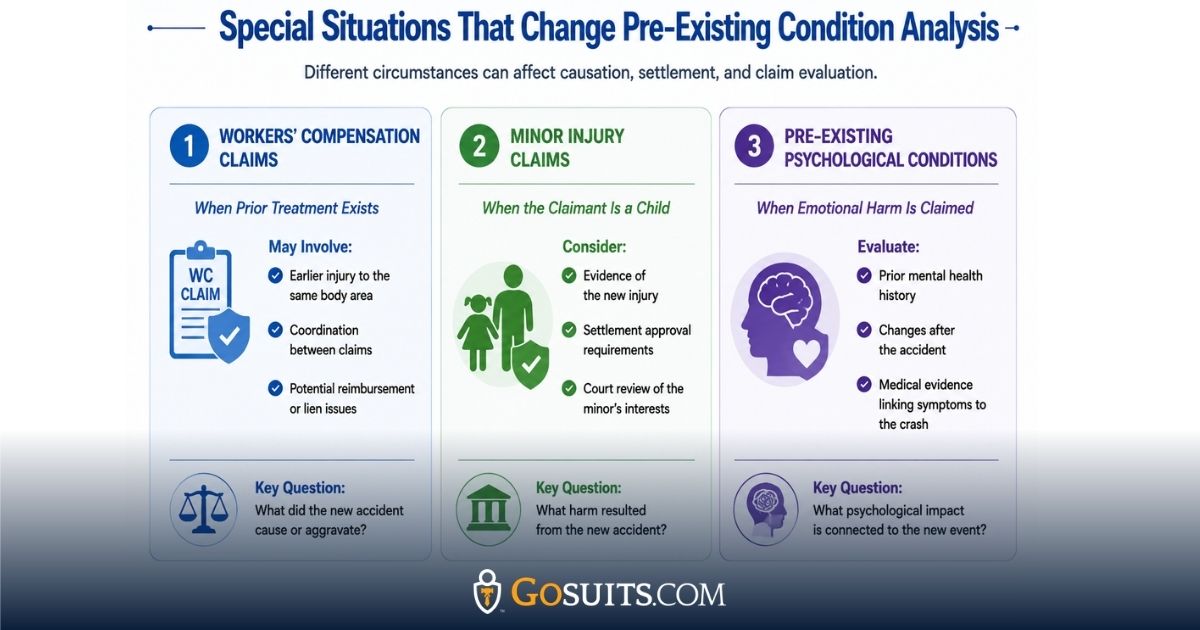
Some pre-existing-condition claims involve additional legal or procedural issues. Workers’ compensation, claims involving minors, and pre-existing psychological conditions can each change how causation, settlement, or reimbursement issues are evaluated.
A Condition Already Being Treated for a Workers’ Compensation Claim
When an earlier injury is connected to a workers’ compensation claim, a later personal injury claim involving the same body part may require coordination between the two matters.
Under 820 ILCS 305/5(b), an employer may have reimbursement and lien rights against a qualifying third-party recovery when workers’ compensation benefits have been paid or accepted. These reimbursement issues are separate from determining what the later accident caused or aggravated, but they can affect how a personal injury settlement is paid.
A Condition That Existed Before a Minor’s Injury
When the claimant is a minor, the evidence must still establish what the new accident caused or aggravated. Illinois generally requires court involvement in settling a minor’s personal injury claim. Under 755 ILCS 5/19-8, a representative may compromise a ward’s claim with leave of court and on the terms the court directs. A separate affidavit procedure may apply under 755 ILCS 5/25-2 when the ward’s personal estate does not exceed $10,000 and the statute’s other requirements are satisfied.

A Psychological Condition That Existed Before the Crash
A pre-existing psychological condition may be relevant when emotional or psychological harm is part of the damages claimed. Illinois recognizes emotional distress as a compensable element of damages in appropriate personal injury cases.
The existence of an earlier condition does not by itself establish what harm resulted from the new accident. The analysis depends on the relevant medical history and evidence connecting any claimed change to the accident. Depending on the causation dispute, appropriate medical or other opinion testimony may also be relevant.
Sources:
- Illinois Pattern Jury Instructions, Civil, complete PDF
- Illinois Courts, Illinois Pattern Civil Jury Instructions
- Voykin v. Estate of DeBoer, 192 Ill. 2d 49 (2000)
- Illinois Courts — Illinois Pattern Jury Instructions, Civil, IPI 30.21
- Illinois Appellate Court — Campbell v. Autenrieb, 2018 IL App (5th) 170148
- Illinois Supreme Court — Kunkel v. Walton, 179 Ill. 2d 519 (1997)
- Illinois General Assembly — 735 ILCS 5/8-802
- Illinois Supreme Court Rule 215
- Illinois Appellate Court — Sakellariadis v. Campbell, 391 Ill. App. 3d 795 (1st Dist. 2009)
- 735 ILCS 5/2-1116, Illinois General Assembly
- Illinois General Assembly — 820 ILCS 305/5(b)
- Illinois General Assembly — 755 ILCS 5/19-8
- Illinois Appellate Court — Wreglesworth v. Arctco, Inc., 316 Ill. App. 3d 1023 (2000)
- Illinois Appellate Court — Ott v. Little Company of Mary Hospital, 273 Ill. App. 3d 563 (1995)
- Illinois Appellate Court — Yanan v. Ewing, 205 Ill. App. 3d 96 (1990)
Frequently Asked Questions
Can I still get compensation if I had a pre-existing condition?
Yes. A pre-existing condition does not automatically bar an Illinois injury claim. The key question is what injury or aggravation the new accident caused, supported by the available medical evidence.
Will the insurance company find out about my old injury?
Possibly, if prior medical history is relevant to the condition at issue. Before a lawsuit is filed, an insurer may seek relevant records through a medical authorization or other applicable claim procedures. Once litigation begins, putting a physical or mental condition at issue does not automatically make a claimant’s entire medical history discoverable; the permissible scope remains subject to relevance and applicable Illinois law (Kunkel v. Walton; 735 ILCS 5/8-802).
Can the insurance company deny my claim just because I had a prior injury to the same body part?
Not on that basis alone. Under Voykin v. Estate of DeBoer, a prior injury generally needs a relevant connection to the current injury, often established through expert evidence. The fact that the same body part was previously injured is not automatically enough.
What is the difference between a pre-existing condition and an aggravation?
A pre-existing condition existed before the accident. An aggravation occurs when the accident worsens that condition. Illinois treats aggravation as part of the overall injury and damages analysis rather than a separate damages category.
What if a different accident hurt the same body part before?
A separate earlier accident may raise an apportionment issue. The evidence may need to establish whether the injuries from the two accidents can reasonably be separated and what harm is attributable to each event.
How do I prove the accident made my condition worse?
Medical evidence generally provides the foundation. Relevant evidence may include pre- and post-accident treatment records, symptom history, diagnostic findings, imaging comparisons when available, and medical opinions addressing what the accident caused or aggravated.
Do I have to complete an independent medical examination?
Not automatically. In a filed Illinois lawsuit, a court may order an examination under Illinois Supreme Court Rule 215 when the claimant’s physical or mental condition is in controversy. Pre-suit insurer requests are different from a court-ordered Rule 215 examination.
Is a pre-existing condition the same as being partly at fault?
No. Comparative fault concerns responsibility for causing the accident. A pre-existing condition concerns medical causation and damages. Under 735 ILCS 5/2-1116, Illinois applies separate rules for reducing or barring recovery based on contributory fault.
Does it matter if my condition was untreated before the crash?
It can. A treatment gap or records showing that a condition was stable, resolved, or asymptomatic may provide useful evidence of the claimant’s pre-accident condition and help establish what changed afterward.
Can a psychological condition that existed before the crash also be part of my claim?
Potentially. When psychological harm is properly part of an Illinois injury claim, a pre-existing condition may raise similar aggravation and causation questions. The analysis depends heavily on the particular medical and other evidence.