The Privette Doctrine: Can a Contractor Sue the Hirer?
Under California law, a person or company that hires an independent contractor generally is not liable to the contractor’s injured employees. The California Supreme Court established this presumption in Privette v. Superior Court (1993) 5 Cal.4th 689, reasoning that the contractor — not the hirer — bears responsibility for workplace safety. The hirer is presumed to have delegated that responsibility when it engaged the contractor. Two recognized exceptions can overcome the presumption: the retained control exception from Hooker v. Department of Transportation (2002) 27 Cal.4th 198, and the concealed hazard exception from Kinsman v. Unocal Corp. (2005) 37 Cal.4th 659. Proving either exception requires specific, concrete evidence — not merely showing that the hirer supervised general progress or held safety meetings.
Legal Snapshot
- Legal Topic: Hirer Liability to Independent Contractor’s Employees — Privette Doctrine
- Case Stage: Pre-litigation through trial (frequently resolved on summary judgment)
- Primary Legal Issue: Whether a hirer’s conduct falls within a recognized exception to the Privette presumption of non-liability
- Primary Authority: Privette v. Superior Court (1993) 5 Cal.4th 689; Hooker v. Department of Transportation (2002) 27 Cal.4th 198; Kinsman v. Unocal Corp. (2005) 37 Cal.4th 659; Sandoval v. Qualcomm Incorporated (2021) 12 Cal.5th 29
- Governing Statute: California Labor Code § 3602 (workers’ compensation exclusivity); California Civil Code §§ 1714 et seq. (general negligence)
- Date Legal Authority Last Reviewed: June 2025
What Does the Privette Doctrine Mean?
When a property owner, general contractor, or other party — called the “hirer” — engages an independent contractor to perform work, one fundamental question arises if a worker is injured: who is responsible for that worker’s safety?
California’s answer, established by the Supreme Court in Privette v. Superior Court, is that the hirer is generally not liable in tort to the contractor’s employees. [1] The doctrine rests on two connected ideas. First, an independent contractor, by definition, controls the manner and means of its own work. Second, California’s workers’ compensation system provides the injured worker’s exclusive remedy against their direct employer (the contractor), and the injured employee already benefits from that coverage regardless of fault. [2] Allowing an additional tort lawsuit against the hirer would effectively transfer the contractor’s responsibilities to the hirer while the contractor retains its compensation insurance protections — a result the court found inequitable.
Construction sites in Orange County — from large commercial builds near the Irvine Spectrum to residential developments in Costa Mesa — routinely involve multiple tiers of contractors. The Privette doctrine shapes every one of those relationships. A property owner may hire a general contractor, who in turn subcontracts specialty trades. If an electrician employed by a subcontractor is injured, the Privette presumption initially shields both the general contractor and the property owner from that worker’s tort claim. The injured worker files a workers’ compensation claim against their direct employer, and that is ordinarily where the civil liability analysis ends — unless an exception applies.
The doctrine is not merely a defense that hirers raise at trial. California courts routinely grant summary judgment in the hirer’s favor when the plaintiff cannot produce evidence satisfying one of the two recognized exceptions. Understanding precisely what evidence can defeat summary judgment is therefore critical for any injured contractor employee contemplating a civil claim. Construction accident lawyers evaluate this question at the outset of every case involving a multi-party job site.
What Does California Law Say?
The Privette doctrine is a rule of California common law, built from a line of California Supreme Court decisions. The core statute involved is Labor Code § 3602, which makes workers’ compensation the exclusive remedy of an employee against their employer. [2] The Supreme Court in Privette reasoned that when a hirer delegates work to an independent contractor, the contractor — not the hirer — becomes responsible for providing workers’ compensation coverage, and the hirer should not face tort liability that would otherwise make it bear both the contractor’s insurance costs and the tort judgment.
Several subsequent California Supreme Court decisions have refined the doctrine:
- Privette v. Superior Court (1993) 5 Cal.4th 689 — established the foundational presumption that a hirer is not liable for injuries to a contractor’s employees under the “peculiar risk” doctrine, and extended the rule broadly. [1]
- Hooker v. Department of Transportation (2002) 27 Cal.4th 198 — held that a hirer may be liable only when it retains control over any part of the work and its exercise of that control affirmatively contributed to the injury. Merely retaining the right to control, without acting on it in a way that contributes to the harm, does not create liability. [3]
- Kinsman v. Unocal Corp. (2005) 37 Cal.4th 659 — recognized a concealed hazard exception: a hirer who knows of a hidden danger on the premises, and whose contractor could not reasonably discover or protect against it, owes a duty to warn. [4]
- SeaBright Insurance Co. v. US Airways (2011) 52 Cal.4th 590 — confirmed that when a hirer delegates work to a contractor, it also delegates to that contractor any tort duties that would have been owed to the contractor’s employees, including duties arising under Cal/OSHA regulations. [5]
- Sandoval v. Qualcomm Incorporated (2021) 12 Cal.5th 29 — tightened the retained control analysis significantly. The Supreme Court held that the retained control exception requires proof that the hirer’s exercise of control was a proximate cause of the injury, and that the affirmative contribution must be more than passively permitting a dangerous condition to exist. [6]
Together, these cases create a framework in which the Privette presumption is the default rule, and the two exceptions each have demanding proof requirements that courts scrutinize carefully on summary judgment motions filed in Orange County Superior Court and throughout California.
The Retained Control Exception: What Does It Actually Require?
The retained control exception is the more frequently litigated of the two. The California Supreme Court in Hooker stated the rule clearly: a hirer is liable only if it retains control over safety conditions and exercises that control in a manner that “affirmatively contributed” to the worker’s injury. [3] Sandoval v. Qualcomm reinforced this framework, clarifying that affirmative contribution means the hirer’s actual exercise of control — not merely its authority to control — must be a proximate cause of harm. [6]
Two separate questions govern this analysis:
- Did the hirer retain control? Control over the manner of work — not just the result — is what counts. A hirer retains control when it directs how work is performed, not merely what outcome is expected.
- Did the hirer’s exercise of that control affirmatively contribute to the injury? This is the harder question and is where most plaintiffs fail. Passively failing to stop an unsafe practice is generally insufficient; the hirer must have actively done something (or directed something to be done) that made the workplace more dangerous.
Evidence That Can Establish Retained Control
What documents and facts tend to show that a hirer actually exercised control over work methods — rather than merely monitoring progress? Courts and practitioners look to the following categories of evidence:
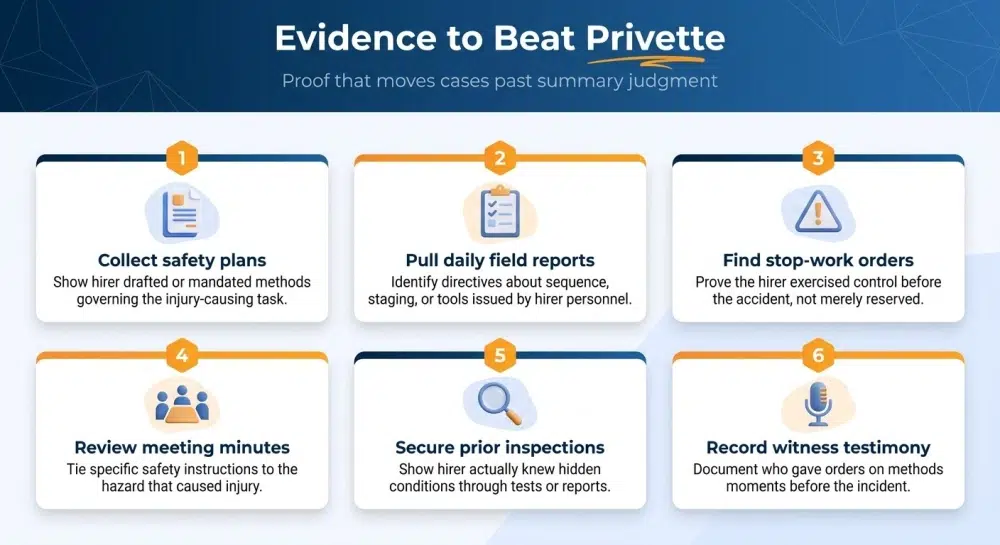
- Project-specific safety plans drafted or mandated by the hirer. If the hirer prepared or required a site safety plan that governed the specific task during which the worker was injured, this can indicate actual exercise of control over that task. The plan must address the manner of performance, not just general goals.
- Daily reports showing hirer directives to subcontractors. Field reports in which hirer personnel instruct subcontractor workers how to perform a task — how to stage materials, what sequence to follow, which tools to use — can demonstrate affirmative direction over work methods.
- Stop-work authority exercised before the accident. If hirer supervisors actually stopped work, required changes in procedure, or sent workers home for safety reasons in the period preceding the injury, that exercise of authority is strong evidence of retained control. By contrast, a contractual right to stop work that was never used tends to support the hirer’s position.
- Site meeting minutes documenting safety instructions. Minutes of toolbox talks, preconstruction meetings, or safety orientations in which hirer personnel gave specific safety directives to contractor employees can support the retained control theory — particularly where the directive relates to the hazard that caused the injury.
- Contracts that give the hirer authority over means and methods. Although the mere existence of a contractual right to control is not enough under Hooker, contract language is relevant context. Courts look at whether that authority was actually exercised.
- Hirer personnel physically present and directing the work at the time of injury. A hirer supervisor who was present on the job and giving specific direction to contractor employees at the time of the incident is the clearest form of affirmative contribution.
What does not establish retained control, standing alone: general oversight authority, periodic inspections for quality, contractual rights to terminate the contractor, or requiring compliance with industry standards or OSHA regulations. Courts have repeatedly rejected theories premised solely on those forms of involvement because they do not amount to directing the work itself.
Example (Hypothetical): A commercial property owner in Irvine hires a general contractor to renovate an office building near the I-405 corridor. The general contractor subcontracts the electrical work. A subcontractor employee is injured when working on an energized panel. If evidence shows that the property owner’s facilities manager attended daily site meetings, issued written directives to the electrical subcontractor specifying the sequence for energizing circuits, and signed off on the work plan that required work on live circuits without adequate lockout-tagout procedures, those facts could support a retained control claim. If, instead, the property owner simply required weekly progress reports and made no specific directives about electrical procedures, the Privette presumption would likely prevail.
The Concealed Hazard Exception: What Does Kinsman Require?
The second recognized exception involves a hazard that the hirer knows about but that the contractor cannot reasonably discover or protect against. The California Supreme Court in Kinsman v. Unocal Corp. imposed a duty on the hirer in those circumstances to warn the contractor and its employees of the danger. [4]
Three elements must be satisfied:
- The hirer knew of the hazard. Actual knowledge is required, not constructive knowledge or what the hirer should have known. Evidence of prior incidents, internal reports, inspection findings, or communications documenting the hazard is central to this element.
- The hazard was concealed — not obvious. A hazard that a reasonably careful contractor would discover during ordinary pre-work investigation or that is visible to the eye does not qualify. The danger must be of a type that is hidden from persons exercising ordinary diligence.
- The contractor could not reasonably discover or protect against it. This element is closely related to concealment. The plaintiff must show not just that the contractor did not discover the hazard, but that a reasonable contractor in that position would not have found it either.
The Kinsman case itself involved a chemical hazard at a refinery — asbestos-containing thermal insulation that workers could not reasonably identify as dangerous without specialized knowledge the hirer possessed and the contractor lacked. A construction site analogy might involve hidden underground utilities, undisclosed prior contamination of soil, or structural defects concealed behind finished surfaces that the hirer knew about from prior inspections but did not disclose.
Example (Hypothetical): A landowner in Newport Beach hires a contractor to perform foundation repairs. The landowner has inspection records showing a hidden subsurface void — a space left by a collapsed prior structure — directly beneath the planned excavation area. The landowner does not disclose this to the contractor. A worker is injured when the excavation collapses into the void. The landowner’s prior knowledge of the concealed subsurface defect, combined with the contractor’s inability to discover it through ordinary pre-work review of publicly available records, could satisfy the Kinsman elements.
It is important to distinguish concealed hazards from hazards that exist but are simply not investigated. A contractor who fails to perform reasonable site assessment carries some responsibility for what that assessment would have revealed. The Kinsman exception targets dangers that diligent investigation would not uncover — not merely dangers that the contractor happened to overlook.
How Sandoval v. Qualcomm Tightened the Retained Control Analysis
Sandoval v. Qualcomm Incorporated (2021) 12 Cal.5th 29 is the most recent California Supreme Court pronouncement on the retained control exception, and it made that exception harder to satisfy. [6]
The case arose from a serious electrical injury at Qualcomm’s facilities when a contractor employee performing testing on electrical equipment was severely burned by an arc flash. Qualcomm had retained authority over site safety and had issued general safety directives, but the Supreme Court held that those facts were insufficient to satisfy Hooker‘s affirmative contribution requirement.
The court drew a sharp distinction between two things a hirer might do:
- Passively permitting the contractor to proceed with dangerous work — even when the hirer knows the danger. This is not affirmative contribution under Sandoval.
- Actively directing or causing the dangerous condition through the exercise of control — this can satisfy the exception.
The practical effect is significant. A plaintiff cannot satisfy the retained control exception by proving only that the hirer knew of the hazard, was present on the job, had general safety authority, and failed to stop the unsafe work. The plaintiff must identify a specific act by which the hirer exercised its retained control in a way that caused or worsened the dangerous condition. The failure to act — even negligently — in the face of danger is generally not enough.
For workers injured on complex construction sites in Orange County or elsewhere in California, this distinction between active direction and passive permission is the fault line that often determines whether a claim against the hirer can survive summary judgment. For this reason, thorough evidence-gathering about exactly what hirer personnel said and did — not just what authority they held — is essential from the earliest stage of a case. Our team assisting with personal injury claims regularly evaluates this exact question during case assessment. You can learn more about how California courts distinguish control from non-delegable duties in construction cases.
How Does This Apply to a Real Injured Worker’s Situation?
Construction workers who are injured on California job sites often face a complex claims landscape. The workers’ compensation system provides medical coverage and wage replacement from the direct employer — the contractor or subcontractor — regardless of who was at fault. That claim proceeds independently of any civil lawsuit. [2]
The question of whether the injured worker can also bring a tort claim against the hirer — the general contractor, property owner, or other contracting party above the employer in the project hierarchy — is where the Privette doctrine becomes controlling. Because the workers’ compensation claim and the tort claim are separate proceedings, pursuing one does not foreclose the other.
In practice, the sequence typically looks like this:
- The injured worker files a workers’ compensation claim against the direct employer (the subcontractor).
- If facts suggest the hirer (general contractor or property owner) may have retained control or concealed a hazard, the worker’s attorney investigates whether a separate tort claim can be sustained against the hirer.
- The hirer’s defense almost always includes a Privette motion for summary judgment, requiring the plaintiff to produce admissible evidence satisfying one of the recognized exceptions.
- If the plaintiff survives summary judgment, the case proceeds to trial in Orange County Superior Court (for Orange County claims, cases are typically filed at the Central Justice Center in Santa Ana).
Timing matters. Evidence critical to the retained control exception — field reports, meeting minutes, safety directives, electronic communications — may be altered, lost, or overwritten if not preserved promptly. Construction projects generate enormous volumes of digital records, and many document management systems automatically purge data after project completion. Early action to send preservation letters and retain evidence is not optional; it is often the difference between having a viable case and having none.
Workers injured in construction accident scenarios throughout Orange County, as well as those in Fullerton, Santa Ana, and surrounding communities, face these same legal hurdles when the direct employer is not the only party whose conduct contributed to the injury. Construction accident lawyers who handle these cases know that the Privette presumption must be addressed directly before any other damages discussion is meaningful.
What Evidence Can Matter in a Privette Exception Case?
The evidence required to overcome the Privette presumption is specific to the exception being pursued. The following categories are commonly relevant:
For the Retained Control Exception
- Project safety plans and job hazard analyses — documents showing who prepared them, whether the hirer reviewed or revised them, and whether they governed the specific task involved in the injury.
- Daily field reports and inspection logs — entries from hirer supervisors or inspectors that include specific directives to contractor employees about work procedures.
- Stop-work notices and corrective action orders — evidence that the hirer exercised stop-work authority before the accident, demonstrating actual exercise of control rather than merely holding it in reserve.
- Site meeting minutes and toolbox talk records — contemporaneous documentation of what hirer personnel told contractor employees about how to perform particular tasks.
- Witness statements and deposition testimony — from contractor employees, hirer supervisors, and third-party witnesses present at the time of the incident, addressing who gave what directions.
- Project communications and emails — written instructions from hirer personnel to contractor personnel that bear on the manner of work performance rather than merely the end result.
- Contracts and subcontract agreements — relevant to understanding the scope of delegated authority, but not determinative standing alone.
For the Concealed Hazard Exception
- Prior inspection reports, testing results, or internal assessments — documents showing the hirer knew of the hazard before the contractor arrived on site.
- Communications between hirer personnel about the hazard — emails or memoranda acknowledging the dangerous condition.
- Prior incident records — evidence that the same hazard caused problems before the contractor engagement.
- Expert testimony — from a qualified professional explaining why the hazard was not discoverable through ordinary pre-work investigation by a contractor exercising reasonable care.
No category of evidence automatically establishes liability. Each piece must be evaluated in the context of the specific facts to determine whether it supports the affirmative contribution or concealment elements that the California Supreme Court requires.
What Damages or Remedies May Be Available?
If an injured contractor employee succeeds in a civil tort claim against the hirer under one of the Privette exceptions, the recoverable damages in California include:
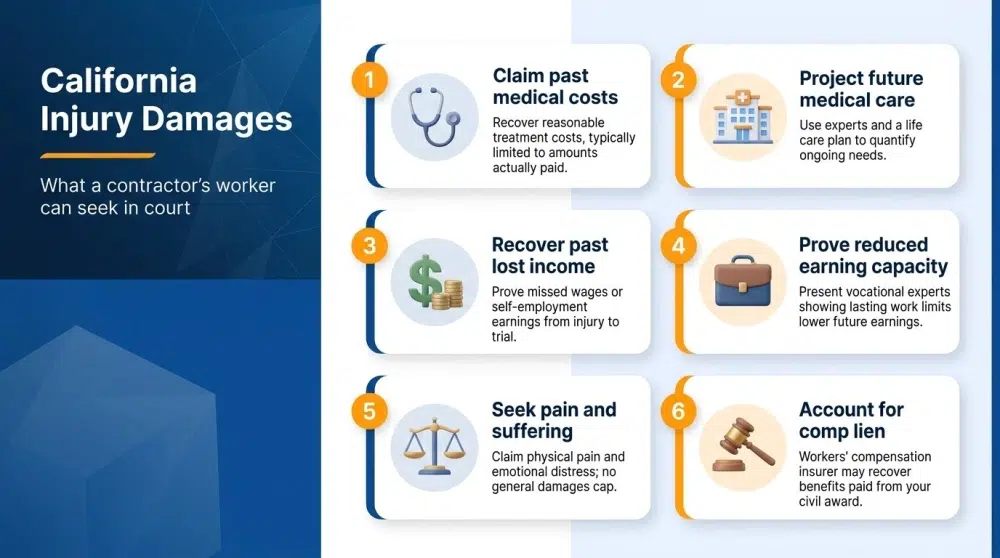
- Past medical expenses — the reasonable cost of medical treatment received from the time of injury through the date of trial. Under California’s Howell v. Hamilton Meats rule, the recoverable amount may be limited to amounts actually accepted by providers rather than billed. [7]
- Future medical expenses — anticipated costs of ongoing or future care, usually established through expert testimony and a life care plan.
- Past lost income — wages or self-employment income lost from the date of injury through trial.
- Future loss of earning capacity — impairment of the ability to earn future income, which may be established through vocational expert testimony when the injury causes permanent work limitations.
- Pain and suffering — non-economic damages for physical pain and emotional distress. California does not cap non-economic damages in general personal injury cases (medical malpractice has a separate statutory cap scheme not applicable here).
- Physical impairment and disfigurement — separately compensable categories under California law.
- Wrongful death damages — if the worker died from the injury, surviving family members may bring a wrongful death claim that includes loss of financial support, loss of companionship, and related losses.
There is an important offset to understand. California law allows workers’ compensation carriers who paid benefits to assert a lien against any civil recovery the worker obtains from third parties. The net amount actually received by the worker after satisfying the lien and paying attorney fees may be substantially different from the gross verdict or settlement amount. Workers injured in construction accident scenarios should understand this lien framework before evaluating settlement offers. Work injury lawyers familiar with California lien law — including hospital liens, insurance carrier liens, and Medi-Cal recovery claims — address this issue in every case. If the injury proves fatal, the family may have additional remedies through a wrongful death claim, which proceeds on a separate legal basis.
Recoverability of any category of damages depends on the applicable law, the facts of the specific case, and the evidence presented. No particular outcome can be guaranteed.

What If the Hirer Disputes Liability?
Hirers and their insurers virtually always dispute liability in Privette-based cases. The standard defense theory is straightforward: the contractor was responsible for its own employees’ safety, the hirer merely oversaw the project result, and no specific act by the hirer contributed to the injury. Defense counsel typically moves for summary judgment early, arguing that the plaintiff cannot produce evidence of affirmative contribution or concealment.
Defeating that motion requires concrete evidence, not general assertions. California courts have made clear that a plaintiff’s good-faith belief that the hirer was present and “in charge” is not sufficient. The plaintiff must point to admissible evidence showing what specific acts the hirer took that caused or contributed to the harm, or what specific knowledge the hirer possessed and withheld. Personal injury claim evaluation in these cases therefore begins with a detailed investigation of the project record rather than a general damages assessment.
Multiple parties are frequently named in these lawsuits — the property owner, the general contractor, and intermediate subcontractors who themselves hired the injured worker’s employer. Each defendant may assert the Privette defense. The plaintiff must separately analyze each party’s conduct against the exception requirements.
What If Insurance Is Involved?
Workers’ compensation insurance coverage is mandatory under California law for employers who have employees. California Labor Code § 3700 requires every employer to secure workers’ compensation. [2] When a contractor fails to carry required coverage, the state’s Uninsured Employers Benefits Trust Fund (UEBTF) may provide a limited remedy, and the hirer that engaged an uninsured contractor may face exposure under certain circumstances.
Commercial general liability insurance carried by the hirer, general contractor, or property owner may also be implicated in a civil tort claim. Contractors typically are required by contract to name the hirer as an additional insured. The coordination of these policies — including questions of primary versus excess coverage, additional insured status, and indemnity agreements — is often litigated separately from the underlying liability questions.
Workers injured on Orange County construction sites should be aware that the contractual indemnity provisions in construction contracts can sometimes create additional avenues of recovery or, alternatively, limit what the injured worker ultimately receives after all lien holders and indemnity obligations are resolved.
How Long Do I Have to Act?
California has specific deadlines that govern claims arising from construction site injuries. Missing a deadline can permanently bar a valid claim:
- Workers’ compensation claim — no absolute statute of limitations, but claims must generally be filed within one year of the date of injury or the date the worker knew or reasonably should have known that the injury was work-related. California Labor Code § 5405 governs this deadline. [2]
- Civil tort claim against the hirer — California Code of Civil Procedure § 335.1 provides a two-year statute of limitations for personal injury actions. The two-year period generally begins running from the date of the injury. [8]
- Wrongful death claim — also subject to a two-year limitations period under CCP § 335.1, beginning from the date of the worker’s death. [8]
- Claims against public entities — if the hirer is a California government agency or public entity (such as a state transportation project), the Government Claims Act requires filing a government claim within six months of the date of the incident before filing suit. CCP § 945.4. [9]
- Evidence preservation — this is not a legal deadline per se, but construction project records, electronic logs, and site conditions can change or be lost within days of an incident. Acting to preserve evidence should be treated as urgently as any filing deadline.
Deadlines in any specific case depend on the facts and applicable law. These time limits should be verified by an attorney familiar with California personal injury law. Do not rely on general information to calculate your deadline.
Frequently Asked Questions
Does the Privette doctrine apply if the hirer required the contractor to follow specific safety rules?
Not automatically. Requiring compliance with OSHA regulations or general industry safety standards, standing alone, does not constitute retained control under California law. Courts have repeatedly held that requiring a contractor to work safely is not the same as directing how the work is performed. The hirer must have exercised actual control over the specific manner of work, and that exercise must have affirmatively contributed to the injury, to satisfy the Hooker exception.
Can a general contractor be liable under Privette to an employee of its subcontractor?
Yes, the Privette doctrine applies up and down the contracting chain. A general contractor stands in the position of “hirer” relative to subcontractors and their employees, just as a property owner does relative to the general contractor. The same exceptions — retained control and concealed hazard — apply to the general contractor’s conduct. Each party’s liability must be analyzed separately based on that party’s specific acts and knowledge.
Does the workers’ compensation claim affect the tort lawsuit?
The two proceedings are separate, but they interact. Workers’ compensation provides the exclusive remedy against the direct employer under California Labor Code § 3602. A tort claim against the hirer — a third party — is permitted under California Labor Code § 3852 because the hirer is not the worker’s employer. However, the workers’ compensation carrier that paid benefits has a lien on any third-party civil recovery. The net amount the injured worker receives after the lien is satisfied may be significantly less than the gross recovery. This coordination must be factored into any settlement evaluation.
What if the hirer knew the contractor was doing dangerous work but said nothing — is that enough for liability?
Under Sandoval v. Qualcomm (2021), generally no. The California Supreme Court held that passively permitting a contractor to proceed with dangerous work, even when the hirer knows of the danger, does not satisfy the affirmative contribution requirement. The hirer must have actively exercised retained control in a way that made the situation more dangerous, not merely stood by while a hazard existed. This is one of the most significant limitations of the retained control exception as currently interpreted.
Can I sue a property owner in California if their property had a hidden defect that injured me while I was working there as a contractor?
Potentially yes, under the Kinsman concealed hazard exception. If the property owner knew of a hazard on the property — such as a hidden subsurface void, concealed structural defect, or undisclosed chemical contamination — that you and your employer could not reasonably discover through ordinary pre-work investigation, the owner may owe a duty to warn. The three elements of the exception (hirer knowledge, concealment, contractor’s inability to discover) must all be supported by evidence. The Central Justice Center in Santa Ana is where Orange County civil cases of this type are typically filed.
What is the difference between the hirer’s right to control work and the hirer’s actual exercise of control?
This distinction is central to the Privette retained control analysis. Nearly every construction contract gives the hirer the right to supervise, inspect, and require safe practices. That contractual right does not establish the exception. What matters under Hooker and Sandoval is whether the hirer actually exercised that right in a way that caused or contributed to the specific injury. A hirer that held stop-work authority but never used it, or that monitored progress without directing work methods, retains only the right to control — not actual control for purposes of the exception.
How soon should I speak with a lawyer after a construction site injury in California?
As soon as reasonably possible. Construction sites are active environments where conditions change rapidly, equipment is moved, and digital records may be overwritten. Physical evidence at the scene — the work area, tools, equipment, scaffolding, warning signs or lack thereof — is best documented immediately. The workers’ compensation claim should be filed promptly to preserve medical coverage. An attorney can also send evidence preservation letters to all parties before critical records are lost or destroyed. Orange County construction accident claims often turn on records that exist only in the early weeks after an injury. Waiting significantly increases the risk of losing evidence that could establish the Privette exceptions.

Talk With a GoSuits Attorney
Construction site injury claims involving the Privette doctrine require careful evaluation of project documents, contractual relationships, and the specific conduct of every party above the injured worker’s direct employer. The retained control and concealed hazard exceptions are fact-intensive — they cannot be assessed without reviewing the actual records from the job site, the contract structure, and what hirer personnel said and did before and during the incident.
If you or a family member was injured while working as a contractor or subcontractor employee in Orange County or elsewhere in California, understanding whether the Privette doctrine applies — and whether an exception may overcome it — is the first step in evaluating your options. GoSuits serves clients throughout California as part of a personal injury practice that also handles Irvine construction accident cases and related work injury claims.
Schedule a free consultation with a GoSuits personal injury attorney to discuss the facts of your situation.
This article is provided for general informational purposes only and does not constitute legal advice. Reading this article does not create an attorney-client relationship. The law applicable to your situation depends on the specific facts of your case and may differ from the general principles described here. Consult a licensed California attorney for advice regarding your individual circumstances. Legal authority cited in this article was reviewed as of June 2025; the law may have changed.
References and Resources
- Privette v. Superior Court (1993) 5 Cal.4th 689 — CourtListener / California Supreme Court
- California Labor Code § 3602 — Workers’ Compensation Exclusivity — California Legislative Information
- Hooker v. Department of Transportation (2002) 27 Cal.4th 198 — CourtListener / California Supreme Court
- Kinsman v. Unocal Corp. (2005) 37 Cal.4th 659 — CourtListener / California Supreme Court
- SeaBright Insurance Co. v. US Airways, Inc. (2011) 52 Cal.4th 590 — CourtListener / California Supreme Court
- Sandoval v. Qualcomm Incorporated (2021) 12 Cal.5th 29 — CourtListener / California Supreme Court
- California Labor Code § 3852 — Employee Third-Party Claims — California Legislative Information
- California Code of Civil Procedure § 335.1 — Two-Year Statute of Limitations for Personal Injury — California Legislative Information
- California Government Code § 945.4 — Government Claims Act — California Legislative Information
- California Courts — Official Website of the California Courts (courts.ca.gov)