Signing a California personal injury settlement release before you have finished treatment is almost always permanent. Under California Civil Code section 1542, a general release can extinguish not only the claims you know about at signing but also claims you do not yet know or suspect exist, provided the release includes an express waiver of section 1542. Once the check is cashed and the release is signed, going back to the other driver’s insurer for a second payment because a surgery became necessary or a disc injury worsened is almost never possible. The door closes at the moment of execution.
This article explains what maximum medical improvement (MMI) means, why the section 1542 waiver appears in virtually every California release form, which future medical costs claimants routinely leave on the table when they settle early, how a treating physician documents future care, the narrow grounds on which a release can ever be challenged, how property damage releases differ from bodily injury releases, and why the calendar pressure an adjuster creates is usually not a real legal deadline.
This article provides general legal information only. It does not constitute legal advice and does not create an attorney-client relationship. Every claim is different. If you were injured in an accident in the Irvine or Orange County area, speak with a personal injury lawyer before signing any release document.
Legal Snapshot
- Legal Topic: Premature Settlement of a Personal Injury Claim; Release of Claims; Civil Code Section 1542 Waiver
- Case Stage: Pre-litigation / Settlement negotiation
- Primary Legal Issue: Whether a signed release permanently bars recovery for future injury-related costs when the claimant has not reached maximum medical improvement
- Primary Authority: California Civil Code § 1542 (amended by Stats. 2018, Ch. 157, Sec. 2, effective January 1, 2019)
- Jurisdiction: California (article is specific to California law; references to Orange County / Irvine courts)
- Governing Court for Orange County Civil Cases: Orange County Superior Court; Central Justice Center, Santa Ana
- Date Legal Authority Last Reviewed: June 2025
What Is Maximum Medical Improvement, and Why Does It Matter Before You Settle?
Maximum medical improvement is the point at which a treating physician determines that a patient’s condition has stabilized and is unlikely to change significantly with further treatment. The term does not mean the patient is fully healed. It means that the physician has reached the limit of what additional active treatment can reasonably accomplish. Some patients at MMI still live with chronic pain, restricted movement, or a permanent functional deficit.
MMI matters in a personal injury claim because it is the moment at which the full scope of the injury becomes measurable. Before that point, the treating physician cannot accurately project whether future surgery will be needed, how many more injections are appropriate, whether a course of physical therapy will be required again in two or three years, or what assistive equipment or medications the patient will need long-term. A settlement reached before MMI is necessarily based on incomplete medical information.
Insurance adjusters are aware of this. Early settlement offers frequently arrive within days or weeks of a collision, when emergency care has been rendered but the injury trajectory is still unknown. Along the SR-73 Toll Road or in stop-and-go traffic on the I-405 through Irvine and Costa Mesa, rear-end collisions and intersection crashes regularly produce soft-tissue injuries and disc problems that do not fully declare themselves for weeks or months. Settling in that early window can mean releasing claims for costs that will come due years later.
Reaching MMI before settling is not a legal requirement, but it is the practical standard that allows a claimant to understand what is being given up in exchange for the settlement payment. Injured people who are also patients sometimes feel strong pressure to resolve the financial aspect of a claim while still coping with treatment and recovery. That pressure is understandable, but the legal reality is that the release signed today closes the file on costs that do not exist yet but may be coming.
What Does California Civil Code Section 1542 Say, and Why Is the Waiver in Almost Every Release?
The Statute
California Civil Code section 1542, as amended effective January 1, 2019, provides:
“A general release does not extend to claims that the creditor or releasing party does not know or suspect to exist in his or her favor at the time of executing the release and that, if known by him or her, would have materially affected his or her settlement with the debtor or released party.”
The statute was enacted to protect people from accidentally giving up claims they did not know they had. Without section 1542, a broadly worded general release signed to settle, for example, a property damage claim or a soft-tissue injury could potentially be read to wipe out an unrelated and unknown claim that arose from the same event. Section 1542 prevents that result by default: a general release does not reach unknown claims unless the releasing party expressly waives the statute’s protection.[1]
The Waiver Language
Because the statute can be waived, insurers routinely include a specific section 1542 waiver in their settlement release forms. The waiver paragraph typically states something along these lines: the releasing party expressly waives and relinquishes any and all rights and benefits under California Civil Code section 1542, or any comparable provision of any other law, and acknowledges that this release applies to all claims arising from the incident, whether known or unknown, suspected or unsuspected, fixed or contingent, at the time of signing.
The practical effect of that waiver is significant. If you sign a release containing it, and you later develop a condition traceable to the same accident, such as a delayed spinal disc herniation that becomes evident on an MRI six months after settlement, section 1542 no longer protects you. The release you signed reaches that unknown claim because you expressly surrendered the statute’s protection at the moment you executed the document.
California courts enforce section 1542 waivers when they are clear and explicit and when there is a sufficient indication that the releasing party was aware of the risks of the unknown. The California Supreme Court recognized the enforceability of such waivers in the context of settlements negotiated with the assistance of counsel, and appellate decisions have continued to uphold them.[2]
Why the Waiver Appears in Nearly Every Release
Insurers use section 1542 waivers as a standard drafting practice because their goal is finality. A release without a section 1542 waiver could later be argued to leave unknown claims open, which creates uncertainty in their reserves and exposure. By requiring the waiver, the insurer obtains the broadest possible closure of the claim at the time of settlement.
This does not mean the waiver is automatically improper. In a case where the injury is well-understood, the claimant has reached MMI, medical bills and future care costs have been documented, and the settlement value fairly reflects all of that, a section 1542 waiver may be acceptable. The problem arises when a claimant signs a release with a 1542 waiver before knowing whether future surgery will be needed or what the long-term care picture looks like. At that point, the unknown claim being waived may be the most expensive part of the case.
Personal injury lawyers who handle claims for injured people in Irvine, Newport Beach, Santa Ana, and the surrounding Orange County communities routinely review the specific release language presented by the opposing insurer and assess whether a section 1542 waiver is appropriate given the current state of the client’s medical situation.
Which Future Medical Costs Are Routinely Missed When a Case Settles Too Early?
The following categories of future care are among the most commonly overlooked when a claim settles before MMI or before a complete medical picture emerges.
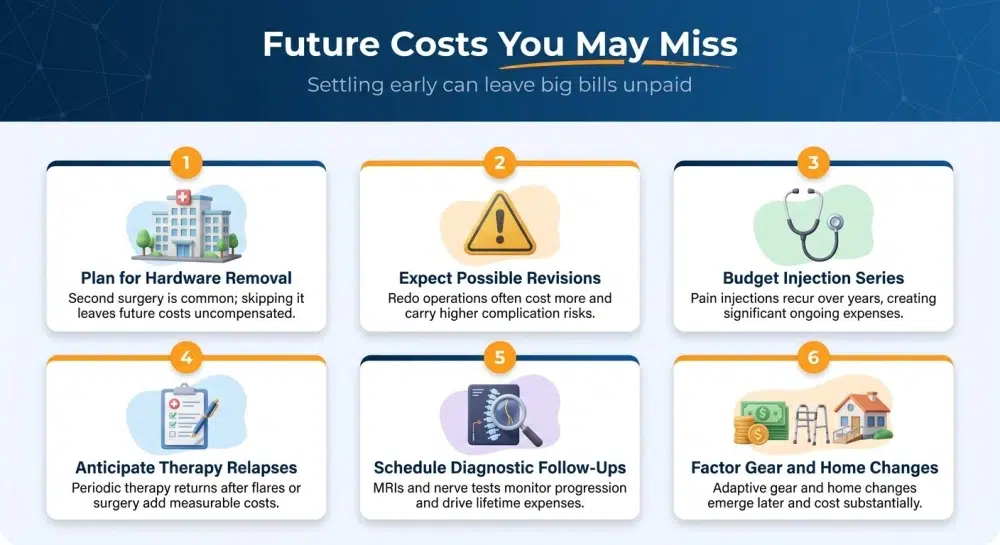
Hardware Removal Surgery
When an injured person undergoes orthopedic surgery involving plates, screws, rods, or other internal fixation hardware, a second surgical procedure to remove that hardware is often necessary. Hardware may cause ongoing pain, irritation, or infection, or may need to be removed as part of a planned staged repair. The need for hardware removal is sometimes known at the time of the initial surgery; other times it becomes apparent only after healing has progressed. A settlement reached while the primary surgery is still recent and the hardware’s long-term tolerance is unknown can miss the cost of a second procedure entirely.
Revision Surgery
Spinal surgeries, joint replacements, and other significant orthopedic interventions sometimes fail to achieve the intended result, or a condition deteriorates after an initial successful procedure. Revision surgery, meaning a second or subsequent operation to correct or redo the first, is often more complex and more expensive than the original procedure. Because revision is not certain at the time of initial surgical repair, its possibility is easy to overlook when settling early. Yet the risk of revision may be a documented and statistically significant probability that a life care planner or treating surgeon can quantify.
Injection Series
Epidural steroid injections, nerve block injections, and similar interventional pain management procedures are often administered in series rather than as a single treatment. A patient may require three injections initially, then additional series every one to two years as a pain management strategy, rather than advancing to surgery. If a settlement is reached after the first injection series but before the pattern of recurrent treatment is established, the claimant may be releasing the claim for the subsequent series, which can continue for many years and generate significant cost.
Physical Therapy Relapse and Ongoing Rehabilitation
A completed course of physical therapy does not necessarily mean the therapy need is permanently resolved. Many spinal and orthopedic injuries require periodic return to physical therapy when symptoms flare, when a patient undergoes surgery and needs post-surgical rehabilitation, or when functional decline sets in over time. A claimant who has completed an initial therapy course but has not reached long-term stability may have a foreseeable need for additional therapy cycles that an early settlement does not account for.
Diagnostic Follow-Up
Ongoing imaging studies, including MRIs, CT scans, and electromyography, are sometimes necessary to monitor injury progression, evaluate the success of a surgical repair, or assess a condition that was initially treated conservatively. The cost of periodic diagnostic follow-up over a lifetime can be substantial, particularly for traumatic brain injury, spinal cord injuries, and serious orthopedic fractures. When a claim settles before this diagnostic trajectory is established, those future costs are given up without compensation.
Prescription Medications
Chronic pain conditions and neurological injuries resulting from a collision may require long-term prescription medication management. A settlement reached while a medication regimen is still being adjusted or has not yet been established does not account for the projected cost of those medications over the claimant’s expected life.
Adaptive Equipment and Home Modification
For serious injuries, the future care picture may include durable medical equipment, mobility aids, home modifications, or attendant care. These costs are often not immediately apparent in the acute phase of recovery but emerge as the injury’s long-term functional impact becomes clearer.
How Does a Treating Physician Document a Future Care Opinion?
A treating physician’s opinion about future medical needs is one of the most important components of a personal injury claim’s value. Without documented future care projections, a claimant may have difficulty demonstrating to an insurer or a jury what future treatment will cost and why.
A future care opinion is typically documented through a narrative medical report in which the treating physician addresses the following:
- Current diagnosis and condition status: Whether the patient has reached MMI and what the residual condition is at that point.
- Prognosis: Whether the condition is expected to remain stable, to worsen, or to require intervention.
- Specific recommended future treatment: Itemized identification of anticipated treatments, whether surgery, injections, therapy, or medications, with an explanation of the medical basis for each recommendation.
- Frequency and duration: How often each treatment will be needed and for how long, whether a single future procedure or periodic recurrence over years.
- Causal connection: A statement that the anticipated future care is causally related to the injuries sustained in the accident.
In serious injury cases, personal injury attorneys often engage a life care planner, typically a registered nurse or physician who collaborates with the treating team to produce a comprehensive life care plan. A life care plan itemizes every category of anticipated future care over the injured person’s expected lifetime, assigns current costs to each item, and provides the data necessary to quantify the future damages claim with a degree of precision that a narrative medical report alone may not achieve.
Settling before any of this documentation exists means that the settlement is not based on a full assessment of future care needs. The insurer’s early offer is based on its own estimate of what care might be needed, not on an independent medical opinion tailored to the specific patient’s condition.
For claimants in Orange County whose cases are ultimately filed in the Orange County Superior Court at the Central Justice Center in Santa Ana, the future care opinion will be a critical piece of evidence if the case goes to trial. Building that documentation takes time and requires the patient to continue treatment long enough for the trajectory to become clear.
Can a Signed Release Ever Be Set Aside? The Narrow and Rarely Successful Grounds
California courts treat signed releases as binding contracts and are generally reluctant to undo them. The policy in favor of finality of settlements reflects both the value of certainty to parties who have resolved their dispute and the broader interest in encouraging out-of-court resolution of civil claims.
The recognized grounds for challenging a signed release are narrow and require significant proof:
Fraud or Misrepresentation
If a party to the release made a materially false statement of fact that induced the other party to sign, the release may be voidable. For example, if an adjuster represented that the only available coverage was a specific policy limit that was later shown to be false, and the claimant signed a release in reliance on that representation, a fraud claim might be asserted. The burden of proving fraud is high: the misrepresentation must be of fact, not merely opinion; it must be material; it must be actually and reasonably relied upon; and it must have caused the harm.[3]
Duress or Undue Influence
If the circumstances under which the release was signed involved unlawful pressure or exploitation of a vulnerability, the release may be voidable on grounds of duress or undue influence. Ordinary financial pressure, urgency, or eagerness to receive payment does not constitute duress. The pressure must be wrongful and must overcome the free will of the signing party. Cases in which this ground succeeds are uncommon in the insurance settlement context.
Mutual Mistake
If both parties shared a material mistaken belief about a fact at the time of signing, the release may be subject to reformation or rescission. In the personal injury context, the challenge is that the entire premise of a section 1542 waiver is that the parties are agreeing to release even unknown claims. Courts have been skeptical of mutual mistake arguments in releases that contain clear section 1542 waivers, because the waiver reflects a deliberate decision to address the unknown.
Lack of Mental Capacity
A release signed by someone who lacked the mental capacity to understand the nature and effect of the document, due to injury, medication, or cognitive impairment at the time of signing, may be challengeable. This ground requires medical evidence of the incapacity at the specific moment of execution.
Failure of Consideration
If the promised payment was never made, the release would lack consideration and would be unenforceable. In practice, this is rare because payments are typically made in exchange for the release.
The Practical Reality
Most challenges to signed personal injury releases fail. The courts in California have repeatedly enforced releases containing section 1542 waivers, including in cases where the released party later discovered that the injuries were more serious than believed at the time of signing. The clearest lesson from this body of law is that the opportunity to protect against an unknown injury claim exists before signing, not after.[2]
How Are Property Damage Releases Different From Bodily Injury Releases?
Property damage and bodily injury are legally distinct components of a personal injury claim, and they can and often should be resolved at different times.
A property damage release, when correctly drafted, resolves only the vehicle repair or total loss component of the claim. It does not affect the bodily injury claim, which remains open. A properly limited property damage release should contain language specifying that it is limited to property damage and expressly preserving all bodily injury claims arising from the same incident.
The danger arises when a property damage release is drafted with overbroad language that purports to release “all claims” or “any and all claims of every nature” arising from the accident without clearly carving out bodily injury. If a claimant signs such a document and later seeks to pursue a bodily injury claim, the opposing party may argue that the general release language encompassed the injury claim as well.
Some insurers send settlement checks for vehicle damage with release language either printed on the check itself or on an accompanying document. Endorsing such a check may, in some circumstances, constitute acceptance of the release terms stated on the document. Anyone who receives a check for vehicle damage with accompanying release language should read that language carefully before depositing the check.
The practical approach for most claimants is to resolve the property damage claim promptly so that the vehicle can be repaired or a replacement obtained, while keeping the bodily injury claim open pending completion of treatment. That approach requires a properly scoped property-damage-only release, not a general release that sweeps in the injury claim.
Why the Calendar Pressure an Adjuster Creates Is Usually Not a Real Legal Deadline
Insurance adjusters sometimes communicate settlement offers with accompanying deadlines: “This offer expires in ten days,” or “We need an answer by Friday or we will close the file.” These statements create a sense of urgency that can push injured people to sign releases before they are ready.
With limited exceptions, those adjuster-imposed deadlines are not mandated by law. An adjuster’s “offer expiration” is typically a negotiating tool, not a legal cut-off date. An insurer that communicates a good-faith offer today and then withdraws it arbitrarily the following week still has obligations under California’s fair claims settlement regulations, found in Title 10 of the California Code of Regulations, sections 2695.1 through 2695.15, which govern insurer claims handling practices.[4]
The real legal deadline in a California personal injury claim is the statute of limitations, not the insurer’s offer expiration date. Under California Code of Civil Procedure section 335.1, most personal injury actions must be filed within two years of the date of injury.[5] If a government entity is involved, the Government Claims Act (Government Code sections 810 et seq.) requires a pre-suit claim to be filed within six months of the incident before a lawsuit can proceed.[6]
Here’s the thing about two years. It’s genuinely plenty of time for your treatment to work its way toward MMI, and for the long-term picture to come into focus. If an adjuster is hammering you about some made-up deadline, keep in mind that saying yes to a settlement months before the actual statute runs is pretty much always your call, not something the law is forcing. And the cost of being patient, of waiting until things have stabilized and you can see the future care clearly, that cost almost always shows up as a better settlement decision. Not a dead claim.
One thing you really can’t afford to do? Let the clock tick down while nobody’s watching the statute of limitations. If settlement talks are crawling toward the two-year mark without a resolution, filing a lawsuit just to preserve your claim becomes a very live option. Personal injury lawyers who represent people in Irvine and across Orange County are basically obsessive about calendaring those deadlines, and they’ll tell you straight whether it’s time to file suit to protect your rights while settlement discussions keep moving.
If you are dealing with an insurer’s settlement pressure and you have not yet reached MMI, speaking with personal injury lawyers early in the process can clarify what your options actually are and remove the artificial urgency that adjusters sometimes create.
What Evidence Matters in Documenting a Full Injury Claim Before Settlement?
Resolving a claim at full value requires documentation that covers both what has already happened and what is expected to occur in the future. The following categories of evidence are typically gathered before a well-informed settlement decision can be made:
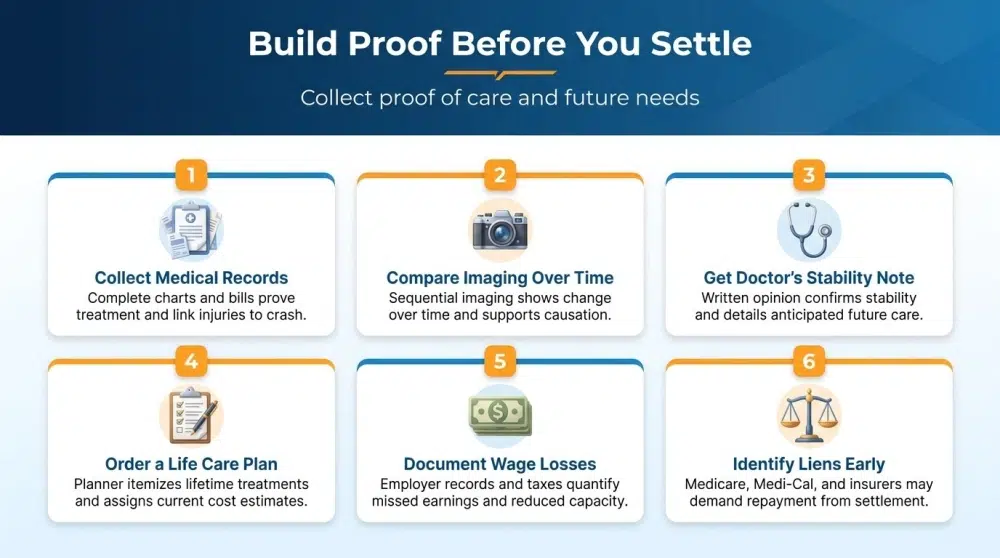
- Medical records and bills to date: All records from emergency care, follow-up appointments, specialist consultations, physical therapy, and surgical procedures.
- Diagnostic imaging: X-rays, MRI studies, CT scans, and any other imaging that shows the injury and its progression. Baseline imaging and follow-up imaging together can demonstrate whether the condition has stabilized or is continuing to evolve.
- Treating physician opinion on MMI and prognosis: A written medical opinion addressing whether MMI has been reached, what the residual condition is, and what future care is recommended.
- Life care plan: In serious injury cases, a life care plan developed by a qualified planner in collaboration with the treating team, projecting all anticipated future care over the injured person’s expected lifetime.
- Lost wage documentation: Employer records, tax returns, and pay stubs documenting income lost during the recovery period, as well as a vocational evaluation if future earning capacity has been affected.
- Police report and accident reconstruction materials: Documentation of the accident scene, including photographs, the crash report, and where appropriate a reconstruction analysis, to establish liability clearly before settlement.
- Lien and subrogation information: Identification of any health insurance subrogation claims, Medicare or Medi-Cal reimbursement obligations, and workers’ compensation liens that must be accounted for in the settlement so the claimant understands the net recovery.
Settling before this documentation is assembled means releasing the claim without knowing whether the settlement value is adequate to cover all past and future costs.
What Damages May Be Available in a California Personal Injury Claim?
California law permits recovery of both economic and non-economic damages in a personal injury claim. Whether any specific category of damages is available and what amounts are appropriate depend on the facts, the evidence, and the applicable law in each case.
- Past medical expenses: The reasonable cost of all medical treatment already received for injuries caused by the accident.
- Future medical expenses: The projected cost of all medical treatment reasonably expected to be needed in the future, supported by physician opinion and a life care plan where appropriate.
- Lost income: Earnings lost because the injured person was unable to work during recovery.
- Loss of earning capacity: Reduction in the ability to earn income in the future if the injury has permanently impaired work capacity.
- Physical pain and suffering: Compensation for the physical discomfort caused by the injury and its treatment, including future pain.
- Mental anguish: Compensation for anxiety, depression, fear, grief, and other emotional consequences of the injury.
- Physical impairment: Compensation for the loss of the ability to do activities that the injured person was able to do before the accident.
- Disfigurement: Compensation for permanent scarring or changes in appearance resulting from the injury or its treatment.
- Property damage: Repair or replacement cost for the vehicle and personal property damaged in the crash.
- Punitive damages: Available in California under Civil Code sections 3294 et seq. in cases involving malice, oppression, or fraud, such as certain drunk-driving situations involving conscious disregard for others’ safety. Punitive damages are not available in every case and require clear and convincing evidence.
A settlement that resolves all of these categories simultaneously, including future damages that have not yet been quantified, is the most significant risk of settling before MMI. Each category released is permanently closed.
How Long Do I Have to File a Claim or a Lawsuit in California?
California Code of Civil Procedure section 335.1 provides a two-year statute of limitations for most personal injury claims. The period generally begins to run on the date of the accident.[5]
Important exceptions and variations include:
- Government entity involvement: If the claim is against a city, county, state agency, or other public entity, the California Government Claims Act requires a written claim to be filed with the entity within six months of the incident. Failure to file a timely government claim typically bars the lawsuit.[6] For incidents on SR-55, SR-133, or SR-73 in Orange County involving Caltrans or another public entity, this shorter deadline applies.
- Minors: The statute of limitations for a minor’s personal injury claim is generally tolled until the minor turns 18, with the two-year period then running from that date. Court approval is generally required for minor’s settlements.[7]
- Discovery rule: In some cases involving delayed discovery of an injury, the limitations period may not begin to run until the claimant knows or reasonably should know of the injury and its cause. This exception is narrow and fact-specific.
The statute of limitations is the real one. Everything else an adjuster throws at you about expiring offers or closing files, that’s negotiation theater. But if you don’t get a lawsuit on file before the actual limitations period runs out, your claim can be dead. Game over. Talking to a personal injury attorney well before that date gives you breathing room to really look at your case, finish your treatment, and make a settlement call from a place of actual information instead of panic.

What Should I Do If an Insurer Is Asking Me to Sign a Release Before I Have Finished Treatment?
- Do not sign without reading. Read every release document, including the section 1542 waiver language, before putting your signature on it. If language is unclear, do not sign until it has been reviewed.
- Consult your treating physician. Ask your doctor whether you have reached MMI and whether there are anticipated future treatment needs. Get that opinion in writing before making any settlement decision.
- Request a property-damage-only release separately. If you want to resolve the vehicle damage while keeping the bodily injury claim open, ask the insurer in writing for a release limited specifically to property damage that expressly preserves all bodily injury claims.
- Do not cash checks with release language. Before depositing any check the insurer sends, confirm what release language, if any, appears on the check or in any accompanying documents. Cashing a check that includes release terms can constitute acceptance of those terms.
- Document the adjuster’s pressure. Keep records of any communications in which the adjuster imposes artificial deadlines or creates urgency. Those communications can be relevant context if the insurer’s conduct becomes an issue.
- Track the actual statute of limitations. Know the two-year deadline from the date of your accident and, if a government entity may be involved, the six-month government claim deadline. Do not let the real deadline slip while focused on the insurer’s artificial ones.
- Speak with a personal injury attorney. An attorney can review the proposed release, assess whether the settlement offer reflects the full value of the claim, advise on timing in relation to MMI and future care documentation, and negotiate modifications to release language if appropriate.
Here’s the thing. An injury claim with ongoing treatment, real medical costs, and a release that includes a section 1542 waiver is permanent. Once it’s signed, it’s done. If you were injured in the Irvine area, anywhere along the I-405, out on the SR-73 Toll Road, or in communities like Newport Beach, Costa Mesa, Anaheim, or Santa Ana, a GoSuits personal injury attorney can look at where you are, review the paperwork, and explain your options before you sign a thing. Schedule a free consultation to get started.
Related California Personal Injury Resources
Injured people in Irvine and across Orange County often have questions that go beyond the settlement release itself. The following GoSuits knowledge-base articles address related topics:
- Should you sign an insurance release after a car accident – A broader guide to the types of release documents insurers send after a crash, what each form does, and what red flags to look for before signing anything.
Talk With a GoSuits Attorney
A California personal injury claim that involves ongoing treatment, a section 1542 waiver, and pressure from an insurance adjuster to settle quickly has real stakes. The decision to sign a release before reaching maximum medical improvement, or before future care has been documented, can permanently close off the ability to recover costs that will come due in the future.
Were you hurt in a crash? Irvine, Newport Beach, out on the I-405, along the SR-73 Toll Road, anywhere in Orange County, really, our Irvine personal injury lawyers can take a look. They’ll review whatever release documents you’ve been asked to sign, give you an honest read on whether the offer reflects everything you’re dealing with now and what’s likely still coming, and advise you on the timing, specifically your MMI status and where you are on the statute of limitations.
GoSuits serves injured people across California, Texas, and Illinois. We handle car accident claims, truck accident claims, serious injury cases, and wrongful death claims on a contingency basis. Car accident lawyers in Irvine and across Orange County are available to speak with you about your situation at no cost to you unless your case resolves favorably.
Schedule a free consultation with our Irvine personal injury team today. There is no fee to speak with us, and no fee at all unless we recover for you.
You can also learn more about our prior cases and results, read about our attorneys, and explore our firm’s approach to representing injured people across California. Our practice areas include the full range of personal injury matters.
References and Legal Authorities
- California Civil Code Section 1542 (Unknown Claims) – California Legislature Official Text
- California Civil Code Section 1541 (Obligation Extinguished by Release) – California Legislature
- Fraud – Legal Information Institute, Cornell Law School
- California Department of Insurance – Fair Claims Settlement Practices Regulations (Title 10, CCR §§ 2695.1–2695.15)
- California Code of Civil Procedure Section 335.1 (Two-Year Personal Injury Statute of Limitations) – California Legislature
- California Government Code Section 911.2 (Six-Month Government Claims Deadline) – California Legislature
- California Code of Civil Procedure Section 372 (Guardian Ad Litem; Minor’s Claims) – California Legislature
- California Civil Code Section 3294 (Punitive Damages: Malice, Oppression, or Fraud) – California Legislature
- California Courts – Judicial Branch of California (Official Court System Information)
- Statute of Limitations – Legal Information Institute, Cornell Law School
- California Code of Civil Procedure – Full Code, California Legislature
- California Civil Code – Full Code, California Legislature