California Dog Bite Law: Is the Owner Automatically Liable?
Yes, in most situations. California Civil Code section 3342 makes a dog owner strictly liable for damages any time the dog bites a person who is in a public place or who is lawfully on private property, including the owner’s own property, at the time of the bite.[1] The statute removes the old “one-bite rule” that existed at common law: an owner does not need advance knowledge that the dog was dangerous, and the dog does not need a prior biting history. If the bite happened, the owner is liable. That said, section 3342 is not unlimited. It covers bites only, not other types of dog-caused injuries. And certain defendants, including non-owner handlers and landlords, fall outside the statute altogether, where ordinary negligence principles apply instead.
Legal Snapshot
- Legal Topic: Dog Bite Liability — California Strict Liability and Negligence
- Case Stage: Pre-litigation / Claim Investigation / Civil Complaint
- Primary Legal Issue: Owner liability for dog bites and other dog-caused injuries
- Primary Authority: California Civil Code § 3342 (strict liability); Cal. Food & Agricultural Code §§ 31602, 31604 (dangerous and vicious dog designations); Cal. Code of Civil Procedure § 335.1 (statute of limitations)
- Jurisdiction: State of California
- Date Legal Authority Last Reviewed: July 2025
What Does Strict Liability Mean in a Dog Bite Case?
Strict liability is a legal standard that holds a party responsible for harm without requiring proof that the party acted carelessly. In most personal injury cases, the injured person must show that the defendant failed to use reasonable care. Strict liability removes that requirement: the injured person establishes liability simply by proving that (1) the defendant owned the dog, (2) the dog bit the person, and (3) the person was in a public place or was lawfully present on private property when the bite occurred.[2]
Before California enacted Civil Code section 3342, California followed the common-law “one-bite rule,” which generally allowed a dog owner to escape liability for a first bite if the owner had no reason to know the dog was dangerous. The statute eliminated that defense entirely for owners in covered situations.
The practical impact for bite victims is significant. There is no need to dig up the dog’s history, find prior incident reports, or prove the owner knew about a dangerous propensity. The bite itself, occurring in a covered context, is enough to trigger the owner’s liability. The Irvine personal injury lawyers at GoSuits handle this type of claim regularly, including bites that happen on trails around the Irvine Spectrum, in neighborhood parks, and in residential communities throughout Orange County.
What Does California Civil Code Section 3342 Say?
The statute reads, in subdivision (a): “The owner of any dog is liable for the damages suffered by any person who is bitten by the dog while in a public place or lawfully in a private place, including the property of the owner of the dog, regardless of the former viciousness of the dog or the owner’s knowledge of such viciousness.”[1]
The statute further specifies that a person is lawfully on private property when present to perform a duty imposed by state or federal law or postal regulations, or when present at the express or implied invitation of the owner. That language brings postal carriers, delivery workers, meter readers, and social guests within the statute’s protections.
Section 3342 does not apply to every situation. Subdivision (b) expressly provides that the statute does not authorize a claim against a governmental agency using a dog in military or police work when the bite occurred while the dog was defending itself from an annoying, harassing, or provoking act, or while assisting an employee in the apprehension of a suspect, the investigation of a crime, the execution of a warrant, or the defense of a peace officer or another person. Subdivision (c) limits that exception: it does not apply when the bite victim was not a party to, a participant in, or suspected of being involved in the act that prompted the use of the police or military dog. Subdivision (d) further requires that the governmental agency must have adopted a written policy on the appropriate use of dogs before the exception applies.[1]
In plain terms, an ordinary civilian bitten by a police dog while simply passing by does not lose the right to a civil claim simply because the dog was on duty. Whether the police-dog exception applies depends on the specific facts of the encounter.
How Does Trespass Status Affect a Claim?
Section 3342 extends liability only to persons who are lawfully on private property. A trespasser, defined as someone who entered without permission or legal authority, does not have a claim under the statute.[1]
That does not mean a trespasser can never recover anything. California courts have addressed whether a property owner owes any duty to trespassers under negligence principles, and the analysis depends on the circumstances, including the owner’s knowledge that trespassers were likely in the area. However, those claims are harder to bring than a strict liability bite claim, and the outcome is far less predictable. An injured trespasser should consult an attorney to understand what theories, if any, remain available under the specific facts.
Where Section 3342 Stops and Ordinary Negligence Takes Over
Civil Code section 3342 covers bites. When a dog causes injury in some other way, the strict liability statute does not apply directly, and the injured person must instead rely on ordinary negligence law or a related theory. Several common situations fall outside the bite statute.
Injuries That Are Not Bites
If a large dog jumps on a person and knocks that person to the ground, causing a broken wrist or a head injury, the owner is not automatically liable under section 3342 because there was no bite. The injured person must prove that the owner failed to exercise reasonable care in controlling the dog. California courts have recognized negligence claims for such incidents, but the burden is on the plaintiff to demonstrate that the owner acted unreasonably under the circumstances.
A woman is walking near a trailhead in Newport Beach when a large, off-leash dog charges from a neighboring yard and knocks her down, fracturing her shoulder. The dog never bites. Because section 3342 does not cover non-bite injuries, her claim against the owner must be brought under negligence. She would need to show that the owner failed to restrain a dog known to jump aggressively on strangers. Whether a leash ordinance violation supports a negligence per se theory is a separate issue addressed below.
Non-Owner Handlers
Section 3342 imposes liability on the “owner” of the dog. A person who is merely handling, walking, or caring for someone else’s dog at the time of a bite is not the owner and does not carry the strict liability imposed by the statute. The handler’s potential liability flows from negligence: whether the handler exercised reasonable care in controlling a dog that the handler knew or should have known posed a risk of biting. An injured plaintiff pursuing a handler who is not the owner must establish that negligence, rather than relying on the no-prior-bite rule of section 3342.
Landlord Liability
A landlord who owns the property where a tenant keeps a dog is not typically treated as the dog’s “owner” under section 3342. A landlord’s potential liability is rooted in negligence, specifically whether the landlord had actual knowledge that a tenant’s dog was dangerous and the legal authority to require removal or restriction of the animal, yet failed to act.[3]
California courts have recognized that a landlord who knew about a tenant’s dangerous dog and did nothing can be held liable in negligence for a bite that occurs on the premises. The critical phrase is “actual knowledge”: a landlord who never saw the dog or received no complaints about it does not face the same liability risk as one who was told the dog had previously attacked a neighbor. Victims who are bitten on rental property should document any prior complaints to the landlord or property management company, because that communication is often central to whether the landlord faces liability at all. The legal framework for what constitutes actual versus constructive notice in a premises context is examined more closely in our knowledge-base article on constructive vs. actual notice in premises liability.
Leash Law Violations as Negligence Per Se
California Health and Safety Code section 121695 confirms that local governments retain authority to enact stricter animal control rules than the state minimum.[4] Orange County and individual cities such as Irvine, Costa Mesa, and Santa Ana have enacted leash ordinances requiring dogs to be kept on a leash of a specified maximum length in public areas. When a dog owner violates a leash ordinance and that violation causes an injury, the doctrine of negligence per se may allow a court to treat the ordinance violation itself as evidence of negligence, removing the need for the plaintiff to separately prove the owner’s conduct was unreasonable. Negligence per se does not automatically establish that the violation caused the injury: causation between the unleashed condition and the harm suffered must still be shown.
Potentially Dangerous and Vicious Dog Designations Under California Law
Beyond the civil bite statute, California’s Food and Agricultural Code establishes an administrative process for formally designating dogs that pose an ongoing threat to public safety. These designations are relevant to civil claims because they create a documented record of a dog’s dangerous history.
California Food and Agricultural Code section 31602 defines a “potentially dangerous dog” as one that, when unprovoked, on two separate occasions within the prior 36-month period, engages in behavior requiring a person to take defensive action to prevent injury; bites a person causing less than a severe injury; or, on two separate occasions within 36 months, has killed, seriously bitten, or otherwise injured another domestic animal when off the owner’s property.[5]
Food and Agricultural Code section 31604 defines a “severe injury” as any physical injury resulting in muscle tears, disfiguring lacerations, or that requires multiple sutures or corrective or cosmetic surgery.[6] A dog that inflicts a severe injury on a person crosses the threshold into the “vicious dog” category under section 31603, which carries more serious consequences including the potential for court-ordered confinement, removal from a jurisdiction, or, in appropriate circumstances, destruction of the animal.
A prior dangerous or vicious dog designation can be highly significant in a civil lawsuit. If a dog owner continued to keep a dog that had already been designated potentially dangerous without taking required precautions, and that dog then bites someone, the designation provides concrete evidence of the owner’s awareness of the risk. While section 3342 does not require knowledge of prior dangerousness, that knowledge becomes highly relevant when assessing whether the owner was negligent in addition to strictly liable, and it may support claims for additional categories of damages.
Reporting, Quarantine, and Orange County Animal Care
When a dog bite occurs in Orange County, the bite is typically required to be reported to Orange County Animal Care, which is the county agency responsible for animal control services across unincorporated Orange County and many cities that contract with the county for these services. Individual cities, including Irvine, maintain their own animal control programs in some cases, and reporting requirements may vary by jurisdiction.
After a bite is reported, California law generally requires the dog to be quarantined for ten days from the date of the bite to monitor for signs of rabies. The quarantine may occur at the owner’s home under certain conditions, at a licensed veterinary facility, or at an animal care shelter, depending on the vaccination status of the dog and local agency requirements.[7]
From a civil claim standpoint, the bite report filed with animal control is a document that can be obtained through a public records request and used in litigation. It typically captures identifying information about the dog and owner, a description of the incident, and any prior history on file for that animal. Requesting that report early is one of the most straightforward steps a bite victim can take to preserve evidence.
Which Insurance Policy Usually Responds to a Dog Bite Claim?
For most residential dog bite claims in California, the policy that initially responds is the dog owner’s homeowner’s insurance or renter’s insurance policy. Most standard homeowner’s and renter’s policies include personal liability coverage that extends to incidents caused by the insured’s pets on and off the home premises, subject to applicable exclusions.
Common exclusions to watch for include breed-specific exclusions (some insurers exclude pit bulls, Rottweilers, and other breeds), business-use exclusions that may apply if the dog was used in a commercial setting, and intentional-act exclusions. If the owner’s policy excludes the breed involved, or if the owner has no policy at all, the injured person may have no insurance source to draw from and must pursue the owner’s personal assets directly.
When the bite occurs on a rental property and the landlord is a named defendant for negligence, the landlord’s property or general liability policy may also be implicated. Those policies typically have their own exclusions and coverage conditions that must be analyzed on a case-by-case basis.
Because insurance coverage analysis involves reading policy language against the specific facts of the incident, an injured person pursuing this type of claim can benefit from having someone experienced with personal injury claims in Irvine review the available coverage before any settlement discussions begin. Our Irvine personal injury team is available to help you understand what insurance sources may apply to your situation.
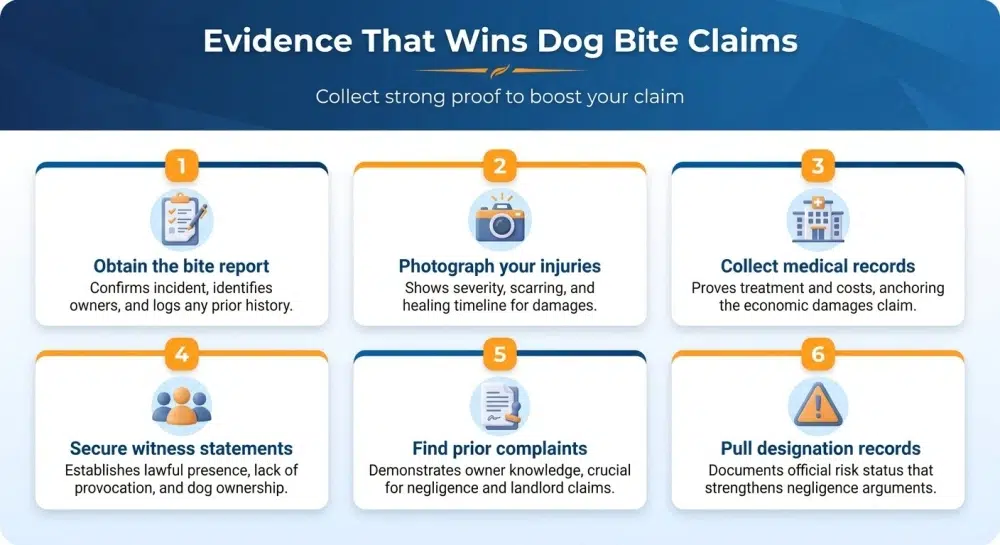
What Evidence Can Matter in a Dog Bite Claim?
Because strict liability under section 3342 does not require proof of negligence for the bite itself, a victim’s evidentiary focus shifts toward documenting the injury and its effects rather than proving fault. That said, evidence of prior incidents remains valuable when pursuing negligence claims alongside the strict liability claim, or when the defendant argues that the plaintiff was a trespasser or provoked the dog.
| Evidence Type | Why It May Matter |
|---|---|
| Animal control bite report | Confirms the incident was reported, identifies the dog and owner, documents prior history on file for the animal |
| Photographs of injuries | Establishes severity of the bite and any resulting scarring or disfigurement; taken as soon as possible after the incident |
| Medical records and bills | Documents the treatment required, establishes the economic damages component of the claim |
| Witness statements | Confirms the victim’s lawful presence, the absence of provocation, and the ownership of the dog |
| Photographs of the location | Shows whether a leash was being used, whether the area was public or private, and the conditions at the time |
| Prior incident reports or complaints | Establishes owner’s knowledge of dangerousness, which is relevant to negligence and potentially to damages |
| Communications with the owner or landlord | May show prior complaints or warnings; central to a landlord negligence theory |
| Veterinary or dangerous-dog designation records | If the dog had been formally designated potentially dangerous or vicious, this record documents prior official recognition of the risk |
| Mental health treatment records | Dog attacks can produce post-traumatic stress and anxiety; psychological treatment supports mental anguish damages |
Evidence does not automatically prove every element of a claim, and its value depends on how it fits the specific legal theory being pursued. But gathering it early, before witnesses’ memories fade or surveillance footage is deleted, preserves the options available when presenting the claim.

What Damages or Remedies May Be Available?
Dog bite claims in California can involve both economic and non-economic categories of damages, depending on the nature and severity of the injury. The following categories are potentially recoverable, though what any particular injured person can recover depends on the facts of the case and applicable law.
- Medical expenses: Emergency treatment, wound care, antibiotics, sutures, and any required reconstructive or cosmetic surgery are the most common economic damages in a bite case.
- Future medical expenses: Severe bites sometimes require multiple surgeries, scar revision procedures, or ongoing psychological care. Anticipated future costs that are reasonably certain to be incurred may be recoverable.
- Lost income: Wages lost during recovery from the bite injury, including time off for medical appointments, may be recoverable if documented.
- Loss of earning capacity: If scarring, disfigurement, or injury affects the person’s ability to perform their occupation going forward, a claim for diminished future earning capacity may be available.
- Physical pain and suffering: Non-economic damages for the pain experienced from the bite itself and the recovery process.
- Mental anguish: Fear of dogs following an attack, anxiety, post-traumatic stress, and other psychological harm are recognized forms of non-economic damage under California law.
- Disfigurement: Permanent scarring is specifically recognized as a category of non-economic damage, particularly relevant in bite cases where the face, hands, or other visible areas are affected.
- Wrongful death damages: When a dog attack causes a fatal injury, California Civil Code section 377.60 governs who may bring a wrongful death action, and sections 377.61 and 377.34 govern the categories of damages available to surviving family members and through a survival action, respectively.[8]
The recoverability of each category depends on the applicable law and what the facts of the specific case can support. No outcome is guaranteed, and a damages analysis requires reviewing the medical evidence, employment records, and the extent of documented harm.
What If the Dog Owner Claims the Victim Provoked the Dog?
California’s Civil Code section 3342 expressly states that liability applies regardless of prior viciousness or the owner’s knowledge. The statute does not create an express provocation defense, but California courts have recognized that evidence of provocation by the injured person may be considered under California’s comparative fault framework.[9]
Under California’s pure comparative negligence system, an injured person’s recovery can be reduced in proportion to their own share of fault in causing the incident. If a court finds that the injured person’s conduct contributed to the bite, the damages award is reduced accordingly. This means a bite victim who taunted, struck, or cornered the dog before being bitten may see their recovery diminished, even if the owner is still found primarily responsible. The injured person does not lose the entire claim as long as their fault does not reach 100 percent, but the reduction can be substantial.
From a defense standpoint, dog owners frequently argue provocation or trespass status in an effort to limit or eliminate liability. Documenting the circumstances of the bite promptly, including the victim’s location and conduct in the moments before the bite, helps address these defenses.
How Long Do I Have to File a Dog Bite Claim in California?
California Code of Civil Procedure section 335.1 provides a two-year statute of limitations for personal injury claims, including dog bite claims against private individuals. The two-year period generally begins to run from the date of the bite.[10]
Several circumstances can affect this deadline. When the injured person is a minor, California Code of Civil Procedure section 352 tolls the limitations period until the minor’s eighteenth birthday, at which point the two-year period begins to run. When a government entity is a named defendant, for example in a claim against a city that owns the dog used by its animal control officers, California Government Code section 911.2 typically requires a government tort claim to be filed within six months of the incident, a much shorter deadline that does not automatically toll or extend like the civil statute of limitations.[11]
Missing a filing deadline ordinarily bars the claim entirely. Because the deadline analysis depends on who the defendant is and the specific facts of the incident, identifying the correct deadline as soon as possible is important. If a government entity may be involved, waiting even a few weeks can foreclose the claim.
A twelve-year-old child is bitten by a neighbor’s dog at a residential community near the Central Justice Center in Santa Ana. The child’s parents may have two years from the date of the bite to file on the child’s behalf, or the limitations period may be tolled until the child turns eighteen, at which point the child has two additional years. The precise application of the tolling rule to the facts should be confirmed with an attorney rather than assumed.
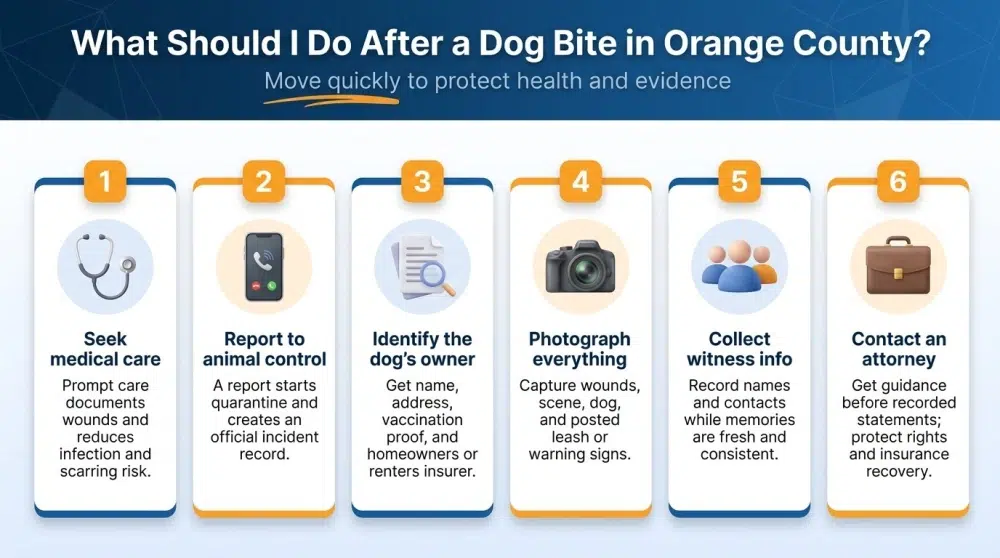
What Should I Do After a Dog Bite in Orange County?
The steps taken immediately after a dog bite can significantly affect both the medical outcome and the civil claim.
- Seek medical attention immediately. Dog bites carry a serious infection risk. A medical provider can document the wound, order appropriate treatment, and create a contemporaneous record of the injury that becomes central to the claim.
- Report the bite to animal control. Contact Orange County Animal Care or the local city animal control agency. The report starts the quarantine and documentation process and creates an official record tied to the specific dog and owner.
- Identify the dog’s owner. Get the owner’s name, address, and contact information. Ask for the dog’s vaccination records and the owner’s homeowner’s or renter’s insurance information.
- Photograph everything. Take photographs of the bite wounds, the location where the bite occurred, the dog (if it can be done safely), and any nearby leash laws or warning signs.
- Collect witness information. If anyone else saw the incident, record their names and contact information while the memory is fresh.
- Preserve communications. If you later learn that prior complaints were made to the landlord or property management company about this dog, preserve any written communications you have.
- Contact an attorney before providing statements. Insurance adjusters for the dog owner may contact you quickly. Speaking with an attorney before giving a recorded statement can help you understand what information is relevant and what is not.
Orange County residents have access to the Orange County Superior Court, with the Central Justice Center in Santa Ana serving as the primary civil trial court for the region. Understanding which court venue applies and what local rules govern the filing of a civil claim is part of the practical work involved in pursuing a bite claim through litigation, if that becomes necessary.

Related California Personal Injury Resources
- Constructive vs. Actual Notice in Premises Liability — Understanding what property owners must know before facing a negligence claim
- What Is Considered Personal Injury in California?
- Negligence Laws in California: A Comprehensive Guide
- How Long Do You Have to Sue for Personal Injury in California?
- Irvine Pedestrian Accidents: Your Rights
Talk With a GoSuits Personal Injury Attorney in Irvine
A dog bite claim can involve strict liability under Civil Code section 3342, concurrent negligence arguments, landlord liability theories, insurance coverage disputes, and strict filing deadlines that vary depending on who the defendant is. If you or a family member were injured by a dog in Orange County, a GoSuits injury attorney can review the specific circumstances of your case and explain what options may be available to you.
GoSuits serves personal injury clients in Irvine, Santa Ana, Costa Mesa, Newport Beach, Fullerton, and throughout Orange County. We also serve clients across California and in Texas and Illinois.
You can speak with our Irvine personal injury lawyers about your situation at no cost. There is no obligation to hire anyone after the initial conversation.
References and Legal Authorities
- California Civil Code § 3342 — Dog Bite Strict Liability — California Legislative Information (leginfo.legislature.ca.gov)
- Strict Liability — Legal Information Institute, Cornell Law School (law.cornell.edu)
- California Civil Code § 3342.5 — Post-Bite Owner Duties and Court Proceedings — California Legislative Information (leginfo.legislature.ca.gov)
- California Health and Safety Code § 121695 — Local Authority to Regulate Dogs — California Legislative Information (leginfo.legislature.ca.gov)
- California Food and Agricultural Code § 31602 — Potentially Dangerous Dog Definition — California Legislative Information (leginfo.legislature.ca.gov)
- California Food and Agricultural Code § 31604 — Severe Injury Definition — California Legislative Information (leginfo.legislature.ca.gov)
- California Health and Safety Code § 121575 — Rabies Quarantine Requirements — California Legislative Information (leginfo.legislature.ca.gov)
- California Code of Civil Procedure § 377.60 — Wrongful Death Standing — California Legislative Information (leginfo.legislature.ca.gov)
- California Civil Code § 1714 — General Negligence and Comparative Fault — California Legislative Information (leginfo.legislature.ca.gov)
- California Code of Civil Procedure § 335.1 — Two-Year Statute of Limitations for Personal Injury — California Legislative Information (leginfo.legislature.ca.gov)
- California Government Code § 911.2 — Six-Month Government Tort Claim Deadline — California Legislative Information (leginfo.legislature.ca.gov)
This article is published for general informational purposes only and does not constitute legal advice. Reading this article does not create an attorney-client relationship between the reader and GoSuits or any attorney associated with the firm. The law described in this article reflects California statutes verified as of July 2025 and may be subject to amendment. Individual circumstances vary significantly and affect which legal rules apply. Anyone with questions about a specific dog bite incident should consult a licensed California attorney. Attorney review of this article is recommended before publication.