- Incident overview
- What we know so far from authorities
- Where the crash happened and why that matters locally
- Law and safety context: off-highway motorcycles, e-bikes, and pedestrians
- Civil liability questions families often ask in pedestrian hit incidents
- Insurance angles that may apply
- Immediate next steps after a serious pedestrian collision
- How to obtain official records and assistance in Orange County
- Evidence preservation and protecting a potential claim
- Community reflections and safety reminders
- Why timely action matters
- Commentary from Gosuits Irvine, California Personal Injury Attorney
- References
Incident overview
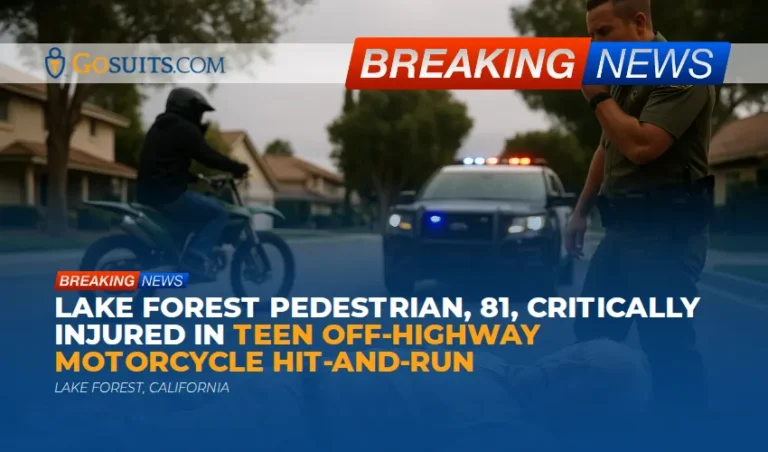
Lake Forest residents are hurting after an 81-year-old community member, a Vietnam War pilot and longtime teacher at El Toro High School, was critically injured while walking near Toledo Way and Ridge Route Drive. According to statements reported publicly, he was struck by a teen riding what law enforcement later identified as an off-highway motorcycle. Community members have rallied to support the injured neighbor and his family as he remains in critical condition. This summary is based on information attributed to the Orange County Sheriff’s Department and widely shared in local reporting. We will avoid speculation and focus on what is known, the relevant California laws, and practical steps families can take.
What we know so far from authorities
According to the Orange County Sheriff’s Department, the collision occurred on Thursday, April 16, near Toledo Way and Ridge Route Drive in Lake Forest. The rider was initially reported to be on an e-bike but was later determined to be operating an off-highway motorcycle, which is not permitted to be driven on public roads except under narrow crossing exceptions [1]. Deputies indicated the teen left the scene, was later identified, and was arrested on suspicion of hit-and-run involving injury. While there may be a separate criminal process, our focus here is on the civil safety and recovery issues that often follow a serious pedestrian injury.
Where the crash happened and why that matters locally
The intersection area of Toledo Way and Ridge Route Drive sits among residential neighborhoods not far from El Toro High School, Lake Forest Sports Park, and community corridors that see a mix of students, families, and seniors. Anyone who has walked the stretch near the Toledo and Ridge Route corridor knows car speeds can feel quick as vehicles transition between the I-5 access points and local streets. Even at modest speeds, a pedestrian is highly vulnerable. National data show pedestrians are at a significantly increased risk of severe injury when struck by a motorized vehicle, and older pedestrians can face more complex recoveries due to age-related fragility [7].
Local context matters for evidence, too. The area includes traffic signals, potential city or private cameras, and nearby businesses along Ridge Route that sometimes retain video for short periods. If this crash had been captured by traffic cameras or private security systems, quick action is usually necessary to request preservation before footage is overwritten. More on that below.
Law and safety context: off-highway motorcycles, e-bikes, and pedestrians
Off-highway motorcycles are not street-legal on public roads
California law classifies off-highway motorcycles as off-highway motor vehicles. Generally, you cannot operate an off-highway motor vehicle on a public street or highway, except to cross under strict conditions or when specifically authorized for certain limited purposes [1]. These are different from Class 1, 2, or 3 electric bicycles that the Vehicle Code recognizes for roadway use under defined rules. The preliminary clarification by deputies that the vehicle involved was an off-highway motorcycle, not an e-bike, is an important distinction under California law.
Duty to remain at the scene and render aid
California requires anyone involved in a collision causing injury to stop, remain at the scene, and provide reasonable assistance. Leaving the scene can trigger serious criminal penalties under the Vehicle Code [2]. The civil implications can also be significant, as leaving the scene complicates medical triage, evidence gathering, and insurance-related steps for the injured person.
Pedestrians’ rights and drivers’ duties
California drivers must yield to pedestrians in marked crosswalks and at unmarked crosswalks at intersections, though pedestrians also have duties to exercise due care for their own safety. The law is clear that drivers must reduce speed and take other measures as necessary to ensure pedestrian safety [3]. Whether the person on a motorized vehicle is treated as a driver under a particular Vehicle Code section can depend on the vehicle type and where it is being operated, but the bottom line is that roadway users must exercise care around pedestrians.
Why these distinctions matter after a crash
When an off-highway motorcycle is operated on a public roadway, it raises questions that can affect civil fault determinations and insurance coverage, from licensing and equipment requirements to unlawful operation on roads. These facts can influence how liability is evaluated and which policies may respond.
Civil liability questions families often ask in pedestrian hit incidents
In the wake of a severe pedestrian injury, families often ask who may be financially responsible for medical bills, rehabilitation, and other losses. While every case turns on its facts, here are common civil considerations in California, stated generally:
- Negligence by the rider may be evaluated if they violated traffic laws, operated an off-highway motorcycle unlawfully on a public road, failed to yield, or drove recklessly.
- Potential liability for parents or guardians of a minor can arise under several legal theories. California recognizes parental responsibility in narrow statutory ways, and separate from that, negligent entrustment or negligent supervision claims may be considered depending on who provided the vehicle, where it was operated, and how. The details matter and are highly fact specific.
- Comparative fault can be assessed if there are allegations that a pedestrian stepped out unexpectedly or was outside a crosswalk, among other scenarios. California uses comparative fault principles, so fault can be allocated among multiple parties as supported by the evidence.
California’s general two-year statute of limitations for personal injury claims typically applies, but there are shorter deadlines if a public entity is involved for any reason, and evidence issues can arise much sooner. Confirming deadlines is important [4].
Insurance angles that may apply
When a pedestrian is struck, multiple policies may be in play:
- Liability insurance of the at-fault rider or vehicle owner. If a minor is involved, the analysis may include household policies. Given the vehicle was reportedly an off-highway motorcycle, it is not uncommon to see gaps in coverage, which makes exploring all potential sources important.
- Uninsured/Underinsured Motorist coverage on the injured person’s own auto policy can sometimes apply to pedestrians who are hit by a motor vehicle, including when the at-fault person flees or lacks adequate coverage. The California Department of Insurance provides consumer information on UM/UIM and urges drivers to consider it because it protects them when the at-fault party is uninsured or underinsured [5].
- Medical Payments (Med Pay) coverage on an auto policy may help with immediate medical costs regardless of fault, subject to policy terms.
- Health insurance coordination is often critical. Keep records of bills and explanations of benefits. Reimbursement rights or liens can attach depending on the plan.
Before opening conversations with any insurer, it is generally wise to consult with a qualified attorney in a free consultation to understand rights and potential pitfalls. Statements given to insurance adjusters can be used later to minimize a claim if they are incomplete or imprecise. Where appropriate in context, motorcycle accident lawyers review the coverage landscape to identify all potential policies that could help an injured pedestrian recover.
Immediate next steps after a serious pedestrian collision
Orange County families navigating a crisis like this are dealing with medical updates, logistics, and emotions all at once. A few practical steps, in neutral and general terms:
- Prioritize medical care. In acute cases, Orange County responders often transport to regional trauma centers equipped for complex injuries. California EMSA maintains the list of designated trauma centers statewide [6].
- Document everything from day one. Save hospital wristbands, discharge summaries, medication lists, and receipts. Start a simple recovery journal with dates, pain levels, and limitations.
- Identify potential witnesses and video. Neighbors on Toledo Way and Ridge Route may have Ring or other security footage. Businesses along Ridge Route sometimes keep recordings for only days. Time is critical to request preservation.
- Do not discuss details with insurance adjusters yet. Consider speaking with an attorney first to understand your rights and how to handle calls. What is said early can be taken out of context later.
- Understand mandatory crash reports. California requires drivers to submit an SR-1 to DMV within 10 days of a crash causing injury or death. While a pedestrian is not the driver, families should know this report exists and can become part of the paper trail insurers review [8].
For those looking for a step-by-step walkthrough tailored to local hit-and-run situations, this guide on Irvine Hit and Run Steps That Protect Your Claim explains practical ways to safeguard evidence and avoid common missteps after a fleeing driver incident.
Given the proximity to our main office market, Irvine motorcycle accident lawyers frequently counsel injured pedestrians and their families on how motor vehicle rules intersect with insurance and liability when a two-wheeled motorized vehicle is involved on public roads.
How to obtain official records and assistance in Orange County
Collision report from the Orange County Sheriff’s Department
Lake Forest contracts with the Orange County Sheriff’s Department for policing services. For traffic collision or incident reports handled by OCSD, requests typically go through OCSD Records. The Sheriff’s official site explains how to request reports and what identification is required. Expect to provide the report number if available, time and location of the crash, and proof of involvement or authorization [9].
City of Lake Forest Police Services
The City’s Police Services page offers local contact information and pointers for residents. While collision reports are processed by OCSD, the City site provides community safety resources and contact routes for non-emergency follow-up [10].
Coroner and autopsy records if a case becomes a fatality
In the event a critically injured person does not survive, the Orange County Sheriff’s Department Coroner Division oversees death investigations and related records. Families can find information on how to request coroner reports and who is eligible to receive them. Because these are sensitive records with privacy rules, review the Coroner Division’s guidance on next steps and timelines [11].
DMV SR-1 crash reporting
California law requires an SR-1 report to DMV within 10 days when a collision results in injury or death, or property damage above a statutory threshold, regardless of fault. Drivers are obligated to file; insurers may file on a driver’s behalf in some circumstances, but the driver is legally responsible. Knowing whether an SR-1 was filed can help families ensure the administrative pieces are complete [8].
Victim compensation resources for crime-related injuries
Because deputies described this as a hit-and-run with injury, some families ask if state victim compensation may help with certain out-of-pocket expenses. The California Victim Compensation Board provides information about eligibility for crime-related injuries, covered expenses, and application steps. This is separate from a civil claim and subject to program rules and documentation [12].
Regional trauma centers and transfers
For catastrophic injuries, it is common in Orange County to see transports to Level I and Level II trauma centers capable of neurosurgery and other advanced care. California EMSA’s trauma system resources can confirm which hospitals are designated at which levels statewide [6].
Evidence preservation and protecting a potential claim
In the first days after a serious crash near Toledo Way and Ridge Route Drive, many forms of evidence can disappear quickly. Consider this general, non-exhaustive checklist that families often find helpful:
- Scene photos and maps. Capture the intersection, traffic controls, sight lines, and any skid marks or debris as soon as it is safe.
- Witness names and contact information. Neighbors who saw the collision or the immediate aftermath can provide crucial details about direction of travel, signals, and speed.
- Video preservation letters. Nearby residences and businesses may have security cameras facing Ridge Route or Toledo. Ask them to preserve the clips for the time window around the crash.
- Medical records. Keep a running folder of imaging, lab results, discharge instructions, and therapy notes to show the full scope of injuries and recovery progress.
- Avoid social media discussion. Insurance investigators sometimes review public posts and can misinterpret well-intentioned updates.
If an insurer for the rider or a household adjuster calls quickly with questions or a recorded statement request, it is prudent to pause. A brief, no-cost consultation with a seasoned injury lawyer can help families understand what to say and what not to say. Many people do not realize that small wording choices or incomplete timelines can be used to cast doubt on fault or injury severity later.
Community reflections and safety reminders
Lake Forest is a place where people know each other at the grocery store on Ridge Route, see familiar faces at Heritage Hill Historical Park events, and cheer for students at El Toro High. When a beloved neighbor is gravely hurt, the whole community feels it. A few safety reminders that reflect both California law and common-sense roadway courtesy:
- Two-wheeled motorized vehicles should be used where legally permitted. Off-highway motorcycles are built for trails and designated OHV areas, not public streets. The law is clear about this distinction [1].
- Slow down near schools, parks, and senior walking routes. Even a 5 to 10 mph reduction in speed can dramatically cut injury risk to a pedestrian.
- Yield to pedestrians at crosswalks, marked and unmarked at intersections, and be prepared to stop. The Vehicle Code requires drivers to exercise due care for pedestrians [3].
- Stay at the scene and call for help when a collision occurs. Leaving the scene is dangerous and unlawful [2].
While community generosity is powerful, the most immediate help after a crash will always be skilled medical care and a clear path to preserve rights and benefits that can support long-term recovery.
Why timely action matters
Here is what should happen, and why it matters, in plain terms:
- Get the paper trail started early. Collision reports, medical records, and proof of time missed from work are building blocks for any insurance evaluation. Waiting months can mean lost documents and faded memories.
- Secure video and witnesses within days. Many Lake Forest businesses and homes overwrite camera footage in a week or less. Quick requests can be the difference between having visual proof or relying on word-of-mouth.
- Identify all potential insurance. Off-highway motorcycles often sit in coverage gray areas. Finding every applicable policy takes time, and some notices must be given promptly.
- Avoid early recorded statements. Rushing to speak with an adjuster can lock someone into a timeline or phrases that do not reflect later medical findings. Consulting an attorney for a free review before any insurance calls is a low-effort way to prevent costly missteps.
- Track the recovery journey. A simple journal of symptoms, doctor visits, and daily struggles can tell the story that imaging alone cannot, especially important for pain, dizziness, or cognitive changes that ebb and flow.
These steps help ensure that when insurance companies evaluate the claim, there is a complete, timely, and accurate record. That can directly impact how responsibility and damages are assessed.
Commentary from Gosuits Irvine, California Personal Injury Attorney
Our hearts are with the injured neighbor, his family, his former students at El Toro High, and the Lake Forest community. What happened near Toledo Way and Ridge Route Drive is devastating. The purpose of this write-up is to share general information and context that families in our area often need right away. It is not case-specific guidance.
From a civil-injury perspective, a few points stand out. First, deputies’ clarification that the vehicle was an off-highway motorcycle operated on a public street is legally significant because the Vehicle Code does not allow off-highway vehicles to be used on public roads except in limited, defined circumstances. Second, the allegation of leaving the scene matters for both public safety and the civil timeline. Hit-and-run behavior delays emergency aid and complicates evidence preservation. Third, the injured pedestrian’s age is part of why early, specialized medical care and careful documentation of recovery are so important.
Insurance companies, and sometimes corporate defendants, commonly move fast after a traumatic event. They know many families have not navigated a claim before and may not be familiar with coverage nuances like UM/UIM, Med Pay, or how household policies interact when a minor is involved. Adjusters can sound helpful while gathering statements that narrow or shift the narrative about fault, speed, or injuries. We have also seen early low offers framed as quick solutions before the full extent of medical needs is known.
That is why initial, no-cost consultations matter. They give people space to understand their rights, how California’s rules on pedestrians and off-highway vehicles apply generally, and what to expect from insurers. Even if someone chooses not to retain a lawyer, a brief conversation before speaking to insurance can prevent avoidable mistakes.
References
- California Vehicle Code 38025: Operation of off-highway motor vehicles on highways – California Legislative Information
- California Vehicle Code 20001: Duty to stop at scene of accident – California Legislative Information
- California Vehicle Code 21950: Right-of-way at crosswalks – California Legislative Information
- Code of Civil Procedure 335.1: Two-year limitation for injury to person – California Legislative Information
- Uninsured and Underinsured Motorist Coverage – California Department of Insurance
- Trauma System and Trauma Center Information – California Emergency Medical Services Authority
- Pedestrian Safety – National Highway Traffic Safety Administration
- Vehicle Accidents and SR-1 Reporting Requirements – California DMV
- Records and Report Requests – Orange County Sheriff’s Department
- Police Services – City of Lake Forest, CA
- Coroner Division – Orange County Sheriff’s Department
- Victim Compensation Eligibility – California Victim Compensation Board