- What Are Your Employee Rights After a Workplace Injury in Texas?
- How Does Texas Workers’ Compensation Work and Is My Employer Required to Carry It?
- What Happens If My Texas Employer Is a Nonsubscriber?
- What Steps Should You Take Right After a Workplace Injury in Texas?
- What Are Your Rights to Medical Care and Wage Replacement?
- When Can You File a Third-Party Workplace Injury Claim?
- Are You Protected From Retaliation After Reporting a Workplace Injury?
- What Federal Laws Protect Injured Workers?
- How Do California and Illinois Laws Compare for Injured Workers?
- What Should Employers and Defendants Know About Liability?
- What Do the Statistics Say About Texas Workplace Injuries?
- When Should You Talk to a Workplace Injury Lawyer in Texas?
- Frequently Asked Questions
- How Gosuits Dallas Personal Injury Attorneys Support Injured Workers
- References
What Are Your Employee Rights After a Workplace Injury in Texas?
If you have been hurt on the job in Texas, you are likely facing a stack of paperwork, mounting medical bills, and pressure from your employer or its insurance carrier to make decisions quickly. You deserve clear answers. Texas treats workplace injuries differently than almost any other state, and understanding your employee rights can change the outcome of your claim.
Texas is the only state in the country where private employers can choose whether to carry workers’ compensation insurance. According to the Texas Department of Insurance, roughly 28% of Texas private employers do not subscribe to workers’ compensation [1]. That single fact reshapes the legal landscape for injured workers across the state. Whether your employer is a subscriber or a nonsubscriber, you still have meaningful rights, and the path to recovery looks different in each case.
This guide walks you through what employee rights at work look like after an injury, how reporting deadlines work, what benefits you may claim, when a third-party workplace injury claim makes sense, and how protections under federal law, California law, and Illinois law compare. We will also cover the perspective of employers and defendants so you understand what to expect from the other side of a civil case.
How Does Texas Workers’ Compensation Work and Is My Employer Required to Carry It?
Texas workers’ compensation is governed by the Texas Labor Code, Title 5, and administered by the Division of Workers’ Compensation (DWC) within the Texas Department of Insurance [2]. Subscribing to workers’ compensation gives Texas employers legal immunity from most negligence lawsuits filed by injured workers. In exchange, the worker receives no-fault benefits regardless of who caused the accident.
If your employer carries workers’ compensation, you are entitled to four core categories of benefits under the Texas Labor Code:
- Medical benefits covering all reasonable and necessary care related to the injury, with no copay or deductible.
- Income benefits replacing a portion of lost wages, including Temporary Income Benefits (TIBs), Impairment Income Benefits (IIBs), Supplemental Income Benefits (SIBs), and Lifetime Income Benefits (LIBs) for catastrophic injuries.
- Death benefits for eligible family members if a workplace injury proves fatal.
- Burial benefits covering reasonable funeral expenses up to a statutory cap.
Texas does not require private employers to subscribe. Public employers, contractors on government projects, and certain industries face stricter rules, but most private businesses can opt out. When they do, they lose the immunity shield, which is where injured worker rights in Texas become significantly more complex.
What Happens If My Texas Employer Is a Nonsubscriber?
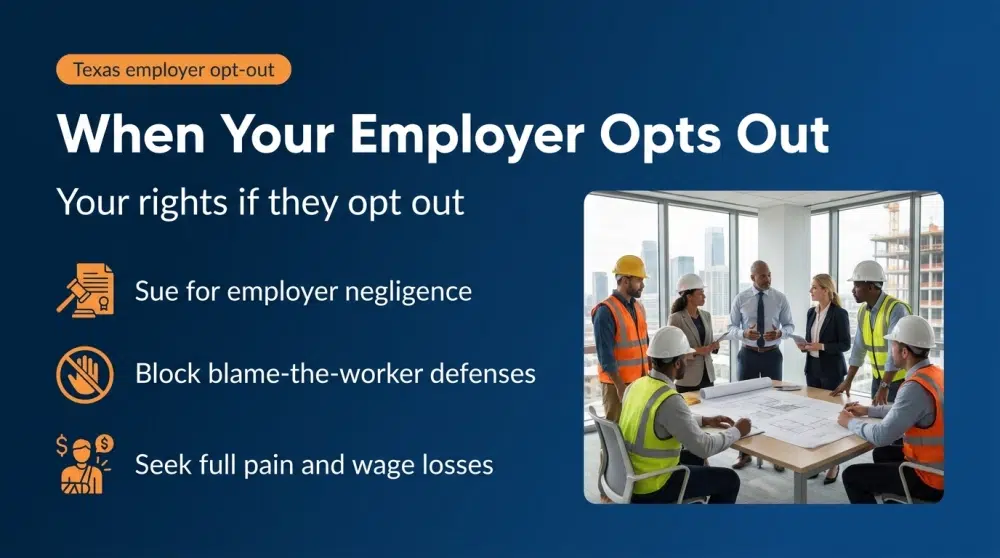
If your employer chose not to carry workers’ compensation, you have a different set of rights, often more powerful ones. Under Section 406.033 of the Texas Labor Code, a nonsubscriber loses three core legal defenses in any negligence lawsuit brought by an injured worker [3]:
- Contributory negligence cannot be raised. Your own carelessness does not bar recovery.
- Assumption of risk is not available. The employer cannot argue you knew the job was dangerous.
- Fellow servant rule is eliminated. The employer is liable even when a coworker caused the injury.
To win a nonsubscriber case in Texas, you generally must prove that your employer was negligent and that the negligence caused your injury. Common theories include unsafe equipment, inadequate training, missing safety guards, failure to warn of known hazards, and understaffing. A skilled workplace injury lawyer Texas workers turn to will gather OSHA reports, internal safety logs, training records, and witness statements to build the case.
Nonsubscriber cases are filed as ordinary civil lawsuits in Texas state district court or, where federal jurisdiction applies, in federal court. Damages can include past and future medical expenses, lost wages, lost earning capacity, physical pain, mental anguish, physical impairment, and disfigurement. There is no cap on most categories of compensatory damages in Texas employer negligence workplace injury cases involving nonsubscribers.
What Steps Should You Take Right After a Workplace Injury in Texas?
Your actions in the first hours and days after an injury directly affect your claim. Texas has strict deadlines, and missing them can cost you benefits.
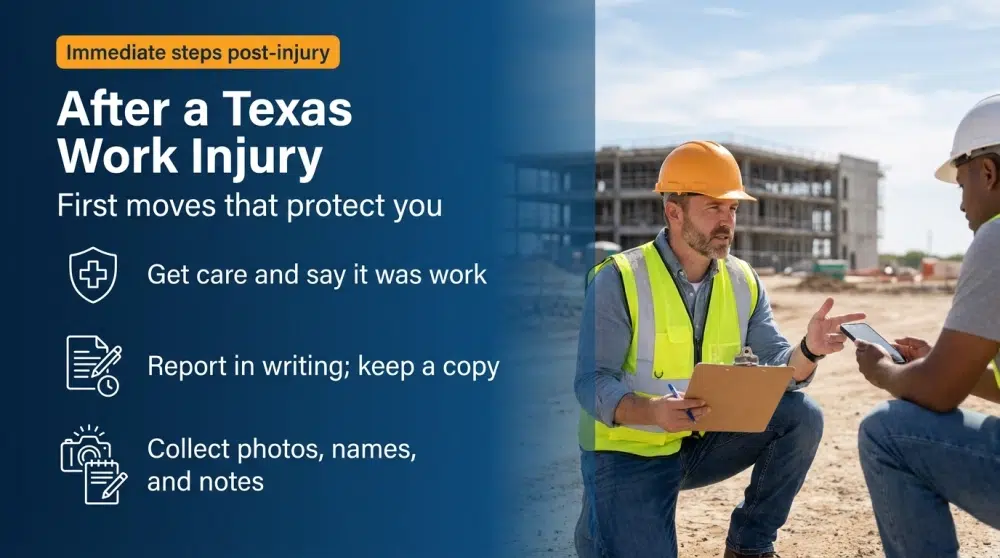
- Get medical care immediately. Tell the treating provider the injury happened at work and request copies of all records.
- Notify your employer within 30 days. Section 409.001 of the Texas Labor Code requires written notice within 30 days of the injury or the date you knew the injury was work-related [4]. Failing to give notice can bar your benefits.
- File a DWC Form-041 within one year. The claim form must reach the DWC within one year of the injury date, or you risk losing all rights to workers’ compensation benefits.
- Document the scene. Take photos of the equipment, the area, and any visible hazards. Save your work clothes if they are damaged.
- Identify witnesses. Coworkers who saw the incident or saw the hazard beforehand can be critical.
- Keep a written log. Note your symptoms, doctor visits, conversations with supervisors, and missed shifts.
- Do not give a recorded statement to the insurance adjuster until you have spoken with a lawyer.
For a nonsubscriber claim or a third-party claim, the Texas statute of limitations is typically two years from the date of injury under Texas Civil Practice and Remedies Code Section 16.003 [5]. Acting quickly preserves evidence and witness memory.
What Are Your Rights to Medical Care and Wage Replacement?
Medical care is one of the most important worker rights laws in Texas. Under the workers’ compensation system, an injured employee may receive treatment from any doctor in the certified network if the employer participates in one, or from any qualified provider if the employer is not in a network [6]. The treating doctor coordinates care, refers to specialists, and certifies maximum medical improvement.
So how much do you actually get? Roughly 70% of your average weekly wage, with state caps the DWC sets every year. You wait seven days before benefits start, and if your disability stretches past 14 days, that first week gets paid back to you. One thing worth knowing. Texas workers’ comp doesn’t cover pain and mental anguish at all, which is partly why third-party and nonsubscriber claims tend to produce bigger recoveries.
If you are working with a nonsubscriber, your medical care typically goes through your private health insurance, the employer’s voluntary benefit plan (often called an ERISA plan), or out-of-pocket until liability is established and a settlement or judgment is reached. ERISA plans have their own rules, deadlines, and lien rights that injured workers should not navigate alone.
Construction, oil and gas, warehousing, and trucking are among the industries with the highest rates of catastrophic workplace injuries in Texas. Workers hurt on these sites often need long-term, sometimes lifelong care. The construction accident lawyers in Dallas handling these cases see falls from height, struck-by incidents, scaffolding collapses, and equipment failures pretty regularly, and these cases almost always involve multiple defendants who could share liability.
When Can You File a Third-Party Workplace Injury Claim?
A third-party workplace injury claim is a civil lawsuit against someone other than your employer who contributed to your injury. Workers’ compensation does not block these claims, and they are often the most valuable part of an injured worker’s recovery.
Common third-party defendants include:
- General contractors and subcontractors on a multi-employer construction site whose negligence caused the hazard.
- Equipment manufacturers whose defective product caused the injury, opening a product liability claim under Chapter 82 of the Texas Civil Practice and Remedies Code.
- Property owners whose premises were unsafe.
- Negligent drivers who hit a worker on the job, including delivery drivers, sales staff, and roadside workers.
- Vendors and maintenance companies who serviced the equipment that failed.
Third-party recoveries can include the full range of personal injury damages: past and future medical bills, full lost wages and earning capacity, pain and suffering, mental anguish, physical impairment, disfigurement, and loss of consortium for spouses. If a workplace injury is fatal, surviving family members may pursue a wrongful death claim under Chapter 71 of the Texas Civil Practice and Remedies Code [7]. The Dallas wrongful death lawyers who handle these cases coordinate the survival action and the wrongful death claim so that both the decedent’s estate and the surviving family receive what the law allows.
If you also recover workers’ compensation benefits, the workers’ compensation carrier holds a subrogation lien on your third-party recovery under Section 417 of the Texas Labor Code. A skilled lawyer can often negotiate that lien down significantly, putting more money in your pocket.
Are You Protected From Retaliation After Reporting a Workplace Injury?
Yes. Texas law protects injured workers from retaliation. Section 451.001 of the Texas Labor Code makes it unlawful for an employer to discharge or in any other manner discriminate against an employee because the employee has filed a workers’ compensation claim in good faith, hired a lawyer to represent them in a claim, instituted a proceeding under the Texas Workers’ Compensation Act, or testified in such a proceeding [8].
If you can prove retaliation, available remedies include reinstatement, back pay, lost benefits, and in some cases punitive damages. The burden is on the employee to show that the protected activity was a motivating factor in the adverse action, but circumstantial evidence such as timing, inconsistent reasons for the discipline, and disparate treatment of similarly situated coworkers can carry that burden.
This protection is one of the strongest workplace rights in Texas. Many workers fear filing a claim because they worry about losing their job. Documenting your performance reviews, attendance, and supervisor communications before and after the injury creates a paper trail you can use if retaliation occurs.
What Federal Laws Protect Injured Workers?
Several federal statutes layer on top of Texas law to protect employee rights in the workplace.
- Occupational Safety and Health Act (OSH Act). The OSH Act, enforced by OSHA, gives every worker the right to a workplace free of recognized hazards. Workers may file a complaint with OSHA, request an inspection, and refuse work in cases of imminent danger. OSHA’s Section 11(c) prohibits retaliation against employees who exercise these rights [9].
- Family and Medical Leave Act (FMLA). The FMLA allows eligible employees of covered employers to take up to 12 weeks of unpaid, job-protected leave for a serious health condition, including a workplace injury. The U.S. Department of Labor enforces FMLA rights [10].
- Americans with Disabilities Act (ADA). If a workplace injury results in a long-term impairment, the ADA requires covered employers to provide reasonable accommodations unless doing so would create undue hardship [11].
- Federal Employers’ Liability Act (FELA). Railroad workers injured on the job pursue claims under FELA rather than state workers’ compensation.
- Jones Act and Longshore and Harbor Workers’ Compensation Act. Maritime workers have separate federal remedies.
The interaction between OSHA, the FMLA, the ADA, and Texas state law often determines the strongest path forward. For example, an OSHA citation issued to a nonsubscribing employer can become powerful evidence of negligence in a civil personal injury suit. Skilled accident injury attorneys know how to use those federal records.
How Do California and Illinois Laws Compare for Injured Workers?
If your employer operates across state lines or you were injured outside Texas, jurisdictional rules may give you choices. A side-by-side look helps explain why state law matters.
California
California requires nearly every employer with at least one employee to carry workers’ compensation insurance under California Labor Code Section 3700 [12]. Failure to carry coverage exposes the employer to criminal penalties and direct civil liability. California’s workers’ compensation system pays temporary disability at two-thirds of average weekly wages, subject to caps published annually by the Division of Workers’ Compensation. California also recognizes serious and willful misconduct claims that can increase benefits by 50% when the employer’s conduct was egregious.
Illinois
Illinois mandates workers’ compensation coverage for nearly all employers under the Illinois Workers’ Compensation Act, 820 ILCS 305 [13]. Benefits include medical care, temporary total disability at two-thirds of average weekly wage, permanent partial disability, vocational rehabilitation, and death benefits. Illinois also enforces strict notice requirements, generally 45 days, and a three-year statute of limitations for filing a claim with the Illinois Workers’ Compensation Commission.
If you live or work in any of these states, the choice of forum and choice of law analysis can affect benefit levels, available damages, and procedural deadlines. Workplace accident legal help should start with a jurisdictional review.
What Should Employers and Defendants Know About Liability?
This article focuses on civil cases, and a fair analysis covers both sides. Employers and their insurers face real obligations and real exposure when a worker is hurt.
From the defense perspective, several principles drive case strategy:
- Subscriber status matters. A subscribing employer typically has the exclusive remedy defense available, limiting recovery to workers’ compensation benefits.
- Comparative fault still applies in third-party cases. Under Texas Civil Practice and Remedies Code Chapter 33, a plaintiff whose responsibility exceeds 50% recovers nothing. Below 50%, the recovery is reduced proportionally.
- Independent contractor classification can shift liability away from the hiring company if properly documented.
- Indemnity and additional-insured agreements between general contractors and subcontractors often determine who actually pays a judgment.
- Loss control records created in the ordinary course of business may be discoverable; safety audits prepared in anticipation of litigation may be protected.
Defendants who document training, follow OSHA standards, and respond promptly to known hazards reduce their exposure. Plaintiffs who establish clear notice of a hazard and a failure to act build strong cases. Both sides benefit from early investigation.

What Do the Statistics Say About Texas Workplace Injuries?
Texas workplace injury claims involve real numbers that frame why these rights exist.
- The U.S. Bureau of Labor Statistics reported 578 fatal work injuries in Texas in 2022, the highest of any state that year [14].
- Nationally, BLS recorded 5,486 fatal occupational injuries in 2022, with transportation incidents the leading event.
- The construction industry accounted for roughly one in five workplace fatalities nationally, and Texas leads the nation in construction worker deaths in many recent annual reports.
- OSHA’s national emphasis on falls, struck-by, caught-in/between, and electrocutions, the so-called Fatal Four, mirrors the leading causes of serious injuries on Texas job sites [9].
These figures matter because they shape what juries hear and what insurance carriers know. A serious workplace injury is not a rare event; it is a foreseeable outcome of inadequate safety, and the law treats it that way.
When Should You Talk to a Workplace Injury Lawyer in Texas?
The honest answer is: as soon as practical. Texas workplace injury claims involve overlapping deadlines, multiple potential defendants, and insurance carriers whose financial interests do not align with yours. Self-representation in these cases is rarely a fair fight. The carrier has lawyers, adjusters, and experienced investigators on its side. You should have someone on yours.
A workplace injury lawyer Texas workers consult early can preserve evidence before it disappears, send litigation hold letters to employers and equipment manufacturers, coordinate independent medical examinations, identify third-party defendants you may not have considered, and value the claim properly so you do not accept a lowball settlement. For nonsubscriber cases in particular, building a negligence case requires fast action on safety records, training files, and OSHA records that companies are not required to volunteer.
For a deeper walkthrough of the immediate post-injury process, our knowledge base article on steps to take after a workplace injury a legal overview covers the procedural roadmap in detail.
How Gosuits Dallas Personal Injury Attorneys Support Injured Workers
If you or a loved one has been hurt on the job in Texas, you do not have to navigate this alone. The injury attorneys at Gosuits handle work injury cases across the Dallas-Fort Worth metroplex, including Plano, Frisco, McKinney, Carrollton, Arlington, and Fort Worth, and we serve clients throughout Texas, California, and Illinois. We invite you to schedule a free consultation to talk through your situation in plain language with no pressure to hire.
Our practice is built around a simple idea: injured people get better outcomes when their lawyer uses every available tool. Gosuits has invested in proprietary, in-house legal software that accelerates case intake, evidence collection, medical record review, and litigation tracking. Documents that used to take weeks to assemble now move in days. That speed lets us spend more time on the parts of the case that demand human judgment, like strategy, negotiation, and trial preparation. We see this technology as a force multiplier for our clients, not a replacement for the hands-on legal work they deserve.
Even with software speeding things up, you’re not getting handed off to a case manager at Gosuits. Every client has a designated attorney. That’s it. You call, you text, you email, and the lawyer making decisions on your case is the one who picks up. We did it this way on purpose, honestly, because injured workers shouldn’t have to chase their own lawyer through a chain of staff while the bills just keep piling up.
Thirty years of combined experience between us. Across pretty much every personal injury area you can think of: work injury claims, construction site accidents, truck crashes, motorcycle collisions, product liability, premises liability, and wrongful death. And trial readiness isn’t just a tagline for us, it’s how we actually work. Insurance carriers absolutely keep tabs on which firms try cases and which ones only settle, and that reputation drives the value of every offer we get. When they know we’ll push a case all the way to verdict if the offer’s lowballed, our clients get better numbers, and they get them sooner. Past results are in our prior cases section.
You can learn more about the lawyers who would handle your matter on our our attorneys page, the firm’s story and values on our about us page, and the full range of cases we handle on our practice areas page. If you have questions about your workplace injury, your rights, or what comes next, reach out. We are here to help you understand the road ahead.
References
- Texas Workers’ Compensation Nonsubscription Reports – Texas Department of Insurance
- Workers’ Compensation Information for Employees – Texas Department of Insurance
- Texas Labor Code Chapter 406 – Texas Constitution and Statutes
- Texas Labor Code Chapter 409 Notice of Injury and Claims – Texas Constitution and Statutes
- Texas Civil Practice and Remedies Code Chapter 16 Limitations – Texas Constitution and Statutes
- Workers’ Compensation Health Care Networks – Texas Department of Insurance
- Texas Civil Practice and Remedies Code Chapter 71 Wrongful Death and Survival – Texas Constitution and Statutes
- Texas Labor Code Chapter 451 Anti-Retaliation – Texas Constitution and Statutes
- Workers Rights Under the OSH Act – U.S. Occupational Safety and Health Administration
- Family and Medical Leave Act – U.S. Department of Labor
- Americans with Disabilities Act of 1990 – U.S. Equal Employment Opportunity Commission
- California Labor Code Section 3700 – California Legislative Information
- Illinois Workers’ Compensation Act 820 ILCS 305 – Illinois General Assembly
- Census of Fatal Occupational Injuries – U.S. Bureau of Labor Statistics
- Texas Rules and Standards – Texas Judicial Branch