- What Are Employee Rights After a Workplace Injury in Illinois?
- How Does the Illinois Workers’ Compensation System Work?
- What Are the Reporting Deadlines for a Workplace Injury in Illinois?
- What Medical Benefits Are Available After a Work Injury in Illinois?
- What Wage Replacement and Disability Benefits Apply?
- What Protections Exist Against Employer Retaliation?
- When Can an Injured Worker File a Third-Party Civil Lawsuit?
- What Happens When a Workplace Injury Becomes Fatal?
- What Defenses Do Illinois Employers and Insurers Raise?
- How Do Federal Worker Rights Laws Apply in Illinois?
- What Local Considerations Apply for Chicago Workers?
- How Do California Worker Rights Compare?
- How Do Texas Worker Rights Compare?
- Frequently Asked Questions
- How Gosuits Chicago Personal Injury Attorneys Can Help
- References and Resources
What Are Employee Rights After a Workplace Injury in Illinois?
If you have been hurt on the job in Illinois, you carry a set of legal rights the moment the injury happens. Those rights are not favors from your employer. They are obligations written into the Illinois Workers’ Compensation Act [1], federal labor statutes, and Illinois common law. Whether you slipped on a wet floor in a Chicago warehouse, fell from scaffolding on a Loop construction site, or developed a repetitive-stress condition over years at a desk, you are entitled to medical care, wage replacement, and protection from being punished for filing a claim.
Workplace rights in Illinois sit at the intersection of three systems: the no-fault state workers’ compensation framework, federal occupational safety law administered by OSHA [2], and traditional civil tort law that may apply when a third party (not your direct employer) caused your harm. Understanding which system applies to your situation, and in what order, is the difference between a full recovery and a stalled claim. The personal injury lawyers who handle these cases regularly know that the paperwork moves on tight deadlines and that one missed notice can cost an injured worker thousands of dollars in benefits.
This guide walks through your employee rights at work in Illinois, covering reporting timelines, medical and disability benefits, retaliation protections, third-party civil claims, fatal-injury options for surviving family, and how Illinois compares with worker rights laws in California and Texas. It is written for injured workers and their families. It is not a substitute for talking with a lawyer about the facts of your case.
How Does the Illinois Workers’ Compensation System Work?
What is the basic bargain of workers’ compensation?
Illinois operates a no-fault workers’ compensation system. That means you generally do not have to prove your employer was negligent to collect benefits; you only have to show the injury arose out of and in the course of your employment. In exchange, the law restricts your right to sue your employer directly for most workplace injuries. The Illinois Workers’ Compensation Commission (IWCC) administers the program [3].
The trade-off is meant to deliver faster, more predictable benefits than traditional civil litigation. According to the U.S. Bureau of Labor Statistics, private industry employers in Illinois reported a non-fatal workplace injury and illness rate of roughly 2.4 cases per 100 full-time workers in recent years, with thousands of those incidents serious enough to require days away from work [4]. The system is built to absorb that volume.
Who is covered, and who is not?
Most Illinois employees are covered from their first day on the job, including part-time and seasonal staff. Coverage extends to undocumented workers under Illinois law [1]. A small number of categories sit outside the standard system, such as certain agricultural workers, sole proprietors who have not elected coverage, and some independent contractors. Misclassification is a frequent fight; if you have been told you are a 1099 contractor but actually work under the direction and control of a single company, you may still qualify as an employee for workers’ compensation purposes.
What Are the Reporting Deadlines for a Workplace Injury in Illinois?
How quickly must I notify my employer?
Illinois law generally requires that you report a workplace injury to your employer within 45 days of the accident [1]. For occupational diseases or repetitive-stress conditions, the clock runs from the date you knew or reasonably should have known the condition was work-related. Notice can be oral or written, but written notice (email, text, or a signed incident report) creates a record that benefits you if the employer later disputes when or whether you reported.
What is the statute of limitations for filing a claim?
Beyond notice, you must file a formal Application for Adjustment of Claim with the IWCC within three years of the date of the injury, or within two years of the last compensation payment, whichever is later [3]. Missing this deadline almost always ends the claim, regardless of how strong the underlying facts are. This is one of the clearest reasons not to attempt reporting a workplace injury in Illinois on your own without consulting counsel; the procedural rules are unforgiving.
What information should I document?
- Date, time, and exact location of the incident, including which floor, work zone, or job site.
- Names of witnesses and supervisors who were present or to whom you reported.
- Photographs of the hazard, equipment, or scene before it is cleaned up or repaired.
- Medical records from every provider, starting with the first emergency room visit.
- Copies of every form you sign, including the employer’s first report of injury.
What Medical Benefits Are Available After a Work Injury in Illinois?
Who pays for the medical care?
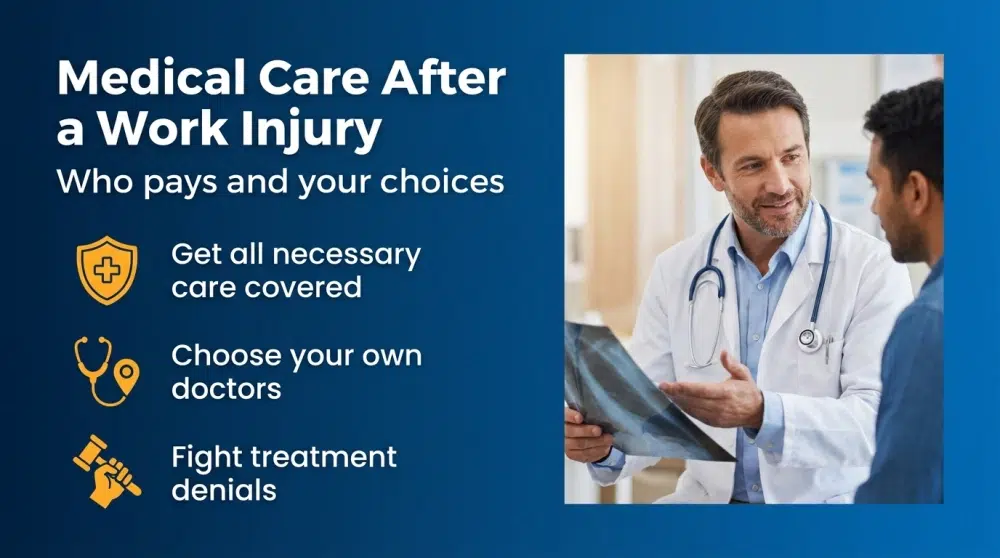
Under the Illinois Workers’ Compensation Act, your employer (through its insurance carrier) is responsible for all reasonable and necessary medical care related to the work injury, with no copays or deductibles charged to you [1]. That includes emergency room visits, hospitalization, surgery, prescriptions, physical therapy, prosthetics, and travel costs for medical appointments. The Illinois Health Care Services Lien Act (770 ILCS 23) governs how providers may assert liens against any settlement, which is a separate layer that affects how much money reaches your pocket [5].
Can I choose my own doctor?
Illinois gives injured workers meaningful choice. Under the Act, you generally have the right to two choices of physician, plus referrals from those doctors. If your employer participates in a Preferred Provider Program (PPP), the rules are slightly different and your initial choices may be drawn from a network. You should always confirm in writing whether a PPP applies before agreeing to see a specific provider.
What if the insurer denies treatment?
Denials are common. Insurers may dispute whether a particular surgery, MRI, or specialist visit is causally related to the work injury. When that happens, you can request an emergency hearing before an arbitrator at the IWCC under Section 19(b) of the Act. A skilled work-injury attorney can move these motions quickly and produce treating-physician testimony to overcome the denial.
What Wage Replacement and Disability Benefits Apply?
What is Temporary Total Disability (TTD)?
If your treating doctor takes you off work entirely, you are entitled to Temporary Total Disability benefits equal to two-thirds of your average weekly wage, subject to statutory minimums and maximums set by the IWCC [3]. TTD is non-taxable. It begins after a three-day waiting period and continues until you are released to return to work or reach maximum medical improvement.
What about partial or restricted-duty work?
If you can return in a light-duty capacity at lower wages, you may receive Temporary Partial Disability (TPD), which covers two-thirds of the difference between your pre-injury and post-injury earnings. Employers are obligated to make a good-faith effort to accommodate medical restrictions. If they refuse and send you home, that refusal can convert your status back to TTD.
What permanent disability benefits exist?
- Permanent Partial Disability (PPD) compensates lasting impairment to a specific body part or the body as a whole, calculated using the AMA Guides and statutory schedules.
- Permanent Total Disability (PTD) applies when the injury prevents any gainful employment, paying lifetime benefits at two-thirds of average weekly wage.
- Wage Differential awards apply when the injury forces a permanent move to a lower-paying job, paying two-thirds of the lost earning capacity until age 67 or five years from the award, whichever is later.
- Vocational Rehabilitation covers retraining costs when the injury prevents return to the prior occupation.
Permanent disability benefits in Illinois are where the largest disputes arise. Insurers routinely undervalue PPD ratings, and the difference between a 15% loss of a leg and a 35% loss of a leg can be tens of thousands of dollars.
What Protections Exist Against Employer Retaliation?
Can my employer fire me for filing a claim?
No. Illinois recognizes a common-law cause of action for retaliatory discharge when an employer fires an employee for exercising rights under the Workers’ Compensation Act. The Illinois Supreme Court established this protection in Kelsay v. Motorola, and it has been reaffirmed and expanded over decades [6]. A fired worker can recover lost wages, emotional-distress damages, and in egregious cases punitive damages.
Retaliation also takes subtler forms: demotion, reduction in hours, reassignment to undesirable shifts, hostile supervision, or refusal to accommodate medical restrictions. Each can support a separate legal claim. Employer retaliation for an injury claim in Illinois is one of the most common employment disputes that reaches the courts.
What federal protections layer on top?
The Family and Medical Leave Act (FMLA) [7] entitles many injured workers to up to 12 weeks of job-protected leave. The Americans with Disabilities Act (ADA) [8] requires reasonable accommodation for qualifying impairments. OSHA’s anti-retaliation rules under Section 11(c) protect workers who report safety hazards or refuse to perform tasks they reasonably believe will cause serious injury [2]. These federal layers run in parallel with the Illinois state remedies and often produce stronger leverage in negotiation.
When Can an Injured Worker File a Third-Party Civil Lawsuit?

What is the third-party exception to exclusivity?
Workers’ compensation is the exclusive remedy against your direct employer in most cases. It is not the exclusive remedy when a separate party (not your employer or a co-worker) caused or contributed to the injury. Common third-party defendants include:
- General contractors and subcontractors on a multi-employer construction site whose negligent supervision or unsafe practices caused the injury.
- Equipment manufacturers whose defective machine, tool, or vehicle caused the harm, opening a product liability claim.
- Negligent drivers who hit a worker performing duties on the road or in a work zone.
- Property owners who failed to warn or repair known hazards on premises where the worker was sent to perform a job.
- Vendors and delivery companies whose drivers cause crashes involving employees on company errands.

How do third-party claims interact with workers’ compensation?
You can pursue both at the same time. The workers’ compensation carrier, however, holds a statutory lien against any third-party recovery for the benefits it has paid, subject to a 25% reduction for attorney fees and a pro-rata share of costs under Section 5(b) of the Act [1]. Coordinating the two recoveries is technical work, and a poorly negotiated lien can swallow most of the third-party award. This is one area where injured worker rights Chicago residents value most depend on having counsel who understands both systems.
What about construction site cases?
Construction injuries in Illinois are particularly likely to involve viable third-party claims because most large job sites have multiple contractors on site. A roofer hurt by a crane operator working for a different subcontractor can file a workers’ comp claim against the roofing employer and a separate negligence claim against the crane company. Construction accident lawyers handle these dual-track cases routinely. In our Chicago construction accident lawyers practice, we see falls from heights, struck-by-object incidents, and electrocutions as the dominant injury patterns, consistent with OSHA’s “Fatal Four” data [2].
What Happens When a Workplace Injury Becomes Fatal?
What benefits go to surviving family?
When a worker dies from a job-related injury or illness, Illinois workers’ compensation provides death benefits to the surviving spouse and dependent children, generally 66 2/3% of the deceased worker’s average weekly wage with statutory minimums and maximums, plus burial expenses up to a capped amount [3]. Benefits continue for a set duration that depends on the dependents’ status.
Can the family also bring a wrongful death lawsuit?
Yes, against third parties. Illinois’ Wrongful Death Act [9] allows the personal representative of the estate to bring a civil claim against any non-employer whose negligence caused the death. Damages can include loss of financial support, loss of society, and grief and sorrow. When a workplace fatality involves a third-party driver, defective equipment, or a separate contractor, the wrongful death claim usually delivers far more compensation than the comp death benefits alone. Our wrongful death lawyers in Chicago coordinate the comp death claim with the civil action so that families do not have to navigate two parallel processes by themselves.
According to the Bureau of Labor Statistics’ Census of Fatal Occupational Injuries, Illinois recorded approximately 184 fatal work injuries in a recent reporting year, with transportation incidents and contact with objects or equipment among the leading causes [4]. Each one of those numbers represents a family suddenly shifted from a two-income household to one, and from planning a future together to planning a funeral.
What Defenses Do Illinois Employers and Insurers Raise?
An honest discussion of workers rights laws has to address the other side of the table. Employers and their insurance carriers are not adversaries because they are evil; they are adversaries because the system pits financial interests against each other. The most common employer and insurer defenses include:
- Causation disputes: arguing the injury was pre-existing, degenerative, or caused by an off-duty event rather than work.
- Notice defenses: claiming the worker did not report within 45 days or did not name the correct supervisor.
- Course-and-scope arguments: contending the injury happened during a personal errand, lunch break off premises, or commute.
- Independent Medical Examinations (IMEs): hiring a defense-friendly physician to challenge the treating doctor’s restrictions or impairment rating.
- Surveillance: investigators record injured workers performing activities that appear inconsistent with their stated limitations.
- Apportionment: assigning a percentage of the impairment to non-work causes to reduce permanent disability awards.
Defendants also have legitimate concerns. Fraudulent claims do exist, and employers carry premium burdens that affect the entire workforce. The proper response is documentation, consistent medical treatment, and accurate reporting on both sides. When you have credible records and credible witnesses, defense tactics lose most of their force.
How Do Federal Worker Rights Laws Apply in Illinois?
What does OSHA require?
The Occupational Safety and Health Act [2] imposes a general duty on employers to furnish a workplace free from recognized hazards. OSHA promulgates specific standards for fall protection, machine guarding, hazard communication, confined-space entry, and many other risks. Workers have a right to file confidential complaints, request inspections, and refuse work they reasonably believe presents an imminent danger of death or serious injury.
What does the FMLA cover?
Eligible employees of covered employers can take up to 12 weeks of unpaid, job-protected leave for a serious health condition, including a workplace injury. Health insurance must be maintained during the leave on the same terms as if the employee were working [7].
What does the ADA require?
The Americans with Disabilities Act requires employers with 15 or more employees to provide reasonable accommodations to qualified employees with disabilities, which can include workplace injuries that result in lasting impairments [8]. Accommodations might include modified equipment, reassignment to a vacant position, or schedule changes. Employers can refuse only if the accommodation would impose an undue hardship.
What Local Considerations Apply for Chicago Workers?
Chicago is the working heart of Illinois, and workplace injury patterns reflect that. Cook County emergency departments treat thousands of work-related injuries each year. Construction in the Loop and along the river, warehousing and logistics in the I-55 and I-294 corridors, manufacturing in the southern suburbs, and food service throughout the city each produce distinct injury profiles.
Chicago workers also benefit from city-specific protections. The Chicago Minimum Wage and Paid Sick Leave Ordinance [10] provides paid sick leave that can supplement workers’ compensation in the early days after an injury, before TTD begins. The Cook County Earned Sick Leave Ordinance offers similar protections in suburban communities such as Evanston, Skokie, Cicero, and Oak Park. For workers in surrounding cities like Naperville, Aurora, Joliet, Elgin, and Rockford, the same Illinois Workers’ Compensation Act applies, but local emergency room access and arbitration venue can differ.
If you are searching for an Illinois workplace injury lawyer, geography matters less than experience with the IWCC and with Cook County civil courts. Hearings are conducted at IWCC arbitration venues across the state, and a Chicago-based legal team handles cases for workers throughout northern Illinois. The personal injury lawyers in Chicago who routinely appear before these arbitrators understand local docket practices that out-of-region counsel often do not.
How Do California Worker Rights Compare?
California operates a workers’ compensation system that shares the no-fault structure with Illinois but differs in important details. California’s reporting window for notice is 30 days, shorter than Illinois’ 45 [11]. California uses a comprehensive medical provider network (MPN) system that tightly controls physician choice, whereas Illinois leaves more room for two free choices. California’s permanent disability ratings use the AMA Guides 5th Edition with a state-specific schedule, producing different dollar outcomes than Illinois on similar injuries.
California also has a stronger statutory scheme for serious-and-willful misconduct claims, allowing a 50% increase in benefits when an employer’s serious and willful misconduct caused the injury under Labor Code Section 4553. Illinois does not have a direct equivalent, though punitive damages remain available in retaliatory-discharge actions. Both states permit third-party civil claims and have active wrongful death statutes.
How Do Texas Worker Rights Compare?
Texas is the major outlier among large states because workers’ compensation is optional for most private employers [12]. An employer that opts out (a “non-subscriber”) loses the immunity from civil suit that the comp system provides; an injured worker can sue the non-subscriber employer directly for negligence, and the employer cannot raise the traditional defenses of contributory negligence or assumption of the risk. That sometimes produces larger recoveries for injured workers in Texas than the equivalent claim would yield in Illinois.
For employers that do subscribe to Texas workers’ compensation, the benefits structure resembles Illinois in design but differs in detail. Texas reporting deadlines are 30 days for notice and one year for filing the claim with the Division of Workers’ Compensation. Texas permits more aggressive use of designated doctors than Illinois.
The practical lesson for injured workers is that jurisdiction drives strategy. The same injury at the same employer might generate a workers’ comp claim in Illinois, a negligence lawsuit in Texas, or a hybrid claim with strong supplemental benefits in California.
How Gosuits Chicago Personal Injury Attorneys Can Help
If you have been hurt at work in Illinois, the next steps you take in the first weeks shape what you can recover months and years later. A free consultation with a Chicago-based injury attorney lets you walk through the facts of your situation, understand which benefits and claims apply, and identify the deadlines that have already started running.
Our firm represents injured workers and their families across Illinois, Texas, and California. We focus on personal injury matters, including workplace injuries, construction site incidents, vehicle collisions, premises liability, product defects, and wrongful death claims. The attorneys on our team bring more than 30 years of combined experience handling serious-injury and fatality cases, including trials and substantial pretrial resolutions. Trial readiness matters because insurers value cases differently when they know the lawyer across the table will actually try the case rather than settle on any terms.
What sets our approach apart is the proprietary technology platform we developed in-house to move cases faster. Our software automates document intake, organizes medical records, tracks lien negotiations, and flags procedural deadlines so nothing falls through the cracks. Clients see the difference in faster updates, cleaner case files, and earlier resolution of issues that traditionally drag claims out for months.
Technology accelerates the work, but it does not replace the lawyer. Every client at our firm has a designated attorney handling the case from start to finish. We do not use case managers as the primary point of contact, and clients have direct access to their attorney, including by cell phone in active matters. You will not be passed from intake staff to a paralegal to a junior associate; you will know who is handling your file and how to reach that person.
Our practice areas include workplace and construction injuries, motor vehicle and commercial-truck collisions, motorcycle crashes, rideshare incidents, premises liability, defective products, catastrophic injury, and wrongful death. We have recovered substantial verdicts and settlements for clients facing similar situations. You can review our prior cases to see the kinds of outcomes we have produced for past clients, learn about the lawyers who would handle your matter on the our attorneys page, read more about the firm on the about us page, and explore the full list of practice areas we cover.
For a deeper procedural walkthrough on what to do after a workplace injury, our knowledge base article on steps to take after a workplace injury a legal overview covers the early-days checklist in more detail.
If you would like to talk through your situation, you can schedule a free consultation with our team. There is no fee unless we recover compensation for you, and the conversation is confidential whether or not you decide to move forward.
References and Resources
- Illinois Workers’ Compensation Act, 820 ILCS 305 – Illinois General Assembly
- Workers’ Rights Under the OSH Act – Occupational Safety and Health Administration
- Illinois Workers’ Compensation Commission – Official Site
- State Occupational Injuries, Illnesses, and Fatalities – U.S. Bureau of Labor Statistics
- Illinois Health Care Services Lien Act, 770 ILCS 23 – Illinois General Assembly
- Kelsay v. Motorola, Inc., 74 Ill. 2d 172 (1978) – Justia
- Family and Medical Leave Act – U.S. Department of Labor Wage and Hour Division
- Disability Discrimination and the ADA – U.S. Equal Employment Opportunity Commission
- Illinois Wrongful Death Act, 740 ILCS 180 – Illinois General Assembly
- Chicago Minimum Wage and Paid Sick Leave Ordinance – City of Chicago
- Information for Injured Workers – California Department of Industrial Relations
- Texas Workers’ Compensation Employer Information – Texas Department of Insurance
- Illinois Comparative Negligence Statute, 735 ILCS 5/2-1116 – Illinois General Assembly
- Workers’ Compensation Information – National Institute for Occupational Safety and Health (NIOSH)
- Workers’ Compensation Overview – Cornell Law School Legal Information Institute