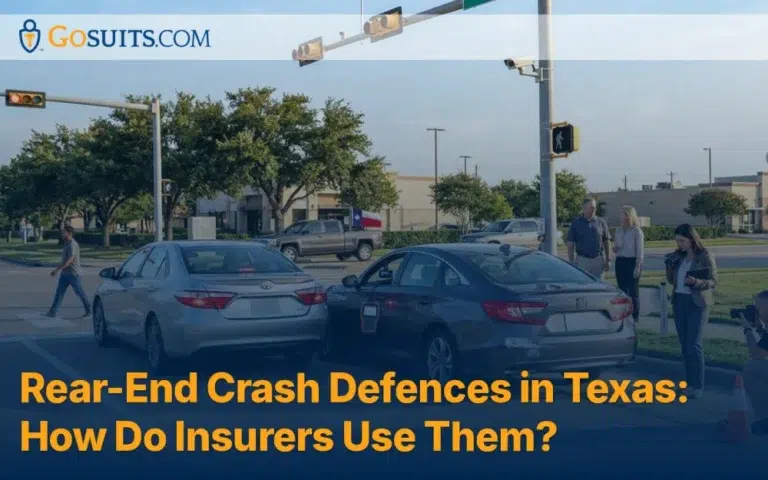
The short answer: In Texas, a driver who strikes another vehicle from behind does not automatically bear full liability. Insurers and defence attorneys routinely deploy specific arguments, including the sudden stop defence, the low property damage argument, brake-light failure, and contributory negligence in chain-reaction collisions, to reduce or eliminate what they pay. Understanding how each argument works and what evidence dismantles it is the most practical thing an injured person can do after a rear-end crash in Dallas or anywhere in Texas.
Legal Snapshot
- Legal Topic: Rear-end collision liability; Texas negligence defences
- Case Stage: Pre-litigation, demand phase, and civil litigation
- Primary Legal Issue: Negligence, comparative fault, causation, and damages in rear-end crash claims
- Primary Authority: Texas Transportation Code § 545.062 (following distance); Texas Civil Practice & Remedies Code Chapter 33 (proportionate responsibility); Texas Pattern Jury Charges
- Date Legal Authority Last Reviewed: July 2025
The Following-Driver Fault Presumption in Texas
Texas Transportation Code § 545.062 requires a driver to maintain an assured clear distance ahead, meaning a driver must follow at a distance that allows them to stop safely in the event traffic in front of them slows or stops.[1] When a rear-end collision occurs, this statute creates a strong factual inference, though not an irrebuttable legal presumption, that the following driver was negligent.
In practice, juries and adjusters treat rear-end crashes as presumptive following-driver fault because the physical circumstances, one vehicle striking the back of another, are consistent with failure to maintain a safe following distance, distracted driving, or excessive speed. The Texas Pattern Jury Charges address negligence in terms of ordinary care, and a following driver who strikes a leading vehicle will face significant difficulty convincing a jury that the crash was not their fault without credible, specific evidence supporting one of the recognised defences.[2]
It matters. If you were rear-ended in Dallas, you’re starting from a spot of relative factual strength on liability, which is not nothing. You’ve still got to establish negligence by a preponderance of the evidence, that burden’s yours. And then things shift. The following driver has to actually put something on the table, an affirmative defence or a competing theory of causation, if they want to reduce their share of fault or wipe it out completely.
Texas runs on modified comparative fault. It’s spelled out in Civil Practice & Remedies Code Chapter 33. [3] The rule’s actually pretty straightforward, at least on paper. Get pegged at 51% or more at fault? You recover nothing. Land under 51% and you still recover, but your damages get shaved down by whatever percentage of fault the jury hangs on you. And this is basically the whole backdrop for the defences below. Every single one of them is trying to do the same thing: push your fault number up. Either above zero, or ideally above that 50% line where you walk away empty-handed.
How Defendants Rebut the Presumption
Defendants in Texas rear-end cases do not need to disprove every element of the plaintiff’s negligence claim. They need only introduce sufficient evidence to support a credible competing theory of fault. Texas courts have recognised several categories of rebuttal evidence.[4]
| Defence Category | What the Defendant Claims | What the Plaintiff Must Counter With |
|---|---|---|
| Sudden stop | The leading vehicle stopped abruptly without warning, giving the following driver no opportunity to react | Evidence of following distance, reaction time physics, brake-light function, and road conditions |
| Sudden emergency | An unforeseeable hazard forced the following driver to act in a way that caused the crash | Evidence that the hazard was foreseeable or that the driver created the emergency through their own negligence |
| Low property damage (MIST) | Vehicle damage was minimal, therefore force was minimal and no significant injury was possible | Medical evidence, biomechanical analysis, and published crash-injury research |
| Brake-light failure | The leading vehicle’s brake lights were not functioning, removing the warning that deceleration was occurring | Post-crash inspection records, witness testimony, dashcam footage |
| Comparative fault (chain reaction) | A third vehicle caused the initial impact, and the plaintiff’s negligence contributed to the chain | Physical evidence, event data recorder data, and witness accounts identifying the initiating collision |
The Sudden Stop Defence Explained
The sudden stop defence is the most frequently used rear-end rebuttal in Texas personal injury cases. The following driver argues that the leading vehicle made an abrupt, unexpected stop that gave insufficient time for a reasonably prudent driver to react and brake.
For the defence to succeed, the defendant typically must show three things:
- The leading vehicle’s stop was sudden rather than gradual.
- The stop was not foreseeable under the circumstances (for example, no visible traffic build-up, no traffic signal, no pedestrian, no prior deceleration pattern).
- The following driver was maintaining a reasonable speed and following distance before the stop occurred.
Texas appellate courts have consistently held that an abrupt stop, standing alone, does not excuse the following driver’s obligation to maintain a safe following distance. The duty under § 545.062 is a continuing one, not discharged simply because the leading vehicle slows faster than expected.[4] The following driver must maintain a cushion adequate for the range of foreseeable traffic conditions, including emergency stops.
The critical role of following distance physics
Human reaction time in an emergency braking scenario averages between 1.5 and 2.5 seconds depending on attentiveness and anticipation.[5] At 60 mph, a vehicle travels approximately 88 feet per second. A driver with a 2-second reaction time travels roughly 176 feet before braking begins. The defendant’s speed and following gap at the moment of impact are therefore central facts in evaluating the sudden stop defence. Accident reconstruction analysis, event data recorder (EDR) data from both vehicles, and road geometry data from the specific collision point all contribute to quantifying whether a reasonably alert driver could have stopped in time.
The Sudden Emergency Doctrine
The sudden emergency doctrine is a distinct Texas common-law defence that applies when a driver, without fault of their own, is confronted with an unexpected peril that leaves insufficient time for deliberate action.[6] The doctrine, if accepted by a jury, assesses the driver’s conduct against the standard of a reasonable person in the same emergency, rather than against normal conditions. It can reduce or eliminate liability if applied successfully.
Two conditions must be met for the doctrine to support a jury instruction in Texas:
- The emergency must have been sudden and unforeseen, not a hazard the driver created or could have anticipated with ordinary care.
- The driver’s response must have been one a reasonable person might have chosen under those specific conditions.
The sudden emergency doctrine is frequently litigated in rear-end cases involving a vehicle cutting in front of the following driver at close range, a pedestrian or animal entering the roadway abruptly, or a large object falling from a truck in heavy traffic. What it does not cover is the driver’s own prior inattention that led to an emergency they created. A driver who was texting, driving too fast, or following too closely when a hazard appeared cannot claim sudden emergency because their own negligence contributed to the emergency.[6]
Plaintiffs facing a sudden emergency argument should gather dashcam footage, witness accounts, and surveillance video to establish what the defendant was doing immediately before the emergency arose. An emergency cannot be unforeseeable if the driver had multiple prior seconds of warning and failed to reduce speed.
The Minor Impact Soft Tissue (MIST) Defence
The minor impact soft tissue defence, commonly abbreviated MIST in Texas litigation, is the argument that minimal vehicle damage proves minimal force, and minimal force means minimal injury. It is one of the most aggressively deployed insurance defence strategies in Texas rear-end claims and one that is most directly contradicted by published medical and biomechanical research.
The argument typically takes this form in an adjuster’s denial letter or a defence expert’s report: the property damage estimate was modest, say $800 to $1,500, therefore the delta-V (the change in velocity of the struck vehicle during the collision) was low, therefore the biomechanical forces experienced by the occupants were insufficient to cause the injuries claimed.
Why the MIST argument is frequently overstated
Modern vehicle bumper systems are specifically engineered to absorb and recover from low-speed impacts without permanent deformation. A bumper that sustains minimal visible damage has still transferred force to the vehicle’s occupants. The energy absorbed by a bumper in a 5 mph impact is not lost; it propagates into the vehicle structure and, through inertia, into the bodies of the occupants, particularly the head and cervical spine.[7]
Several factors affect how much force reaches an occupant in a low-speed rear-end crash:
- Mass differential. When a heavier vehicle strikes a lighter one, a greater proportion of the collision energy transfers to the lighter vehicle’s occupants. A pickup truck striking a compact sedan at the same speed produces different occupant loading than two identical vehicles striking each other.
- Headrest geometry. The distance between a driver’s head and the headrest at the moment of impact determines how much the head accelerates independently of the torso. A poorly adjusted headrest significantly increases cervical whiplash loading.
- Occupant position and muscle tension. An occupant who is turned or was not anticipating the impact experiences different loading than an occupant who is bracing.
- Bumper override or underride. When vehicle bumper heights are mismatched, the bumpers may not engage directly, transferring force through the frame and undercarriage in a mechanically different, often more injurious, pattern.
Texas courts have held that low property damage evidence is admissible and relevant, but it does not establish as a matter of law that the plaintiff was not injured.[4] The plaintiff who is injured in a genuinely low-impact collision on, say, the LBJ Freeway (I-635) near Garland Road is not barred from recovery simply because the bumpers look intact. What that plaintiff must do is present compelling medical and biomechanical evidence that separates the physical reality of injury from the misleading signal of visible damage.
Biomechanical Testimony and the MIST Defence
Biomechanical engineers and accident reconstructionists are retained by both sides in contested MIST cases. The defence expert typically calculates the delta-V of the collision from vehicle crush data, EDR readings, or physical evidence, then compares that delta-V to published injury thresholds to argue the forces were below what the literature associates with soft-tissue injury. The plaintiff’s experts counter by challenging the delta-V calculation, by challenging the relevance of population-level injury thresholds to the specific plaintiff, and by introducing the individual factors that may have made this particular occupant more susceptible to injury at a given force level.
What courts look for in biomechanical opinions
Under Texas evidentiary standards governing expert testimony, a biomechanical expert’s opinion must be based on a reliable methodology applied to the specific facts of the case.[8] A defence expert who simply cites a population-level study showing that most people do not sustain injury at a given delta-V, without accounting for the specific occupant’s age, pre-existing conditions, headrest position, or seating posture, may face a challenge to the admissibility of that opinion. Plaintiffs in Dallas County District Court cases facing MIST defences benefit from biomechanical experts who testify about the individual analysis, not just the statistical average.
Biomechanical testimony pairs most effectively with MRI findings and treating physician opinions that connect the specific crash mechanism to the specific injury pattern. An orthopedic surgeon who testifies that a cervical disc herniation at C5-C6 is consistent with a whiplash-type extension-flexion loading event, confirmed by MRI showing a right-sided disc protrusion compressing the nerve root, provides a medical bridge that makes the biomechanical delta-V argument substantially harder to sustain in front of a jury. Learning more about whiplash and soft-tissue injury claims in Texas can help you understand how MRI evidence and treating physician testimony interact with low-damage defence strategies.
Brake-Light Failure and Visibility Issues
A functioning brake light system is required under Texas Transportation Code § 547.323, which mandates that every motor vehicle be equipped with at least one brake lamp visible from a distance of not less than 300 feet to the rear.[9] A brake-light failure removes the primary warning signal available to a following driver that the leading vehicle is decelerating.
The brake-light defence is most credible when:
- The post-crash inspection or police photographs document a non-functioning brake lamp at the time of the crash.
- The crash occurred at night or in reduced visibility conditions where other cues to deceleration (hazard lights, traffic pattern, road geometry) were diminished.
- Witness testimony supports that the brake light was not visible before the impact.
The defence is weakest when dashcam footage from the following vehicle or a nearby vehicle clearly shows the brake lights activating before impact. It is also weakened significantly if the plaintiff’s vehicle had an EDR that recorded the pre-impact speed and the timeline of the leading vehicle’s deceleration, or if independent witnesses saw the brake lights engaged.
When a plaintiff’s brake-light failure is established, it becomes relevant to comparative fault under CPRC Chapter 33. A jury might apportion some percentage of responsibility to the plaintiff for operating a vehicle with defective equipment that contributed to the following driver’s failure to perceive deceleration in time. Brake-light failure does not, however, relieve the following driver of the duty to maintain a safe following distance that accounts for the possibility of vehicle equipment failures on roads in the Dallas area, a fact that plaintiffs’ counsel will emphasise during closing argument.
Chain-Reaction Rear-End Collisions
Chain-reaction crashes, those involving three or more vehicles in a sequential rear-end series, present the most complex liability questions in Texas rear-end litigation. Stop-and-go traffic on North Texas corridors like I-30 or US-75 (Central Expressway) through Plano regularly produces multi-car pileups in which each successive driver claims to have been pushed by the vehicle behind them or stopped short by the vehicle in front.

Identifying the initiating event
Texas law requires that each defendant’s independent negligence be established.[3] In a three-vehicle chain reaction, Driver 1 is the lead vehicle, Driver 2 strikes Driver 1 from behind, and Driver 3 strikes Driver 2. The plaintiff is typically Driver 1 or Driver 2.
The starting point for analysis is identifying which collision was the initiating event that set the chain in motion. Once the initiating collision is identified, the analysis works forward: did each subsequent driver maintain an appropriate following distance given the traffic conditions? Did Driver 3 have sufficient time and distance to stop after Driver 2’s taillights became visible? These questions are answered by the physical evidence: crush damage patterns, EDR data from all involved vehicles, tyre-mark analysis, witness placement relative to the chain, and dashcam or surveillance footage.
The “empty space” problem
Defendants in middle-position vehicles frequently argue they were “pushed” into the front vehicle by the rear impact and bear no independent liability. Texas courts have rejected this as a categorical defence. Even if Driver 2 was struck by Driver 3, Driver 2’s own following distance at the moment of impact with Driver 1 is still relevant: if Driver 2 was following at an appropriate distance, the rear impact might not have been sufficient to propel Driver 2’s vehicle into Driver 1 at injurious speed. If Driver 2 was already tailgating Driver 1 when struck from behind, Driver 2’s following distance contributed to the forward collision independently of Driver 3’s action.
Texas Civil Practice & Remedies Code Chapter 33 allows the jury to apportion responsibility among all negligent parties, including non-settling parties who are submitted on the jury charge. A plaintiff in a chain-reaction crash may be able to recover against multiple defendants, each bearing a proportionate share, with the plaintiff’s own percentage of fault deducted from the total award provided it remains below 51%.[3]
Medical Evidence That Answers a Low Property Damage Argument
When an insurer deploys the MIST argument, the most effective counter is a combination of immediate post-crash medical presentation, diagnostic imaging, and consistent treatment records that collectively establish that the injury occurred, was caused by the crash, and has persisted despite treatment.
Immediate medical documentation
The time between a crash and a plaintiff’s first medical visit is scrutinised heavily in low-damage cases. A plaintiff who sought care at an emergency room or urgent care within hours of the collision has a contemporaneous record establishing symptom onset before any delay could be construed as inconsistency. Adrenaline and the sympathetic stress response can mask pain perception immediately following a crash; neck stiffness, headache, and radiating arm symptoms often become most pronounced 24 to 72 hours after the event. A physician who documents the delayed-onset nature of soft-tissue symptoms provides important context.
MRI findings
MRI is the gold standard imaging modality for soft-tissue injury. X-rays, which insurers may point to as showing “no acute bony abnormality,” are essentially irrelevant to the diagnosis of cervical disc herniation, facet joint injury, or ligament sprain. A cervical MRI that documents a new disc herniation at C5-C6 with right-sided nerve root compression, not present on any prior imaging, is objective medical evidence of structural injury that a simple bumper repair estimate cannot address. The plaintiff’s treating physician’s opinion connecting the MRI findings to the crash mechanism and to the plaintiff’s reported symptoms is the evidentiary bridge between the imaging and the liability claim.
Functional capacity evaluations and impairment ratings
When injuries persist beyond the acute phase, a functional capacity evaluation (FCE) documents objectively what the plaintiff can and cannot do in relation to the demands of their employment and daily activities. An FCE performed by a licensed physical therapist, combined with a treating physician’s impairment rating under the American Medical Association Guides, provides the economic foundation for lost earning capacity claims and future medical damages, even in cases where the property damage was minimal.
Treatment consistency
Gaps in medical treatment are as damaging in MIST cases as in any other soft-tissue claim. An insurer reviewing records that show a plaintiff attended physical therapy twice then missed the next six weeks has a ready argument that the condition resolved quickly after the crash and that later care addresses a different problem. Consistent, documented treatment with clear chart notes explaining any gaps (financial hardship, work schedule, transportation difficulty) is the most defensible medical record pattern in a low-impact rear-end case.
Evidence That Matters in a Texas Rear-End Claim
Regardless of which defences are raised, the following categories of evidence are routinely outcome-determinative in Texas rear-end cases:
- Police report. Documents the investigating officer’s assessment of fault, the positions of the vehicles, and any citations issued. A citation to the following driver for following too closely or inattention strongly supports the plaintiff’s liability narrative.
- Event data recorder (EDR/black box) data. Both vehicles may carry EDRs that record speed, brake application, throttle position, and seatbelt status in the seconds before impact. EDR data often directly refutes or corroborates the sudden stop and following distance defences.
- Dashcam footage. Video of the moments leading up to the crash establishes following distance, brake-light visibility, and road conditions with a precision that witness memory cannot match.
- Surveillance and traffic camera footage. Intersections, parking lots, and highway entrance ramps near the crash site may have recorded the collision or the seconds immediately preceding it.
- Photographs and vehicle inspection reports. Post-crash photographs of all vehicles establish the location and extent of damage. In MIST cases, photographs showing minimal visible damage require supplementation with engineering reports that explain the energy dynamics.
- Witness statements. Independent witnesses who observed the vehicles’ relative speeds, following distances, and brake-light activity before impact are often the most credible evidence on the sudden stop and brake-light defences.
- Medical records and imaging. The treating physician’s notes, diagnostic imaging reports, and referral records document the injury, its onset, and its progression over time.
- Expert opinions. Accident reconstruction engineers, biomechanical engineers, treating physicians, and vocational experts each address different components of liability and damages. In contested rear-end cases, at least one expert opinion in each area is typically necessary to meet the evidentiary standards of a Dallas County District Court trial.
Damages and Remedies
Texas law recognises the following categories of compensable damages in a rear-end personal injury claim. The availability and amount of each depend on the facts and the strength of the supporting evidence:
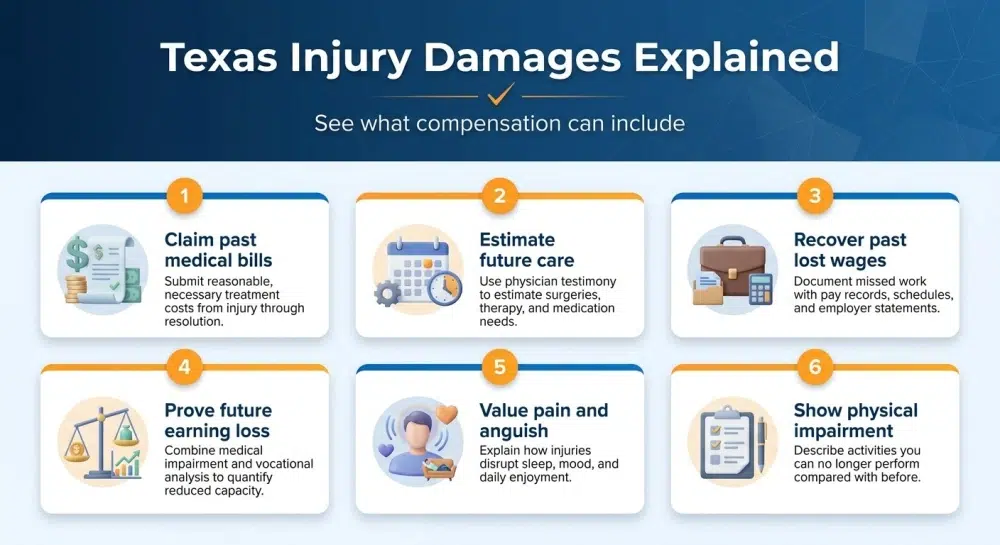
- Past medical expenses. Reasonable and necessary costs of medical care received from the date of the crash through the date of trial or settlement.
- Future medical expenses. Projected costs of ongoing treatment, surgery, physical therapy, or medication based on expert medical testimony.
- Past lost income. Wages, salary, self-employment income, or earning opportunity lost between the date of injury and the date of trial.
- Future lost earning capacity. Reduction in the plaintiff’s ability to earn income caused by permanent impairment, established through vocational expert and medical testimony.
- Physical pain and mental anguish (past and future). Compensation for the subjective experience of pain and psychological distress caused by the injury and its aftermath.
- Physical impairment (past and future). Compensation for loss of the ability to perform activities the plaintiff was capable of performing before the injury.
- Disfigurement (past and future). Where applicable, compensation for permanent scarring or altered physical appearance.
- Property damage. Cost to repair or replace the plaintiff’s vehicle.
Each category of damages must be proven by the preponderance of the evidence. Non-economic damages, particularly pain and mental anguish, are not capped in ordinary personal injury cases in Texas, though different rules apply to certain government defendants and medical malpractice claims.
If you or a loved one suffered a fatal injury in a Dallas-area rear-end crash, wrongful death lawyers on our Dallas team can explain the claims available to surviving family members under Texas Civil Practice & Remedies Code Chapter 71.[10]

Deadlines: The Texas Statute of Limitations
The general statute of limitations for personal injury claims in Texas is two years from the date of the injury, established by Civil Practice & Remedies Code § 16.003.[11] For a rear-end crash, the clock begins running on the date of the collision. Filing a lawsuit after the two-year deadline will, absent a narrow tolling exception, result in dismissal regardless of the strength of the liability case.
Several exceptions and shorter deadlines apply in specific circumstances:
- Government defendant. Claims against a Texas governmental entity (a city bus, for example) require written notice within six months of the incident under the Texas Tort Claims Act, and must be filed in compliance with Chapter 101’s procedural requirements.[12]
- Minor plaintiff. The two-year period is tolled until the minor reaches age 18, at which point the two-year clock begins, meaning the minor generally has until their 20th birthday to file.
- Discovery rule. In limited circumstances, where an injury was not and could not have been reasonably discovered at the time of the crash, the limitations period may run from the date of reasonable discovery rather than the date of the event. This exception is narrow and fact-specific.
Treating the two-year deadline as a deadline to file a lawsuit, not a deadline to contact an attorney, is the safest approach. Building the necessary evidence for a contested rear-end case, particularly one involving MIST defences, biomechanical analysis, and expert medical opinions, requires significant time before the complaint is filed. [DEADLINE REQUIRES LEGAL VERIFICATION for claims involving government entities or minor plaintiffs.]
A rear-end crash claim in Dallas involves liability disputes, insurance negotiations, and deadlines that can permanently affect what you recover. A GoSuits personal injury attorney can review the specific facts of your case, identify which defences the insurer is likely to deploy, and explain what evidence you need to answer them.
What to Do Next
If you were injured in a rear-end collision in the Dallas area, several immediate steps protect both your health and your legal claim:
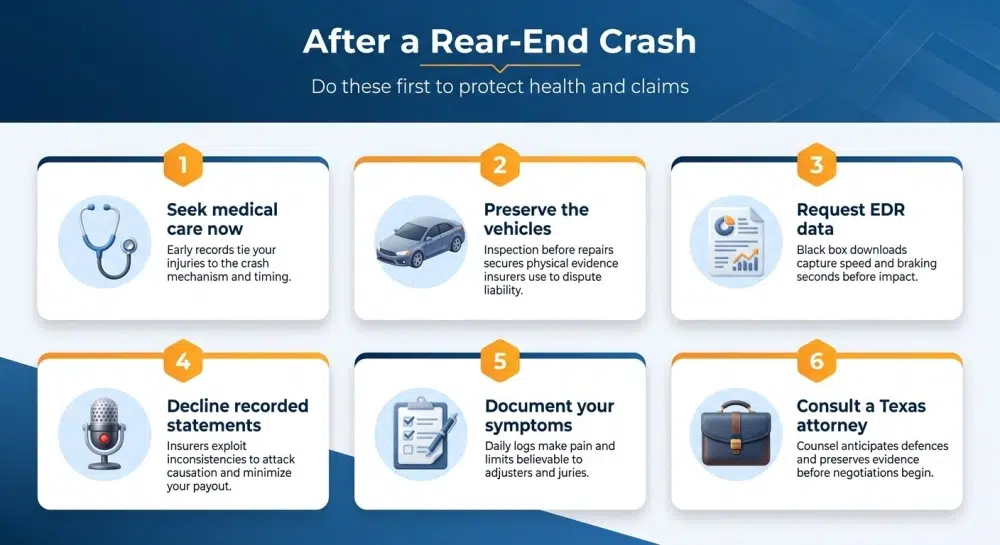
- Seek medical evaluation promptly. Delayed symptom onset is well-documented in rear-end crashes. Seek care within 24 hours and describe the crash mechanism clearly to the treating physician so it is documented in the chart.
- Preserve the vehicles. Before any repair is made, request that the vehicles be preserved and inspected by an expert. Once repaired, the physical damage evidence that refutes or supports a MIST argument is lost.
- Request EDR data. EDR data can be overwritten when a vehicle is repaired or in subsequent driving events. A litigation hold letter or preservation demand must go to the at-fault driver and their insurer quickly.
- Obtain the police report. The Dallas Police Department and Texas Department of Public Safety both maintain crash reports. Your attorney can help you obtain the complete record, including any supplements filed by the investigating officer.
- Do not give a recorded statement to the other driver’s insurer. Adjusters use recorded statements to identify inconsistencies that support MIST and sudden stop defences. You are not legally obligated to give one. Speak with an attorney first.
- Document your symptoms. Keep a daily log of your pain levels, limitations, and how the injury affects your work and daily activities. This contemporaneous record is often more credible to juries than reconstructed testimony about the distant past.
- Consult a personal injury attorney. The defences discussed in this article are well-established. An attorney who handles Texas rear-end cases regularly will recognise which defences apply to your specific facts and build the evidentiary record needed to counter them before litigation begins.
Our Dallas personal injury team handles rear-end collisions, truck accident matters on I-35E and I-20, and other serious crash cases throughout the Dallas-Fort Worth metro. Visit our attorneys page to learn about the attorneys who would handle your case, or review our prior cases for an overview of the types of matters we have resolved. For a complete list of practice areas, see our practice areas page. For a broader overview of how the Dallas personal injury claim process works from crash to resolution, our personal injury lawyers in Dallas are available for a no-cost initial consultation.
References
- Texas Transportation Code § 545.062, Following Distance – Texas Statutes (statutes.capitol.texas.gov)
- Texas Pattern Jury Charges and Court Rules – Texas Judicial Branch (txcourts.gov)
- Texas Civil Practice & Remedies Code Chapter 33, Proportionate Responsibility – Texas Statutes (statutes.capitol.texas.gov)
- Littles v. Smith, No. 14-18-00493-CV – Texas Court of Appeals, 14th District (2019) (courtlistener.com)
- Federal Judicial Caseload Statistics – United States Courts (uscourts.gov)
- Sudden Emergency Doctrine – Legal Information Institute, Cornell Law School (law.cornell.edu)
- Negligence – Legal Information Institute, Cornell Law School (law.cornell.edu)
- Texas Court Rules and Evidentiary Standards – Texas State Law Library (guides.sll.texas.gov)
- Texas Transportation Code § 547.323, Brake Lamp Requirements – Texas Statutes (statutes.capitol.texas.gov)
- Texas Civil Practice & Remedies Code Chapter 71, Wrongful Death – Texas Statutes (statutes.capitol.texas.gov)
- Texas Civil Practice & Remedies Code § 16.003, Two-Year Limitations Period – Texas Statutes (statutes.capitol.texas.gov)
- Texas Tort Claims Act, Chapter 101 – Texas Statutes (statutes.capitol.texas.gov)