
- What is whiplash, and how do courts treat it as an injury?
- Why does soft-tissue damage not show on X-ray?
- What imaging and evaluations actually document soft-tissue injuries?
- What causes delayed neck pain after a Dallas crash?
- Does low property damage mean low injury in Texas?
- How do treatment gaps hurt a soft-tissue injury claim?
- What is a functional capacity evaluation, and when does it matter?
- What arguments do defendants use to undervalue soft-tissue claims?
- What is the deadline to file a soft-tissue injury claim in Texas?
- How GoSuits Dallas Handles Soft-Tissue Injury Cases
- Frequently Asked Questions
- References
What is whiplash, and how do courts treat it as an injury?
Whiplash is a neck injury caused by a sudden, forceful back-and-forth movement of the head and cervical spine, similar to the motion of a cracking whip. [1] It most commonly follows a rear-end collision, though side-impact crashes and T-bone accidents on North Texas corridors like I-35E or the LBJ Freeway (I-635) can produce the same loading pattern on the cervical spine.
The injury is not limited to the neck. Whiplash often involves the muscles, tendons, ligaments, discs, and nerve roots of the entire cervical region, and it can extend into the thoracic and lumbar spine. These are all categorized as soft-tissue injuries: damage to the body’s connective tissues and muscles rather than to bone. Because they involve no fracture or visible structural failure on standard imaging, they are routinely undervalued in insurance negotiations.
In Texas civil courts, whiplash and broader soft-tissue injuries are recognized as compensable personal injury claims when causation is properly established. Plaintiffs must prove, under a preponderance of the evidence standard, that the defendant’s negligence caused the collision and that the collision caused the injury. [2] Texas follows a modified comparative fault rule, meaning a claimant who is 51% or more at fault cannot recover. [3] Defendants frequently challenge both causation and the extent of injury in soft-tissue cases, which is why thorough documentation from the outset is so important.
If you have been injured in a collision in the Dallas area and wonder whether your soft-tissue injury claim has value, speaking with personal injury lawyers who handle these disputes every day is the most useful first step – not interpreting an adjuster’s early offer.
Why does soft-tissue damage not show on X-ray?
X-rays produce images by passing radiation through the body and recording which tissues absorb more or less of it. Dense structures, primarily bone, block radiation effectively and show up bright white. Soft tissues, including muscles, ligaments, tendons, and intervertebral discs, allow most radiation to pass through and therefore appear only as faint shadows, if at all.
When a ligament is sprained, micro-tears occur at the fibrous level. When a muscle is strained, individual fibers are disrupted. Neither type of damage alters the mineral density that X-ray depends on to create contrast. The result is a radiograph that looks entirely normal while the patient is experiencing significant pain, restricted motion, and functional limitations.
This gap between objective findings and subjective symptoms is exactly what insurance carriers exploit after a Dallas crash. An adjuster may receive a radiology report noting “no acute bony abnormality” and close the file with a minimal settlement offer, arguing the injured person cannot be significantly hurt if the imaging is clean. The reasoning is medically inaccurate but financially convenient for the insurer.
Courts in Texas have addressed this tension. The fact that X-rays are negative does not defeat a soft-tissue injury claim; it simply shifts the burden of documentation to other modalities and functional assessments. [4] The claim does not disappear because a bone is intact. It requires a different evidentiary strategy.
What imaging and evaluations actually document soft-tissue injuries?
Magnetic Resonance Imaging (MRI)
MRI is the gold standard for visualizing soft tissue after a crash. Unlike X-ray, MRI uses magnetic fields and radio waves to produce detailed images of muscles, tendons, ligaments, and intervertebral discs. Disc herniations, disc bulges pressing on nerve roots, ligament tears, and muscle edema are all visible on MRI where X-ray shows nothing.
A cervical MRI performed after a whiplash injury can reveal disc pathology that directly explains neck pain, radiating arm pain, or headaches. A lumbar MRI can show whether a low-impact crash aggravated a pre-existing disc condition or created a new one. These findings give treating physicians a structural basis for the symptoms and give your claim a documented, objective anchor that adjusters cannot dismiss as easily.
One caution: MRI findings must be interpreted alongside clinical presentation. Incidental findings, disc changes that pre-date the crash, exist in a meaningful portion of adults and are not themselves evidence of crash-related injury. Your physician’s role is to distinguish pre-existing and acute findings through clinical correlation.
CT Scan
Computed tomography provides higher bone detail than X-ray and can detect subtle fractures that plain films miss. In soft-tissue cases, CT is often used to rule out bony injury rather than to document muscle or ligament damage. A CT myelogram, in which contrast dye is injected into the spinal canal, can visualize disc herniation and nerve compression with high precision when MRI is contraindicated or inconclusive.
Diagnostic Ultrasound
Musculoskeletal ultrasound is an increasingly available, real-time tool for evaluating tendons and muscles. A skilled technician can visualize tendon tears, muscle hematomas, and bursal inflammation that standard imaging misses. It is less commonly ordered than MRI in crash cases but can provide useful supplemental documentation, particularly for shoulder and extremity soft-tissue injuries.
Nerve Conduction Studies and Electromyography (NCS/EMG)
When the crash caused nerve compression or injury, NCS/EMG studies measure the electrical activity of nerves and muscles. These tests document radiculopathy, the radiating pain and numbness that follows when a herniated disc impinges a nerve root, and peripheral nerve injury. Because nerve conduction abnormalities are objectively measured, the results are difficult to dismiss as purely subjective.
From a Dallas car accident claim perspective, an EMG that confirms L4-L5 radiculopathy is a significant piece of evidence. It gives the treating physician, the neurosurgeon, and the jury something concrete to evaluate. car accident lawyers who regularly handle crash cases know that absent this type of objective support, low-impact defense arguments are much harder to counter.
Functional Capacity Evaluations
A functional capacity evaluation (FCE) is addressed in detail in its own section below, but it belongs in this list because it is the primary tool for documenting the functional dimension of a soft-tissue injury. While MRI shows structure, an FCE shows what a person can actually do at work and in daily life given their injury.
What causes delayed neck pain after a Dallas crash?
One of the most misunderstood phenomena in crash medicine is the delayed appearance of symptoms. A driver or passenger involved in a rear-end collision on the Dallas North Tollway may walk away from the scene feeling only mildly shaken. By the next morning, or sometimes two to three days later, they wake with severe neck stiffness, headaches, and difficulty turning their head. This pattern is not fabricated – it has a physiological basis.
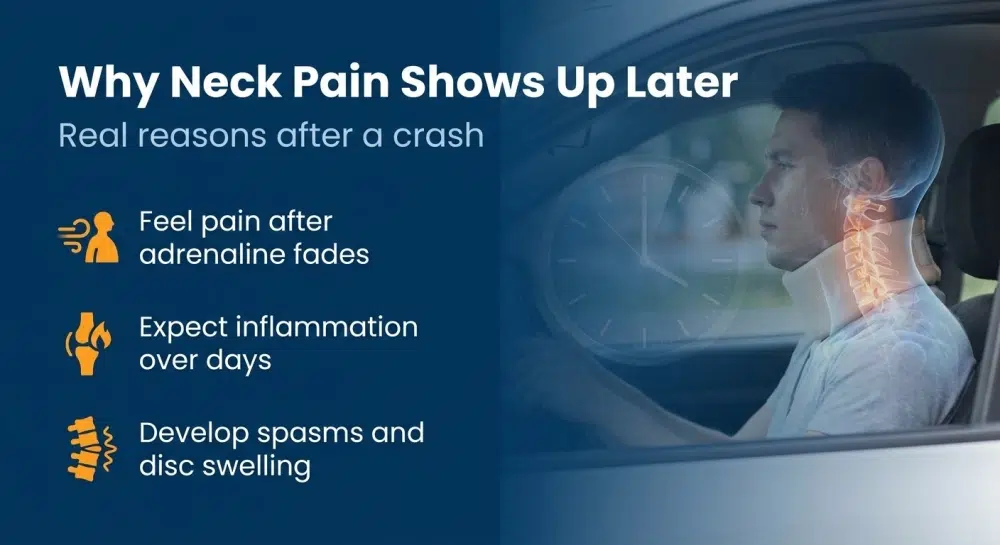
Several mechanisms contribute to delayed-onset symptoms:
- Adrenaline and the sympathetic response. During and immediately after a collision, the body releases catecholamines that act as natural pain suppressants. These stress hormones keep pain perception low during the immediate post-crash period. As hormone levels normalize over hours and days, pain that was already present begins to register.
- Inflammatory cascade. Soft-tissue trauma triggers an inflammatory process. Swelling, prostaglandin release, and nerve sensitization develop progressively over 24 to 72 hours after injury, which is why peak pain often does not arrive until the day or two after the event.
- Muscle guarding and secondary spasm. The body responds to cervical ligament injury by contracting surrounding muscles protectively. These secondary muscle spasms can become more painful than the original ligament strain and typically peak in the days following the crash.
- Disc inflammation. Intervertebral disc injuries may not produce immediate radiculopathy. As the disc swells and nucleus pulposus material contacts nerve root tissue, radiating pain and numbness can develop over a period of days to weeks.
Delay in symptoms is also delay in seeking care – and that gap creates a serious problem for any claim. Texas courts and insurance adjusters will scrutinize the time between the crash and a plaintiff’s first medical visit. If you felt fine the day of a crash on I-30 but developed significant neck pain two days later, the delay in treatment does not mean the injury is less real. It does mean the documented medical record needs to explain that gap clearly.
Does low property damage mean low injury in Texas?
This is one of the most persistent and harmful misconceptions in Texas crash litigation. Defense attorneys and insurance carriers frequently argue that minimal vehicle damage proves minimal force, and therefore minimal injury. The argument has a simple logic: if the bumper shows little damage, the occupant could not have absorbed enough energy to be hurt. Texas courts have allowed this argument, but they have also recognized its limitations.
The relationship between vehicle damage and occupant injury is not linear, and biomechanics research has documented why. Several factors explain why low-speed collisions can produce significant soft-tissue injury:
- Modern bumper design. Today’s bumpers are engineered to absorb and recover from low-speed impacts with minimal visible damage. A bumper that springs back to its original shape has still transferred force to the vehicle frame and, through it, to the occupants.
- The struck vehicle’s mass and stiffness. When a heavier or stiffer vehicle strikes a lighter one, more of the collision energy is transferred to the occupant of the lighter car rather than absorbed in structural deformation.
- Head restraint position. The distance between a driver’s head and the headrest at impact determines how much unrestrained cervical motion occurs. A poorly positioned headrest allows greater acceleration of the head relative to the torso, increasing the rotational forces on the cervical spine even at low delta-V.
- Occupant position and awareness. A driver who sees a crash coming and tenses their neck muscles often fares better than one struck from an unexpected direction, such as a merge-related side-impact on I-35E, where the head may be turned at the moment of impact.
The Texas Supreme Court has held that plaintiffs may present evidence of injury even when vehicle damage is minimal. [5] However, low-property-damage arguments are an established defense strategy that defense counsel in Dallas County District Court cases regularly deploy. Our Dallas personal injury team understands how to counter this argument with appropriate biomechanical evidence and medical documentation.
Conversely, defendants who face a genuine low-impact crash with exaggerated injury claims also have legitimate grounds to challenge causation. The analysis must be fact-specific on both sides.
How do treatment gaps hurt a soft-tissue injury claim?
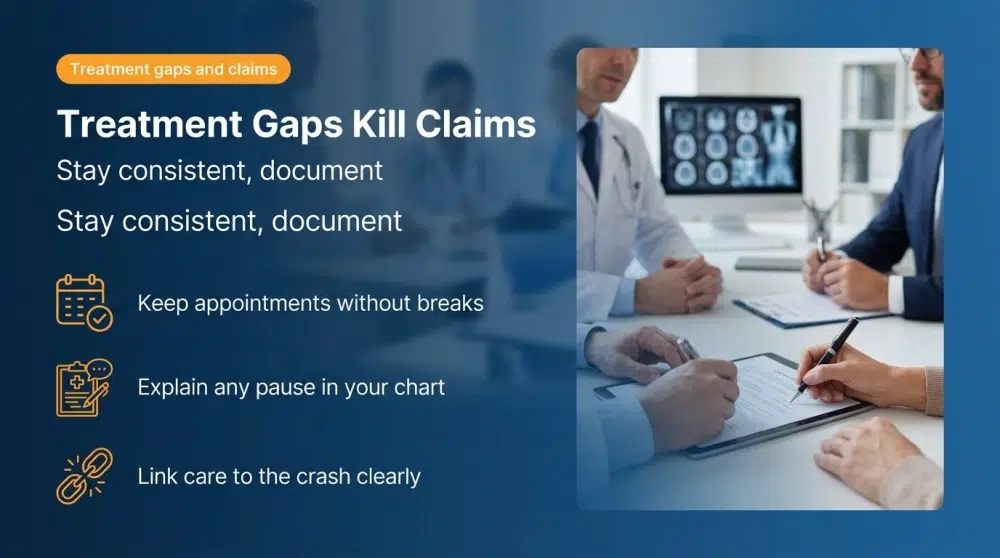
A treatment gap is any extended period during which an injured person stops attending medical appointments and then resumes, or stops treatment entirely before reaching maximum medical improvement. These gaps are among the most damaging elements in a soft-tissue claim, and insurance carriers actively search for them when reviewing medical records.

Why gaps matter legally
Texas law requires plaintiffs to establish that the injuries claimed are causally related to the crash and that the medical care received was reasonable and necessary. [6] A defense attorney will argue that a gap in treatment demonstrates one or more of the following:
- The injury resolved. If a plaintiff stopped seeing a doctor for eight weeks and then resumed, the defense will argue the condition had healed and the later care addressed a different, unrelated problem.
- The plaintiff was not actually in pain. Sustained, significant pain typically drives consistent treatment seeking. Extended periods without care are characterized as inconsistent with the level of suffering the plaintiff claims.
- The later medical expenses are not crash-related. Adjusters routinely use gaps to sever the causal chain between the collision and subsequent bills, reducing the claimed damages.
Common reasons for gaps – and why they still create risk
People stop treatment for understandable reasons: loss of insurance coverage, inability to take time off work to attend appointments, recovery of the vehicle while the body is still being treated, or the genuine belief that they are improving and no longer need care. None of these reasons eliminate the legal damage that the gap creates.
If you live in Plano, Carrollton, or any part of the Dallas-Fort Worth metro area and you find your treatment faltering due to cost or logistics, those are facts that should be documented in your medical record by your treating physician. A chart note explaining that treatment was delayed due to financial hardship is far more defensible than a silent six-week gap.
The “come and go” pattern
Soft-tissue pain often follows a non-linear recovery course. Patients may feel better after a course of physical therapy, return to normal activities, and then experience a flare-up triggered by extended sitting, a particular motion, or cold weather. Defense counsel frames these flare-ups as new injuries rather than continuation of the original one. Consistent documentation that addresses the episodic nature of chronic soft-tissue pain – particularly from a treating neurologist or pain management physician – is the most reliable counter-argument.
What is a functional capacity evaluation, and when does it matter?
A functional capacity evaluation (FCE) is a structured, multi-hour assessment conducted by a licensed physical or occupational therapist to measure a person’s actual physical abilities in relation to the demands of their job and daily life. It goes far beyond what an X-ray or MRI can show because it measures function: how far a person can walk, how much they can lift, whether they can sustain a seated work posture, and how their performance compares to baseline occupational standards.
In soft-tissue injury claims, particularly those involving significant or permanent impairment, an FCE serves several functions:
- Establishes work capacity limitations. When an injured worker or crash victim is unable to return to their previous occupation, an FCE provides objective documentation of what they can and cannot do. This directly informs lost earning capacity calculations.
- Evaluates consistency. FCEs include validity measures to assess whether the person’s self-reported limitations are consistent with observed performance. A valid FCE that confirms a claimant cannot perform the demands of their job carries significant weight with a jury.
- Supports treatment planning. Treating physicians use FCE results to establish work restrictions and guide ongoing rehabilitation planning through maximum medical improvement.
- Documents permanency. When an FCE is performed after a person has reached maximum medical improvement, its findings establish the permanent baseline of functional limitation that forms the core of future damages calculations.
For Dallas plaintiffs whose soft-tissue injuries have prevented them from returning to construction work, driving, or office employment, an FCE connected to the treating physician’s records is a substantial evidentiary asset. For defendants, an FCE that shows full functional capacity is equally valuable in disputing claimed limitations.
If your treating team has not discussed an FCE and you have significant functional limitations from a crash injury, that is worth raising with your attorney. An understanding of how normal scan results interact with injury claims in Dallas is directly relevant to how an FCE fits into the broader evidentiary picture.
What arguments do defendants use to undervalue soft-tissue claims?
Understanding the defense playbook helps you avoid the mistakes that make those arguments work.
Pre-existing conditions as a liability shield
Defense counsel will obtain all prior medical records and argue that any cervical or lumbar pathology visible on post-crash imaging pre-dated the collision. Texas follows the “eggshell plaintiff” doctrine, meaning a defendant takes the plaintiff as they find them – a pre-existing degenerative disc does not eliminate recovery if the crash aggravated the condition. [7] However, this protection requires clear medical evidence distinguishing the pre-existing baseline from the crash-related aggravation.
Surveillance and social media activity
Insurance carriers routinely conduct surveillance on claimants in soft-tissue cases. A photograph of a plaintiff carrying groceries or a social media post showing activity inconsistent with reported limitations is used aggressively at deposition and trial. This does not mean injured people must stop living their lives, but it does mean the gap between what you claim you cannot do and what is observable must be consistent and explainable by the episodic nature of soft-tissue pain.
Independent medical examinations
Defendants in Texas litigation may request an independent medical examination (IME) by a physician of their choosing. [8] Despite the “independent” label, IME physicians in defense-retained examinations have a documented tendency to minimize injury findings. Understanding that the IME report is an adversarial document – not an objective medical opinion – is necessary for framing your own treating physician’s opinions as the primary medical evidence.
Attacking the treating physician’s methodology
When a soft-tissue claim proceeds to the Dallas County District Court, defense experts may challenge whether the treating physician’s causation opinion is based on a reliable methodology under Texas evidentiary standards. [9] Treating physicians who document causation reasoning contemporaneously, connect the crash mechanism to the injury type, and address alternative explanations create a more defensible foundation than those who simply note “patient injured in MVA.”

What is the deadline to file a soft-tissue injury claim in Texas?
Texas Civil Practice & Remedies Code § 16.003 provides a two-year statute of limitations for personal injury claims. [10] The clock generally begins on the date of the collision. If you were involved in a crash on a Dallas-area highway and have not filed a civil lawsuit within two years of that date, you may be permanently barred from recovery – regardless of the strength of your injury evidence or the clear liability of the other driver.
Two years sounds like a long time, but the practical demands of soft-tissue claims compress that window considerably. Gathering complete medical records, completing treatment or reaching maximum medical improvement, obtaining expert opinions, and filing a formal petition at the George L. Allen Sr. Courts Building for Dallas County District Court all require time that disappears faster than most people expect.
There are narrow exceptions to the two-year rule – claims involving governmental defendants, for example, require pre-suit notice within six months of the incident under the Texas Tort Claims Act [11] – but those exceptions are narrow and strictly applied. The safest approach is to treat the two-year general limit as an outer boundary, not a comfortable default.
A whiplash injury claim in Texas that is otherwise well-documented will fail completely if it is filed one day after the limitations period expires. Time is not a soft consideration in this analysis.
How GoSuits Dallas Handles Soft-Tissue Injury Cases
Soft-tissue injury claims are among the most contested in Texas civil litigation. Insurance carriers know that visible imaging gaps, treatment gaps, and low property damage arguments are powerful tools against unrepresented claimants or those whose medical records are poorly developed. Building a claim that survives those challenges requires disciplined documentation, consistent medical follow-through, and legal strategy that anticipates defense arguments before they are made.
GoSuits combines proprietary litigation technology with the kind of attorney-direct access that is rare in personal injury practice. Our attorneys handle cases throughout Texas, California, and Illinois. Every client has a designated attorney – not a case manager, not a paralegal relay – with direct access throughout the life of their case. That means when your treating physician’s records arrive, when the IME report comes in, or when the defense makes a settlement offer based on a low-property-damage argument, you speak directly to the attorney making strategic decisions about your case.
Our proprietary software accelerates the evidence-gathering and case-evaluation process, allowing our attorneys to analyze medical timelines, identify treatment gaps early, flag causation documentation issues, and prepare demand packages with more precision than traditional case management methods allow. Technology in our hands is a tool for better attorney work – it does not replace the attorney relationship.
Our attorneys have 30 years of combined experience representing injured people in car accident claims, truck accident matters, workplace injuries, and other serious personal injury cases. That trial experience matters in soft-tissue cases specifically: the realistic possibility that a case will proceed to a Dallas County District Court jury changes how insurance carriers evaluate settlement demands. Adjusters do not discount claims the same way when they know the attorneys on the other side are prepared for trial.
We have recovered significant outcomes for clients injured in crashes across the Dallas-Fort Worth area, including cases involving whiplash injury claims in Texas where initial adjuster offers were a fraction of what the evidence ultimately supported. You can review a selection of our prior cases to understand the range of matters we have handled.
If you were injured in a Dallas-area collision and are dealing with soft-tissue symptoms, disputed imaging, a treatment gap, or a low-property-damage argument from the other driver’s insurer, a free consultation with our team gives you a clear picture of how your claim is positioned. Visit our attorneys page to learn more about who would be working on your case, or read more about our approach on our about us page.
We also handle the full range of Dallas personal injury matters – from truck crashes on I-20 to premises liability and work injuries. You can see a complete list on our practice areas page.
injury claims stall when documentation is thin and treatment is inconsistent. The earlier a skilled attorney reviews your case, the earlier any gaps can be addressed. Schedule a free consultation with our Dallas team today.
References
- Whiplash Definition – Legal Information Institute, Cornell Law School
- Texas Civil Practice & Remedies Code Chapter 33 – Proportionate Responsibility – Texas Statutes
- Texas Modified Comparative Fault 51 Percent Bar – GoSuits Knowledge Base
- Torres v. Garcia et al., No. 13-23-00105-CV – Texas Court of Appeals, 13th District (2024)
- Flores v. Ochoa, No. 09-21-00384-CV – Texas Court of Appeals, 9th District (2024)
- Texas Civil Practice & Remedies Code Chapter 18 – Evidence – Texas Statutes
- Texas Rules of Evidence – Texas Judicial Branch
- Texas Rules of Civil Procedure (Rule 204 – Physical and Mental Examination) – Texas Judicial Branch
- Texas Court Rules Guide – Texas State Law Library
- Texas Civil Practice & Remedies Code § 16.003 – Two-Year Limitations Period – Texas Statutes
- Texas Tort Claims Act (Tex. Civ. Prac. & Rem. Code Chapter 101) – Texas Statutes
- Federal Judicial Caseload Statistics – United States Courts
- Negligence – Legal Information Institute, Cornell Law School