
- Why do CT scans and MRIs so often miss a mild traumatic brain injury?
- What does diffusion tensor imaging actually show that a standard MRI does not?
- What does neuropsychological testing measure, and why does it matter in a brain injury claim?
- How do accounts from family members and coworkers prove cognitive and behavioral change?
- What should a symptom diary record, and why is that detail so important?
- What is post-concussion syndrome, and how is it documented for a civil claim in Dallas?
- How does Texas civil law treat a brain injury claim when imaging is normal?
- Frequently Asked Questions
- How GoSuits Dallas Handles Brain Injury Claims
- References
Why do CT scans and MRIs so often miss a mild traumatic brain injury?
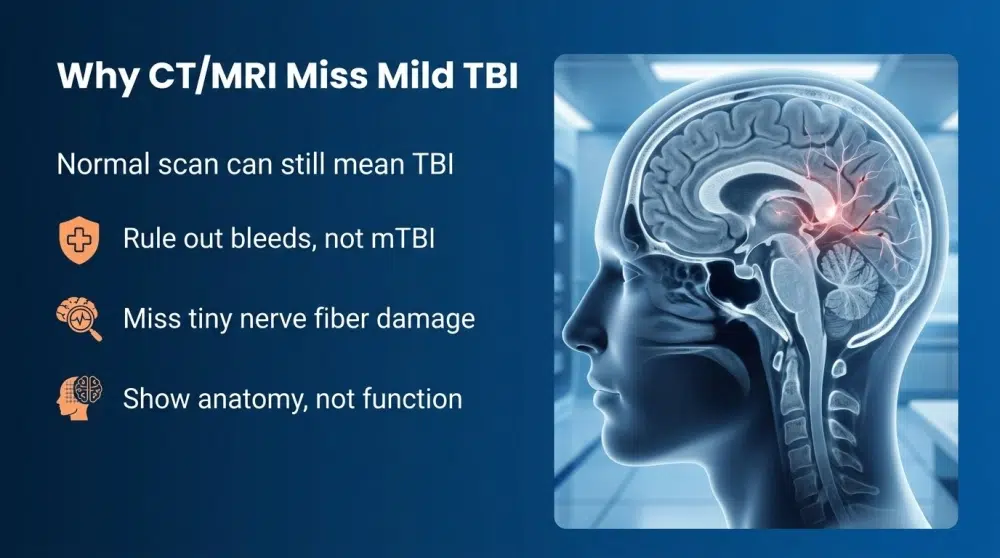
Most people don’t realize this until it’s happening to them. You’re in a wreck, maybe on I-35E, maybe just some stop-and-go rear-end on the LBJ, and the ER runs the standard tests. CT. Sometimes MRI. You get discharged with a sheet that says ‘no acute intracranial abnormality’ or something along those lines, and you drive home with a headache, that foggy time-warp feeling, and paperwork that seems to say your brain came out clean. Here’s the thing though. That result isn’t actually saying nothing’s wrong. It’s saying something much narrower.
CT scans have one job, more or less. Find the stuff that’ll kill you fast. Skull fractures, large hemorrhages, obvious mass-effect. And for that? They’re quick and they’re reliable. Problem is, mild TBI doesn’t play in that arena. The damage is microscopic, happening at the level of individual axons. Those long fibers that wire your neurons together and carry signals from one side of your brain to the other. When your head snaps forward and back in a crash, those axons stretch, twist, kind of get wrenched. But they don’t visibly tear. And the aftermath is very real. Ion channels misfire, calcium flux goes off, neurotransmitters get thrown into chaos, and you get symptoms that mess with your life. A CT just doesn’t see any of that. [1]
MRI does beat CT on soft-tissue detail, no question. But it’s still just anatomy. Not function. The sequences most ERs run are set up to catch gross lesions, bleeding, swelling, that kind of thing. Diffuse axonal injury doesn’t cooperate. It spreads micro-damage across the white matter in a pattern the standard 1.5-Tesla MRI basically can’t see. And roughly 80% of all TBI cases are classified as mild. Most of those come back with normal-looking CT and MRI. [2] Which sounds strange until you think about it. It’s not a fluke. It’s exactly what you’d expect from using blunt anatomical tools on damage that’s happening at the cellular level.
The CDC actually says this outright. A concussion is one form of mTBI, and it causes chemical changes in the brain plus stretching of brain cells that can leave lasting effects on how you think, learn, and feel. All without showing up on conventional imaging. [3] So put it this way. A normal scan rules out a bleed or a fracture. Full stop. It doesn’t rule out a concussion. And it definitely doesn’t rule out whatever neurological mess follows one.
What does diffusion tensor imaging actually show that a standard MRI does not?
DTI’s a different animal. Yes, it’s an MRI sequence, but the specialty is that it measures water movement along white matter tracts, not just anatomy. Healthy axons have this really ordered structure, and water moves efficiently along their length because of it. Once axons get disrupted, that order falls apart and the water diffuses more randomly. DTI captures the whole shift through a metric called fractional anisotropy. Disrupted regions come back with lower values. And here’s the part that matters. All this can show up on DTI even when a conventional MRI looks completely clean. [4]
The StatPearls clinical reference, published through the National Library of Medicine, notes that DTI is used specifically to detect axonal injury in mild to moderate TBI cases where standard imaging shows no abnormalities. Functional MRI (fMRI) is also used in research and clinical settings to differentiate TBI patients from control groups by examining activation patterns during cognitive tasks. Single Photon Emission Computed Tomography (SPECT) imaging, which measures cerebral blood flow, can reveal hypoperfusion in areas that look structurally normal on a conventional scan. [2]
None of these advanced modalities are universally available at every Dallas-area emergency room, and their admissibility in civil litigation depends on how well the ordering physician can articulate what the findings mean and why they are reliable. That is why advanced imaging alone rarely closes a civil case. It is one piece of a larger evidentiary picture that also includes functional performance testing, documented symptoms, and testimony about how the injured person’s life changed after the crash.
For plaintiffs pursuing brain injury lawyers in Dallas or defendants evaluating damages exposure, understanding what DTI can and cannot show is worth the time. A DTI report that shows reduced fractional anisotropy in the corpus callosum or frontal white matter is objective data. It can corroborate a neuropsychologist’s performance findings and make it considerably harder for a defense expert to argue that every symptom is exaggerated or pre-existing.
What does neuropsychological testing measure, and why does it matter in a brain injury claim?
Neuropsychological testing is a structured battery of standardized performance tasks administered by a licensed neuropsychologist. It does not rely on self-report alone. Instead, it produces scores on specific cognitive domains by measuring how a person actually performs timed tasks under controlled conditions. The comparison is made against population norms adjusted for age, education level, and other demographic factors.
A typical battery for a mTBI claim covers several domains:
- Processing speed measures how quickly the brain takes in, interprets, and responds to simple information. Tests like the Symbol Digit Modalities Test or Trail Making Test Part A capture this. Slower processing speed after a crash is one of the most consistently observed deficits in mTBI populations.
- Working memory reflects the ability to hold information in mind and manipulate it. Digit span tasks and the WAIS-IV Working Memory Index are common instruments. Research cited in the StatPearls TBI chapter notes that working memory is one of the cognitive domains most affected in mild TBI cases. [2]
- Attention and concentration covers both sustained attention (holding focus over time) and divided attention (managing two streams of information at once). Deficits here often show up first at work, when a person who previously handled multitasking without trouble starts making errors or losing track of conversations.
- Verbal and visual memory tests whether new information is being encoded and retrieved normally. The California Verbal Learning Test and various visual reproduction tasks measure these functions separately.
- Executive function covers planning, cognitive flexibility, inhibition of impulse, and problem-solving. The Wisconsin Card Sorting Test, Tower of London tasks, and Category Fluency tests probe these areas. Frontal lobe involvement is common in acceleration/deceleration injuries because the frontal and temporal lobes are the brain regions most often affected in TBI. [2]
Critically, a skilled neuropsychologist also administers validity indicators, sometimes called performance validity tests or symptom validity tests. These embedded and stand-alone measures detect whether a person is performing below their actual ability, intentionally or not. When a plaintiff’s scores pass validity testing across the battery, the performance deficits carry substantially more weight because they cannot be attributed to poor effort or deliberate exaggeration. Courts and defense teams take this seriously. Brain injury lawyers handling these cases in Dallas routinely work with neuropsychologists who can explain validity testing to a jury at the Dallas County District Court at the George L. Allen Sr. Courts Building.
How do accounts from family members and coworkers prove cognitive and behavioral change?
Neuropsychological test scores show how a person performs on a given day in a clinical setting. What they do not always capture is the functional erosion that happens at home and at work over weeks and months. That gap is where collateral testimony becomes indispensable.
A spouse or partner who lives with the injured person every day has a longitudinal view that no clinician can replicate in a 90-minute evaluation. What a spouse might describe to a treating physician or document in a written statement:
- Personality and mood shifts that appeared within days or weeks of the crash. Irritability, emotional lability, uncharacteristic anger, or social withdrawal that was not present before.
- Sleep disruption, including difficulty falling asleep, frequent waking, or excessive daytime fatigue. Sleep disturbance is one of the documented complications of mTBI. [2]
- Memory failures that are concrete and specific. Forgetting conversations that happened an hour earlier, losing track of whether routine household tasks were completed, or repeatedly misplacing items that were never a problem before.
- Headache frequency and severity as observed, not just reported. Headache is the single most common symptom associated with concussion and mTBI. [2]
- Light and noise sensitivity, sometimes visible as squinting in normal indoor lighting or becoming distressed by noise levels that the injured person previously tolerated without difficulty.
Coworkers and supervisors offer a different but equally concrete picture. A salesperson who closed deals fluently before a crash but now loses the thread mid-pitch is showing a real functional deficit. An engineer who reviewed technical documents without error and now produces work that requires multiple revisions has a documented change in output. Supervisors who see this should document it contemporaneously in performance notes. Colleagues who had direct working relationships should preserve emails, project timelines, and other artifacts that show before-and-after performance.
In civil litigation, this testimony is admissible as lay opinion about observed behavior under the Texas Rules of Evidence. [5] A lay witness cannot offer a medical diagnosis, but they can describe what they saw, how it differed from what they observed before the crash, and when those changes appeared. When a neuropsychologist’s performance testing points in the same direction that collateral witnesses independently describe, the convergence is difficult to dismiss as coincidence or exaggeration.

What should a symptom diary record, and why is that detail so important?

A symptom diary is a daily written record kept by the injured person, or by a family member when the person’s cognitive state makes self-monitoring unreliable. Its value in a personal injury claim is that it creates a contemporaneous record, one that predates any litigation and therefore carries more weight than retrospective descriptions prepared for an attorney or at deposition.
An effective diary entry goes beyond “headache today.” Detailed entries record:
- Specific symptoms with severity ratings. Not just “headache” but “headache began at approximately 9 a.m., rated 7 out of 10, located behind both eyes, persisted until 2 p.m.” The same granularity applies to dizziness, nausea, visual disturbance, word-finding difficulty, and fatigue.
- Triggers and aggravating factors. Screen exposure often worsens post-concussion symptoms. Physical exertion, bright light, loud environments, and concentrated mental effort are common triggers. Documenting what preceded a symptom flare ties the pattern to the underlying injury.
- Cognitive events. A specific example like “missed a work deadline because I read the same paragraph three times and could not retain it” is far more useful than the general statement “my memory is bad.”
- Functional impact. “Could not drive on I-30 today because merging traffic required attention I could not sustain” or “left the grocery store after 10 minutes because the noise and lights produced a severe headache.” These describe real-world impairment, not abstract suffering.
- Sleep log. Time to sleep, number of awakenings, quality on waking, and daytime fatigue level.
- Medication taken and any effect, without editorializing about whether it worked.
- Medical appointments. Date, provider name, and what was discussed or prescribed. This ties the diary record to the medical chart.
From a civil claim perspective, a diary that runs continuously from the days immediately following the crash through the course of treatment gives treating physicians and consulting neuropsychologists a timeline that they can use to evaluate whether the symptom pattern is consistent with mTBI. It gives opposing counsel much less room to argue that complaints appeared only after litigation began. And it gives personal injury lawyers documentation to present to a jury in a straightforward, human form.
What is post-concussion syndrome, and how is it documented for a civil claim in Dallas?
Post-concussion syndrome refers to a cluster of symptoms that persists beyond the expected recovery window after a mild TBI. Most adults with a single uncomplicated concussion improve within two to four weeks. [3] When symptoms persist significantly longer, the condition is often described as post-concussion syndrome or persistent post-concussion symptoms. The symptoms span several domains:
- Physical: headache, dizziness, fatigue, visual disturbance, sensitivity to light and noise.
- Cognitive: slowed thinking, word-finding problems, difficulty concentrating, memory gaps.
- Emotional and behavioral: irritability, anxiety, depression, emotional lability, social withdrawal. The StatPearls TBI reference notes that post-concussion patients frequently exhibit frontal lobe syndrome symptoms, including labile affect, poor social judgment, and loss of social graces, which appear in up to 23% of adult TBI patients. [2]
- Sleep: insomnia, hypersomnia, non-restorative sleep.
In the context of a civil claim arising from a Dallas-area crash, documentation of post-concussion syndrome rests on several categories of evidence working together. First, a consistent medical record showing that the same symptoms were reported at multiple appointments over time, ideally with objective functional assessments at each visit rather than just subjective complaint notation. Second, neuropsychological testing administered at appropriate intervals, which can track whether deficits are improving, stable, or worsening. Third, collateral testimony from people who interact with the claimant regularly. Fourth, the symptom diary described above.
Texas personal injury cases involving post-concussion syndrome require establishing that the condition causally connects to the crash. This is not automatic. If you had pre-existing headaches or anxiety before the collision, the defense will argue that what you are experiencing now is unrelated to the accident. Pre-existing conditions do not bar recovery under Texas law, because Texas follows the well-established rule that a defendant takes the plaintiff as they find them, but they do complicate causation arguments. The more thoroughly the treating record documents the pre-crash baseline and the post-crash change, the stronger the causation evidence. [6]
Our Dallas personal injury team sees these claims regularly across the Dallas-Fort Worth metroplex, including cases arising from crashes on US-75 and the Dallas North Tollway, where stop-and-go conditions make rear-end collisions common. The geographic concentration of daily commuter traffic in the DFW corridor means mTBI from vehicle collisions is not an unusual claim. What is unusual is how rarely it is properly documented from day one.
How does Texas civil law treat a brain injury claim when imaging is normal?
Texas follows a preponderance of the evidence standard in civil cases. That means a plaintiff must show that it is more likely than not that the defendant’s negligence caused their injury and damages. There is no requirement that physical injury be visible on imaging, and no rule that automatically bars recovery because a CT or MRI was negative. Texas courts have repeatedly handled claims where subjective symptoms and functional testing supported a TBI finding even when conventional imaging was unremarkable.
The Texas Rules of Evidence govern what testimony and documentary evidence can reach a jury. Under Rule 702, a qualified medical or psychological professional may offer opinion testimony about diagnosis and causation if the opinion is based on sufficient facts and reliable methods. [5] A licensed neuropsychologist who administered a validated battery, applied standard norms, and ruled out alternative explanations meets that standard. DTI findings interpreted by a radiologist with expertise in traumatic injury can be presented in the same way.
From the defendant’s perspective, the normal imaging result is often the primary tool for arguing that no significant injury occurred. Defense counsel may argue that symptoms are pre-existing, psychosomatic, or exaggerated for litigation purposes. This is why the evidentiary layers matter so much. A plaintiff who has a contemporaneous symptom diary, multiple treating physician notes documenting consistent complaints, neuropsychological testing showing performance deficits that passed validity screening, collateral witness accounts that match the clinical picture, and (where available) DTI findings showing white matter changes is in a substantially different position than a plaintiff whose entire case rests on self-reported symptoms alone.
Claims filed in Dallas County are handled at the Dallas County District Court, located at the George L. Allen Sr. Courts Building on Commerce Street in downtown Dallas. The applicable statute of limitations for a personal injury claim in Texas is generally two years from the date of the injury. [7] Missing that window extinguishes the right to recover, regardless of the strength of the underlying evidence. If you were injured in a Dallas crash and are still in the process of documenting your symptoms, the timeline matters as much as the documentation itself. Talking to personal injury lawyers early gives you time to build the record correctly before that deadline arrives.
Texas also follows a modified comparative fault rule with a 51% bar. If a jury finds that a plaintiff was more than 50% responsible for the accident, the plaintiff recovers nothing. If the plaintiff’s fault is 50% or less, recovery is reduced proportionally by their percentage of fault. [8] In intersection or multi-vehicle crashes where fault is disputed, this rule shapes how defense teams approach a soft-tissue or mTBI claim, and it is one reason that thorough documentation of the crash itself, not just the injury, matters from the start.
For anyone navigating the aftermath of a crash anywhere in the Dallas-Fort Worth area, connecting with brain injury lawyers is a step worth taking sooner rather than later. The window for preserving vehicle data, obtaining traffic and surveillance footage, and beginning a thorough medical record has a practical shelf life that runs shorter than the legal deadline.
How GoSuits Dallas Handles Brain Injury Claims
A mild traumatic brain injury claim is not a simple soft-tissue case. It requires building a complete picture from multiple categories of evidence, managing the relationship between medical treatment and legal strategy, and knowing when advanced imaging or neuropsychological consultation will strengthen the record rather than create new questions. GoSuits has handled these claims for clients across Texas, California, and Illinois, with 30 years of combined experience across our attorney team.
What sets our approach apart is how we put technology to work without removing the attorney from the relationship. Our proprietary case management software processes documentation, tracks deadlines, flags missing evidence, and monitors treatment timelines at a speed that manual review cannot match. That means your attorney has a clear, current picture of your file at every stage. It also means less time waiting for information to surface and more time on substantive legal work.
Every client at GoSuits has a designated attorney, not a case manager, not a rotating staff member. You can reach your attorney directly. That structure matters in a brain injury case because the medical and legal questions evolve over time. Neuropsychological evaluations may come weeks after the crash. DTI results may arrive months later. Your attorney needs to be tracking that timeline continuously, not reviewing a file summary prepared by someone else.
Our trial experience is real and current. Insurance carriers know which firms actually try cases and which ones settle every file regardless of value. That knowledge affects how quickly and seriously a carrier responds to a brain injury demand, and it shapes the room available in negotiations. When a case does go to the Dallas County District Court, our attorneys are prepared because trying cases is a regular part of our practice, not an exception to it.
You can review our prior cases, read about our attorneys, learn more about our firm, and see the full scope of practice areas we handle. If you were involved in a crash in the Dallas area and you are dealing with symptoms that appeared normal on imaging, speak with our team about what the evidence-building process looks like and what can still be documented at this stage.
A free consultation costs you nothing and does not commit you to anything. Schedule a free consultation to talk through where your case stands and what steps would most strengthen your record.

References
- Traumatic Brain Injury & Concussion – Centers for Disease Control and Prevention (CDC)
- Traumatic Brain Injury (Archive), Georges A. and Das J.M. – StatPearls, National Library of Medicine (NCBI Bookshelf)
- Concussion Basics – CDC HEADS UP Program
- About Traumatic Brain Injury – CDC National Center for Injury Prevention and Control
- Texas Rules of Evidence – Texas Judicial Branch, Rules & Standards
- Traumatic Brain Injury and CTE Awareness – GoSuits Knowledge Base
- Statute of Limitations for Personal Injury in Texas – GoSuits Knowledge Base
- Texas Modified Comparative Fault 51 Percent Bar – GoSuits Knowledge Base
- Federal Rules Governing Practice and Procedure – United States Courts
- Texas Court Rules Guide – Texas State Law Library