After a crash on a Dallas road, proving that the other driver was distracted at the moment of impact is one of the most challenging parts of a civil injury claim. Texas has a statewide ban on reading, writing, or sending electronic messages while driving, and the City of Dallas also enforces a hands-free ordinance. But a statute violation alone is not proof that the driver was looking at a screen when your crash happened. The evidence that actually moves a civil case forward is digital: wireless carrier records, device-level app data, and the infotainment and telematics logs embedded in the other vehicle. Each of these data sources has a limited lifespan. A written preservation demand sent within days of the crash is often the only way to prevent permanent loss of the most valuable evidence.
Legal Snapshot
- Legal Topic: Proving distracted driving in a Texas civil personal injury claim
- Jurisdiction: Texas (State) / City of Dallas (Local Ordinance)
- Primary Legal Issue: Negligence and negligence per se based on distracted driving
- Primary Statutory Authority: Tex. Transp. Code § 545.4251 (statewide electronic messaging ban, eff. Sept. 1, 2017)
- Secondary Authority: Tex. Civ. Prac. & Rem. Code § 16.003 (two-year limitations period); Tex. Civ. Prac. & Rem. Code Ch. 41 (exemplary damages); Dallas City Code Chapter 28 [AUTHORITY TO VERIFY – specific hands-free ordinance section]
- Case Stage: Pre-litigation through discovery
- Date Legal Authority Last Reviewed: July 2025
What Does Distracted Driving Mean Under Texas Law?
Texas law uses the phrase “electronic message” to define the core prohibited behavior. Under Texas Transportation Code § 545.4251, a driver commits a violation by reading, writing, or sending an electronic message including a text, email, instant message, or social media post on a portable wireless communication device while the vehicle is in motion. [1]
The statute treats the act of engaging with an electronic message as the prohibited conduct, not merely holding a phone. A driver who is scrolling a social media feed, viewing a video, or composing a message is engaged with an electronic message. A driver who is talking hands-free through Bluetooth or glancing at a GPS display is generally not violating the statewide statute, though local ordinances may impose stricter requirements.
Distraction in a civil negligence context is broader than what the statute covers. A driver who adjusts the infotainment touchscreen, reads a navigation alert, or is distracted by any non-driving task can be found negligent even without a statutory violation. The statute, when violated, supports a negligence per se argument meaning the plaintiff can use the legal violation itself as evidence of a breach of the duty of care. The violation does not, by itself, prove causation or damages.
The Dallas Hands-Free Ordinance and Why It Matters in a Civil Claim
The City of Dallas adopted a hands-free driving ordinance that goes beyond the statewide texting ban. Dallas prohibits drivers from holding or using a wireless communication device in any manner while driving, including for phone calls, unless the device is used completely hands-free. [2] This means that a driver who is holding a phone to make a call in Dallas, conduct not expressly prohibited by the statewide statute, may be violating local law.
In a civil case, a violation of the Dallas ordinance carries the same potential legal significance as a violation of the state statute. If a plaintiff can show that the at-fault driver was holding a device and that the holding contributed to the collision, the ordinance violation can form the basis of a negligence per se argument under Texas law. Whether the standard courts in Dallas apply is the Texas negligence per se doctrine – which asks whether the plaintiff was in the class of persons the ordinance was designed to protect and whether the harm was of the type the ordinance was designed to prevent is a matter for the attorneys and ultimately the court to resolve. [3]
Stop-and-go traffic on the LBJ Freeway (I-635), merge-point congestion at the High Five interchange, and rear-end collisions in downtown Dallas near the Arts District are all driving conditions where a driver momentarily looking at a handheld device can cause a serious crash. The local ordinance creates an additional legal hook in those situations where the statewide texting ban might not reach.
What Texas Negligence Law Requires in a Distracted Driving Claim
Proving distracted driving in a Texas civil personal injury claim requires establishing four elements of negligence: (1) the defendant owed the plaintiff a duty of care; (2) the defendant breached that duty; (3) the breach caused the plaintiff’s injury; and (4) the plaintiff suffered damages as a result. [4]
Every driver on a Texas public road owes a duty of reasonable care to other road users. Breach can be established through a statutory violation (the negligence per se theory) or through evidence that the driver failed to act as a reasonably prudent person. Causation requires a connection between the distraction and the crash itself. A phone log that shows a text was sent three minutes before the crash proves phone use, but not necessarily that the driver was distracted at the moment of impact. A log that shows a text was being composed at the same second as the collision is far stronger evidence.
Texas uses a modified comparative fault rule with a 51% bar. Under Texas Civil Practice and Remedies Code § 33.001, a plaintiff who is more than 50% responsible for their own injury cannot recover damages. [5] A defendant in a distracted driving case will often argue that the plaintiff was also not paying attention, was speeding, or made a sudden lane change. Digital evidence that precisely places the distraction at the moment of impact makes it harder for the defense to shift blame.
How Phone Records Are Obtained and What They Actually Show
Wireless carrier records are among the most commonly sought evidence in a distracted driving case. Car accident lawyers in Dallas typically pursue them through a civil subpoena issued after suit is filed, or through a pre-suit demand to preserve the records combined with formal discovery once litigation begins.
Carrier records are governed in part by the federal Stored Communications Act (18 U.S.C. §§ 2701–2712), which limits when private parties can compel disclosure without a court order. [6] In practice, most major wireless carriers require a valid civil subpoena before releasing subscriber content. The carrier will typically produce call detail records, SMS logs, and data connection timestamps. They will not generally produce the content of messages, which is more heavily protected.
What Carrier Records Can and Cannot Tell You
| Evidence Type | What It Can Show | What It Cannot Directly Show |
|---|---|---|
| Carrier call detail records | Outgoing/incoming call timestamps, call duration, tower pings | Whether driver was looking at screen; hands-free vs. handheld |
| SMS/MMS logs | Time of transmission, whether a text was sent at or near time of crash | Message content (generally protected); who physically sent it |
| Data connection logs | Period of active data usage (app activity, streaming) | Which specific app was open; where device was physically located in car |
A carrier log showing an outgoing text message transmitted at the precise time of the crash is powerful evidence. A log showing a call ended two minutes before the crash is less probative but can still support a timeline showing driver distraction in the minutes leading up to impact.
App-Level Data: What Goes Beyond the Carrier Record
Wireless carrier records capture communications infrastructure data. They do not capture everything a phone was doing. App-level data, logs kept by the operating system or individual applications, can fill that gap and often tells a more complete story about what the driver was doing on the device.
Social media applications, email clients, navigation apps, and streaming services each generate their own interaction logs. A driver who was scrolling Instagram or tapping through a Spotify playlist leaves a record in the app’s server logs and on the device itself. Obtaining that data in civil litigation typically requires a subpoena to the app provider or preservation of the actual device.
Device-level forensic analysis – conducted by a qualified digital forensics analyst can extract timestamps for screen activity, application open/close events, and interaction logs from the device’s operating system. This analysis is more precise than carrier records because it shows what was on screen and when. However, it requires the physical device, which must be preserved and produced in discovery. If the other driver’s phone is damaged, replaced, or backed up remotely before a preservation demand is served, that evidence may be unrecoverable.
The distinction between carrier-level and app-level evidence matters in a Dallas crash case because rush-hour congestion on routes like US-75 (Central Expressway) or I-35E through downtown creates stop-and-go conditions where a driver might pick up the phone for only a few seconds. App-level logs can pinpoint those seconds in ways a carrier record cannot.
Vehicle Infotainment Logs and Telematics: The Car Itself as a Witness
Modern vehicles log more driver behavior than most people realize. Infotainment systems record interaction events, touchscreen taps, navigation queries, media selections, and Bluetooth call activity with timestamps. Event data recorders (EDRs, often called “black boxes”) capture pre-crash vehicle dynamics including speed, throttle position, brake application, and steering input in the seconds before a collision. [7]
In a distracted driving case, infotainment logs can show that a driver entered a navigation address, initiated a phone call through the car’s system, or changed a media source in the moments before the crash. A Bluetooth call that ended seconds before impact, combined with a text log from the carrier, paints a detailed picture of the driver’s attention in the moments before the collision without requiring the driver to admit anything.
Telematics data from connected-car systems (available on many newer Ford, GM, Toyota, and other vehicles) can also record cellular connectivity events and phone pairing activity. Some manufacturers retain this data on remote servers, which means a preservation demand must go to both the vehicle owner and potentially the manufacturer’s connected-services program.
Accessing EDR data typically requires a physical download from the vehicle using a manufacturer-compatible tool. If the vehicle is totaled and sent to a salvage yard after a crash on a Dallas corridor like I-30, the EDR data can be destroyed quickly. Preservation of the vehicle or at minimum a timely EDR download is critical evidence that can support the car accident lawyers handling the claim.
A driver rear-ends another vehicle during stop-and-go traffic near the North Dallas Tollway interchange at rush hour. The at-fault driver’s carrier records show an outgoing SMS transmitted 11 seconds before the crash. The at-fault vehicle’s infotainment system logs show a navigation query entered 45 seconds before impact. Neither fact alone is dispositive, but together they establish a pattern of device interaction in the moments before the crash, supporting the distraction claim. A forensic analyst downloads the EDR and confirms the driver applied brakes only 0.4 seconds before impact, consistent with a severely reduced reaction time. This combination of digital evidence forms a coherent factual picture that a jury can evaluate.

Why the Preservation Demand Has to Go Out Within Days
Digital evidence has a shelf life measured in hours and days, not weeks. Wireless carriers retain certain call detail records for 18 to 24 months, but other data, particularly IP session records and tower-level pings, may be overwritten on rolling retention cycles as short as 30 days. App providers may purge server-side interaction logs even faster. Vehicle infotainment systems have fixed storage that is overwritten by new events automatically.
A litigation hold letter (also called a preservation demand) is a formal written notice instructing the recipient to suspend routine destruction of records related to the incident. Personal injury attorneys send these letters as early as the day of the crash, before a lawsuit is even filed. The letter should go to the at-fault driver, their employer if they were driving for work, the wireless carrier associated with their device number, any app providers whose logs may be relevant, the vehicle manufacturer’s connected-services program, and the insurer. If the crash occurred on an interstate or a road with surveillance cameras, such as the monitored portions of I-35E in Dallas, the letter should also go to TxDOT or the relevant city agency, since traffic camera footage is typically overwritten on a short cycle.
Failure to send a timely preservation demand can result in evidence being destroyed through ordinary business operations, which is not necessarily spoliation unless the party had a litigation duty to preserve. But the practical result is the same: the evidence is gone. The plaintiff then must make their distracted driving case without the most precise evidence available.
What Evidence Can Matter in a Dallas Distracted Driving Claim?
The following categories of evidence commonly arise in distracted driving civil cases. No single piece of evidence automatically establishes liability. The strength of the overall case depends on how multiple sources corroborate each other.
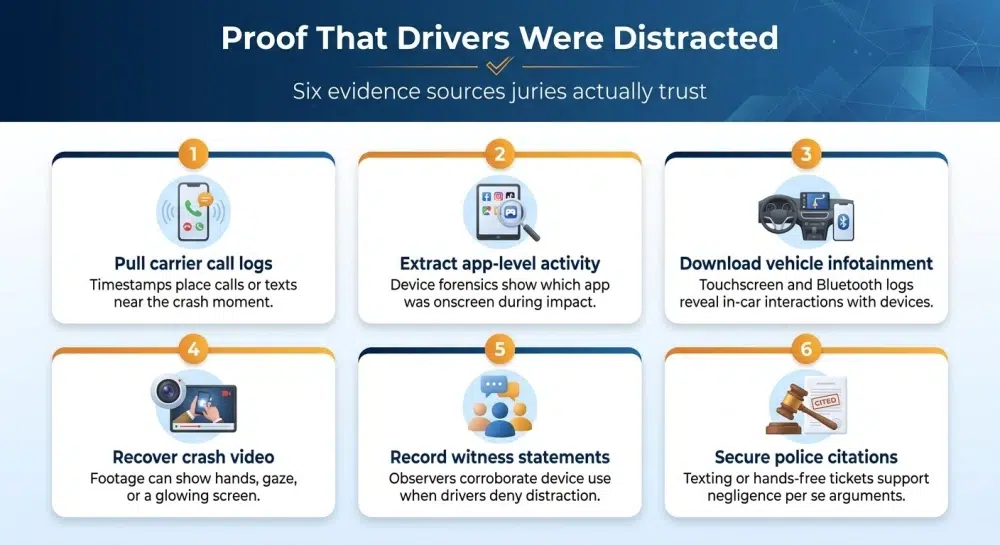
- Wireless carrier call and text logs: Establish whether a call or text transmission occurred at or near the time of the crash, jurisdiction: established through civil subpoena.
- App-level data and device forensics: Shows what the driver’s screen was displaying and when; requires device preservation and often forensic extraction.
- Vehicle infotainment and EDR logs: Can place the driver interacting with the dashboard or a paired device; requires prompt vehicle preservation and specialized download equipment.
- Dashcam or traffic camera footage: Visual confirmation of phone use; may show the driver’s hands, posture, or head position. Dallas traffic cameras and private dashcam footage on I-635 or I-30 can be invaluable.
- Witness statements: Bystanders, passengers, or other drivers who observed the at-fault driver holding or looking at a device in the moments before the crash.
- Police reports and citations: A citation for violating § 545.4251 or the Dallas hands-free ordinance documented at the scene is admissible evidence and can support negligence per se.
- Social media posts: Geo-tagged posts or stories published at or near the crash time can show the driver was actively using a device. These require preservation since content is often deleted.
- Accident reconstruction: An expert may use physical evidence, skid marks, vehicle damage patterns, and EDR data to establish that reaction times were consistent with distraction.
What Damages May Be Available?
In a Texas personal injury claim arising from a distracted driving crash, recoverable damages can include both economic and non-economic losses. Recoverability depends on the specific facts, applicable law, and what the evidence supports.
- Medical expenses: Reasonable and necessary costs of treatment from the crash, including emergency care, surgery, rehabilitation, and ongoing care.
- Future medical expenses: Projected costs for treatment the plaintiff is reasonably expected to need in the future as a result of the injuries.
- Lost wages: Income the plaintiff lost during recovery.
- Loss of earning capacity: Reduced ability to earn income in the future if the injuries are disabling or career-limiting.
- Physical pain and mental anguish: Texas recognizes both as distinct compensable damages categories.
- Physical impairment and disfigurement: Recognized separately from pain and anguish under Texas law.
- Property damage: Vehicle repair or replacement costs.
- Wrongful death damages: If a distracted driving crash proves fatal, Texas Civil Practice and Remedies Code Chapter 71 provides a wrongful death cause of action for certain family members. Fatal crash attorneys serving Dallas handle these cases under a separate statutory framework.
- Exemplary damages: Under Texas Civil Practice and Remedies Code Chapter 41, a jury may award exemplary damages if a plaintiff proves by clear and convincing evidence that the defendant’s conduct constituted gross negligence. Egregious distracted driving, such as watching a video while driving at freeway speed, could potentially support this theory, though it is a high standard that requires case-specific analysis.
The actual amount of any recovery depends on the facts of the specific case, the evidence available, and applicable legal standards. No outcome can be promised or guaranteed.
What If the Other Driver Disputes Distraction?
Defendants in distracted driving cases routinely deny that they were using a device. Without a confession or eyewitness, the digital evidence described above becomes the foundation of the plaintiff’s case. Defendants and their insurers may also raise several defenses.
Four defenses tend to show up. One, you were more than half responsible, so under Texas law you’re out. Two, it wasn’t distraction at all, it was the road, or the car, or some other driver who conveniently disappeared before anyone got a statement. Three, and this one’s tricky, the phone log shows activity close to the crash but not at the crash, so how do you really prove anything? Four is the hands-free thing. If the driver was using Bluetooth, they’ll argue no law was violated and you’ve got nothing to hang the case on.
The counter to all of this is pretty straightforward, at least in theory. You build a record. Preservation demands go out early, a forensic analyst gets brought in, and an accident reconstruction pro helps tie the timeline together. Do all that, and the evidence starts pointing at one thing. Because here’s the thing about digital evidence: the more precisely it can pin distraction to the exact moment of impact, the harder it gets for the other side to spin an alternate theory. Vague evidence lets the defense argue anything. Precise evidence kind of shuts the door.
How Long Do You Have to Act in Texas?
The general statute of limitations for a personal injury claim in Texas is two years from the date of the injury under Texas Civil Practice and Remedies Code § 16.003. [8] This deadline is strict. Missing it will almost certainly bar the claim entirely, regardless of how strong the evidence of distraction might be.
Two years to file. That’s what the statute says, and if you’re filing in Dallas County, you’ll be walking that petition into the George L. Allen Sr. Courts Building on Commerce. But two years is kind of a misleading number, because the evidence you’d need to actually win the case isn’t going to be around that long. Cell carrier logs get overwritten, the car’s infotainment system loops back over its own data, and that traffic camera down the block probably purges footage on a monthly cycle at best. So yeah, you technically have two years. Practically, you’ve got days.
That two-year rule isn’t ironclad, though. There are exceptions. If a government entity is the defendant, for example, you’re playing by a completely different set of rules, usually with much shorter notice deadlines that can sneak up on people. Claims involving injured kids follow different timing too. And if the defendant actively hid facts that stopped you from figuring out you’d been injured in the first place, that can push the clock back. But honestly, don’t try to figure out which exception applies to you on your own. Talk to a lawyer, and do it soon. [DEADLINE REQUIRES LEGAL VERIFICATION based on the specific facts of each case.]
What Should You Do After a Distracted Driving Crash in Dallas?
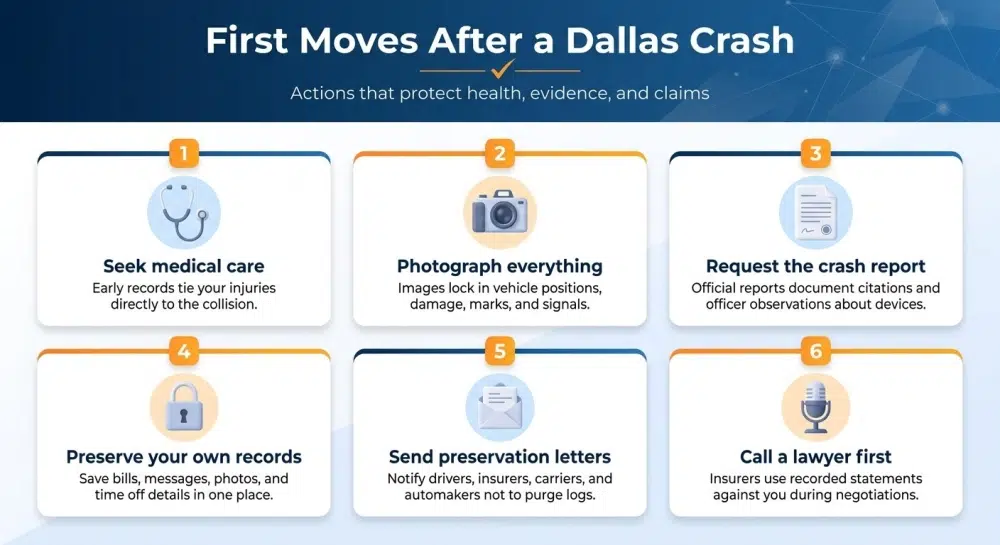
- Seek medical treatment immediately, even if you feel fine. Some injuries from vehicle crashes are not apparent until hours or days later, and gaps in treatment can affect your claim.
- Document the scene. Photograph both vehicles, the roadway, traffic signals, skid marks, and any physical evidence. If other drivers or bystanders witnessed the crash, obtain their contact information. Our guide on distracted driving accident claims covers what to capture at the scene.
- Request the police report. A crash report from the Dallas Police Department or the Texas Department of Public Safety is an official record of the incident and may note whether an officer observed signs of device use.
- Preserve your own evidence. Do not delete any photos, messages, or records related to the crash. Keep all medical bills, correspondence with insurers, and records of lost work.
- Contact a personal injury attorney promptly. An attorney can send a preservation demand within days of the crash, identify all available digital evidence, and advise on the strength of the distracted driving claim before evidence begins to disappear. Do not give a recorded statement to the other driver’s insurer without legal guidance, what you say can be used against you.
Related Texas Personal Injury Resources
These resources address related legal issues under Texas law that may be relevant after a Dallas distracted driving crash:
- Distracted Driving Accident Claims – GoSuits Knowledge Base
- Texas Modified Comparative Fault and the 51 Percent Bar
- Accident Reconstruction in Disputed Fault Cases – Dallas
- What to Do Right After a Car Accident in Texas
- Statute of Limitations for Personal Injury in Texas
- Exemplary Damages in Dallas – Gross Negligence Claims

Talk With a GoSuits Personal Injury Attorney in Dallas
A distracted driving injury claim involves medical evidence, digital evidence, insurance disputes, and legal deadlines, all moving at different speeds. If you were injured in a Dallas car accident and believe the other driver was looking at a phone or device, a GoSuits personal injury attorney can review the circumstances of your case, explain what evidence may still be available, and advise you on your options.
Our Dallas personal injury team serves clients throughout the Dallas-Fort Worth metroplex, including Plano, Carrollton, Irving, and McKinney.
Attorney Review Recommended: This article should be reviewed by a Texas-licensed personal injury attorney admitted in Dallas County before publication. The reviewer should confirm the current text of Dallas City Code Chapter 28 (hands-free ordinance citation and effective date), verify the current EDR download standards applicable in Texas civil proceedings, and confirm that no relevant changes to Texas Transportation Code § 545.4251 or Chapter 41 have been enacted since this article was drafted.
References and Legal Authority
- Texas Transportation Code § 545.4251 – Electronic Messaging Ban – Texas Constitution and Statutes (statutes.capitol.texas.gov)
- Dallas City Code – Municipal Code Library (library.municode.com) [AUTHORITY TO VERIFY – specific hands-free ordinance section and effective date]
- Sarah Cook v. Texas Highway Walls, LLC, No. 03-22-00736-CV (Tex. App.-Austin 2024) – CourtListener (discussing negligence per se in Texas vehicle crash context)
- Negligence – Legal Information Institute, Cornell Law School (law.cornell.edu)
- Texas Civil Practice and Remedies Code § 33.001 – Proportionate Responsibility – Texas Constitution and Statutes (statutes.capitol.texas.gov)
- 18 U.S.C. § 2701 – Stored Communications Act – Legal Information Institute, Cornell Law School (law.cornell.edu)
- Event Data Recorders – U.S. Department of Transportation / NHTSA (nhtsa.gov)
- Texas Civil Practice and Remedies Code § 16.003 – Two-Year Limitations Period – Texas Constitution and Statutes (statutes.capitol.texas.gov)
- Texas Civil Practice and Remedies Code Chapter 41 – Exemplary Damages – Texas Constitution and Statutes (statutes.capitol.texas.gov)
- Manuel Gonzalez v. The State of Texas, No. 05-20-00337-CR (Tex. App.-Dallas 2021) – CourtListener (cellular evidence in Texas vehicle offense proceedings)