
- What Are Exemplary Damages Under Texas Law?
- How Does CPRC Chapter 41 Structure the Exemplary Damages Claim?
- How Do Exemplary Damages Differ from Compensatory Damages?
- What Is the Gross Negligence Standard in a Texas DWI Crash Case?
- What Does “Clear and Convincing Evidence” Actually Require?
- What Cap Applies to Exemplary Damages – and When Does It Not Apply?
- Does the Intoxication Exception to the Cap Actually Exist in Texas?
- What Evidence Supports an Exemplary Damages Claim After a DWI Crash?
- What Does an Exemplary Damages Claim Mean for the Defendant?
- Where Are These Cases Filed in Dallas?
- Frequently Asked Questions
- How GoSuits Dallas Approaches These Cases
- References
What Are Exemplary Damages Under Texas Law?
When you hear the term “punitive damages,” Texas civil law uses a different label: exemplary damages. The Texas Civil Practice and Remedies Code defines them as “any damages awarded as a penalty or by way of punishment” – not to make the plaintiff whole, but to express society’s condemnation of conduct that falls far outside ordinary negligence. [1]
Texas courts distinguish two categories of conduct that can trigger exemplary damages: fraud and gross negligence. In the context of a drunk driving crash, the applicable theory is almost always gross negligence. A driver who gets behind the wheel with a blood-alcohol concentration well above the legal limit – after perhaps receiving DWI warnings, being stopped at prior sobriety checkpoints, or having a prior DWI conviction – has done more than make a careless error. Texas law treats that choice as evidence of a conscious disregard for others’ safety, which is the foundation of a gross negligence claim.
Exemplary damages are available only in civil cases. A criminal prosecution for intoxication manslaughter or intoxication assault runs through the District Attorney’s office and is entirely separate. The civil case is where injured victims or surviving families pursue personal injury lawyers for compensation – and where the question of exemplary damages comes up.
How Does CPRC Chapter 41 Structure the Exemplary Damages Claim?
Chapter 41 of the Texas Civil Practice and Remedies Code is the governing statute for exemplary damages in civil litigation. [2] It sets the definition, the required finding, the burden of proof, and the cap. Understanding its structure matters because courts interpret it strictly, and any gap in proof can defeat the claim entirely.
What Section 41.001 Defines
Section 41.001 defines “exemplary damages” and “gross negligence.” Gross negligence involves two elements that must both be proven: an objective prong and a subjective prong. The objective prong asks whether the act or omission, viewed objectively, involved an extreme degree of risk – meaning a high probability of serious harm to others. The subjective prong asks whether the defendant had actual, subjective awareness of that risk and proceeded anyway with conscious indifference to the rights, safety, or welfare of others. [3]
In a DWI crash, the objective prong is usually straightforward – driving drunk on I-35E through downtown Dallas or I-635 (the LBJ Freeway) at night objectively creates an extreme degree of risk of serious injury or death. The subjective prong requires more specific evidence about what this particular driver knew or should have recognized at the time.
What Section 41.003 Requires
Section 41.003 sets the conditions under which exemplary damages may be awarded. The claimant must prove by clear and convincing evidence that the harm resulted from fraud, malice, or gross negligence. That heightened evidentiary burden – clear and convincing – applies only to the exemplary damages finding. The underlying negligence claim still requires proof only by a preponderance of the evidence. [2]
Section 41.003 also requires the jury to find gross negligence unanimously. A single juror who is unpersuaded can defeat the exemplary award even if eleven others are convinced. This is a meaningful procedural hurdle that affects how trial counsel prepares the case.
What Section 41.004 Excludes
Not all injury cases are eligible. Section 41.004 bars exemplary damages in cases where the claimant’s own percentage of responsibility exceeds 50 percent. This tracks Texas’s modified comparative fault framework. If a plaintiff contributed substantially to their own harm, the door to exemplary damages may close entirely.
How Do Exemplary Damages Differ from Compensatory Damages?
Compensatory damages put the plaintiff back – financially – to where they were before the injury. They cover medical bills, lost income, future care costs, property damage, and noneconomic harms like pain and suffering and loss of consortium. Every plaintiff who proves liability and injury is entitled to compensatory damages. [4]
Exemplary damages are separate. They are awarded on top of compensatory damages when the defendant’s conduct meets the higher threshold. Their purpose is not remedial but punitive and deterrent: to punish the defendant and signal to others that this category of conduct carries civil consequences beyond the ordinary cost of negligence.
Practically speaking, the distinction matters for several reasons:
- Burden of proof differs. Compensatory damages require a preponderance of the evidence (more likely than not). Exemplary damages require clear and convincing evidence.
- Insurance coverage often differs. Many liability policies contain exclusions for punitive damages. Whether a drunk driver’s insurer must pay exemplary damages depends on the policy language and Texas law – a contested area that often requires separate analysis.
- Caps apply differently. Texas caps exemplary damages by statute. Compensatory damages in most personal injury cases are not capped (though there are specific exceptions for certain defendants).
- Tax treatment differs. Under federal tax law, compensatory damages for physical injuries are generally excluded from gross income. Punitive or exemplary damages generally are taxable. This is a planning consideration for plaintiffs who receive substantial exemplary awards.
For a family that lost someone to a drunk driver on the Dallas North Tollway – or who suffered catastrophic injuries in a DWI crash – the compensatory award addresses the measurable losses. The exemplary award, when it comes, sends a different message.
What Is the Gross Negligence Standard in a Texas DWI Crash Case?
Gross negligence is not simply “really bad negligence.” Texas courts have consistently held that it requires a different quality of conduct – not a matter of degree, but a different kind of mental state. Ordinary negligence is failing to see a risk a reasonable person would have seen. Gross negligence is seeing the risk (or knowing you likely have impaired perception) and proceeding anyway. [3]
The Objective Prong in a DWI Context
Drunk driving on crowded Dallas roads – I-30 through the heart of the city, stop-and-go traffic near Deep Ellum, or late-night traffic on US-75 (Central Expressway) – creates objectively extreme risk. Texas courts have found that operating a motor vehicle while intoxicated satisfies the objective prong of gross negligence analysis. The case of Steak & Ale of Texas, Inc. v. Borneman, 62 S.W.3d 898 (Tex. App. – Fort Worth 2001), which involved alcohol service and the subsequent conduct of an intoxicated driver, illustrates how appellate courts analyze the cause chain and the objective risk created by drunk driving. [5]
The Subjective Prong – Where Cases Are Won or Lost
The harder fight is usually the subjective prong. The plaintiff must show that the defendant had actual awareness of the extreme risk. Evidence that supports this finding in drunk driving cases typically includes:
- Prior DWI arrests or convictions. A driver who has been arrested for driving while intoxicated before has been directly told – by law enforcement and the courts – that drunk driving endangers others. Prior convictions are powerful evidence of subjective awareness.
- High blood-alcohol concentration. Courts and juries view a BAC of 0.15, 0.18, or higher differently than a BAC just above the legal limit of 0.08. An extremely high BAC, especially combined with erratic driving witnessed before the crash, supports the inference that the driver knew they were heavily impaired.
- Refusal to submit to testing. When a driver refuses a breathalyzer or blood draw after a crash, that refusal can be used in the civil case. Combined with other evidence, it can suggest consciousness of extreme intoxication.
- Continuing to drive after consuming alcohol over an extended period. Witness accounts from bars or restaurants showing the defendant drank heavily over several hours before driving support the inference that they knowingly drove in a severely impaired state.
- Driving despite a suspended license due to prior DWI. This compounds the subjective awareness – the driver knew they had lost their license because of prior drunk driving and drove anyway.
The Texas Supreme Court addressed the gross negligence framework in several foundational cases that Chapter 41 courts routinely follow. The subjective element is the most fact-intensive part of the analysis, which is why thorough investigation and skilled deposition of the defendant matter so much. Your attorney handling this kind of personal injury claim will work to develop this evidence through discovery before trial.
What Does “Clear and Convincing Evidence” Actually Require?
Texas courts define “clear and convincing evidence” as proof that produces “a firm belief or conviction” in the mind of the fact-finder about the truth of the allegations. [1] It sits between the preponderance standard (more likely than not, which is roughly 51%) and the beyond-a-reasonable-doubt standard used in criminal cases.
In practical terms, “clear and convincing” means you cannot simply show that the drunk driving probably created extreme risk and that the driver was probably aware of it. The evidence has to produce a firm, settled conviction – not just a probability. A jury that concludes the driver “probably” knew what they were doing is not enough. They have to be firmly convinced.
This is why the quality of evidence assembled before trial is so critical. A single witness who testifies that the defendant looked intoxicated before getting in the car is weaker than a combination of: security footage showing the defendant stumbling in the parking lot, restaurant receipts showing hours of alcohol consumption, the defendant’s post-arrest statement acknowledging heavy drinking, a prior DWI on their record, and a BAC reading more than twice the legal limit.
The clear and convincing burden also affects how appellate courts review the jury’s finding. If a defendant appeals an exemplary award, the appellate court applies a higher standard of review – it does not simply defer to the jury but looks at whether the evidence as a whole would produce a firm belief or conviction. Several Texas appellate courts have reversed exemplary awards on this basis. That reality shapes how careful litigators prepare these cases from the beginning.
What Cap Applies to Exemplary Damages – and When Does It Not Apply?
Section 41.008 of the CPRC caps exemplary damages. Under the standard cap, exemplary damages may not exceed the greater of: (1) two times the amount of economic damages plus an amount equal to noneconomic damages up to $750,000; or (2) $200,000. [2]
In practice, in cases involving serious injuries or death, option (1) typically controls because economic damages are substantial. If a plaintiff recovers $1.5 million in economic damages and $500,000 in noneconomic damages, the cap under option (1) would be: 2 × $1,500,000 = $3,000,000, plus noneconomic damages up to $750,000 = $3,750,000. The exemplary damages award could not exceed that figure, even if the jury awarded more.
This cap has real-world significance for defendants and their insurers when evaluating settlement options. It also affects plaintiffs’ decision-making about whether to pursue the exemplary damages theory through trial or accept a settlement that falls below the theoretical cap.
The cap is calculated per claimant, not per case. In a multi-victim crash – which happens regularly in DWI collisions on heavily traveled Dallas corridors – each injured plaintiff has a separate cap calculation based on their own damages. The wrongful death lawyers handling a case with multiple victims from a single crash must account for this structure when evaluating overall case value.

Does the Intoxication Exception to the Cap Actually Exist in Texas?
This question generates genuine confusion, and the answer matters. Section 41.008(c) of the CPRC lists categories of conduct for which the damages cap does not apply. [2] The list includes conduct that constitutes a felony under specific Texas Penal Code provisions – including certain offenses involving intoxication.
Specifically, the cap does not apply if the damages result from a felony involving the operation of a motor vehicle while intoxicated – referencing felony DWI offenses under the Texas Penal Code. [6] This is not automatic. The jury must find in the civil case – by clear and convincing evidence – that the defendant committed the underlying felony. The civil and criminal proceedings are separate, but the civil jury can make its own finding on this question.
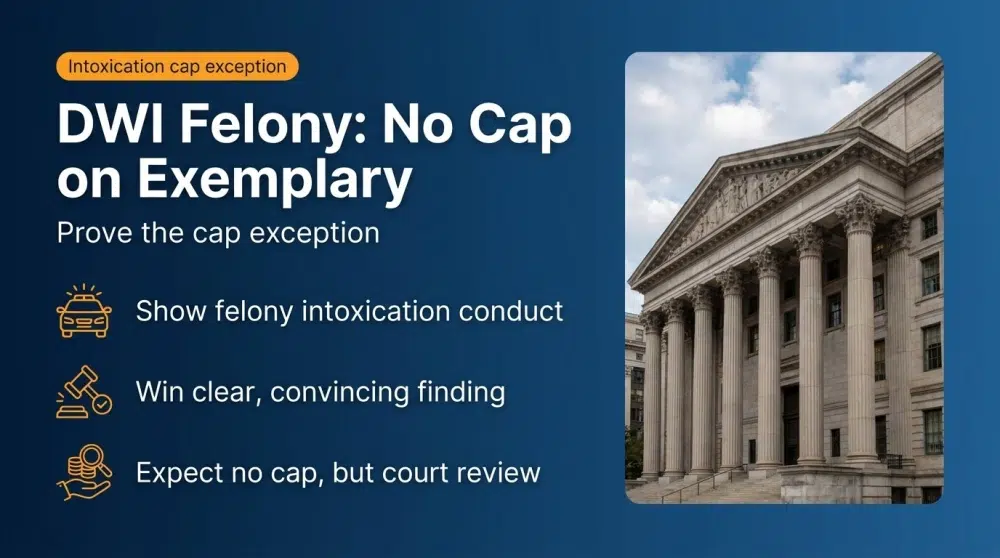
When the cap exception applies, there is no statutory ceiling on the exemplary damages award. The jury sets the amount, subject only to appellate review for excessiveness under federal constitutional standards (the Due Process Clause limits grossly disproportionate punitive awards as established by the U.S. Supreme Court in cases like BMW of North America v. Gore and State Farm Mutual Automobile Insurance Co. v. Campbell). [7]
For a plaintiff whose loved one was killed by a repeat DWI offender – say, a driver with two prior DWI convictions who crossed into oncoming traffic near Plano on US-75, resulting in a fatality – pursuing the cap exception can change the financial reality of the case dramatically. But it requires careful pleading, coordinated investigation, and trial presentation that clearly develops the felony conduct finding for the jury.
This is one reason why wrongful death lawyers with trial experience in Dallas County District Court, where civil cases of this kind are filed at the George L. Allen Sr. Courts Building, approach drunk driving wrongful death cases differently than routine crash litigation. The stakes are higher and the procedural steps are more demanding.
What Evidence Supports an Exemplary Damages Claim After a DWI Crash?
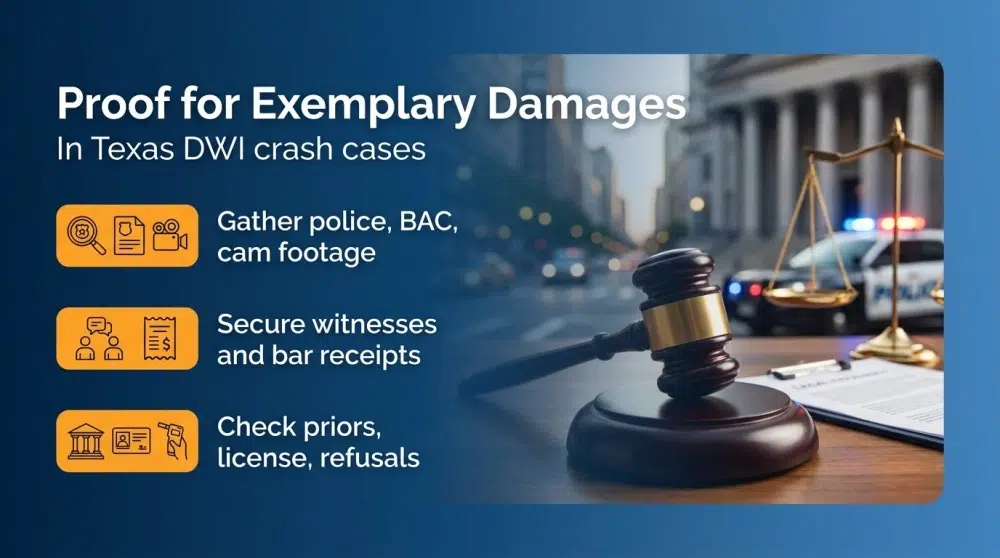
Building the evidentiary record for exemplary damages in a Texas DWI crash case requires working across multiple sources, often under time pressure. Evidence is perishable – surveillance footage gets overwritten, witnesses’ memories fade, and the driver’s vehicle may be repaired before it is inspected.
Law Enforcement Records
The police accident report, DWI investigation report, and any dashcam or bodycam footage from the responding officers form the factual foundation. The investigating officer’s observations of the driver – speech, coordination, smell of alcohol, behavior – appear in the report and become important at trial. The Texas Department of Transportation tracks crash data, and TxDOT’s annual motor vehicle crash statistics document DWI crash patterns that provide context. [8]
Blood draw or breathalyzer results, obtained pursuant to Texas Transportation Code warrant procedures or consent, establish the BAC. Under Texas law, a BAC of 0.08 or above establishes intoxication as a legal matter. But for exemplary damages purposes, the absolute level – whether it was 0.09 or 0.23 – contributes to the gross negligence and subjective awareness analysis.
Criminal Records of the Defendant
Prior DWI convictions are among the most powerful pieces of evidence in an exemplary damages case. They establish that the defendant had direct, court-enforced knowledge that drunk driving causes extreme risk. In Texas, a driver who accumulated a prior DWI and drove drunk again is in a very different position than a first-time offender. Criminal history records, available through the Texas Department of Public Safety and court records, must be obtained early.
Scene Evidence and Reconstruction
Accident reconstruction analysis from qualified investigators can establish vehicle speed, braking (or absence of braking), and trajectory. When a drunk driver runs a red light in Oak Cliff or rear-ends a vehicle stopped in traffic on I-30 without any attempt to brake, reconstruction evidence supports the inference of severely impaired reaction time and judgment.
Witness Accounts from Before the Crash
Friends, servers, bartenders, or rideshare drivers who saw the defendant before the crash can testify about their condition. Texas Dram Shop Act liability for alcohol vendors who overserved the driver is a related but separate claim. Even when no dram shop claim exists, witnesses to the defendant’s pre-crash drinking are relevant to the exemplary damages analysis in the direct negligence case against the driver.
The Defendant’s Own Statements and Records
Post-arrest statements, social media posts from earlier in the evening, credit card records showing bar tabs, and text messages sent from the car can all be relevant. Courts in Dallas County District Court allow broad discovery in civil litigation, and skilled car accident lawyers use that process aggressively to develop this evidence before trial.
What Does an Exemplary Damages Claim Mean for the Defendant?
From a defendant’s perspective, an exemplary damages claim changes the calculus of the case substantially. Even if insurance covers compensatory damages (subject to policy limits), many liability policies either exclude punitive damages entirely or have separate, lower limits for them. A defendant who faces an uncapped exemplary award – because the jury found felony intoxication conduct – may be personally exposed beyond their insurance coverage.
Defendants in Texas also face the reality that gross negligence findings can affect them in other ways – professional licenses, employment in regulated industries, and immigration status (for non-citizen defendants) can all be affected by the civil finding, which often tracks closely with the criminal conviction. The civil discovery process also runs alongside or after the criminal proceeding, and a criminal conviction for felony DWI can be introduced in the civil case.
For defendants, early and experienced legal representation is essential. The Texas Rules of Civil Procedure governing discovery in the Dallas County District Court are demanding, and a defendant who is not prepared for the breadth of document production and deposition requests can find themselves at a serious disadvantage.

Where Are These Cases Filed in Dallas?
Civil personal injury and wrongful death cases arising from DWI crashes in Dallas County are filed in the Dallas County District Court at the George L. Allen Sr. Courts Building, located at 600 Commerce Street in downtown Dallas. Multiple district courts sit at that location and have jurisdiction over civil cases. [9]
The Texas Rules of Civil Procedure govern pretrial procedure and discovery. [10] The Texas Rules of Evidence govern admissibility at trial. Local rules for Dallas County district courts impose additional requirements and are available on the Texas Office of Court Administration’s local rules database. Cases involving significant injuries or death typically require coordination of expert witnesses – crash reconstructionists, forensic toxicologists, economic damages experts – whose retention and disclosure deadlines are set early in the scheduling order.
Venue can matter. If the crash occurred in a neighboring county – Collin County (where Plano, Frisco, and McKinney are located, all Dallas cluster cities), or Denton County – the case may be filed there instead. Carrollton, Irving, and other cities in the Dallas metro area fall within the Dallas cluster for our purposes, but the specific county court depends on where the crash occurred and where the defendant resides.
Understanding the local court system, its judges, and the litigation culture of Dallas County is something that develops through years of practice in that courthouse. If you are injured and considering a personal injury claim after a DWI crash in the Dallas-Fort Worth metroplex, working with attorneys who know how these cases proceed in Dallas County is worth your serious attention.
How GoSuits Dallas Approaches These Cases
At GoSuits, our team handles personal injury and wrongful death cases across Texas, including DWI crash claims filed in Dallas County District Court. If you or someone you love was injured – or if you lost a family member – in a crash caused by a drunk driver, a free consultation with our Dallas personal injury attorneys can help you understand what your case involves.
We are frank about what the law requires. Proving exemplary damages under CPRC Chapter 41 is not a formality. It requires clear and convincing evidence of gross negligence, a unanimous jury finding, and careful analysis of whether the cap exception applies. That work begins before a lawsuit is ever filed.
What sets GoSuits apart is how we do that work:
- Proprietary case management technology. Our attorneys use GoSuits’ proprietary software platform to manage evidence, track deadlines, coordinate expert witnesses, and monitor discovery in real time. This means nothing falls through the cracks and your case moves forward efficiently – without the delays that cost injured clients time and money.
- No case managers between you and your attorney. Every GoSuits client has direct, unfettered access to their designated attorney. You are not passed off to a case manager or paralegal for answers to your questions. Your attorney knows your case and is available to you.
- 30 years of combined experience across our legal team. Our attorneys bring decades of civil litigation experience – including trial experience – to every case. Trial experience matters in DWI crash litigation because the realistic threat of a jury verdict shapes settlement negotiations. Insurance adjusters and defense counsel respond differently to attorneys who have actually tried cases.
- A record of results for clients. Our prior cases reflect what our team has accomplished for clients across Texas, California, and Illinois. We serve clients throughout the Dallas-Fort Worth metroplex, including those in Carrollton, Plano, McKinney, and surrounding communities.
You can learn more about our team at our attorneys page and read about who we are at our about page. Our full range of practice areas includes car accident claims, wrongful death litigation, and the full spectrum of personal injury work in Texas.
If you were injured in a DWI crash in Dallas, Plano, Carrollton, or anywhere in the Dallas-Fort Worth area, reach out now. The evidence that supports your claim – surveillance footage, the defendant’s driving history, witness accounts – has a shelf life. Schedule a free consultation and let our Dallas personal injury attorneys review what you have.
References
- Exemplary Damages – Legal Information Institute, Cornell Law School
- Texas Civil Practice and Remedies Code Chapter 41 – Texas Legislature Online
- F.F.P. Operating Partners, L.P. v. Duenez, 237 S.W.3d 680 (Tex. 2007) – CourtListener
- What Are the Different Types of Personal Injury Damages – GoSuits Knowledge Base
- Steak & Ale of Texas, Inc. v. Borneman, 62 S.W.3d 898 (Tex. App. – Fort Worth 2002) – CourtListener
- Texas Penal Code Chapter 49 – Intoxication and Alcoholic Beverage Offenses – Texas Legislature Online
- Frederking v. Cincinnati Insurance Co., 929 F.3d 195 (5th Cir. 2019) – CourtListener
- Annual Texas Motor Vehicle Crash Statistics – Texas Department of Transportation
- Dallas County District Courts – Dallas County Official Website
- Texas Rules of Civil Procedure and Court Rules – Texas Judicial Branch