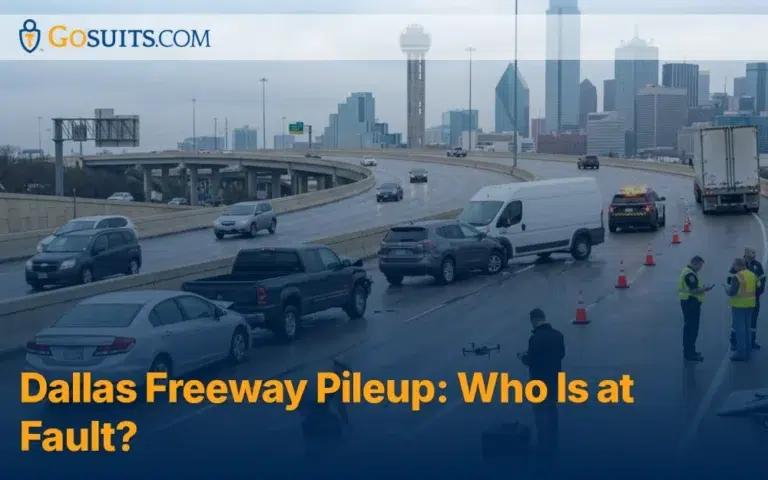
Fault in a Dallas freeway pileup is divided under Texas’s proportionate responsibility system. Each driver or party whose negligence contributed to the chain-reaction crash is assigned a percentage of fault, and each pays damages in proportion to that share. The driver who caused the first collision is the most obvious target, but any driver who followed too closely, drove too fast for conditions, or failed to take reasonable evasive action may also bear a portion of responsibility. A plaintiff who is found more than 50 percent at fault recovers nothing. A plaintiff found 50 percent or less at fault recovers, but the award is reduced by their own percentage. No driver is automatically responsible for the entire chain of events unless the evidence supports that conclusion.
Legal Snapshot
- Legal Topic: Multi-vehicle crash liability, proportionate responsibility, chain-reaction collision
- Case Stage: Pre-litigation through trial
- Primary Legal Issue: Apportionment of fault among multiple defendants; recovery when policy limits are insufficient
- Primary Authority: Texas Civil Practice and Remedies Code Chapter 33 (Proportionate Responsibility); Texas Transportation Code §545.351 (Speed Restrictions); Texas Transportation Code §545.062 (Following Distance)
- Governing State: Texas
- Date Legal Authority Last Reviewed: June 2025
What Is a Chain-Reaction Pileup and Why Does Fault Get Complicated?
A chain-reaction pileup happens when one collision triggers a sequence of additional impacts. On a busy Dallas freeway like I-35E, I-30, the LBJ Freeway (I-635), or the Dallas North Tollway, stop-and-go traffic means that when one vehicle stops short, the vehicles behind may not have enough distance or time to avoid hitting it. That first rear-end impact can push the struck car into the one ahead, and so on through the line.
The legal problem is that the victims and potentially responsible parties multiply with each impact. The third driver in the chain may have been struck only because Driver 2 was also struck. Was Driver 3 following too closely? Was Driver 2 following too closely? Did any driver have time to stop and simply fail to brake in time? Each of those questions has a legal consequence under Texas’s proportionate responsibility rules.
Personal injury lawyers who handle these claims routinely encounter disputes about who struck whom first, how fast each vehicle was traveling, and whether ice, rain, or heavy traffic on a given stretch of highway changed the standard each driver was held to. Answering those questions requires physical evidence, electronic data, and often the testimony of a reconstruction engineer.
What Does Texas Law Say About Proportionate Responsibility?
Texas Civil Practice and Remedies Code Chapter 33 governs how fault is divided when more than one party contributed to causing an injury. [1] The core rules are:
- The 51 percent bar. A plaintiff who is found by the jury to bear more than 50 percent of the responsibility for the occurrence that caused the harm cannot recover any damages. A plaintiff at exactly 50 percent recovers, reduced by that share. [1]
- Proportionate reduction. A plaintiff found less than 51 percent responsible recovers their total damages reduced by their own percentage. If the jury finds total damages of $400,000 and assigns the plaintiff 20 percent responsibility, the plaintiff collects $320,000.
- Several liability as the default. Each defendant ordinarily pays only their own proportionate share. If Driver A is found 60 percent responsible and Driver B is 40 percent responsible, Driver A pays 60 percent of the judgment and Driver B pays 40 percent.
- Joint and several liability exception. A defendant found more than 50 percent responsible for the occurrence may be held jointly and severally liable for the plaintiff’s economic damages. That means the plaintiff can collect the full economic damages from that defendant even if other defendants cannot or will not pay their share. Non-economic damages remain several only. [1]
- Responsible third parties. Any defendant may designate responsible third parties, including drivers who were not sued. If the jury assigns fault to a designated responsible third party, that reduces the percentage attributed to named defendants, which can affect the joint-and-several calculation.
- Settling defendants. When one defendant settles before trial, the remaining defendants receive a credit that reduces the judgment against them under the settlement credit mechanism in Chapter 33.
| Plaintiff’s Fault % | Recovery Available? | How Recovery Is Calculated |
|---|---|---|
| 0% | Yes | Full damages from each defendant in proportion to their share; joint and several for any defendant over 50% |
| 1%–50% | Yes | Total damages reduced by plaintiff’s own percentage |
| 51%–100% | No | No recovery |
What Legal Rules Apply to Each Driver’s Conduct?
Texas law imposes specific duties on every driver operating a vehicle on a public road. In a pileup claim, each defendant’s conduct is measured against these rules.
Duty to Maintain a Safe Following Distance
Texas Transportation Code Section 545.062 requires a driver to maintain a safe distance from the vehicle ahead, one that is reasonable and prudent under the existing conditions. [2] The statute lists factors including the speed of the vehicles, traffic, and road conditions. In stop-and-go traffic on I-30 through downtown Dallas, a driver who follows at a distance that leaves no room to stop when traffic suddenly brakes is typically in violation of this standard. That violation, if proven, can support a finding of negligence.
Duty to Drive at a Reasonable Speed
Texas Transportation Code Section 545.351 provides that a driver may not drive at a speed greater than is reasonable and prudent under the circumstances. [3] Conditions relevant to the speed determination include weather, visibility, road surface, and the presence of other traffic. A driver traveling at posted freeway speed limits during an ice storm on the LBJ Freeway may still be negligent if those conditions required a lower speed to maintain control. The posted limit is never a safe harbor when conditions are hazardous.
General Negligence
Beyond these specific code sections, Texas recognizes a general duty to operate a vehicle with ordinary care for the safety of others. Distracted driving, failure to check mirrors before braking, or failure to activate hazard lights when stopped on a freeway can all constitute negligence independent of a specific statutory violation.
Negligence Per Se
When a driver’s conduct violates a statute like the following-distance or speed provisions, Texas courts may apply the doctrine of negligence per se. Under that doctrine, the violation of the statute establishes the element of negligence without requiring the plaintiff to prove that the conduct fell below a general standard of care, provided the plaintiff is within the class of persons the statute was designed to protect. [4]
How Is the Initiating Impact Identified?
Determining which collision started the chain reaction is central to assigning fault percentages. In litigation, several sources of evidence are used to reconstruct the sequence of events.
Vehicle Damage Sequencing
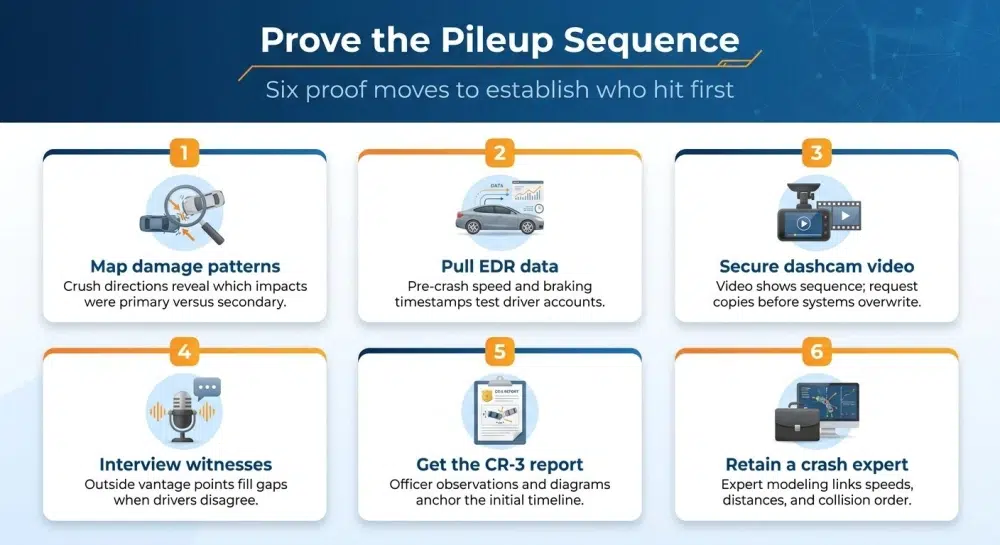
The physical damage to each vehicle carries information about the direction and sequence of force. A vehicle struck from behind shows damage concentrated at its rear. The same vehicle may also show forward impact damage at its front if it was pushed into the car ahead. By analyzing which damage patterns are consistent with a primary impact and which are consistent with secondary or tertiary impacts, a reconstruction engineer can often establish the order of collisions even when witness accounts conflict.
In practice, the first vehicle in a chain-reaction pileup typically shows only front-end damage (from being pushed forward), while the last vehicle to be struck may show only rear-end damage. Middle vehicles commonly show damage at both ends, consistent with being struck from behind and then pushed into the vehicle ahead. This pattern analysis is not conclusive in every case, particularly when vehicles were displaced or moved before measurements were taken, but it provides an objective starting point.
Event Data Recorder (EDR) and Black Box Data
Most modern passenger vehicles and virtually all commercial trucks are equipped with some form of event data recorder. These devices capture pre-crash speed, braking application, throttle position, steering input, and other parameters in the seconds before and during a crash. When preserved and properly downloaded by a qualified technician, EDR data can confirm or contradict a driver’s account of their speed and braking behavior. [5]
EDR data is time-sensitive. Vehicle repairs, salvage, and private auction can eliminate access to this data within days or weeks of a crash. An attorney handling a multi-vehicle pileup claim in Dallas will typically send preservation demand letters to every potential defendant immediately after being retained, and in some cases will seek a court order preventing the destruction or transfer of the involved vehicles.
Commercial trucks operating under Federal Motor Carrier Safety Administration regulations must also carry electronic logging devices that record hours-of-service data and may also record speed and braking events. [6] If a commercial vehicle is involved in a pileup on the Dallas North Tollway or on I-35E near downtown, that data should be treated as critical evidence from the outset.
Dashcam and Traffic Camera Footage
Dashcam footage from any vehicle involved in or near the pileup can directly capture the sequence of events. Traffic signal and toll camera footage along major Dallas corridors may also be available, though it must be requested before it is overwritten, which typically happens within 30 to 90 days depending on the agency. The George Allen Courts Building, where Dallas County civil cases are often filed, is within a few miles of several high-volume interchange areas where camera coverage is more likely.
Witness Accounts
Eyewitnesses who observed the crash from outside the affected vehicles can describe what they saw in terms of which vehicle appeared to be moving before impact, which vehicle stopped first, and what the road conditions were at the time. Witness recollections can be inconsistent, and the value of a particular witness’s account depends heavily on their vantage point and attention level. They are most useful when corroborated by physical or electronic evidence.
What About Ice and Weather Pileups?
North Texas experiences periodic ice storms that create extremely hazardous driving conditions on elevated freeways and overpasses. Stretches of I-35E, the High Five interchange, and sections of the LBJ Freeway have seen large-scale pileups during winter weather events. The legal analysis of those crashes does not differ in its structure, but the application of the duty-to-drive-to-conditions standard becomes particularly important.
In an ice pileup, several drivers may argue that the collision was unavoidable once they hit the ice. Texas law does not automatically accept that argument. A driver who continued at normal freeway speeds after passing warning signs, observing other vehicles slide, or hearing emergency alerts about icy conditions may be found negligent for failing to reduce speed before the loss of control. The question is whether a reasonably prudent driver in the same circumstances would have adjusted speed and following distance before the crash, not whether control could be maintained once the dangerous condition was already encountered. [3]
Insurance adjusters in Texas ice pileup cases routinely argue that the weather event was an “act of God” that eliminates any driver’s liability. Texas courts recognize the act-of-God defense only when the event was truly unforeseeable and there was no negligence by the defendant that contributed to the harm. A driver who ignored widely broadcast winter storm warnings and drove at 70 miles per hour on an icy section of I-635 is unlikely to succeed with that defense.
During a winter storm, a section of the elevated LBJ Freeway becomes icy. Several vehicles in the right lanes slow significantly. A driver in the left lane, traveling at near-highway speed, strikes a slowing vehicle ahead. The collision pushes that vehicle into the car in front of it, causing a five-car pileup. The investigation reveals the striking driver had passed a variable speed message sign displaying reduced speed limits due to icy conditions. EDR data shows the driver applied brakes less than one second before impact, consistent with full speed being maintained until striking distance. The jury could reasonably find that driver primarily responsible for the chain-reaction collision, while also evaluating whether any other driver’s following distance contributed to secondary impacts.

How Does Evidence Establish the Sequence of Collisions?
In contested pileup cases, the following types of evidence commonly determine how fault percentages are ultimately assigned.
- Police crash reports. The Texas Peace Officer’s Crash Report (Form CR-3) records responding officers’ observations about contributing factors, road conditions, weather, and vehicle positions. It is not binding on a jury but provides an important baseline. [7]
- Accident reconstruction analysis. A licensed reconstruction engineer can analyze crush depths, tire marks, vehicle displacements, and EDR data to model vehicle speeds and positions before, during, and after each impact.
- Photographs and video. Crash-scene photography, dashcam footage, traffic camera footage, and aerial imagery can capture vehicle positions and road conditions. Preservation demands must be sent quickly.
- Medical records and injury patterns. The direction of forces applied to an occupant is often reflected in their injury pattern. A driver struck from behind sustains different injuries than a driver who struck another vehicle from behind. Injury pattern evidence can corroborate or contradict claimed sequence.
- Cell phone records. Distracted driving is a significant cause of rear-end collisions. Cell records showing active phone use at the time of impact support a negligence per se finding under the Texas prohibition on hand-held cell phone use while driving. [8]
- Weather and road condition data. Historical weather records, Texas Department of Transportation road condition alerts, and emergency broadcast records can establish what conditions were known before and during the crash.
What Happens When There Are More Claimants Than Policy Limits?
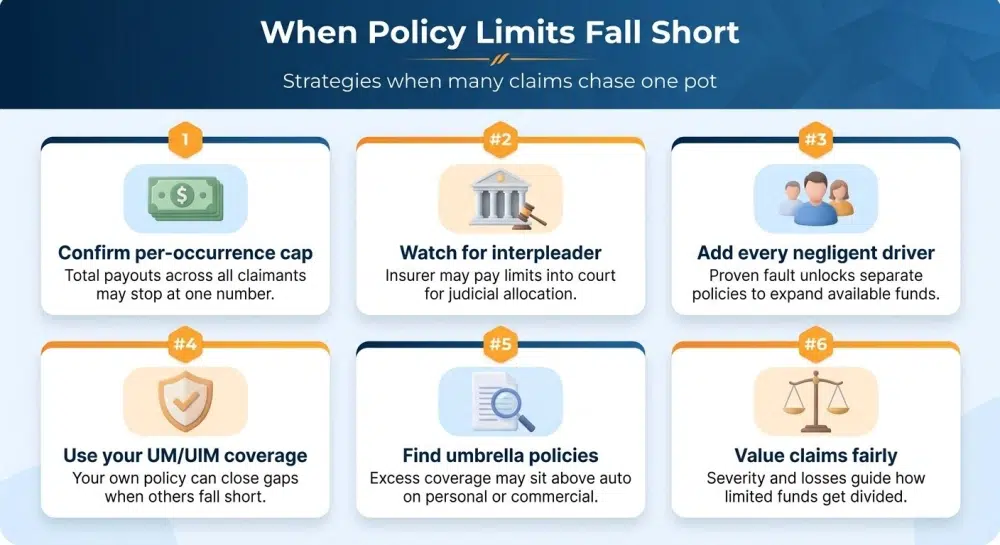
This is one of the most practically significant problems in a large freeway pileup. When ten or fifteen vehicles are involved, there may be ten or fifteen injured parties pursuing claims. If the driver who caused the initiating collision carries only minimum Texas liability insurance ($30,000 per person / $60,000 per occurrence for bodily injury), [9] a single seriously injured plaintiff may already face a situation where the at-fault driver’s policy does not come close to covering their medical expenses and lost income. When multiple injured parties compete for the same policy limit, the problem compounds.
Per-Occurrence Policy Limits
Texas auto insurance policies typically contain both a per-person limit and a per-occurrence limit. The per-person limit is the maximum the insurer will pay any single claimant. The per-occurrence limit is the total the insurer will pay across all claimants in a single crash. If the per-occurrence limit is $60,000 and five people are injured, no individual claimant can receive more than the per-person limit, and the total paid across all five cannot exceed $60,000. When the insurer exhausts its per-occurrence limit, it has no further obligation.
Interpleader and Settlement Allocation
When multiple claimants compete for limited policy funds, an insurer may pay the per-occurrence limit into court through a legal process called interpleader, allowing a court to determine how the funds should be allocated among the claimants. Each claimant’s attorney then argues for the greatest possible share for their client based on injury severity, economic losses, and other relevant factors.
Pursuing Multiple Defendants
One policy usually isn’t enough. Not for a serious pileup. The smarter move is to pursue every driver whose negligence played a part, because in a chain-reaction crash there are often multiple people at fault, and each of them probably has their own insurance. That matters. It stacks the available coverage. Any attorney who regularly handles car accident lawyers Dallas cases will tell you the investigation has to be thorough, cover every vehicle, every driver, because that’s how you build the biggest possible pool of money to work with.
Uninsured and Underinsured Motorist Coverage
So Texas doesn’t force you to buy uninsured or underinsured motorist coverage. UM and UIM, as most people know it. But insurers do have to offer it, which means you might already have it and not realize it. That matters. When the at-fault driver’s policy just isn’t enough to cover what you’ve lost, your own UM/UIM coverage can pick up some of the slack, up to your policy limit. Finding it, pursuing it correctly, making sure nothing gets missed, that’s kind of essential in any case where the negligent driver’s insurance falls short. For a broader look at how insurance stacks up after a Dallas crash, check out our article on layered insurance in multi-carrier Texas crashes.
Personal Judgment Against the Defendant
When insurance is exhausted and damages remain unpaid, a plaintiff may pursue a personal judgment against the defendant and seek to collect from their assets. In practice, many individual drivers who cause catastrophic crashes have limited personal assets, which is why identifying every potentially negligent party from the outset is so important.
Think about a scenario like this. On I-30, right near the High Five interchange, a driver plows into the back of a stopped car and triggers a seven-vehicle pileup. Six of the seven occupants get seriously hurt. The driver who caused it has $60,000 in per-occurrence liability. That’s it. Two other drivers in the chain each have $100,000 policies, but they’re both claiming they weren’t following too closely, which is what people usually say. Then the EDR data drops. One of the middle drivers was going 55 mph when the traffic ahead had already slowed to under 20. The reconstruction engineer looks at all of it and says that middle driver had plenty of room to stop and just failed to brake properly. And just like that, another insurer is in the mix. The available coverage pool jumps from $60,000 to $160,000. Four of the six injured occupants also happen to carry UIM coverage on their own policies, which stacks on top.
What Evidence Can Matter in a Pileup Case?
Based on the types of issues that arise in multi-car crash litigation, the following categories of evidence are often decisive. None of this evidence automatically establishes liability; each category must be properly gathered, preserved, and presented.
- Event data recorder (EDR) downloads – Pre-crash speed, braking timing, and throttle position from every equipped vehicle involved.
- Dashcam footage – Forward-facing cameras on any involved vehicle, as well as any nearby commercial vehicles equipped with fleet dash cameras.
- Traffic and surveillance camera footage – TxDOT traffic cameras, tollway cameras, and nearby business surveillance that may have captured the incident.
- Police crash report (Form CR-3) – Responding officer observations, diagram, contributing factor codes, and weather and road condition notations.
- Weather records – National Weather Service data, TxDOT road condition alerts, and emergency broadcasts for the relevant time and location.
- Vehicle inspection records – Tire condition, brake condition, and maintenance records for each vehicle, particularly commercial trucks.
- Cell phone records – Call logs, text message metadata, and app usage records for each driver at the time of impact.
- Witness statements – Accounts from occupants of non-involved vehicles and pedestrians who observed the sequence of collisions.
- Medical records – Injury patterns that may confirm or contradict claimed direction of impact forces.
- Vehicle inspection photos – Comprehensive photographic documentation of damage on all vehicles before repair, ideally taken before any vehicle is moved from the scene.
What Damages May Be Available?
Texas law permits injured persons to seek compensation for a range of damages that result from another party’s negligence. Recoverability depends on the facts of each case and the applicable law.
- Past and future medical expenses
- Past and future lost earnings and loss of earning capacity
- Physical pain and mental anguish, past and future
- Physical impairment, past and future
- Disfigurement, past and future
- Property damage
Fatal crashes open up a different set of claims. Under Texas Civil Practice and Remedies Code Chapter 71, certain family members can file a wrongful death case. Not everyone qualifies. It’s the surviving spouse, the children, and the parents of the person who died. Those are the beneficiaries. There’s also a separate thing called a survival action, which the estate brings for whatever the person went through between the crash and their death, so kind of the pain and expenses in that window. Fatal crash attorneys in Dallas usually end up handling both at the same time when they come out of the same pileup, because they’re really two sides of the same loss. [10]
Exemplary damages, also called punitive damages, may be available under Texas Civil Practice and Remedies Code Chapter 41 when the plaintiff proves by clear and convincing evidence that the defendant acted with fraud, malice, or gross negligence. [11] A driver who ignored repeated warnings about icy road conditions, drove under the influence of alcohol or drugs, or engaged in street racing that contributed to a pileup may face exemplary damages, though the legal standard is demanding and each case turns on its specific facts.
What If the Other Parties Dispute Liability?
Liability disputes are common in pileup cases precisely because multiple defendants each have a financial interest in shifting responsibility to other parties. Typical defense arguments include:
- The plaintiff was following too closely. Defendants will seek evidence that the injured party also maintained an inadequate following distance.
- The road conditions made the crash unavoidable. The act-of-God defense, discussed above, and its significant limitations under Texas law.
- Another driver, not named in the lawsuit, caused the crash. Texas’s responsible third party designation allows defendants to shift fault to absent parties, potentially affecting the percentage assigned to named defendants.
- The plaintiff’s injuries were pre-existing. Defendants may argue that the plaintiff’s injuries predated the crash. Texas law allows recovery for aggravation of a pre-existing condition, and the plaintiff bears the burden of separating pre-existing harm from crash-caused harm.
The most effective response to these arguments is thorough, early evidence preservation and the engagement of qualified experts who can present the physical and electronic evidence clearly.
How Long Do I Have to Act in Texas?
Texas Civil Practice and Remedies Code Section 16.003 provides a two-year statute of limitations for personal injury claims. [12] The two-year period typically begins on the date of the crash. For wrongful death claims, the period also generally runs from the date of the decedent’s death. Missing the deadline ordinarily bars the claim permanently regardless of how strong the evidence may be.
Several factors can affect the deadline. Claims against governmental entities in Texas may require a formal notice of claim within a shorter period, often six months, before a lawsuit can be filed. Claims involving minor plaintiffs may have different limitation periods. Consulting an attorney promptly after a serious crash is essential to ensuring the right deadlines are identified and met.
Beyond the statute of limitations, time matters in a pileup case for a separate reason. EDR data can be overwritten by subsequent driving. Dashcam footage is routinely recorded over within days. Traffic camera footage is deleted on a rolling cycle. Witnesses’ memories fade. The longer the delay before a formal investigation begins, the greater the risk that critical evidence will be lost.

Talk With a GoSuits Personal Injury Attorney
A multi-car pileup in Dallas involves overlapping liability questions, competing insurance claims, and evidence that can disappear quickly. Whether the crash occurred on I-35E in heavy downtown traffic, on the LBJ Freeway in icy conditions, or on I-30 near Deep Ellum, the legal analysis depends on the facts established by the physical and electronic evidence.
If you or someone in your family was injured in a freeway pileup in Dallas or anywhere in Texas, our personal injury lawyers can review the circumstances of your case, identify all potentially responsible parties, and explain your options. There is no fee unless you recover.
References and Legal Authorities
- Texas Civil Practice and Remedies Code Chapter 33 – Proportionate Responsibility – Texas Legislature Online
- Texas Transportation Code Section 545.062 – Following Distance – Texas Legislature Online
- Texas Transportation Code Section 545.351 – Speed Restrictions; Basic Rule – Texas Legislature Online
- Negligence Per Se – Legal Information Institute, Cornell Law School
- Event Data Recorders (EDR) – National Highway Traffic Safety Administration (NHTSA)
- Electronic Logging Device (ELD) Rule – Federal Motor Carrier Safety Administration (FMCSA)
- Texas Peace Officer’s Crash Report (Form CR-3) – Texas Department of Transportation
- Texas Transportation Code Section 545.4251 – Prohibition on Use of Portable Wireless Communication Device – Texas Legislature Online
- Texas Auto Insurance Requirements – Texas Department of Insurance
- Texas Civil Practice and Remedies Code Chapter 71 – Wrongful Death; Survival – Texas Legislature Online
- Texas Civil Practice and Remedies Code Chapter 41 – Exemplary Damages – Texas Legislature Online
- Texas Civil Practice and Remedies Code Section 16.003 – Two-Year Limitations Period – Texas Legislature Online