When a serious crash on a Texas highway involves a commercial semi-truck, the injured party often faces not one insurance policy but a stack of them – primary liability coverage, excess policies, umbrella policies, and federally mandated endorsements – spread across multiple carriers who may each dispute their responsibility. Understanding how these layers interact is critical to any claim where losses are severe and one policy alone may not come close to covering them.
Legal Snapshot
- Legal Topic: Layered Commercial Insurance, MCS-90 Endorsement, Multi-Defendant Proportionate Responsibility
- Case Stage: Pre-litigation through trial
- Primary Legal Issue: Insurance coverage allocation, policy stacking, and recovery when limits are exceeded
- Primary Authority: 49 C.F.R. Part 387 (FMCSA financial responsibility); Texas Civil Practice and Remedies Code Chapter 33 (proportionate responsibility)
- Date Legal Authority Last Reviewed: July 2025
What Is Layered Insurance Coverage?
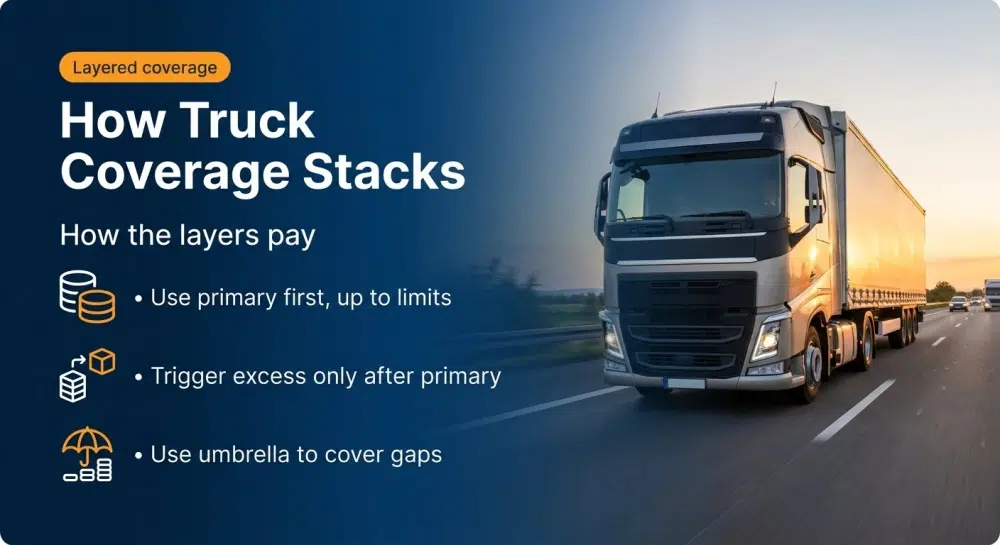
Commercial trucking operations routinely carry more than one insurance policy, and those policies are designed to respond in a particular sequence. The term “layered coverage” refers to the arrangement where one policy must be exhausted before the next one is triggered. Thinking of it as floors in a building is useful: the primary policy is the ground floor, excess coverage sits above it, and umbrella coverage may sit above that. Each layer only opens after the one below it is fully used up.
In a catastrophic crash – a jackknife on the LBJ Freeway in Dallas, for example, involving an 18-wheeler that strikes multiple vehicles in stop-and-go traffic – a single victim’s losses can easily surpass a primary policy’s limits. That is where understanding the full tower of coverage becomes practically important for injured people and their families.
What Are the Three Main Layers in Commercial Trucking?
Layer 1 – Primary Liability Coverage
The primary policy is the foundation. It is the first policy to pay, up to its stated per-occurrence limit, once a covered loss occurs. Federal law – specifically 49 C.F.R. Part 387 – requires motor carriers operating in interstate commerce to maintain minimum liability coverage ranging from $750,000 for certain cargo types to $5,000,000 for hazardous materials, depending on the vehicle and commodity transported. [1] Texas also imposes financial responsibility requirements on carriers operating within state lines under the Texas Transportation Code.
The primary policy typically covers the named insured motor carrier and, to varying degrees, its drivers. When a driver operates under a lease arrangement, the policy language will determine whether the driver’s own insurer or the carrier’s insurer provides primary coverage – a distinction that is frequently disputed when multiple carriers are involved.
Layer 2 – Excess Liability Coverage
An excess policy attaches only after the primary policy’s limits are fully exhausted by a combination of paid claims, settlements, and defense costs, depending on the policy terms. Excess coverage does not “drop down” to take the place of primary coverage when a primary policy is unavailable; it waits for the underlying layer to be depleted. This means the sequence matters enormously. If a primary carrier disputes coverage and refuses to pay, the excess carrier may also refuse to pay until that dispute is resolved.
Here’s the thing. Trucking companies, freight brokers, and cargo owners can each be carrying their own excess policies, and sorting out which one actually applies usually means digging through the contracts that tie them together and reading every policy word by word. Lawyers who handle these cases get it. The paper trail – leases, broker contracts, owner-operator agreements – is kind of just as important as the police report.
Layer 3 – Commercial Umbrella Coverage
An umbrella policy casts a wider net than a plain excess policy. It can pick up certain claims that fall through the gaps in the underlying coverage, subject to its own terms of course. And here’s what a lot of people miss – a real umbrella can sometimes drop down and function as primary coverage when the underlying policy won’t respond. Excess policies can’t. That difference is huge when there’s a coverage dispute at the primary level. Figuring out which type you’re dealing with means actually sitting down with the policy and reading it, word by word.
What Is the MCS-90 Endorsement and What Does It Actually Guarantee?
The MCS-90. It’s a Motor Carrier Safety endorsement, and federal law basically forces any regulated interstate motor carrier to tack it onto their insurance policy. [1] Here’s who it’s actually built to protect: the public, not the carrier. What it does is pretty simple in concept – even if some exclusion in the policy would normally kill coverage, the insurer still has to pay up to the applicable minimum limits when a covered truck causes bodily injury or property damage during interstate commerce.
The MCS-90 is not a separate policy. It is an endorsement stapled to an existing policy. A few critical points that injured parties and their attorneys need to understand:
- It guarantees minimum limits only. The MCS-90 does not create additional coverage above the underlying policy limits; it prevents the insurer from using a policy exclusion to deny coverage entirely, up to the regulatory minimums.
- It applies to public liability. The endorsement specifically protects members of the public harmed by the carrier’s regulated vehicles, not necessarily the carrier’s own employees or contractors under certain circumstances.
- It triggers a right of reimbursement. If an insurer pays a claim under the MCS-90 that it otherwise could have excluded, it has the right to seek reimbursement from the carrier. This matters when analyzing the carrier’s financial exposure.
- It applies to interstate commerce. Whether a particular trip or movement qualifies as interstate commerce can be a contested legal and factual question that affects whether the MCS-90 applies at all.
In practical terms, the MCS-90 is most important when an insurer finds what it believes is a valid policy exclusion – such as an exclusion for a driver the carrier failed to list – and tries to deny coverage. The endorsement stands as a backstop protecting the injured member of the public from losing access to the minimum required coverage.
Picture this. A Dallas trucking company leases a tractor from an independent owner-operator. The owner-operator’s own personal policy? It excludes commercial hauling. Meanwhile, the trucking company’s primary policy excludes vehicles that aren’t listed on its schedule – and this particular tractor got added after the last renewal, so it’s not on there. Here’s where the MCS-90 does its job. If it’s attached to either policy, whichever insurer issued that policy can’t hide behind those exclusions to dodge paying the federal minimum limits to a member of the public hurt by that truck. The insurer might turn around later and chase the carrier for reimbursement, sure, but the injured person’s access to the baseline coverage stays intact.
How Do Multiple Defendants and Their Carriers Fight Over Allocation?
Think about a bad wreck on a Texas highway. Maybe it happens on I-635 near the Dallas North Tollway interchange, or somewhere along I-35E on the way into downtown Dallas. Doesn’t really matter where. What matters is that a serious commercial truck crash usually pulls in a bunch of legally separate parties, and each one probably has its own insurer the motor carrier, whoever actually owns the tractor, the driver if he’s an owner-operator, the freight broker, the cargo shipper, some maintenance outfit, and even a manufacturer if a busted piece of equipment had anything to do with it.
When multiple defendants and multiple insurers exist, allocation disputes arise in two related contexts. First, the carriers dispute among themselves whose policy should respond and in what amount. Second, the defendants dispute among themselves how much of the total damages should be attributed to each party’s conduct. These disputes can occur simultaneously, in separate coverage litigation, and sometimes in the same trial.
Common tools carriers use in allocation disputes include:
- Reservation of rights letters. An insurer defends its insured while simultaneously reserving its right to later disclaim coverage if certain conditions are not met. Receiving one of these letters is a signal of conflict between the insurer and its insured. [6]
- Declaratory judgment actions. An insurer may file a separate lawsuit asking a court to rule on whether it owes coverage before the underlying personal injury case is resolved.
- Contribution and indemnity claims. One defendant may file cross-claims against another, arguing that the second defendant is responsible for paying part or all of what the first defendant has to pay.
- Policy language disputes. “Other insurance” clauses, anti-stacking provisions, and priority-of-coverage provisions are included in commercial policies precisely to manage these disputes.
For injured people, these disputes can delay payment significantly. Understanding how they work – and having legal representation that can navigate multiple simultaneous proceedings – matters a great deal to the practical outcome of a case.

How Does Texas Proportionate Responsibility Apply When There Are Several Defendants?
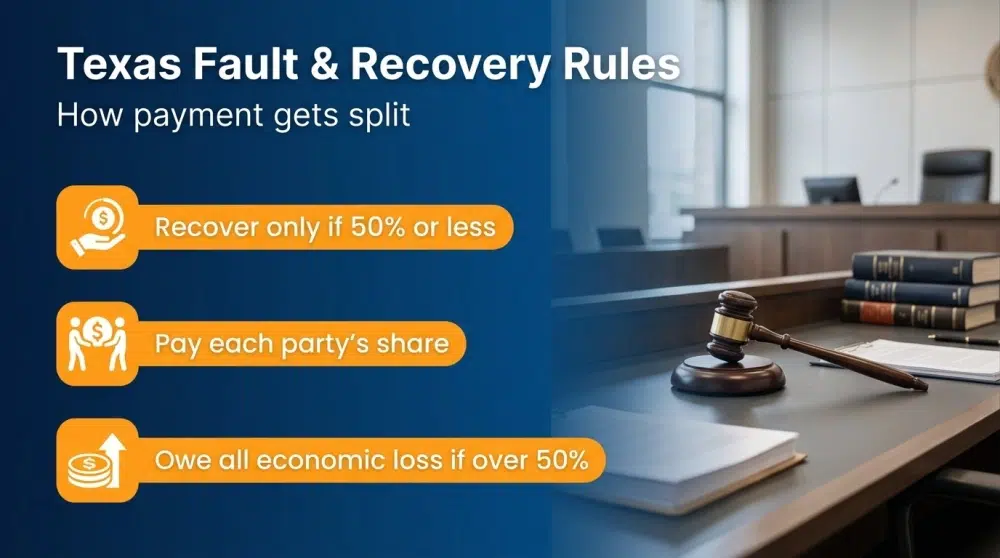
Texas follows a modified comparative fault system governed by Chapter 33 of the Texas Civil Practice and Remedies Code. [2] In a crash involving several defendants, the jury is asked to assign a percentage of responsibility to each party whose conduct contributed to causing the harm. The plaintiff’s recovery is then calculated based on those percentages.
Several rules under Chapter 33 are particularly important in multi-defendant truck crash cases:
- The 51 percent bar. A plaintiff who is found to be more than 50 percent responsible for her own harm cannot recover anything. A plaintiff found 50 percent or less responsible recovers, but her recovery is reduced by her own percentage. [2]
- Proportionate payment of damages. Each defendant generally pays only its own proportionate share of the total damages, not the full amount. If a defendant is responsible for 20 percent and the total damages are determined to be $2,000,000, that defendant pays $400,000.
- Joint and several liability exception. A defendant found more than 50 percent responsible for causing the harm may be held jointly and severally liable for the plaintiff’s economic damages – meaning that defendant can be required to pay more than its proportionate share of economic damages if the other defendants cannot pay. [2]
- Settling defendants. A defendant who settles before trial may be given a credit toward the remaining defendants’ liability, depending on the structure of the settlement and whether it satisfies the statutory requirements for settlement credit.
- Responsible third parties. Texas allows defendants to designate other potentially responsible parties, including parties who have not been sued, which can reduce the percentage attributed to the remaining defendants.
An 18-wheeler crash on US-75 (Central Expressway) near Plano involves three defendants: the trucking company, an equipment maintenance vendor, and a cargo loader. The jury finds the trucking company 55 percent responsible, the maintenance vendor 30 percent responsible, and the cargo loader 15 percent responsible. Total damages are found to be $3,000,000. Because the trucking company is over 50 percent responsible, it can be held jointly and severally liable for all economic damages. The injured party can pursue the trucking company for the full economic damage award even if the other defendants cannot pay their shares. Non-economic damages are paid proportionately.
What Happens When Total Damages Exceed the Available Policy Limits?
In catastrophic crashes – those involving spinal cord injuries, traumatic brain injuries, or wrongful death – total damages can exceed the entire tower of available insurance coverage. When that happens, several paths may still be available to an injured person or a surviving family.
| Situation | What May Be Available | Considerations |
|---|---|---|
| Primary limits are exhausted; excess policy exists | Excess policy triggered once primary limits are paid | Must verify excess policy conditions are met; may require formal tender of primary limits |
| All commercial policies are exhausted | Judgment against defendant entities directly | Recovery depends on defendant’s assets; corporate structure matters |
| Carrier is judgment-proof or insolvent | Other liable parties with separate coverage (broker, shipper, owner) | Requires identifying all potentially responsible parties early |
| Negligent hiring, training, or supervision claim | May create direct liability for the carrier beyond driver’s policy | Discovery of safety records, driver qualification files is critical |
| Product liability if equipment failure contributed | Manufacturer or component maker may be liable | Preservation of the vehicle and failed component is time-sensitive |
When a trucking company faces a claim that threatens to exceed its coverage, its insurer may also become motivated to settle quickly – sometimes for the full policy limits – in order to avoid exposing the company to bad-faith liability. Texas recognizes bad-faith insurance practices under the Texas Insurance Code, and an insurer that refuses a reasonable settlement offer within policy limits, exposing its insured to excess judgment, may face additional liability. [4]
Victims who work with truck accident lawyers experienced in commercial cases understand that the insurer’s own litigation decisions can create pressure that shifts the settlement dynamic. When commercial truck accident attorneys in Dallas pursue every potential defendant and document the full extent of damages early, they place the insurer in a position where delay carries increasing risk.
What Evidence Can Matter in a Multi-Carrier Truck Case?
Multi-carrier truck cases require thorough evidence collection, often under time pressure because electronic data can be overwritten and vehicles can be repaired or sold. The following categories of evidence are frequently important:
- Electronic logging device (ELD) and black box data. Federal regulations require most commercial trucks to use ELDs. [3] These devices record hours of service, vehicle speed, braking, and other data that can directly contradict a driver’s account of events or reveal hours-of-service violations.
- Driver qualification files. Federal regulations require carriers to maintain files documenting a driver’s license, medical certification, prior employment, and drug and alcohol testing history. Gaps or violations in these files can support negligent hiring or negligent entrustment claims.
- Bills of lading and freight contracts. These documents establish the relationship among the carrier, broker, shipper, and consignee – critical for determining who controlled the movement and who may share liability.
- Insurance and lease documents. The actual policy language, endorsements, and lease agreements between the truck owner and the carrier determine coverage priority. Requesting these through discovery early in the case is essential.
- Dashcam and surveillance footage. Footage from the truck’s forward-facing camera, nearby businesses, or traffic cameras along corridors like I-30 or the Dallas North Tollway can be decisive. Preservation letters must be sent immediately.
- Maintenance records. Records showing deferred or inadequate maintenance can support a direct negligence claim against the carrier and potentially implicate a third-party maintenance contractor.
- Post-accident inspection records. Texas Department of Public Safety reports and any Federal Motor Carrier Safety Administration post-crash inspections may document violations that existed at the time of the crash.
- Cell phone records. Distracted driving remains a significant cause of commercial truck crashes. Phone records can show whether a driver was using a handheld device, which is prohibited under 49 C.F.R. § 392.82. [5]
What Damages May Be Available in a Texas Truck Crash Case?
Texas law allows injured people to pursue a range of damages depending on the nature and extent of their injuries. The categories recognized under Texas law include:
- Past and future medical expenses
- Past and future lost earnings and loss of earning capacity
- Physical pain and mental anguish, past and future
- Physical impairment, past and future
- Disfigurement, past and future
- Property damage
In cases involving fatalities, Texas Wrongful Death Act claims may be brought by the surviving spouse, children, and parents of the decedent. A separate survival action may be brought by the estate for damages the decedent suffered between the crash and death. [7] Fatal crashes on Texas interstates frequently involve wrongful death lawyers because the catastrophic nature of commercial truck collisions means fatalities are far more common than in ordinary passenger vehicle crashes.
Exemplary (punitive) damages may be available in Texas under Chapter 41 of the Civil Practice and Remedies Code when the defendant’s conduct is shown by clear and convincing evidence to constitute fraud, malice, or gross negligence. [8] A carrier that knowingly allowed a fatigued driver or an unqualified driver to operate a heavily loaded commercial vehicle may face exemplary damages, though the standard is demanding and each case turns on its specific facts.
The recoverability of any category of damages depends on the applicable law and the facts established by the evidence.
What If the Other Parties Dispute Liability?
Disputes over liability in multi-carrier truck crash cases are nearly universal. Each defendant has its own insurer, and each insurer has a financial incentive to minimize its client’s share of responsibility. Insurers may argue that the plaintiff contributed to the crash, that another defendant bears greater responsibility, or that a designated responsible third party caused the harm.
Building and preserving evidence early is the most effective response to anticipated liability disputes. Accident reconstruction experts can recreate the sequence of events. Trucking safety experts can evaluate whether the carrier’s hiring, training, and supervision practices complied with federal regulations. Medical experts establish the connection between the crash and the injuries sustained.
In cases where a freight broker arranged the load, the broker may argue it had no control over the carrier and therefore owes no duty. Whether a broker’s negligent selection of an unsafe carrier creates liability is a developing area of law that requires careful legal analysis specific to the facts of each case.
How Long Do I Have to Act in Texas?
Texas Civil Practice and Remedies Code Section 16.003 generally establishes a two-year statute of limitations for personal injury claims. [9] For wrongful death claims, the two-year period typically runs from the date of death. Missing this deadline ordinarily bars the claim entirely.
Several factors can affect the deadline, including the identity of the defendants (a government entity may require a formal notice of claim within a shorter period), the involvement of a minor plaintiff, or whether a defendant fraudulently concealed facts. Insurance coverage disputes have their own contractual and statutory deadlines as well. [4]
In multi-carrier commercial truck cases, early action serves another purpose beyond preserving the right to sue. ELD data, dashcam footage, and cell phone records may be subject to automatic overwrite or deletion within weeks. Sending preservation demand letters to every potentially responsible party at the earliest possible stage protects the evidentiary record that the entire case may depend on.
Talk With a GoSuits Attorney
A truck crash claim involving multiple carriers, layered policies, and multi-defendant liability disputes is among the most complex personal injury matters in Texas courts. The coverage tower, the allocation fights among insurers, and the proportionate responsibility rules all affect how much an injured person or a surviving family can actually recover – and when.
If you or someone in your family was injured in a commercial truck crash anywhere in Texas, our Dallas personal injury lawyers can review the circumstances of your case, identify all potentially responsible parties and available coverage, and explain your legal options. There is no fee unless you recover.
Related Texas Personal Injury Resources
References and Legal Authorities
- 49 C.F.R. Part 387 – Minimum Levels of Financial Responsibility for Motor Carriers – Electronic Code of Federal Regulations (eCFR)
- Texas Civil Practice and Remedies Code Chapter 33 – Proportionate Responsibility – Texas Legislature Online
- Electronic Logging Device (ELD) Rule Overview – Federal Motor Carrier Safety Administration (FMCSA)
- Texas Insurance Code Chapter 541 – Unfair Methods of Competition and Unfair or Deceptive Acts or Practices – Texas Legislature Online
- 49 C.F.R. § 392.82 – Hand-Held Mobile Telephone Use Prohibited – FMCSA
- Texas Administrative Code – Texas Secretary of State (regulatory reference for insurance-related administrative rules)
- Texas Civil Practice and Remedies Code Chapter 71 – Wrongful Death; Survival – Texas Legislature Online
- Texas Civil Practice and Remedies Code Chapter 41 – Exemplary Damages – Texas Legislature Online
- Texas Civil Practice and Remedies Code § 16.003 – Two-Year Limitations Period – Texas Legislature Online
- Financial Responsibility and Insurance for Motor Carriers – Federal Motor Carrier Safety Administration
- Texas Civil Practice and Remedies Code Chapter 37 – Declaratory Judgments – Texas Legislature Online
- Texas Courts – Rules and Standards – Texas Office of Court Administration