- How Does Texas Get Personal Jurisdiction Over a Foreign Motor Carrier?
- What Does the Texas Long-Arm Statute Actually Say?
- Can You Serve the Trucking Company Through Its Registered Agent?
- What Is an FMCSA-Designated Process Agent and How Do You Serve One?
- Can the Trucking Company Remove the Case to Federal Court?
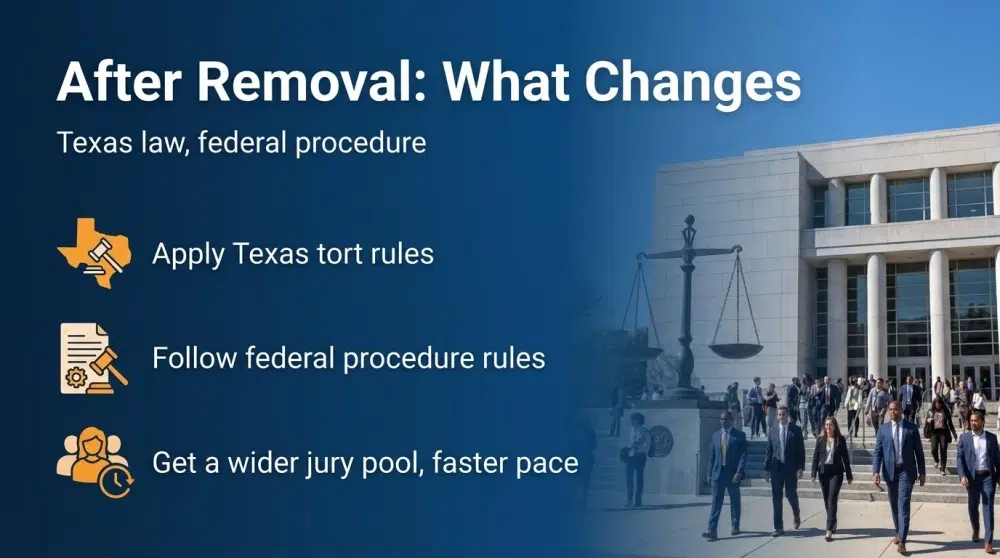
- What Practically Changes After Removal to Federal Court?
- Where Does Freight Broker Liability Fit In?
- Can the Shipper Also Be Held Responsible?
- How Do These Rules Apply Differently to Plaintiffs and Defendants?
- Frequently Asked Questions
- How GoSuits Dallas Handles Out-of-State Trucking Cases
- References
An 18-wheeler rolling through the Dallas-Fort Worth metroplex may wear a DOT number registered in Ohio, a corporate address in Tennessee, and cargo brokered by a logistics company in Illinois. When that truck causes a crash on I-635 or backs up traffic through the High Five interchange, the injured person standing in Texas faces a deceptively difficult first question: how do you actually pull a foreign motor carrier into a Texas courtroom and hold it accountable?
The answer draws on four overlapping bodies of law: Texas personal jurisdiction doctrine, the Texas long-arm statute, federal motor carrier registration requirements administered by the Federal Motor Carrier Safety Administration (FMCSA), and the federal removal statute. Freight brokers and shippers add another layer. This article walks through each piece so you understand how Texas courts reach out-of-state trucking companies and what shifts if the case moves to federal court. If you or someone you love has been injured, speaking with personal injury lawyers who handle these cases in Dallas is the right next step.
How Does Texas Get Personal Jurisdiction Over a Foreign Motor Carrier?
Personal jurisdiction is a court’s authority over a specific person or company. A Texas state court has it over a foreign defendant only if two conditions are met: the defendant has certain connections to Texas, and exercising jurisdiction over them is consistent with the Due Process Clause of the Fourteenth Amendment. [1]
For commercial trucking, those connections are rarely hard to find. An interstate carrier that routinely delivers freight through Carrollton, drops loads in the Frisco distribution corridor, or picks up cargo near the Dallas North Tollway is continuously transacting business in Texas. Courts analyze several categories of jurisdictional contact:
- Specific jurisdiction arises when the lawsuit itself grows out of the defendant’s Texas activities. A crash on I-35E near downtown Dallas involving an out-of-state carrier is the clearest example. The defendant drove into Texas, the injury happened here, and the claim arises from that act.
- General jurisdiction exists when a defendant’s contacts with Texas are so continuous and systematic that the company is essentially at home here, even if the crash happened elsewhere. This is a higher bar for foreign corporations after the Supreme Court’s 2014 decision in Daimler AG v. Bauman.
- Consent through registration is a separate theory. Texas requires foreign corporations doing business in Texas to register with the Secretary of State and designate a registered agent. Some courts have held that registration alone constitutes consent to general jurisdiction, though this remains litigated territory.
For the DFW plaintiff, specific jurisdiction almost always does the job. The truck accident lawyers at GoSuits Dallas evaluate the carrier’s Texas contacts early because jurisdiction shapes every downstream decision, including where to file and whether removal is likely.
Does It Matter That the Driver Was Only Passing Through Texas?
Passing through is still doing business. A carrier’s truck operating on Texas roads under a Texas permit or intrastate authority, delivering freight destined for Texas receivers, is engaging in commercial activity in this state. Texas courts have consistently found specific jurisdiction when the tort occurs on Texas soil, regardless of whether the trucking company has an office or terminal here. [2]
What Does the Texas Long-Arm Statute Actually Say?
Texas Civil Practice and Remedies Code § 17.042 is the governing text. [3] It extends the reach of Texas courts to nonresident defendants who:
- Contract with a Texas resident and performance of the contract requires delivery of services or goods in Texas;
- Commit a tort in whole or in part in Texas; or
- Recruit Texas residents for employment outside the state.
The second category covers virtually every truck accident that occurs on Texas roads. When an out-of-state carrier’s driver causes a rear-end collision in stop-and-go traffic on I-30, or a merge-related crash near the George L. Allen Sr. Courts Building area of downtown Dallas, the tort is committed in Texas. The statute’s reach is co-extensive with the federal due process limit, which means Texas courts assert jurisdiction as broadly as the Constitution allows. [3]
What If the Negligent Act Occurred Outside Texas?
A carrier based in Georgia that negligently maintained its brakes in Georgia, and that brake failure causes a crash in Dallas, still falls within the long-arm statute because the tort produces harmful effects in Texas. Courts look at where the injury occurs, not just where the negligent act took place. The “in part” language of § 17.042(2) does real work here.
Can You Serve the Trucking Company Through Its Registered Agent?
Yes, and this is often the simplest route. A foreign corporation that is registered to do business in Texas must maintain a registered agent in the state with the Secretary of State. [4] Service on that registered agent is service on the company. Texas Rules of Civil Procedure Rule 106 governs personal service, and Rule 107 governs the proof-of-service return.
If the foreign carrier has not registered in Texas, it may still be doing business here in a way that triggers the Secretary of State as agent under Tex. Bus. Orgs. Code § 5.251. That provision makes the Secretary of State the agent for service when a foreign entity transacts business in Texas without the required registration. Service is made by delivering the citation to the Secretary of State, who then forwards it to the defendant’s last known address.
Defendants who have been served through the Secretary of State sometimes challenge service by arguing they did not maintain adequate contacts with Texas. Getting service right from the start matters because defective service can stall a case for months, eating into the two-year statute of limitations that applies to most Texas personal injury claims.
What Is an FMCSA-Designated Process Agent and How Do You Serve One?
Here is where federal trucking law adds something the Texas long-arm statute does not have: a congressionally mandated service mechanism that every registered interstate motor carrier must maintain.
Under 49 U.S.C. § 13304, every motor carrier subject to federal jurisdiction must designate a process agent in each state in which it operates. [5] The designation is filed with the Department of Transportation on Form BOC-3. The agent must be a real person or entity with a physical address in the state, capable of receiving lawsuits on the carrier’s behalf.
Practically, this means:
- Every FMCSA-registered carrier that has operated trucks in Texas has a named process agent in Texas whose identity is publicly searchable in the FMCSA database. [6]
- Serving the FMCSA-designated process agent is valid service on the carrier. Courts in the Northern District of Texas and the Texas state trial courts in Dallas County have both recognized this method.
- If the carrier failed to file a BOC-3 designation, 49 U.S.C. § 13304(a) permits service on “any agent of the carrier within that State,” which is an even broader fallback.
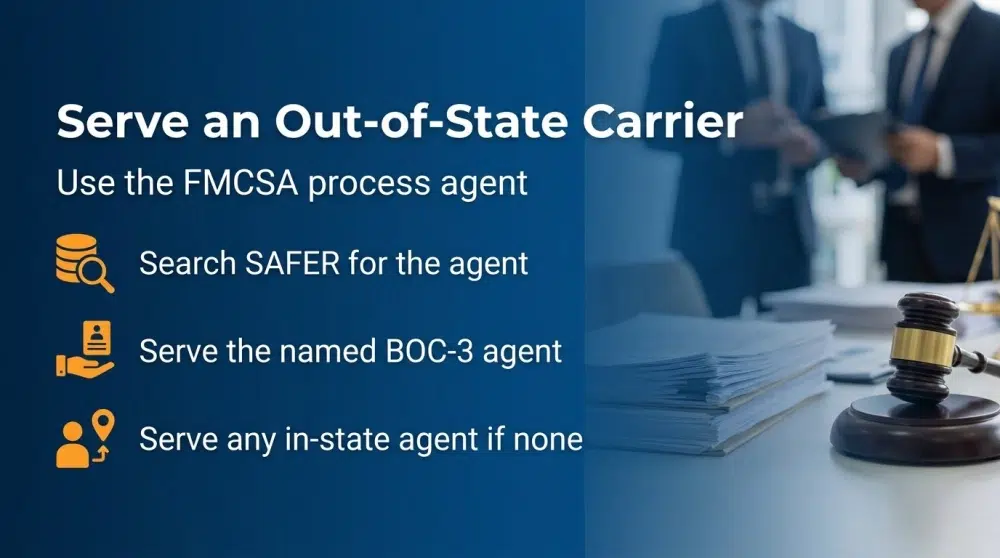
Some carriers hide. Or try to, anyway, buried under leasing arrangements and owner-operator contracts that make it tough to figure out who’s actually running the show. That’s where the process agent route pays off. BOC-3 designations sit in the public record, so the paper trail is harder to bury than the corporate structure might suggest, and you can pull a carrier’s FMCSA registration, safety ratings, and process agent info straight from the SAFER system (that’s the FMCSA’s Safety and Fitness Electronic Records tool). [6] #ref-6
Is Service on the Process Agent Different From Service on the Driver?
Completely different. Serving the driver personally may create jurisdiction over the driver but does nothing for the company. The process agent designated under 49 U.S.C. § 13304 is the agent for the motor carrier entity. Plaintiffs in multi-defendant trucking cases sometimes need to effect separate service on the driver, the carrier, and potentially a leasing company. Getting all defendants served correctly before the 30-day removal clock starts is one reason these cases benefit from experienced truck accident lawyers who know the filing mechanics.
Can the Trucking Company Remove the Case to Federal Court?
Yes, in many cases it can, and it will try. Removal is governed by 28 U.S.C. § 1441, which allows a defendant to remove a state court civil action to the federal district court that geographically encompasses the state court. [7] For a case filed in Dallas County District Court, that is the U.S. District Court for the Northern District of Texas, Dallas Division.
Two removal theories are common in truck accident cases:
Diversity of Citizenship Removal
Under 28 U.S.C. § 1332, a federal court has original jurisdiction when the plaintiff and all defendants are citizens of different states and the amount in controversy exceeds $75,000. [8] If the injured plaintiff is a Texas resident and the motor carrier is incorporated and has its principal place of business outside Texas, diversity exists. Because serious trucking accidents routinely involve damages well above $75,000, this threshold is usually easy to satisfy.
The key tactical issue: the forum-defendant rule under 28 U.S.C. § 1441(b)(2) bars removal on diversity grounds if any defendant who has been properly joined and served is a citizen of the state in which the suit is brought. So if the carrier’s driver is a Texas resident and has been served, removal based on diversity may be blocked. This is one reason defense counsel sometimes moves quickly to remove before the Texas-resident defendant is served.
Federal Question Removal
Plaintiffs who assert claims directly arising under federal regulations, such as violations of Federal Motor Carrier Safety Regulations under 49 CFR Parts 300-399, may create federal question jurisdiction under 28 U.S.C. § 1331. [9] Texas plaintiffs generally prefer to keep their cases in state court, so they often frame claims under Texas negligence law rather than directly pleading federal regulatory violations. This choice of pleading matters.

How Long Does the Defendant Have to Remove?
Thirty days. That’s the window. From the moment the defendant gets served with the initial pleading, they’ve got 30 days to file a notice of removal. [7] And if the case wasn’t removable at first, but something shifts later (like a non-diverse defendant getting dropped), the window opens back up. There’s a ceiling though. A diversity-based removal can’t happen more than a year after the case was originally filed, unless the plaintiff was pulling something shady to game the timing.
What Practically Changes After Removal to Federal Court?
The substantive law governing the injury claim stays largely the same. Federal courts sitting in diversity apply the substantive law of the forum state, meaning Texas tort law, Texas comparative fault rules (the 51% bar under the modified comparative responsibility statute), and Texas damages law still control. What changes is procedure.
| Aspect | Dallas County District Court | N.D. Tex. (Federal) |
|---|---|---|
| Substantive law | Texas tort law | Texas tort law (Erie doctrine) |
| Pleading standard | Texas Rules of Civil Procedure | Federal Rules of Civil Procedure (Twombly/Iqbal plausibility) |
| Discovery | Texas discovery, including Rule 194 disclosures | FRCP 26, broader initial disclosures required |
| Jury pool | Dallas County | Northern District of Texas (broader geographic pool) |
| Case pace | Varies by docket; Dallas civil dockets can be congested | Federal courts typically move faster to trial |
| Remand option | N/A | Plaintiff can move to remand if removal was improper; must file within 30 days |
Say you disagree with the removal. Fine. You’ve got 30 days from the notice to file a motion to remand and try to yank the case back to state court. The grounds you’d typically hang your hat on: something procedural got botched in the removal, or complete diversity is missing, or the amount in controversy doesn’t actually meet the minimum. Federal judges in the Northern District of Texas take remand motions seriously, which matters, because a strong one can put you back in Dallas County pretty quickly.
The wrongful death lawyers on our Dallas team pay close attention to the removal notice. If a loved one was killed in a DFW-area commercial vehicle crash, the forum where the wrongful death claim is litigated can affect the pace of the case and the texture of the jury pool.
Where Does Freight Broker Liability Fit In?
Freight brokers are regulated intermediaries who arrange transportation of cargo between shippers and carriers. They are licensed by the FMCSA but are not motor carriers themselves. This distinction matters enormously in a liability lawsuit.
The central legal battle in broker liability cases is whether the broker qualifies as a “motor carrier” under federal law or whether it is insulated from liability as a mere intermediary. A line of federal decisions following the Seventh Circuit’s 2011 opinion in Schramm v. Foster held that brokers could not be liable under negligence theories because the Federal Aviation Administration Authorization Act of 1994 (FAAAA) preempts state-law negligence claims related to a “price, route, or service” of a broker. [10] This preemption argument has been accepted in some courts and rejected in others.
In Texas federal courts, the freight broker negligence preemption question has produced inconsistent outcomes. You can read more about the legal mechanics in our broker negligence and whether you can sue the trucking broker article, which breaks down the competing frameworks.
What Theories Actually Work Against a Broker in Texas?
Despite the preemption risk, several theories survive:
- Negligent selection of a carrier. A broker that chooses a carrier with a poor safety rating, a pattern of FMCSA violations, or an expired operating authority can face direct negligence claims. The broker’s duty to screen carriers is grounded in Texas common law, and some federal courts have held this duty is not preempted because it is not a “service” regulation.
- Agency / actual carrier liability. If the broker exercised enough operational control over the carrier to blur the line between broker and motor carrier, it may be treated as the motor carrier for liability purposes.
- Statutory broker liability. Under 49 CFR Part 371, brokers who do not disclose their brokerage role and who issue receipts that look like bills of lading have been found to assume carrier-level liability.
The plaintiff’s attorney must evaluate which of these theories fits the specific facts before naming the broker as a defendant. Getting it wrong can result in early dismissal and loss of a potentially solvent defendant.
Can the Shipper Also Be Held Responsible?
Shippers occupy a different position than brokers. They are the businesses that tender cargo for transportation, and they typically have less day-to-day involvement in how trucks are operated. But shipper liability does arise in specific fact patterns:
- Overloading or improper loading. A shipper who loads cargo negligently, creating an unstable or overweight vehicle, may bear shared responsibility for a rollover or load-shift crash.
- Inadequate securing of hazardous material. Shippers of regulated hazardous materials have independent federal duties under 49 CFR Parts 171-180 to classify, package, and document shipments correctly. A violation that contributes to a crash opens the shipper to direct liability.
- Negligent entrustment. A shipper that regularly uses a carrier it knows, or should know, is unsafe may face entrustment liability.
- Direct control over trip timing. When a shipper sets delivery schedules that pressure drivers to drive beyond hours-of-service limits under 49 CFR Part 395, and driver fatigue contributes to a crash, some courts have extended liability upstream to the shipper.
These claims run entirely under Texas tort law. Shippers generally cannot remove on federal question grounds because the claims rest on state negligence principles, though diversity removal remains available where the citizenship facts line up.
How Do These Rules Apply Differently to Plaintiffs and Defendants?
This article has addressed the plaintiff’s perspective throughout, but the same rules carry implications for defendants and their insurers, who are also civil-case parties.
For Plaintiffs
Three things to lock down. Who caused it, how to serve them, and where to file. You want every defendant whose conduct contributed to the injury named, served correctly, and sitting in the court most likely to give you a fair shake. The FMCSA process agent mechanism is genuinely useful because it points you right at the carrier and gives you a solid service pathway before the company has any real chance to get creative about hiding its Texas connections. Filing fast matters too, kind of a lot actually, because the statute of limitations doesn’t wait and defendants have a funny way of misplacing records when they know a lawsuit’s coming.
Texas truck accident lawyers who handle these cases conduct early preservation letters to the carrier, requesting that electronic control module (black box) data, driver logs, dashcam footage, dispatch records, and maintenance files be held. Those records often disappear within 30 to 90 days absent a litigation hold. Your personal injury claim in Dallas County starts from the moment of the crash.
For Defendants
Motor carriers facing a Texas lawsuit will typically evaluate removal immediately. Removal is worth attempting if complete diversity exists and no Texas-citizen defendant has been served. After removal, the carrier has access to federal discovery tools including broader deposition rights and the ability to compel out-of-state witnesses more easily. Insurers for the carrier weigh these procedural advantages against the cost of federal litigation and the risk that a remand motion will succeed, burning time without gaining anything.
Freight brokers facing Texas claims will often move to dismiss on FAAAA preemption grounds. The outcomes of those motions vary by judge. The carrier is often the primary defendant with the deeper insurance coverage, making it the more important target in most cases.
Comparative Fault and Multiple Defendants
Texas follows modified comparative responsibility under Chapter 33 of the Texas Civil Practice and Remedies Code. [11] A plaintiff who is more than 50% responsible for their own injuries recovers nothing. A plaintiff who is 49% or less at fault recovers their damages reduced by their percentage. When multiple defendants are involved, the jury assigns a percentage to each responsible party, including the carrier, broker, shipper, and the plaintiff. Proper apportionment requires identifying and including all defendants whose fault contributed to the injury, which is one more reason that naming the right defendants at the outset matters.
How GoSuits Dallas Handles Out-of-State Trucking Cases
Suing a foreign motor carrier in Texas is a procedurally intensive undertaking. Getting jurisdiction right, serving the correct parties through the correct methods, anticipating removal, and preserving the evidence that makes a difference at trial all require disciplined attention to detail from the moment a case comes in. Our Dallas personal injury team does exactly that.
Traditional firms run one way. We run another. GoSuits built proprietary case management software that tracks every deadline, every disclosure requirement, and every preservation demand as it happens, in real time. That lets our attorneys work fast without letting anything slip, which probably matters more than people realize. You don’t have to wonder if something got done. And separately, but just as important, we don’t use case managers to manage client relationships. Each client has a designated attorney. That’s it. You call your attorney, and they know your case.
Between us, our attorneys have 30 years of experience handling personal injury claims. Commercial truck crashes, wrongful death cases involving fatalities, tangled multi-defendant disputes where carriers, brokers, and shippers are all pointing fingers at each other, we’ve worked all of it. And we take cases to trial. That matters. When a settlement doesn’t actually reflect what our client lost, we don’t just accept it, and carriers know we mean it. You can look through our prior cases if you want to see the kind of results we’ve gotten.
We serve clients across the Dallas-Fort Worth metroplex and throughout Texas. We also handle cases in California and Illinois. Our attorneys are admitted in the courts where your case will be heard, including the Northern District of Texas. To learn more about us, visit our about us page or review our full list of practice areas.
If you or a family member was injured in a crash involving an out-of-state trucking company anywhere in the Dallas-Fort Worth area, we want to hear from you. A free consultation costs nothing and puts the facts in front of attorneys who handle these cases every day. Schedule a free consultation with our Dallas truck accident team today.
References
- Personal Jurisdiction – Legal Information Institute, Cornell Law School
- Court Role and Structure – United States Courts
- Texas Civil Practice and Remedies Code Chapter 17 – Texas Legislature Online
- Foreign Entity Registration Forms – Texas Secretary of State
- 49 U.S. Code § 13304 – Service of Process in Court Proceedings – Cornell LII
- FMCSA Safety and Fitness Electronic Records (SAFER) System – Federal Motor Carrier Safety Administration
- 28 U.S. Code § 1441 – Removal of Civil Actions – Cornell LII
- 28 U.S. Code § 1332 – Diversity of Citizenship – Cornell LII
- 28 U.S. Code § 1331 – Federal Question Jurisdiction – Cornell LII
- 49 U.S. Code § 14501 – Federal Authority Over Intrastate Transportation (FAAAA Preemption) – Cornell LII
- Texas Civil Practice and Remedies Code Chapter 33 – Proportionate Responsibility – Texas Legislature Online
- 49 CFR Part 366 – Designation of Process Agent – Cornell LII
- 49 CFR Part 371 – Brokers of Property – Cornell LII