Texas law allows injured people to bring civil claims against government entities for road defects and dangerous highway conditions, but only within a narrow framework set by the Texas Tort Claims Act (TTCA). The most important thing to understand before anything else is the deadline: the window to formally notify many Texas cities of a potential claim can be as short as 45 to 90 days after the incident, compared to the standard two-year personal injury statute of limitations. Missing that notice deadline can permanently bar a claim, regardless of how serious the injury. This article explains how the waiver of sovereign immunity works, what distinguishes a “special defect” from a “premise defect,” what notice you must give and when, the caps on damages, and how the actual or constructive notice requirement can determine whether a claim moves forward.
Legal Snapshot
- Legal Topic: Government Liability for Road and Highway Defects in Texas
- Case Stage: Pre-litigation / claim filing
- Primary Legal Issue: Waiver of sovereign immunity under the Texas Tort Claims Act; special defect vs. premise defect classification; notice requirements
- Primary Authority: Tex. Civ. Prac. & Rem. Code §§ 101.001–101.109 (Texas Tort Claims Act)
- Secondary Authorities: Individual city charters; Suarez v. City of Texas City, 465 S.W.3d 623 (Tex. 2015); Tex. Dep’t of Transp. v. Perches, 388 S.W.3d 652 (Tex. 2012)
- Jurisdiction: Texas (State law)
- Date Legal Authority Last Reviewed: June 2025
What Is Sovereign Immunity and How Does the TTCA Waive It?
Under Texas common law and constitutional doctrine, the state and its political subdivisions, including cities, counties, and TxDOT, have traditionally enjoyed “sovereign immunity,” meaning they generally cannot be sued without their consent. The Texas Legislature created a partial consent to suit through the Texas Tort Claims Act, codified at Chapter 101 of the Texas Civil Practice and Remedies Code.[1]
The TTCA creates a waiver of immunity in three broad categories: (1) personal injury and death caused by a condition or use of tangible personal property, (2) personal injury and death caused by a motor vehicle operated by a government employee acting within the scope of employment, and (3) personal injury and death caused by a condition or use of real property. Road defect claims against TxDOT or a city typically arise under that third category, specifically the provisions governing premises conditions and special defects under Tex. Civ. Prac. & Rem. Code § 101.021 and § 101.022.[1]
The waiver is not unlimited. The TTCA expressly retains immunity in many situations, including policy-level decisions about road design, discretionary functions of government employees, and claims that fall outside the statute’s defined categories. Whether a particular road condition falls within the waiver is often the central legal question in any case.
What Texas Law Says About Road Defect Claims
Section 101.022 of the Texas Civil Practice and Remedies Code draws the most important line in road defect litigation: whether the condition is a “special defect” or a “premise defect.”[1] That classification determines both the standard of care owed and the type of notice the claimant must prove the government had. If you are filing personal injury claims in Dallas County or anywhere in Texas and the other party is a government entity, you are dealing with this framework from day one.
The Texas Supreme Court has confirmed that a condition qualifies as a “special defect” only when it poses the same type of unexpected, unusual danger to highway users as those specifically listed in the statute, such as excavations or obstructions on a roadway. Suarez v. City of Texas City, 465 S.W.3d 623, 627 (Tex. 2015).[2] In contrast, most deteriorating road surfaces, cracked pavement, and design choices fall into the “premise defect” category, which carries a lower duty of care and significantly more difficult proof requirements.
Special Defect vs. Premise Defect: Why the Distinction Matters
The classification of a road condition as a “special defect” or a “premise defect” is not just a technical label. It changes the entire claim, including the standard of care, the notice burden, and the likelihood of surviving a government entity’s motion to dismiss for lack of jurisdiction.
| Factor | Special Defect (Tex. Civ. Prac. & Rem. Code § 101.022(b)) | Premise Defect (Tex. Civ. Prac. & Rem. Code § 101.022(a)) |
|---|---|---|
| Standard of care owed | Duty owed to all persons, same as private property owners: to warn or make safe | Duty owed only to licensees: to warn of known dangers not known to or likely to be discovered by the licensee |
| Type of notice required | Actual knowledge; constructive notice may suffice in some contexts | Actual knowledge by the government entity of the specific condition |
| Typical examples | Unmarked excavation in roadway, sudden large obstruction in lane, sinkhole creating abrupt drop, flooding covering road without warning | Pothole, deteriorated pavement, loose gravel, worn road markings, general design deficiencies |
| Relative difficulty to establish | Harder to classify, but stronger rights once established | More common classification; actual knowledge requirement makes proof difficult |
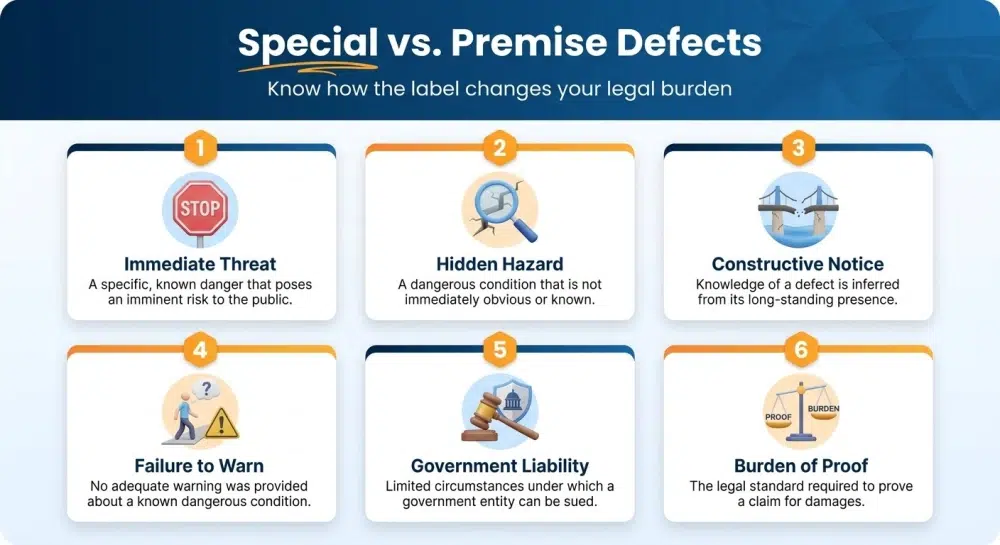
The Texas Supreme Court has held that loose gravel on a road surface is not a special defect as a matter of law. Tex. Dep’t of Transp. v. Gutierrez, 284 S.W.3d 848 (Tex. 2009).[3] Similarly, the Court has analyzed whether off-road conditions adjacent to highways can constitute special defects. Tex. Dep’t of Transp. v. Perches, 388 S.W.3d 652 (Tex. 2012).[4] Courts examine whether a condition presents an unexpected, unusual hazard to ordinary highway users, not merely a hazard that is foreseeable on any public road.
A motorist is driving along a stretch of highway near downtown Dallas when a lane suddenly drops two feet without any warning sign, barricade, or advance notice of road construction. This scenario may support a special defect argument because the condition poses an unexpected, unusual hazard of the type similar to an unmarked excavation. Whether a court would agree depends on the specific facts and evidence.
A cyclist riding on a Dallas County road strikes a pothole that has been present for several months. Even if the pothole caused a serious injury, a court would likely classify this as a premise defect, not a special defect, under current Texas law. The claim could still proceed if the plaintiff can prove the city had actual knowledge of that specific pothole and failed to warn or repair it.
Actual or Constructive Notice: What the Plaintiff Must Prove
For premise defect claims against a Texas governmental unit, the TTCA requires proof that the government entity had actual knowledge of the condition at the time of the injury. This is a demanding standard, and it is the element that defeats many otherwise meritorious claims.
Constructive notice, meaning the government “should have known” about a condition because it was obvious or had persisted for a long time, is generally not sufficient for premise defect claims under the TTCA. Texas courts have interpreted the actual knowledge requirement strictly.[5] If TxDOT or a city did not receive a specific report about a particular pothole or defect, a general awareness that roads deteriorate may not satisfy the statute.
For special defect claims, the standard is more favorable to claimants: the government owes a duty to warn or make safe regardless of whether any individual complaint was received, if the condition was one the government created or was responsible for maintaining.
Evidence that can establish actual knowledge includes maintenance request records, 311 service call logs, prior complaints submitted to the city, internal inspection reports, and communications between city employees about the specific condition. Obtaining these records early, before they are destroyed or overwritten, is critical.
The Notice Deadline: The Rule That Catches People by Surprise
The Texas Tort Claims Act requires a claimant who is injured by a governmental unit to provide formal written notice of the claim no later than six months after the incident or the death of the injured person. Tex. Civ. Prac. & Rem. Code § 101.101(a).[1] This notice requirement is distinct from the two-year statute of limitations that applies to civil personal injury claims under Tex. Civ. Prac. & Rem. Code § 16.003.
The six-month TTCA deadline, however, is not the only deadline that may apply. Individual city charters in Texas frequently impose shorter notice periods. Dallas, for example, has charter provisions governing claims against the city that may require notice within a shorter period. A person injured on a Dallas street, a road maintained by TxDOT near the I-635 LBJ Freeway, or a county road anywhere in North Texas should assume that a very short notice clock is running immediately after the incident.
There is a narrow exception. The TTCA’s formal notice requirement is excused if the governmental unit had “actual notice” of the claim through other means. Tex. Civ. Prac. & Rem. Code § 101.101(c).[1] This exception requires that the governmental unit received prompt, actual knowledge of (1) the injury, (2) the government’s alleged culpability, and (3) the identity of the claimant. A police report alone, or a 911 call log, does not automatically satisfy this exception under Texas case law, though it can be a factor. [DEADLINE REQUIRES LEGAL VERIFICATION FOR EACH SPECIFIC CITY CHARTER PROVISION]
What the Notice Must Include
Under § 101.101(a) of the TTCA, the written notice must describe: (1) the damage or injury claimed; (2) the time and place of the incident; and (3) the incident itself. The notice should be sent to the government entity’s designated office, typically the city secretary for a municipality or the Office of General Counsel for TxDOT, and sending it by certified mail with return receipt creates a verifiable record.
Which Entities Can Be Sued Under the TTCA for Road Defects?
The relevant government defendant depends on which entity has legal responsibility for maintaining the road where the injury occurred.
| Road / Location | Likely Responsible Entity | Notes |
|---|---|---|
| State highways, interstates, U.S. routes (e.g., I-35E in Dallas, I-30, LBJ Freeway / I-635) | Texas Department of Transportation (TxDOT) | TxDOT is a state agency; TTCA applies directly |
| City streets, alleys, city-maintained roads | The municipality (e.g., City of Dallas) | City charter notice provisions may shorten the TTCA deadline |
| County roads and bridges | Dallas County or the applicable county | County precinct maintenance records are important evidence |
| Toll roads and managed lanes | NTTA (North Texas Tollway Authority) or other authorities | Separate enabling legislation; consult an attorney about which statute governs |
In some situations, responsibility for a stretch of road is shared or disputed between a city and TxDOT, particularly on roads that have been reclassified, expanded, or where construction zones created overlapping maintenance obligations. Identifying the right defendant is a threshold task in every government road defect case.
Damage Caps Under the Texas Tort Claims Act
Even when a claimant successfully navigates the immunity waiver, the notice requirements, and the proof of actual or constructive notice, the damages that can be recovered are limited by statute. The TTCA imposes caps on monetary recovery that do not apply in cases against private parties.
| Defendant | Per-Person Cap (Personal Injury or Death) | Per-Occurrence Cap | Property Damage Cap (Per-Occurrence) |
|---|---|---|---|
| State of Texas / TxDOT | $250,000 | $500,000 | $100,000 |
| Municipality (City) | $100,000 | $300,000 | $100,000 |
| County | $100,000 | $300,000 | $100,000 |
Source: Tex. Civ. Prac. & Rem. Code §§ 101.023–101.024.[1]
These caps apply regardless of the severity of the injury. If a person suffers a catastrophic spinal cord injury on a Dallas roadway caused by a government-owned and operated vehicle striking their car accident lawyers, the maximum recovery from the city is $100,000 per person, even if the actual damages are far greater. This is a fundamental and often painful distinction from claims against private parties. Understanding the caps is essential to evaluating the realistic value of a government road defect claim and to determining whether additional defendants, such as a negligent contractor who performed construction work on the road, may also be liable outside the TTCA’s limitations.

Construction Zone Accidents on TxDOT Projects
Road construction zones introduce a layer of complexity. When TxDOT contracts a private company to build or repair a state highway, the private contractor may be independently liable for negligent work that created or worsened a dangerous condition. Private contractor liability operates outside the TTCA and its damage caps, which means the total available recovery may be substantially higher.
Dangerous conditions in North Texas construction zones are a recognized hazard on corridors like US-75 (Central Expressway), the Dallas North Tollway expansion areas, and heavily traveled segments of I-35E. Stop-and-go traffic in active construction zones creates conditions where rear-end collisions and merge-related crashes are common, and missing or inadequate warning signs in those zones may expose the contractor to direct liability.
A personal injury claim in this context may involve both a TxDOT governmental claim (subject to TTCA caps) and a private contractor negligence claim (not subject to caps). Identifying all responsible parties is one of the most consequential early decisions in this type of case. If you are dealing with an injury on a personal injury claim in Texas, understanding this distinction could significantly affect the outcome.
What Evidence Can Support a Road Defect Claim
Government entities defending road defect claims typically challenge the threshold elements: the nature of the defect (special vs. premise), the government’s knowledge of the condition, and the adequacy of the plaintiff’s notice. Evidence that addresses each of these elements is central to a viable claim.
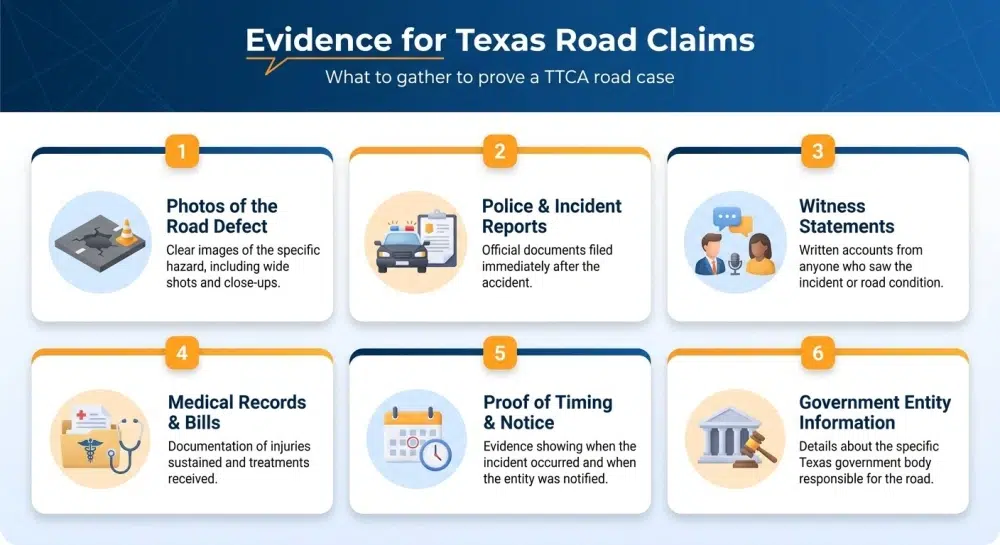
- Photographs and video taken at the scene immediately after the incident, capturing the defect’s size, location, and any lack of warning signs or barriers
- Police reports and incident reports documenting the time, location, and conditions at the scene
- 311 service call records and maintenance logs obtained from the city or TxDOT through a Public Information Act request, which may show prior complaints about the specific condition
- Work order records showing whether the government was aware the road needed repair
- Witness statements from other drivers, pedestrians, or nearby residents who can describe how long the condition existed
- Dashcam and traffic camera footage that may show the condition and the crash itself
- Medical records and bills documenting the injuries and their cause
- Expert testimony from engineers or accident reconstructionists who can establish the defect’s character and the government’s maintenance obligations
None of these evidence types automatically establishes liability. Each piece of evidence must connect to the specific elements required under the TTCA. A prior complaint about a pothole, for example, helps establish actual notice but does not by itself prove the defect caused the injury. Texas courts analyze these elements independently. For more detail on how courts evaluate evidence in Texas cases, see our related article on the personal injury claims process in Texas courts.
What Damages May Be Available in a TTCA Road Defect Case
Within the statutory caps described above, a claimant may potentially recover various categories of damages, depending on the facts of the case and applicable law.
- Medical expenses, both incurred and reasonably anticipated future costs
- Lost income during recovery
- Loss of earning capacity if the injury is permanent
- Physical pain and mental anguish
- Physical impairment
- Property damage, subject to the $100,000 per-occurrence cap
- Wrongful death damages for eligible family members if the injury proves fatal, subject to the caps described above
Punitive or exemplary damages are generally not available against governmental entities under the TTCA. Whether a particular category of damages is recoverable depends on the applicable law and the specific facts of the case.
What If the Government Disputes Liability or Files a Plea to the Jurisdiction
Government entities in Texas defending road defect claims frequently file a “plea to the jurisdiction,” which is a procedural challenge arguing that the court lacks subject-matter jurisdiction to hear the case because immunity has not been waived. This is not a merits defense in the ordinary sense. The governmental unit is arguing that, even if everything the plaintiff says is true, the TTCA does not waive immunity for that type of claim.
Courts resolve pleas to the jurisdiction at an early stage, often before trial and sometimes before extensive discovery. If the plea is granted, the case is dismissed without a judgment on the merits, and the plaintiff may not be able to refile. For this reason, correctly identifying the nature of the defect, satisfying the notice requirements, and pleading the elements of the TTCA waiver precisely in the initial filing is essential. An error at this stage can be fatal to the claim.
Dallas County District Courts and courts handling TxDOT claims in the Dallas area frequently see these jurisdictional challenges. The Dallas Court of Appeals, which sits as the Fifth Appellate District, has published numerous opinions addressing the boundaries of TTCA immunity for road conditions. A Dallas personal injury lawyer familiar with the local courts and the procedural posture of government road defect claims can help navigate this challenge.
How Long Do I Have to Act
Texas law imposes multiple overlapping deadlines in government road defect cases, and each one must be satisfied independently.
- City charter notice deadline: The shortest deadline and often the most dangerous. Some Texas city charters require written notice within 45, 60, or 90 days. [DEADLINE REQUIRES LEGAL VERIFICATION FOR EACH SPECIFIC CITY CHARTER]
- TTCA formal notice: Generally six months after the incident under Tex. Civ. Prac. & Rem. Code § 101.101(a), unless the governmental unit had actual notice earlier.[1]
- Statute of limitations: Two years from the date of injury under Tex. Civ. Prac. & Rem. Code § 16.003, but this period can expire before the notice deadline in some edge cases and is not a substitute for complying with the notice requirement.
Because these deadlines interact and the shortest one can eliminate the claim entirely, anyone injured on a Texas road should consult with a personal injury attorney as soon as possible after the incident, not when the two-year period is approaching.
What Should I Do Next
If you or a family member sustained serious injuries on a road or highway in Texas that may have been caused by a dangerous road condition maintained by a government entity, the most protective steps are:
- Seek immediate medical attention and document all treatment
- Photograph or video the road condition, your vehicle, and the surrounding area before anything changes
- Request the police report as soon as it is available
- Avoid giving recorded statements to any government entity or insurance adjuster before speaking with an attorney
- Submit a Public Information Act request for 311 records, maintenance logs, and prior complaints about the specific road segment
- Consult with a personal injury attorney immediately, given the short notice deadlines that apply to government claims
Road defect cases against TxDOT or a Texas city involve procedural rules and immunity doctrines that are not present in ordinary personal injury cases. Missing the government notice deadline or misclassifying the type of defect can prevent a claim from moving forward entirely.
Talk With a GoSuits Attorney About Your Road Defect Claim
A road defect claim involving a Texas city or TxDOT is one of the most time-sensitive personal injury matters under Texas law. Short notice deadlines, statutory damage caps, and immunity defenses that do not exist in private injury cases make early legal review essential. If you were injured on a Dallas-area road and you believe a dangerous road condition may be involved, a GoSuits Dallas personal injury team can review the circumstances and explain your options.

Related Texas Personal Injury Resources
- Dallas Personal Injury and Accident Lawyers: GoSuits Dallas Personal Injury
- Dallas Car Accident Lawyers: Car Accident Claims in Dallas
- Dallas Slip and Fall Accident Lawyers: Premises Liability and Slip and Fall Claims
- Dallas Wrongful Death Lawyers: Wrongful Death Claims in Dallas
- Understanding the Personal Injury Claims Process in Texas Courts: GoSuits Knowledge Base
References and Resources
- Texas Civil Practice and Remedies Code, Chapter 101 (Texas Tort Claims Act) – Texas Legislature Online, statutes.capitol.texas.gov
- Suarez v. City of Texas City, 465 S.W.3d 623 (Tex. 2015) – CourtListener / Supreme Court of Texas
- Texas Department of Transportation v. Gutierrez, 284 S.W.3d 848 (Tex. 2009) – CourtListener / Supreme Court of Texas
- Texas Department of Transportation v. Perches, 388 S.W.3d 652 (Tex. 2012) – CourtListener / Supreme Court of Texas
- Tex. Civ. Prac. & Rem. Code § 101.022 (Premise Defect and Special Defect Provisions) – Texas Legislature Online
- Texas Courts Online – Official Portal for Texas Judicial Branch, txcourts.gov
- Texas Department of Transportation (TxDOT) – Official Website, txdot.gov
- City of Dallas City Secretary – Official Dallas City Hall
- City of Richardson, Texas v. Val Phelps (Tex. App. Dallas 2019) – CourtListener / Fifth District Court of Appeals
- Sovereign Immunity Overview – Legal Information Institute, Cornell Law School