
California allows an injured person to recover the reasonable cost of medical care they will need in the future, not just the bills already paid. Proving those future costs requires more than a treating doctor’s note. Courts expect a detailed, itemized projection grounded in clinical evidence, market-rate pricing, and a credible economic translation of tomorrow’s dollars into today’s money. Defending those projections requires the same rigor in reverse. This article explains how life care plans are built, how future damages are valued, how discounting and medical inflation interact, and what defence challenges most often shrink or block a plaintiff’s future medical award. It also covers where Medicare set-asides and structured settlements fit when a Medicare-eligible person settles a liability claim.
Legal Snapshot
- Legal Topic: Future Medical Expenses in California Personal Injury Cases
- Primary Legal Issue: Proof, valuation, and present-value discounting of future medical damages
- Jurisdiction: California Orange County Superior Court; Central Justice Center, Santa Ana (civil filings for Orange County)
- Primary Authority: California Civil Code §§ 3281, 3283; California Evidence Code § 801; Sargon Enterprises, Inc. v. University of Southern California, 55 Cal.4th 747 (2012); Corenbaum v. Lampkin, 215 Cal.App.4th 1308 (2013); Judicial Council of California Civil Jury Instructions (CACI)
- Secondary Authority: Jones & Laughlin Steel Corp. v. Pfeifer, 462 U.S. 523 (1983) (present-value discount methodology); CACI No. 3904A (future economic damages reduction to present cash value)
- Case Stage: Pre-trial valuation, expert disclosure, trial, settlement
- Date Legal Authority Last Reviewed: July 2025
What Does “Future Medical Expenses” Mean Under California Law?
California Civil Code § 3283 permits recovery of damages for detriment certain to result in the future.[1] For personal injury cases, that principle translates into an award covering every category of medical care a plaintiff will reasonably need from the time of trial or settlement forward surgeries, medications, therapy, equipment, home modifications, attendant care, and more.
The controlling requirement is reasonable certainty, not mathematical precision. A plaintiff does not need to prove every future expense will definitely occur, but must offer substantial evidence that the need is real and the projected cost is based on reliable methods. California appellate courts have held that future medical damages must be reduced to present cash value before the jury renders a verdict, and the CACI jury instructions reflect that requirement.[2]
Unlike past medical expenses, which are capped under Howell v. Hamilton Meats & Provisions, Inc., 52 Cal.4th 541 (2011) at amounts actually paid and accepted, future medical expenses are not subject to any comparable cap. Because the care has not occurred and no negotiated rate exists, courts look to the reasonable projected cost of treatment, which is typically closer to market or billed rates than to a historical insurer payment.[3] This asymmetry makes future medical damages a critical battleground in catastrophic injury cases filed at the Orange County Superior Court and throughout California.
What Is a Life Care Plan and What Does It Itemize?
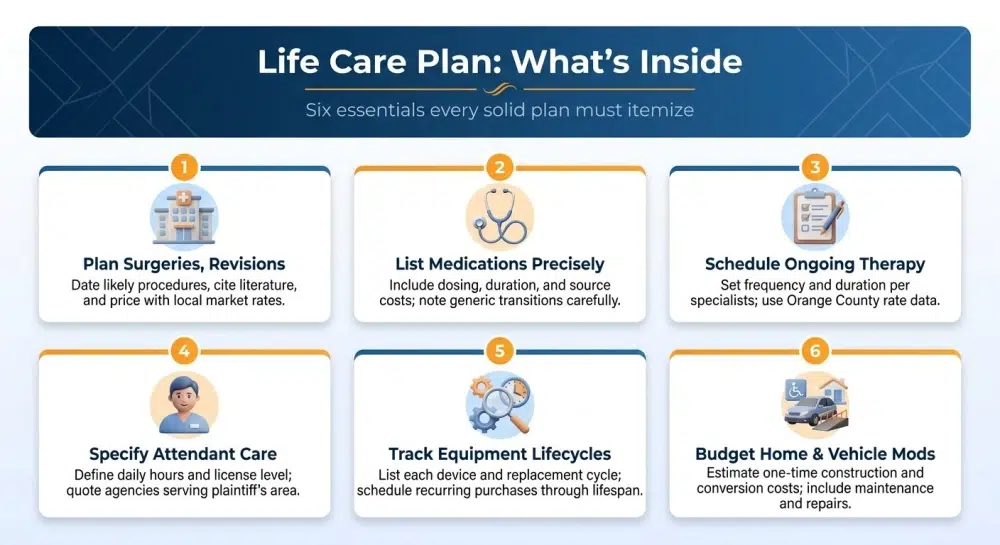
A life care plan is a medically grounded, written document that projects every good and service an injured person will reasonably need over their remaining life, together with the associated costs and timelines. Plans are typically prepared by certified life care planners (credentials include CLCP and CNLCP) with clinical backgrounds in nursing, rehabilitation medicine, or case management. The planner reviews medical records, consults with treating physicians, evaluates the injured person in person, and then constructs an itemized schedule tied directly to the injury, prognosis, and individual circumstances.
Surgical and Procedural Needs
The plan identifies all surgeries expected in the future whether a first surgery that has not yet occurred, revisions to hardware, joint replacements that will wear out, or repeat procedures for recurrent complications. For joint replacements, revision cycles are typically supported by manufacturer data and orthopedic literature. For spinal surgeries, the planner accounts for the likelihood of adjacent segment pathology and hardware failure over time. Each procedure is scheduled with a projected date range, frequency, and cost.
Medications
Chronic pain management, anticoagulants, antispasmodics, antiepileptics, and other drugs are listed individually. The planner specifies current dosing, expected duration, and unit cost from verifiable sources. Where medications are expected to change for example, a shift from name-brand to generic, or a dose adjustment as the patient ages those transitions are documented with supporting clinical rationale.
Therapy and Rehabilitation
Physical therapy, occupational therapy, speech therapy, cognitive rehabilitation, aquatic therapy, and vocational rehabilitation are each separately itemized. The plan specifies frequency (sessions per week or month), duration (months or years), and the expected per-session rate based on Orange County or regional market data. For brain injuries and spinal cord injuries, lifelong maintenance therapy at reduced frequency is common after the intensive acute phase ends.
Attendant Care and Home Health
Attendant care is often the largest single line item in a catastrophic injury life care plan. The plan specifies daily hours of care, the level of care required (home health aide versus licensed vocational nurse versus registered nurse), and the applicable hourly rate for the geographic area where the plaintiff lives. Rates vary across Orange County communities rates in Newport Beach or Irvine may differ from those in Santa Ana or Anaheim and a reliable plan uses community-specific data.
Durable Medical Equipment and Replacement Cycles
Wheelchairs, power chairs, cushions, hospital beds, communication devices, orthotics, prosthetics, shower chairs, hoyer lifts, and ventilators all have finite useful lives. The plan identifies each piece of equipment, its current replacement cycle based on manufacturer specifications and clinical guidelines, and the projected cost of each replacement over the life expectancy of the plaintiff. Failure to account for replacement cycles is one of the most common weaknesses defense experts identify.
Home and Vehicle Modifications
Ramp installation, doorway widening, roll-in showers, accessible bathroom fixtures, ceiling lift tracks, and wheelchair-accessible vehicle conversion costs are included when the injury warrants them. These are typically one-time capital expenditures, though maintenance costs and eventual reinstallation may also be addressed. For Orange County plaintiffs in communities with older housing stock, costs for structural modification can be substantial.
Case Management
A life care planner may recommend ongoing case management typically a registered nurse who coordinates the plaintiff’s care, navigates insurance authorizations, manages provider transitions, and ensures the plan is implemented as medical needs evolve. Case management is billed on an hourly basis and may be projected at varying intensity levels over the plaintiff’s lifetime.
Other Components
Diagnostic imaging, laboratory work, specialist consultations, psychological counseling, pain management clinic visits, injectable treatments (such as spinal injections or Botox for spasticity), and transportation to and from appointments are all candidates for inclusion depending on the nature and severity of the injury.
Billed, Negotiated, or Reasonable Value Which Price Governs Future Care?
For past medical expenses, California applies the Howell rule: recovery is limited to the amount actually paid and accepted.[3] For future medical expenses, that rule does not apply. As the California Court of Appeal confirmed in Corenbaum v. Lampkin, 215 Cal.App.4th 1308 (2013), billed amounts for past services are not evidence of the reasonable value of future services, but the inverse is also true: future expenses are not capped at some hypothetical negotiated rate that does not yet exist.[4]
Because future care has not been provided, no insurer has negotiated a rate and no provider has written off a contractual adjustment. The question is what the care will reasonably cost when it is actually delivered. Life care planners and economists draw on several data sources to anchor that figure:
- Medicare Physician Fee Schedule: A publicly available federal benchmark for CPT-coded procedures. It does not set the ceiling on recovery, but it provides a defensible anchor from which to estimate market costs.[5]
- Regional market surveys: Private payer data, state hospital cost reports, and commercially available cost databases for the Orange County and Southern California region.
- Vendor quotes: For durable medical equipment, home health agencies, and vehicle modification providers, at least two competitive quotes from vendors serving the Irvine and surrounding Orange County area are good practice.
- Facility chargemasters and average allowed amounts: Agency for Healthcare Research and Quality (AHRQ) Healthcare Cost and Utilization Project data provides context for inpatient and outpatient costs at the regional level.[6]
The life care planner must be prepared to explain why each pricing source was chosen and why it reflects what care will actually cost, not merely what a provider happens to list or what an insurer happens to pay.
How Does a Treating Physician Opinion Support the Life Care Plan?
The life care plan is a projection document, but it must be rooted in clinical reality established by treating physicians. California Evidence Code § 801 requires expert opinions to be based on matter of a type reasonably relied upon by practitioners in the field.[7] A life care plan that projects five additional surgeries without any treating physician recommending those surgeries will not survive scrutiny under Sargon Enterprises, Inc. v. University of Southern California, 55 Cal.4th 747 (2012), California’s reliability gatekeeping standard for expert testimony.[8]
Best practice is for the life care planner to:
- Conduct a conference with the treating orthopedist, neurosurgeon, physiatrist, or other specialist to confirm the clinical basis for each projected need.
- Document that conference and the physician’s recommendations in the life care plan with appropriate attribution.
- Align the plan’s projected frequency and duration of each service with what the treating physician recommends, not with generic guidelines alone.
- Address known prognosis issues transparently if the plaintiff’s condition may stabilize or progress, both scenarios should be discussed.
An Irvine personal injury case involving a high-speed rear-end collision on the SR-73 toll road, for example, might produce a cervical disc injury requiring anterior cervical discectomy and fusion. If the treating spine surgeon recommends monitoring for adjacent segment degeneration and projects a probable revision within fifteen years, the life care planner should document that recommendation and price the revision as a specific line item, not merely as a generic “possible future surgery.”
A plaintiff involved in a collision on the I-405 near Costa Mesa sustains a complete spinal cord injury at the L1 level. The life care plan projects: intermittent catheterization supplies (lifetime), pressure-relief wheelchair cushion replacement every two years, power wheelchair replacement every five years, attendant care at four hours per day (lifetime), annual urology consultations, physical therapy maintenance at twice per month (lifetime), and home modification costs of $45,000 for a roll-in shower and ramp. Each item is tied to a specific treating physician recommendation and priced using Orange County market data. The total nominal cost over a projected 35-year life expectancy exceeds $3.8 million before reduction to present value.
How Are Future Damages Reduced to Present Cash Value?
California juries are instructed to reduce future economic damages to their present cash value, the lump sum that, when prudently invested today, will grow to pay for each projected expense as it falls due.[2] The United States Supreme Court addressed the economic logic of this reduction in Jones & Laughlin Steel Corp. v. Pfeifer, 462 U.S. 523 (1983), explaining that discounting future streams to present value is necessary to avoid overcompensating the plaintiff.[9] California CACI No. 3904A reflects this requirement for future economic damages.
The Discount Rate
The discount rate represents the return a plaintiff could earn by investing the lump-sum award in a safe, conservative portfolio. Common methodological approaches include:
- U.S. Treasury yields: Long-term Treasury bond or note yields are a widely accepted benchmark for a “risk-free” return, often used to discount future streams in tort cases. Current yield data is publicly available from the U.S. Department of the Treasury.[10]
- Total-offset method: Some economists assume that the discount rate and the rate of medical cost inflation are approximately equal, so the future stream is presented in today’s dollars without separate discounting. This approach avoids assumptions about precise rates but requires a showing that inflation and returns track each other.
- Explicit nominal-dollar approach: The planner projects costs in future (inflation-adjusted) dollars and then discounts the entire stream back to present value at a market rate, separating the two assumptions.
Experts must disclose their chosen methodology and be prepared to defend it. A small difference in the assumed discount rate can move the present value of a 30-year stream by hundreds of thousands of dollars.
Medical Inflation Assumptions
Medical costs historically inflate faster than general consumer prices. The Bureau of Labor Statistics publishes the Medical Care Consumer Price Index (medical CPI), which documents the historical rate of medical cost inflation and serves as a common input for projections.[11] Prescription drug costs, attendant care wages, and durable medical equipment costs may inflate at different rates, and a rigorous plan addresses each category separately rather than applying a single blanket inflation rate.

Sensitivity Analysis
A credible economics expert will present the present-value calculation under at least two or three combinations of reasonable discount rate and medical inflation assumptions, showing the range of outcomes. This transparency tends to improve credibility with jurors and provides a basis for settlement negotiation in cases filed at the Central Justice Center in Santa Ana.
How Assumptions Drive the Outcome
The following table illustrates how a $100,000 annual care stream over 30 years varies in present value based on different discount rate and medical inflation assumptions. All figures are approximate and are shown for illustrative purposes only.
| Nominal Care Cost (Year 1) | Medical Inflation Rate | Discount Rate | Approximate Present Value |
|---|---|---|---|
| $100,000/year | 3.0% | 4.5% | ~$1.65M |
| $100,000/year | 5.0% | 4.5% | ~$2.20M |
| $100,000/year | 3.0% | 3.0% | ~$2.00M |
| $100,000/year | 5.0% | 3.0% | ~$2.65M |
Approximate values only. Actual calculations depend on the specific schedule of expenditures, chosen methodology, and expert inputs.
How Does Life Expectancy Affect the Calculation?
Every future-cost projection runs for a defined period typically the plaintiff’s projected remaining life expectancy. Life tables published by the Centers for Disease Control and Prevention and the Social Security Administration provide the statistical basis for general life expectancy estimates.[12][13] However, for plaintiffs with conditions that affect life expectancy, such as high-level spinal cord injury, traumatic brain injury with swallowing dysfunction, or severe burns, the life care planner and a physiatrist or specialist may jointly develop a reduced life expectancy estimate supported by peer-reviewed literature and clinical data.
Defense experts frequently challenge the life expectancy assumption. A one-year reduction in assumed life expectancy can decrease the present value of a lifetime care plan by a meaningful amount. Plaintiffs must be prepared to offer clinical support for their life expectancy projection, not merely rely on general population tables when the injury is severe.
How Does the Defence Attack a Future Medical Damages Claim?
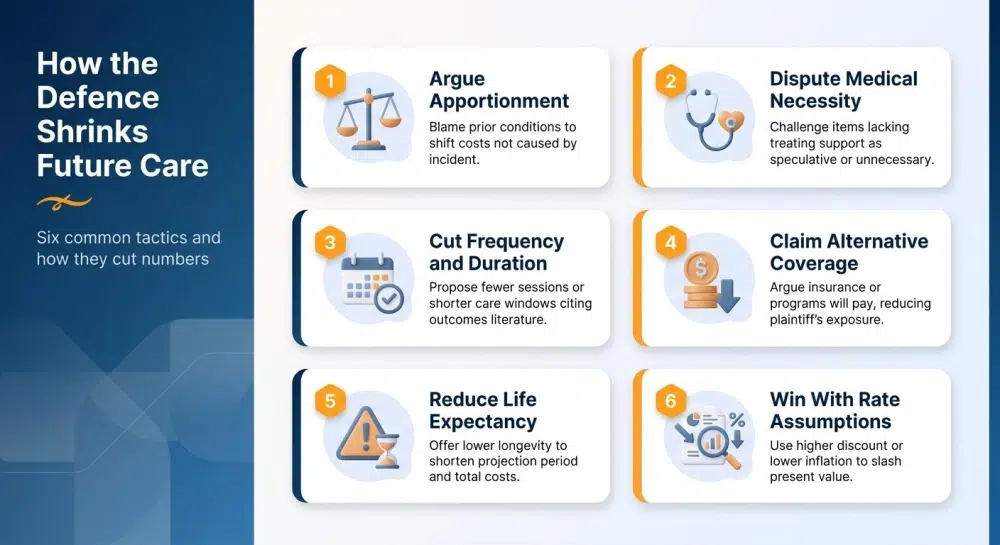
Defence teams hire their own life care planners and economists to construct a competing damages model. The most common categories of challenge are the following.
Apportionment to Pre-existing Conditions
If the plaintiff had an existing degenerative condition, prior injury, or prior surgery before the accident, the defence will argue that a portion of the projected future care is attributable to those pre-existing problems, not the incident at issue. The plaintiff must show, through treating physician testimony and the life care plan, what portion of each projected need is caused or accelerated by the defendant’s conduct, and what portion would have occurred regardless. The Howell line of cases and general California tort principles establish that defendants take plaintiffs as they find them, the so-called eggshell-skull doctrine but that does not eliminate the need to causally allocate each need.
Disputed Medical Necessity
The defence will challenge projected services that are not specifically recommended by the treating team, arguing they are speculative or not medically necessary. A plan that includes services recommended only by the life care planner without treating physician support is particularly vulnerable. Services based on general clinical guidelines without individualized clinical justification are also subject to challenge under the Sargon reliability standard.
Frequency and Duration Disputes
Even when a service is conceded as necessary, the defence often contests frequency and duration. If the plaintiff’s treating therapist recommends physical therapy twice a week, the defence expert may propose once a week for a shorter duration, citing outcomes literature. These disputes are factual and are resolved by the jury after hearing both experts.
Alternative Coverage
The defence may argue that government programs, private insurance, or other resources will cover some or all of the projected care, potentially reducing the plaintiff’s out-of-pocket exposure. California courts generally apply the collateral source rule, which prevents a defendant from reducing the damages award based on payments made by an independent source such as health insurance. However, the interaction between the collateral source rule and the Howell rule in future-care projections can be complex and varies with the specific facts of each case.
Life Expectancy and Mortality Assumptions
As noted above, the defence life care planner or a physiatrist may offer a lower life expectancy estimate, reducing the duration over which care costs are projected. The defence may also argue that general population life tables overstate the plaintiff’s likely longevity given the severity of the injury.
Discount Rate and Inflation Disputes
The defence economist may use a higher discount rate or lower medical inflation rate than the plaintiff’s expert, producing a substantially lower present value for the same stream of care. Both experts typically rely on publicly available data from the same sources Treasury yields and BLS data, but may apply different methodological assumptions. The jury must evaluate the competing presentations.
Where Do Medicare Set-Asides Fit for Medicare-Eligible Plaintiffs?
When a plaintiff who is a Medicare beneficiary whether by age (65 or older) or by disability settles a liability personal injury claim, federal law requires protection of Medicare’s interests. The Medicare Secondary Payer Act, 42 U.S.C. § 1395y(b), provides that Medicare is a secondary payer when another entity is responsible for medical expenses.[14] Failure to account for Medicare’s interest can expose both the claimant and the defendant to later recovery efforts by the Centers for Medicare & Medicaid Services.
A Medicare Set-Aside (MSA) arrangement is a mechanism for allocating a portion of the settlement to pay for future injury-related medical expenses that would otherwise be covered by Medicare. Unlike the workers’ compensation context where CMS has formal review thresholds and approval processes liability MSAs are not subject to a mandatory CMS review process for most cases. However, CMS has issued guidance encouraging voluntary consideration of Medicare’s interests in liability settlements, and many practitioners voluntarily structure an allocation to protect both the plaintiff and the defendant.
The life care plan for a Medicare beneficiary feeds directly into the MSA calculation. The portion of projected future care that Medicare would cover (if there were no settlement) is identified, and an allocation is carved out of the settlement proceeds to fund those anticipated costs. This requires close coordination between the life care planner, the economics expert, and counsel familiar with Medicare secondary payer requirements.
If the MSA allocation is exhausted before the plaintiff’s lifetime care needs are met, Medicare is intended to resume coverage at that point, provided the allocation was spent appropriately on qualifying expenses. Plaintiffs should maintain detailed records of MSA expenditures.
Personal injury lawyers for injured clients in Irvine, Newport Beach, Costa Mesa, and throughout Orange County who are handling cases involving Medicare beneficiaries should factor MSA considerations into settlement planning from the outset, not as an afterthought when closing documents are being prepared.
How Do Structured Settlements Interact With a Life Care Plan?
A structured settlement uses an annuity to fund some or all of the damages award in periodic payments rather than a lump sum. When properly designed, the payment schedule mirrors the life care plan, providing larger payments in years when expensive surgeries are projected and steady income-replacement payments over the plaintiff’s working-age years. The Internal Revenue Code provides federal income-tax exclusions for physical injury settlements, including structured settlement payments, under 26 U.S.C. § 104(a)(2).[15]
Structures are particularly useful in catastrophic injury cases because they can address the risk of a plaintiff outliving a lump-sum award, match the timing of care needs to the availability of funds, and incorporate inflation riders or variable payment streams. The discount-rate assumptions embedded in the annuity pricing should be considered alongside the economist’s present-value analysis when evaluating whether a structured settlement is economically equivalent to a lump-sum offer.
A 35-year-old plaintiff injured on the I-405 near Irvine Spectrum sustains a traumatic brain injury resulting in permanent cognitive impairment and loss of employment capacity. The life care plan projects $180,000 per year in attendant care and therapy for 40 years, plus $220,000 in projected surgical and equipment costs at specific future intervals. The economist reduces the care stream to a present value of approximately $3.1 million. A structured settlement is negotiated that funds the projected surgical costs at the scheduled dates through a step-up annuity, and provides a steady annual attendant care payment with a 3% annual inflation rider. The structure provides certainty of funding while potentially reducing the defendant’s overall cost relative to a cash settlement.
What Evidence Can Strengthen or Weaken a Future Medical Damages Claim?
- Treating physician opinions in writing: Letters or reports from the orthopedist, neurosurgeon, physiatrist, or neurologist specifically recommending future procedures, therapy, and equipment are the strongest clinical foundation for the plan.
- Functional assessments: Occupational therapy functional capacity evaluations and activities of daily living assessments support the attendant care and home modification components.
- Current treatment records: The plaintiff’s actual treatment trajectory to date consistency of care, response to therapy, complications informs the credibility of projections.
- Vendor quotes: At least two quotes from equipment suppliers and home health agencies serving Orange County document that the projected costs reflect real market rates.
- Life care planner credentials and methodology: The planner’s qualifications, reference to clinical guidelines, and transparent sourcing of cost data all affect admissibility under Sargon and California Evidence Code § 801.
- Economist’s calculations: A clearly disclosed discount rate and medical inflation methodology, with sensitivity analysis, is more credible than a single-scenario projection.
- Defence medical examination findings: Under California Code of Civil Procedure § 2032, the defence may require an independent medical examination. The examining physician’s findings whether supporting or contradicting the plaintiff’s projections become part of the evidentiary record.
- Imaging and diagnostic records: MRIs, CT scans, and nerve conduction studies documenting the objective severity of injury support the clinical foundation for projected surgeries and ongoing therapy.
For a more detailed discussion of how life care planning is applied in California injury cases, see our related knowledge base article on life care planning for California injury cases.

How Long Do I Have to Act in California?
California’s general statute of limitations for personal injury claims is two years from the date of injury under California Code of Civil Procedure § 335.1.[16] Claims against government entities typically require a government tort claim within six months of the incident under the California Government Claims Act, Government Code § 945.4.[17] Exceptions apply for minors, discovery-rule situations, and other circumstances.
Future medical damages are part of the personal injury claim and must be asserted within the same limitations period. The deadline does not reset simply because future care has not yet begun. Delay in consulting counsel can allow important evidence including treating physician opinions that establish the basis for future care to become more difficult to obtain or preserve.
[Deadline confirmation: The specific deadline applicable to any individual situation must be confirmed by a licensed California attorney based on the particular facts of the case. Do not rely on general information to determine your filing deadline.]
Talk With a GoSuits Irvine Personal Injury Attorney
Future medical damages in an Irvine or Orange County personal injury case require clinical evidence, a properly constructed life care plan, and a credible economic translation of projected costs into present value. Getting those elements right matters at every stage during discovery, expert disclosure, mediation, and trial at the Central Justice Center in Santa Ana.
If you were injured in a car accident, truck collision, or other incident in the Irvine area and are wondering how your future medical needs factor into the value of your claim, a GoSuits personal injury attorney can review the facts and explain your options. Our Irvine team works with clients throughout Orange County, including Newport Beach, Costa Mesa, Huntington Beach, Fullerton, and Santa Ana.
If you have been injured and want to understand how future medical costs affect what you can recover, the injury claim process in California begins with understanding your options including your right to compensation for care you will need for years or decades to come.
Related California Personal Injury Resources
- Life Care Planning for California Injury Cases (GoSuits Knowledge Base)
- Billed vs. Paid: Why Are My Medical Damages Reduced in California?
- Lost Earning Capacity and Vocational Expert Testimony in California
- Medi-Cal and Medicare Lien Reduction in California
- Defense Medical Examinations Under CCP § 2032
- Settling Before Maximum Medical Improvement in California
- Irvine Personal Injury Lawyers – GoSuits
References and Legal Authorities
- California Civil Code § 3283 – Future Damages for Detriment – California Legislative Information
- CACI No. 3904A – Future Economic Damages: Reduction to Present Cash Value – Judicial Council of California (courts.ca.gov)
- Howell v. Hamilton Meats & Provisions, Inc., 52 Cal.4th 541 (2011) – CourtListener / California Supreme Court
- Corenbaum v. Lampkin, 215 Cal.App.4th 1308 (2013) – CourtListener / California Court of Appeal
- Medicare Physician Fee Schedule Overview – Centers for Medicare & Medicaid Services (cms.gov)
- Healthcare Cost and Utilization Project (HCUP) – Agency for Healthcare Research and Quality (ahrq.gov)
- California Evidence Code § 801 – Opinion Testimony by Expert Witness – California Legislative Information
- Sargon Enterprises, Inc. v. University of Southern California, 55 Cal.4th 747 (2012) – CourtListener / California Supreme Court
- Jones & Laughlin Steel Corp. v. Pfeifer, 462 U.S. 523 (1983) – Cornell Law School / Legal Information Institute
- U.S. Treasury Yield Curve Rates – U.S. Department of the Treasury
- Medical Care Consumer Price Index – Bureau of Labor Statistics (bls.gov)
- United States Life Tables – National Center for Health Statistics / CDC (cdc.gov)
- Life Tables for the United States Social Security Area – Social Security Administration (ssa.gov)
- 42 U.S.C. § 1395y(b) – Medicare Secondary Payer Act – Cornell Law School / Legal Information Institute
- 26 U.S.C. § 104(a)(2) – Exclusion of Physical Injury Settlement Payments from Gross Income – Cornell Law School / Legal Information Institute
- California Code of Civil Procedure § 335.1 – Two-Year Statute of Limitations for Personal Injury – California Legislative Information
- California Government Code § 945.4 – Government Tort Claim Requirement – California Legislative Information