
So here’s the deal. If you’ve got a personal injury claim going in California, the defense actually has a right to send you to their own doctor for a physical exam. It comes from Chapter 15 of the Civil Discovery Act. People call it a defense medical exam, or a DME for short. And honestly, knowing what the law lets them do, what it doesn’t let them do, and what protections you’ve got going in matters a lot. You don’t want to give up more than you have to.
Legal Snapshot
- Legal Topic: Defense Physical and Mental Examinations in California Personal Injury Litigation
- Case Stage: Discovery (pre-trial)
- Primary Legal Issue: Scope, conditions, and limitations of defendant-requested medical examinations of plaintiffs
- Primary Authority: California Code of Civil Procedure (CCP) §§ 2032.010–2032.650 (Civil Discovery Act, Chapter 15, added by Stats. 2004, Ch. 182, Sec. 23, effective January 1, 2005, operative July 1, 2005)
- Date Legal Authority Last Reviewed: July 2025
- Jurisdiction: California State Courts
What Is a Defense Medical Examination?
The other side can send you to their doctor. That’s basically the short version. When you’re suing over injuries, the defense gets to request a physical exam to look at what’s wrong, how serious it is, and where it came from. People call it an “independent” medical exam, which I’ve always thought is kind of a stretch, because the doctor isn’t independent at all. The defendant hires them. Or the insurance company does. Either way, whatever ends up in that report can show up later, either in front of a jury or in the middle of settlement negotiations.
California’s Civil Discovery Act governs these examinations through a detailed framework in CCP §§ 2032.010 through 2032.650. The law distinguishes between two types of discovery examinations: the one physical examination that a defendant may demand without court approval, and any additional or mental examination, which always requires a court order.
Personal injury lawyers who handle Orange County and Irvine area claims encounter defense medical exams frequently, whether the case involves a car collision on the SR-73 Toll Road, a slip-and-fall at an Irvine Spectrum shopping center, or a workplace injury in Santa Ana. Whatever the context, the statutory rules are the same.
What Does California Law Say?
The One Physical Exam a Defendant May Demand Without a Court Order
Under CCP § 2032.220(a), in any case in which a plaintiff seeks recovery for personal injuries, any defendant may demand one physical examination of the plaintiff without first obtaining leave of court, provided two conditions are satisfied:
- The examination does not include any diagnostic test or procedure that is painful, protracted, or intrusive.
- The examination is conducted at a location within 75 miles of the residence of the examinee.
The defendant may make this demand after being served with the complaint or after appearing in the action, whichever occurs first. [1]
What the Demand Must Include
A demand under CCP § 2032.220(c) must specify all of the following:
- The time and place of the examination
- The manner, conditions, scope, and nature of the examination
- The identity and specialty, if any, of the physician who will perform the examination
The examination must be scheduled no earlier than 30 days after service of the demand, unless the court shortens that time on motion by the demanding party. [1]
The Prohibition on Painful, Protracted, or Intrusive Procedures
This limit matters. A lot, actually. It’s one of the better shields plaintiffs get under the statute. If the defense wants some kind of painful test, or something long and drawn out, or something genuinely invasive, they can’t just tack it onto the standard demand and call it a day. They have to go file a motion. Ask the court. Get an order. And when the judge weighs it, the question is basically whether the procedure is reasonably necessary given whatever injuries or conditions you’ve put into play by suing.
The phrase “conditions in controversy” is significant. The examination is limited to the injuries and conditions the plaintiff has put at issue by filing the lawsuit. A defendant cannot use the examination to probe medical history unrelated to the claimed injury.
When a Second Examination or Mental Examination Requires Court Approval
CCP § 2032.310(a) makes clear that any physical examination beyond the single as-of-right exam, as well as any mental examination, requires the party seeking the examination to first obtain leave of court. The motion must:
- Specify the time, place, manner, conditions, scope, and nature of the examination
- Identify the specialty of the examiner
- Be accompanied by a meet-and-confer declaration under CCP § 2016.040, showing the parties attempted to resolve the dispute informally [2]
Notice of the motion must be served on the person to be examined and on all parties who have appeared in the action.
Who Performs the Examination?
Think of it this way. A defense medical examiner isn’t practicing medicine on you in any real sense. They’re a retained expert, meaning they got hired for this case, and that’s legally and practically pretty different from your treating physician. Your treating doctor sits down, gets to know your history, forms a doctor-patient relationship, owes you a duty of care. The defense examiner? Not really any of that. They were brought in by the opposing party to look at the injuries you’re claiming, they don’t have the same duty of care running to you, and they mostly stick to reviewing what the defense sent over and doing the tests the defense okayed.
Because the examiner is a retained expert, the work-product protections that normally shield an attorney’s expert’s writings are waived once the plaintiff exercises the right to demand a copy of the examination report. [3]
Who May Attend the Defense Medical Examination?
California law does not expressly address third-party attendance in the examination room in CCP §§ 2032.210–2032.650. Whether an attorney or a representative may accompany the plaintiff into the examination itself has been addressed by California courts, and practice varies. [4]
But here’s the piece a lot of folks don’t realize. The time on either side of the exam isn’t protected. At all. Lawyers, paralegals, investigators from either side can post up and watch you walk in and walk out. Which sounds intrusive, and honestly it kind of is, but there’s a reason. The defense examiner will be tracking your functional ability and how you move during the exam, so your attorney may want to capture what you looked like beforehand and afterward too. In cases where the defense is basically testing whether your claimed limits are real, those before-and-after windows can turn into damages evidence pretty quickly.
Questions about who may be physically present inside the examination room are best addressed with an attorney familiar with the current state of California case law and the practices of the specific court where the case is pending. [4]
May the Examination Be Audio Recorded?
The Civil Discovery Act does not expressly authorize or prohibit audio recording of a defense medical examination. California courts have addressed this issue in various contexts, and the law is not uniform across all fact patterns. [5]
Because recording rights can depend on the type of examination, the nature of the case, and the specific court, this issue should be raised with an attorney before the examination date. If you believe recording is important, a motion to the court seeking a protective order or a stipulation with opposing counsel may be the most reliable approach.
What Happens During the Examination?
The defense examiner will typically review medical records provided in advance and then conduct a clinical examination. The scope of the clinical examination should correspond to the scope set out in the demand or court order. Common components include:
- A history taken by the examiner (questions about the incident, prior medical history, and current complaints)
- Orthopedic or neurological tests appropriate to the claimed injury
- Range-of-motion measurements
- Functional observations
The examination should not extend to medical conditions the plaintiff has not placed in controversy. If the examiner attempts to conduct a procedure the plaintiff believes exceeds the scope of the demand, the examinee may raise an objection. How to handle scope disputes in the moment is a question best discussed with an attorney before the examination takes place.
Example: Scope Dispute at Examination
Hypothetical example: A plaintiff injured in a rear-end collision on the I-405 near Costa Mesa brings a claim for cervical spine and shoulder injuries. The defense demand specifies a musculoskeletal examination by an orthopedic surgeon. At the examination, the physician attempts to conduct neuropsychological testing not identified in the demand. The plaintiff or the plaintiff’s representative, if present, may object on the ground that psychological testing was not specified in the demand and was not included in the conditions placed in controversy. A dispute of this kind can be brought to the court for resolution.
This is a hypothetical example for illustrative purposes only and does not represent any actual case.
The Examinee’s Right to the Examination Report
One of the most important protections in the Civil Discovery Act is found in CCP § 2032.610. After submitting to a physical or mental examination demanded under Article 2, ordered by the court under Article 3, or agreed upon under CCP § 2016.030, the examined party has the option of making a written demand that the party who requested the examination deliver both of the following:
- A copy of a detailed written report setting out the history, examinations, findings (including results of all tests), diagnoses, prognoses, and conclusions of the examiner
- A copy of reports of all earlier examinations of the same condition of the examinee made by that or any other examiner retained by the defendant [3]
If the plaintiff exercises this option, the defendant must deliver the requested reports within 30 days after service of the demand, or within 15 days of trial, whichever is earlier.
By making this demand, the plaintiff also triggers an important consequence: the work-product protection that would otherwise shield the examiner’s writings and testimony is waived. This means the plaintiff’s attorney can take the defense examiner’s deposition about the examination and report. [3]
This reciprocal exchange is a strategic consideration. Obtaining the defense examiner’s report allows the treating physicians and plaintiff’s medical experts to review and respond to the defense findings. Whether and when to make this demand is a litigation decision that should be made with counsel.
How the Observation Period Before and After the Exam Is Used
Defense teams, and sometimes plaintiffs’ representatives, observe the examinee’s behavior and mobility in the parking lot, waiting room, and as the examinee enters and exits the building. This is not a clandestine tactic unique to this type of litigation, it is a recognized element of the examination process.
From the defense perspective, the observation period may be used to document whether the examinee’s functional behavior outside the examination room is consistent with the complaints reported inside. In cases where a plaintiff claims severe mobility limitations from a car accident on the SR-55 in Newport Beach or a fall at an Anaheim commercial property, the defense examiner’s narrative may include observations about how the plaintiff walked, sat, and moved.
From the plaintiff’s perspective, this underscores the importance of being consistent, truthful, and natural throughout the entire visit, not just during the clinical examination itself. Inconsistencies between reported limitations and observed behavior can be used to challenge credibility at trial or in settlement discussions.
What Evidence May Matter in Connection with a Defense Medical Exam?
The defense medical examination does not occur in isolation. Several categories of evidence interact with the examination findings and can affect how the defense report is used:
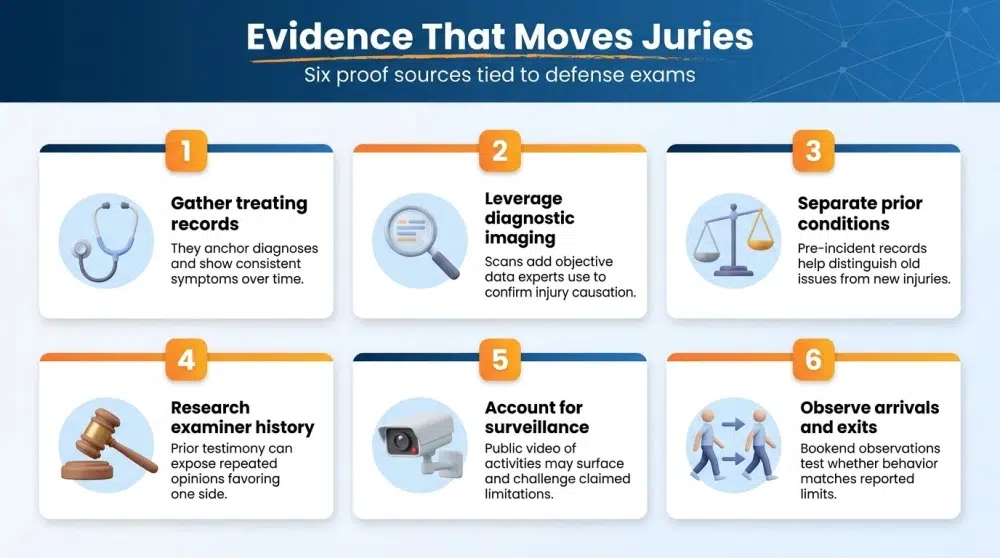
- Treating physician records: The treating physician’s documented findings and diagnoses form the baseline against which the defense examiner’s opinions are compared. Consistent, well-documented treatment records reinforce the plaintiff’s claimed injuries.
- Diagnostic imaging: X-rays, MRI studies, and CT scans provide objective data that either party’s expert can analyze. Imaging conducted before and after the incident is particularly important.
- Prior injury or medical history: If the defense examiner identifies a pre-existing condition, prior records documenting the examinee’s condition before the incident can be used to distinguish the pre-existing condition from injuries caused by the incident.
- The defense examiner’s prior testimony and reports: In cases where the defense uses a retained examiner who regularly testifies for insurers or defendants, prior deposition transcripts and reports by that examiner may be used to identify patterns in the examiner’s opinions.
- Notes from the examination: Any written notes taken by the plaintiff or an attendee during or immediately after the examination can document what occurred, who was present, how long the examination lasted, and what questions were asked.

What Happens If the Defense Examination Conflicts with Treating Physician Findings?
A conflict between the defense examiner’s conclusions and those of the treating physicians is common in contested personal injury litigation. Each side will typically use these competing opinions at trial or in settlement negotiations. The jury evaluates the credibility and basis of each expert’s opinion.
Factors that courts and juries often consider when evaluating competing medical opinions include:
- The amount of time each physician spent with the plaintiff and the depth of the clinical evaluation
- Whether the examiner reviewed all relevant records or only a selected subset
- The examiner’s professional credentials and area of focus
- The frequency with which the examiner testifies for one side in litigation
- Whether the examiner’s opinion is consistent with objective diagnostic studies
How Does This Apply in a Real California Personal Injury Case?
Hypothetical example: A cyclist is struck by a motor vehicle near the intersection of Jamboree Road and the I-405 in Irvine and sustains lumbar spine injuries. The defendant demands a physical examination under CCP § 2032.220(a). The demand names an orthopedic surgeon and specifies a musculoskeletal examination limited to the lumbar spine. The examination is scheduled at an office in Irvine, within 75 miles of the plaintiff’s home. At the examination, the orthopedic surgeon conducts a physical examination, reviews the MRI report, and orders no additional imaging. The plaintiff later demands a copy of the examiner’s written report under CCP § 2032.610. The defense delivers the report within 30 days. The plaintiff’s treating orthopedist reviews the defense report and prepares a rebuttal addressing points on which the two physicians disagree.
This is a hypothetical example for illustrative purposes only and does not represent any actual case.
Personal injury lawyers in Orange County regularly navigate these dynamics for clients injured in communities across the Irvine cluster, including Fullerton, Lake Forest, and Huntington Beach. The CCP framework applies uniformly throughout California, but the local court’s procedural preferences and the Orange County Superior Court’s case management practices can affect timelines and motion practice.
If you have questions about what a defense medical examination means for your specific situation, reviewing the relevant mistakes to avoid after a personal injury in Irvine, California may also be helpful as you prepare.
How Long Do I Have to Act?
The statute of limitations for most personal injury claims in California is two years from the date of injury. Cal. Code Civ. Proc. § 335.1. Claims against government entities require a government tort claim to be filed within six months of the incident before a lawsuit may be filed. Different rules may apply depending on the type of defendant and the nature of the injury.
A defense medical examination is a discovery event that typically occurs after a lawsuit has been filed. The deadlines described in CCP § 2032.220 – including the 30-day minimum notice period and the 30-day period to deliver the examination report, are internal discovery deadlines within the litigation, separate from the statute of limitations.
Deadline note: Statutes of limitations and government claim deadlines are jurisdiction-specific and fact-dependent. Confirm applicable deadlines with a licensed California attorney promptly after an injury occurs.
What Should I Do Next?
If you are scheduled to undergo a defense medical examination, or if you have received a demand for one, these steps are generally advisable:
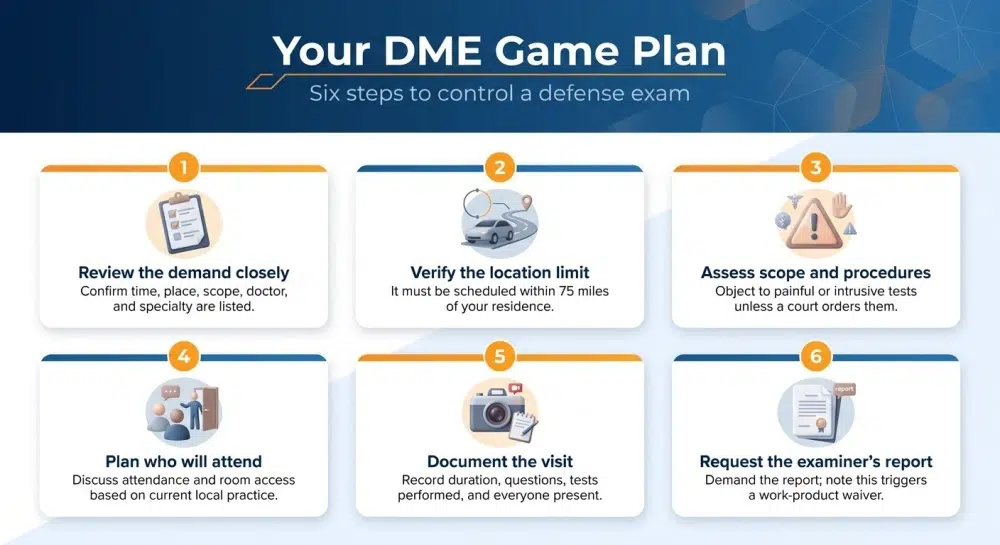
- Review the demand carefully to confirm it specifies the time, place, physician identity, specialty, and scope of the examination as required by CCP § 2032.220(c).
- Confirm the examination location is within 75 miles of your residence.
- Discuss with your attorney whether the scope of the demanded examination exceeds the injuries you have placed in controversy.
- Ask your attorney whether someone should accompany you to the examination facility, and what that person’s role may be.
- Document the examination: note how long it lasted, who was present, what tests were performed, and what questions were asked.
- After the examination, decide with your attorney whether to demand the examiner’s written report under CCP § 2032.610.
- Share the defense report with your treating physicians so they can respond to any findings that conflict with your treatment records.
A personal injury claim involving a defense medical examination involves medical evidence, competing expert opinions, insurance issues, and litigation deadlines. If you were injured in Irvine or anywhere in Orange County and are facing a defense medical exam request, the Irvine personal injury lawyers at GoSuits can review the circumstances of your case and explain your options.
Schedule a free consultation with GoSuits today.
Frequently Asked Questions
Can the defendant demand more than one physical examination of me?
Under CCP § 2032.220, the defendant may demand one physical examination without court approval, provided it does not include painful, protracted, or intrusive procedures and is within 75 miles of your residence. Any additional physical examination, or any mental examination, requires a court order under CCP § 2032.310. For more context on what to expect after an injury in the Orange County area, see: Orange County car accident claims.
Does the examination physician have to be a doctor? Can the defense send a chiropractor or psychologist?
The Civil Discovery Act uses the term “physician” in the context of physical examinations under Article 2 and refers to the “person or persons who will perform the examination” in the context of court-ordered examinations under Article 3. The specialty of the examiner must be disclosed in the demand or motion. If you believe the examiner’s credentials or specialty are inappropriate given the nature of your claimed injuries, this is a matter to discuss with your attorney.
What if the defense examiner’s report contains statements I believe are inaccurate?
Once you receive the report, your treating physicians and your own retained experts can review it and provide their own opinions in response. Your attorney can also depose the defense examiner after the work-product waiver takes effect under CCP § 2032.610(c). Inaccuracies in the defense report are typically addressed through expert testimony at trial or in written expert reports exchanged during discovery.
Can the defense use video surveillance of me in addition to the medical examination?
California law does not prohibit surveillance of a party in a civil lawsuit. Surveillance footage of activities in public places may be discoverable and usable as evidence. Being observed in a parking lot or public setting before or after a medical examination is consistent with established litigation practice. Consistency between your reported limitations and your observable daily activities is therefore important throughout the pendency of your case. See also: personal injury claims arising from pedestrian incidents in the Lake Forest area.
What if I disagree with the location or timing of the demanded examination?
If the location is more than 75 miles from your residence, the demand does not comply with CCP § 2032.220(a)(2), and you may object on that basis. If you have a legitimate scheduling conflict, this is typically addressed by meeting and conferring with opposing counsel to reschedule. If the parties cannot agree, either side may seek court assistance. Do not simply fail to appear at a properly noticed examination without first consulting your attorney, non-appearance can have serious consequences in litigation.
If I demand a copy of the examination report, do I give up anything in return?
Yes. Under CCP § 2032.610(c), exercising the option to demand the defense examiner’s report waives the work-product protection for the examiner’s writings and testimony. This means the defense examiner’s deposition may be taken by the plaintiff, and the examiner’s reports are no longer shielded from discovery. The waiver is mutual and applies to “the taking of the examiner’s testimony.” This is generally viewed as a benefit to plaintiffs, because it allows full cross-examination of the defense examiner, but it is a trade-off that should be considered with your attorney. For context on Orange County personal injury claims: learn more about injury incidents in Huntington Beach.
Do the same rules apply if my case settles before trial?
The defense may still request a medical examination before the case resolves, even if settlement discussions are ongoing. The defendant is not required to wait until trial is scheduled. If the parties settle before an examination takes place, the demand for examination typically becomes moot. If the case settles after an examination, the examination report may be a factor in the settlement valuation.

Related California Personal Injury Resources
- California Code of Civil Procedure § 2032.220 – [Text of CCP § 2032.220]
- California Code of Civil Procedure § 2032.310 – [Text of CCP § 2032.310]
- California Code of Civil Procedure § 2032.610 – [Text of CCP § 2032.610]
- Our Irvine personal injury lawyers handle the full range of injury claims in Orange County, including car accidents, slip-and-fall accidents, and serious injury claims.
- If your case involves vehicle-related injuries, our team also handles car accident lawyers matters throughout Irvine and the surrounding communities.
- For premises-related injuries, our Irvine slip and fall accident lawyers are available to discuss your options.
Talk with a GoSuits Attorney
A defense medical examination is a critical phase of California personal injury litigation. The examining physician works for the other side, the report will be used against you, and the decisions you make before, during, and after the examination can affect your case. An injury claim also involves medical evidence, insurance company tactics, discovery deadlines, and the need to preserve and present evidence effectively.
If you are an injured person in Irvine or elsewhere in Orange County and have received a demand for a defense medical examination, or if you are still deciding whether to file a claim, the team at GoSuits is available to review your situation at no charge. Contact GoSuits to schedule your free consultation.
References and Legal Authorities
- California Code of Civil Procedure § 2032.220 – Physical Examination of Personal Injury Plaintiff (As-of-Right Demand) – California Legislative Information
- California Code of Civil Procedure § 2032.310 – Motion for Physical or Mental Examination (Court Order Required) – California Legislative Information
- California Code of Civil Procedure § 2032.610 – Examinee’s Right to Reports of Examination – California Legislative Information
- California Rules of Court – Rule 3.1150 (Physical and Mental Examinations) – California Courts
- California Code of Civil Procedure § 2032.530 – Audio Recording of Mental Examination – California Legislative Information
- California Code of Civil Procedure § 2032.510 – Right of Counsel to be Present at Mental Examination – California Legislative Information
- California Code of Civil Procedure – Full Text (Civil Discovery Act, Chapter 15) – California Legislative Information
- California Courts – Official Website of the California Judicial Branch
- California Code of Civil Procedure § 335.1 – Two-Year Statute of Limitations for Personal Injury – California Legislative Information
- California Code of Civil Procedure § 2016.030 – Stipulations Concerning Discovery – California Legislative Information