
A life care plan is the document that converts a catastrophic injury into a dollar figure a court can evaluate. It catalogs every medical service, piece of equipment, therapy session, medication, and home modification a seriously injured person will likely need over a lifetime, assigns a unit cost and frequency to each item, and builds a schedule that an economist then reduces to a single present-value number. In Dallas and across Texas, life care plans appear in spinal cord injury cases, traumatic brain injury cases, severe burn cases, amputation cases, and any other injury where care will continue for years. When plaintiffs pursue a personal injury claim, this document can be the most important piece of evidence in the case.
- Legal Topic: Life Care Planning and Future Medical Damages in Texas Personal Injury Cases
- Case Stage: Pre-litigation through trial
- Primary Legal Issue: Proving and valuing future medical expenses with sufficient certainty under Texas law
- Primary Authority: Texas Civil Practice and Remedies Code Chapter 41; Texas Pattern Jury Charges; Texas Rules of Evidence Rule 702
- Date Legal Authority Last Reviewed: 2025
What Is a Certified Life Care Planner and What Do They Produce?
A certified life care planner (CLCP) or certified nurse life care planner (CNLCP) is a clinician, typically a registered nurse, rehabilitation specialist, or vocational evaluator, who has completed specialized training in projecting the long-term care needs of injured individuals. These credentials are issued through organizations such as the International Academy of Life Care Planners, and they signal that the planner has been trained in consistent methodologies for gathering, organizing, and presenting future care data.
The planner produces a written report that serves several functions at once. It communicates the injured person’s diagnosis and prognosis to non-medical readers such as jurors and insurance adjusters. It itemizes every category of anticipated need. It assigns costs to each item using verifiable data sources. And it provides the foundation an economist needs to discount those future streams to present value.
In Dallas personal injury cases, the life care planner typically works from medical records, imaging reports, surgical notes, treating physician depositions, therapy evaluations, neuropsychological test results, functional capacity evaluations, and direct interviews with the injured person and their family. The more thorough the clinical foundation, the more difficult the plan is to attack at trial.
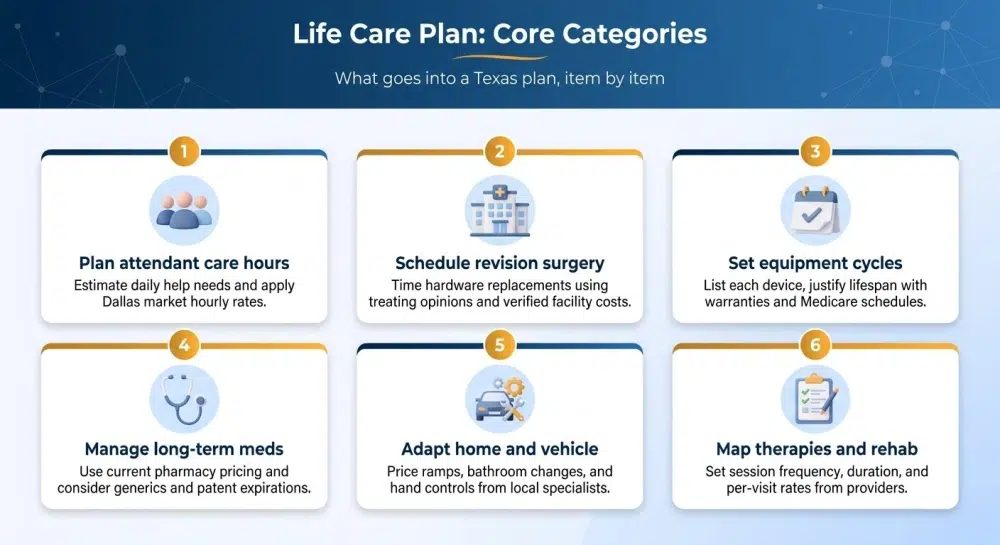
What Categories Does a Life Care Plan Cover?
A comprehensive plan organizes future needs into distinct categories. Each category carries its own pricing methodology and its own vulnerability to defense challenge.
Attendant Care and Home Health
Attendant care is often the single largest line item in a catastrophic injury plan. A certified life care planner determines how many hours per day the injured person requires assistance with activities of daily living, personal hygiene, transfers, medication management, and other tasks they can no longer perform independently. The planner then applies an hourly market rate drawn from Dallas-area home health agencies and staffing data from the Bureau of Labor Statistics Occupational Employment and Wage Statistics program. The total is multiplied across the remaining life expectancy to produce a gross future figure. Defendants frequently challenge both the hours claimed and the hourly rate.
Future Surgeries and Surgical Revisions
For injuries involving hardware implants, spinal fusions, joint replacements, or reconstructive procedures, the plan must project the timing and cost of revision surgeries. Orthopedic implants have published replacement cycles; cochlear implants, spinal cord stimulators, and intrathecal pump systems have documented maintenance and replacement schedules. The planner sources facility and physician costs from verified data, typically including Medicare fee schedule benchmarks, commercial hospital charge data, and vendor pricing information. These projections require treating physician input confirming that a revision is medically probable within the injured person’s life expectancy.
Equipment Replacement Cycles
Power and manual wheelchairs, seating systems, cushions, communication devices, vehicle hand controls, and other durable medical equipment have finite service lives ranging from three years to ten years or more. Each item is listed separately with its unit cost, replacement frequency, and the basis for both figures. In the George Allen Sr. Courts Building in downtown Dallas, defense counsel routinely argue that replacement cycles are too frequent or that the selected models are excessive. A planner who can cite manufacturer warranties, Medicare reimbursement schedules, and peer-reviewed durability studies is in a stronger position than one relying on catalog prices alone.
Medications
The plan lists every medication the treating physician has prescribed or is expected to prescribe on a long-term basis, along with the current cost at a retail or mail-order pharmacy. Where medications are subject to patent expiration or biosimilar availability, the plan may need to account for cost changes. The defense will examine whether the prescribed medications are consistent with standard of care and whether generics would achieve the same therapeutic effect at lower cost.
Home and Vehicle Modifications
For wheelchair users and people with limited mobility, structural modifications to a home can include widening doorways, installing ramps, converting bathrooms, raising countertops, and adding ceiling lifts. Vehicle modifications include hand controls, wheelchair lifts, and adaptive driving equipment. Costs are sourced from licensed contractors and certified driver rehabilitation specialists in the Dallas-Fort Worth area. When a person lives in an area like Plano, Irving, or Carrollton, the local housing stock and contractor market affect feasibility and cost in ways that a generic national estimate will miss.
Therapies and Rehabilitation Services
Physical therapy, occupational therapy, speech and language therapy, cognitive rehabilitation, aquatic therapy, and recreational therapy are each projected separately. The planner specifies frequency in sessions per week or month, duration in months or years, and a per-session cost drawn from local provider rate data. For spinal cord injuries and traumatic brain injuries, some therapies are projected on a lifetime basis; others taper as the person reaches maximum rehabilitation benefit. Vocational rehabilitation may be included if the goal is return to work in a modified capacity.
Physician and Specialist Follow-Up Visits
Ongoing management by physiatrists, neurologists, orthopedic surgeons, urologists, pulmonologists, and other specialists is itemized based on treating provider recommendations and standards of care. Physician visit costs are typically drawn from the Medicare Physician Fee Schedule, which provides a transparent, verifiable benchmark that both sides can examine. [1]
How Does an Economist Reduce Future Costs to Present Value?
Under Texas law, a plaintiff may not recover the raw sum of projected future medical costs as if every dollar would be spent today. Texas Pattern Jury Charge 10.2 instructs juries to reduce future damages to present cash value, meaning the amount of money that, if invested today at a reasonable rate of return, would grow to cover the projected future expenses as they come due. [2]
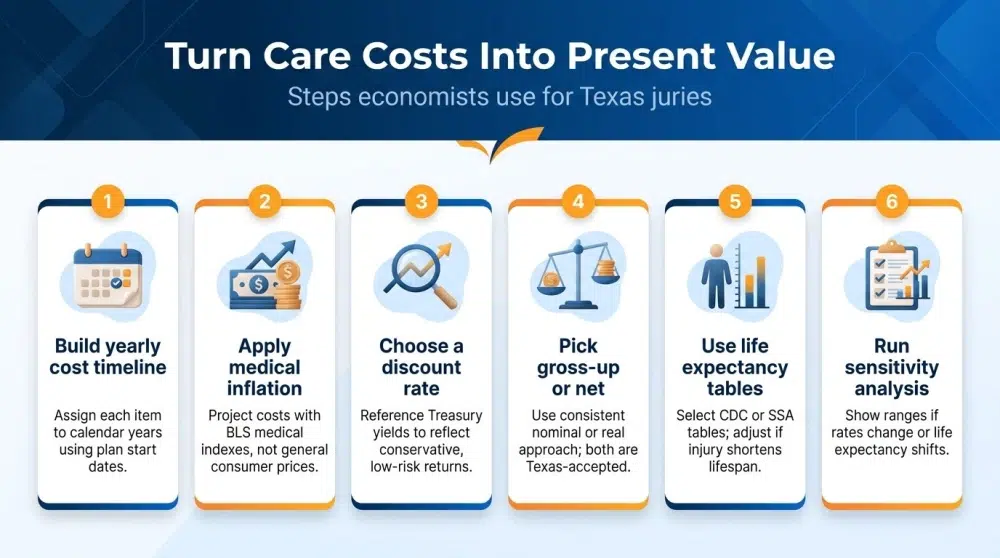
The economist translates the life care planner’s schedule into a discounted present value through several steps.
Building the Cost Timeline
The economist takes each item from the life care plan, assigns it to a calendar year based on the projected start date and end date, and applies a medical cost inflation factor. Inflation adjustments recognize that medical costs have historically risen faster than general consumer prices. The BLS Consumer Price Index for Medical Care Services provides a verifiable inflation series for this purpose. [3]
Selecting a Discount Rate
The economist selects a discount rate that reflects the rate of return an injured plaintiff could conservatively earn on a safe, low-risk investment. U.S. Treasury yields for notes and bonds matching the expected care duration are a common reference point because they represent risk-free nominal returns. [4]
Two general approaches exist. In the gross-up method, costs are projected in nominal dollars at the expected inflation rate and then discounted at the nominal discount rate. In the net discount method, costs are projected in today’s dollars and discounted at the real rate, which equals the nominal rate minus inflation. Both methods, if applied consistently, should produce similar results. Courts in Texas have accepted both approaches when adequately explained by the economist.
Life Expectancy
The economist applies a life expectancy from actuarial tables, typically the National Vital Statistics Reports published by the CDC’s National Center for Health Statistics, or the Social Security Administration period life tables. [5] When a catastrophic injury itself reduces life expectancy, a physiatrist or life expectancy expert must provide that adjusted figure before the economist can apply it.
Sensitivity Analysis
A well-prepared economic report includes sensitivity tables showing how the present value changes if the discount rate rises by 1%, if inflation is lower than projected, or if life expectancy is shorter than estimated. Presenting this analysis openly reduces the risk that cross-examination on assumptions will appear to undermine the entire calculation.
How Does Texas Law Govern Future Medical Damages?
Texas Civil Practice and Remedies Code section 41.0105 limits recovery of past medical expenses to the amounts actually paid or incurred rather than the amounts billed by providers. [6] This rule, established by the Texas Supreme Court in Haygood v. Escabedo, has real consequences for life care plans because it signals that Texas courts focus on reasonable market value rather than gross billed charges. A planner who relies on hospital chargemaster rates without any analysis of what those services actually cost in the market risks having the projections challenged as inflated.
For future medical expenses, the plaintiff must present evidence that the anticipated care is both medically necessary and reasonably probable to occur. Texas courts have held that bare assertions are not sufficient; the plaintiff must support future medical needs with competent medical testimony. The life care plan itself, prepared by a qualified planner and supported by treating physician opinions, provides that foundation when properly constructed.
Texas Rule of Evidence 702 governs the admissibility of expert testimony. The trial court acts as a gatekeeper to exclude testimony not grounded in sufficient facts and reliable methodology. Before presenting a life care plan to a Dallas jury at the George Allen Sr. Courts Building, counsel must be prepared to defend the planner’s qualifications, methods, and data sources through a Daubert-type reliability hearing if the defense challenges admissibility. [7]
Plaintiffs who have suffered spinal cord injuries, traumatic brain injuries, or other catastrophic conditions typically need a GoSuits personal injury lawyer to coordinate the life care planner and economist from the earliest stages of the case, so that the plan reflects current medical evidence and can withstand rigorous cross-examination.

How Do Defendants Attack Each Category of the Plan?
Defense life care planners and economists scrutinize every item in the plaintiff’s plan. Understanding the standard attack vectors helps plaintiffs’ attorneys build a more resilient plan from the start.
Medical Necessity Challenges
The defense argues that specific services are not medically necessary, that the frequency is excessive, or that the duration extends beyond what a treating physician has actually recommended. A plan that tracks every item directly to a treating physician’s opinion or a published standard of care is far more resistant to this challenge than one based primarily on the planner’s independent judgment.
Pricing Challenges
Defendants employ their own planners to substitute lower unit costs. If the plaintiff’s plan uses retail pharmacy prices, the defense may argue that the injured person would qualify for Medicaid, Medicare, or a prescription assistance program. If the plan uses a premium wheelchair model, the defense may argue that a standard model achieves the same function at lower cost. Using the Medicare fee schedule as a floor and documenting specific vendor quotes for specialty items reduces but does not eliminate this vulnerability.
Replacement Cycle Challenges
Defense planners may extend replacement cycles, arguing that equipment lasts longer than the plaintiff projects. Manufacturers’ stated service lives and Medicare’s recognized replacement schedules are the strongest counterarguments. For power wheelchairs, Medicare has published replacement schedules based on clinical outcomes data, and a plaintiff’s plan that aligns with those benchmarks is on defensible ground.
Inflation and Discount Rate Challenges
The defense economist will typically use a higher discount rate and a lower inflation assumption than the plaintiff’s economist, both of which reduce present value. If the plaintiff’s economist uses a net discount rate of 0% based on historical data showing that medical inflation has closely tracked safe investment yields, the defense will argue this is overly aggressive. Presenting multiple scenarios in a sensitivity table allows the jury to understand the range of reasonable outcomes rather than treating the plaintiff’s figures as the only possible answer.
Life Expectancy Challenges
For certain injuries, particularly high-level spinal cord injuries and severe traumatic brain injuries, medical literature supports reduced life expectancy projections. The defense will engage a physiatrist or life expectancy expert to argue for a shorter planning horizon, which directly reduces every lifetime-duration care item. The plaintiff’s team should anticipate this challenge and have the treating physiatrist prepared to address it with specific reference to published outcomes data for the plaintiff’s injury level and age.
Hypothetical Example: Traumatic Brain Injury Case in Dallas County
Example (hypothetical, not a GoSuits case result):
A 35-year-old construction worker suffers a severe traumatic brain injury in a crash on I-635 near the LBJ Freeway interchange. Neuropsychological testing documents significant cognitive impairment, difficulty with executive function, and behavioral dysregulation. The treating physiatrist recommends lifelong case management, cognitive therapy twice weekly for two years and monthly thereafter, behavioral health services, and eventual supported employment services. The worker will require assistance with complex household tasks and transportation indefinitely.
A certified life care planner working from the treating team’s recommendations creates an itemized plan that includes neuropsychology follow-up visits, occupational therapy sessions, behavioral health counseling, case management hours, cognitive aids and technology, home safety modifications, and supported employment coaching. The economist takes the schedule, inflates each year’s costs at the historical rate of medical cost inflation, and discounts the resulting stream to present value using a yield that reflects conservative investment returns on long-term Treasury instruments. The final present-value figure represents the amount that, invested today, would cover the plaintiff’s anticipated care costs throughout a statistically normal life expectancy.
The defense engages its own planner who challenges the frequency of behavioral health visits, substitutes lower-cost cognitive aids, and extends the supported employment period. The defense economist uses a higher discount rate and a lower inflation assumption. The gap between the two present-value figures defines the economic dispute the jury must resolve.
Statute of Limitations and Timing Considerations
In Texas, the general statute of limitations for personal injury claims is two years from the date the cause of action accrues. Texas Civil Practice and Remedies Code section 16.003 sets this period. [8] Some claims involving government entities have shorter deadlines under the Texas Tort Claims Act. Life care planning takes time, particularly for catastrophic injuries where the medical picture may not stabilize for many months after the injury. Retaining a personal injury attorney and beginning the life care planning process early preserves both the legal claim and the quality of the evidence.
What Should I Do If I Need a Life Care Plan for a Serious Injury in Texas?
A claim involving catastrophic injury, long-term care needs, or permanent disability is not well suited to self-representation. The coordination required among treating physicians, a certified life care planner, a vocational expert, and an economist requires experienced case management. Evidence must be preserved, treating providers must be interviewed, and the plan must be completed before expert disclosure deadlines in litigation.
If you or a family member sustained a serious injury in the Dallas area, on I-35E, the Dallas North Tollway, I-30, or any other corridor in the DFW metro, a GoSuits personal injury lawyer can review the facts and explain how a life care plan and economic analysis would be developed for your specific situation. If a catastrophic brain injury is involved, our Dallas brain injury lawyers work directly with rehabilitation specialists and economists to build the evidentiary foundation courts require. If a serious injury claims a life, our wrongful death lawyers in Dallas can explain how survival damages and wrongful death damages are calculated and pursued under Texas law.
If you or someone you care about has suffered a catastrophic injury in Texas and needs to understand how future costs are calculated and presented in court, schedule a free consultation with a GoSuits attorney. There is no fee unless we recover on your behalf.
References
- Medicare Physician Fee Schedule Overview – Centers for Medicare and Medicaid Services (CMS)
- Texas Pattern Jury Charges, PJC 10.2 (Future Damages Reduced to Present Cash Value) – State Bar of Texas [AUTHORITY TO VERIFY current edition URL]
- Consumer Price Index for Medical Care Services – U.S. Bureau of Labor Statistics
- Daily Treasury Yield Curve Rates – U.S. Department of the Treasury
- United States Life Tables – National Center for Health Statistics, CDC
- Texas Civil Practice and Remedies Code Chapter 41 (Damages) – Texas Legislature Online
- Texas Rules of Evidence, Rule 702 (Testimony by Expert Witnesses) – Texas Courts
- Texas Civil Practice and Remedies Code Section 16.003 (Two-Year Limitations Period) – Texas Legislature Online
- Period Life Table – Social Security Administration
- Jones & Laughlin Steel Corp. v. Pfeifer, 462 U.S. 523 (1983) – Cornell LII (present value discounting principles)
- Occupational Employment and Wage Statistics, National – U.S. Bureau of Labor Statistics
- National Spinal Cord Injury Statistical Center – University of Alabama at Birmingham
- Life Care Planning for Personal Injury Cases – GoSuits Knowledge Base