
When someone dies as a result of another party’s wrongful conduct, California law creates two separate civil claims. The wrongful death claim belongs to the surviving heirs for their own losses. The survival action belongs to the decedent’s estate and covers the losses the decedent personally suffered before death. Under California Code of Civil Procedure sections 377.20 through 377.34, a cause of action that existed at the time of death does not disappear; it survives and may be pursued by the estate’s personal representative or by the decedent’s successor in interest. What the estate can recover, including whether pre-death pain and suffering is available, depends on the specific version of section 377.34 that applied when the case was filed, a question that has changed significantly since 2022. Any attorney or family reviewing a California fatal-injury case should verify the current operative text of section 377.34 and any extending legislation before drawing conclusions.
Legal Snapshot
- Legal Topic: Survival Actions in California Estate Recovery After Fatal Injury
- Jurisdiction: California (Orange County / Irvine area)
- Case Stage: Pre-litigation and litigation
- Primary Legal Issue: What losses the decedent’s estate may recover in a survival action
- Primary Authority: California Code of Civil Procedure §§ 377.20–377.34 [1]
- Date Legal Authority Last Reviewed: July 2025 Verify the current operative text of CCP § 377.34 and any extending legislation before publication or reliance.
Two Claims Arise from One Fatal Injury
A fatal accident in California typically gives rise to two parallel civil claims that are legally distinct. Families handling estate matters after a traffic collision on the 405 or a workplace accident in the Irvine Spectrum area, for example, will encounter both when they consult with personal injury lawyers.
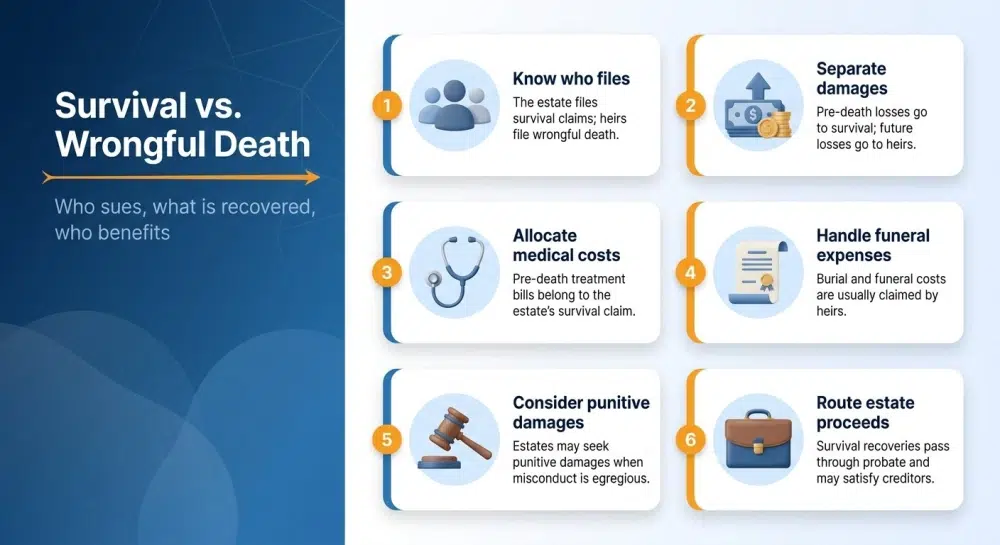
The wrongful death claim (CCP § 377.60) is brought by specific statutory heirs, typically a spouse, domestic partner, or children for losses that are personal to them: the financial support they have lost, the loss of companionship and guidance, and their own grief and suffering. The wrongful death claim belongs to the heirs, not the estate.
The survival action (CCP §§ 377.30–377.35) is different. It is the decedent’s own claim, continued after death. It covers what the decedent lost medical bills, lost earnings, and, under circumstances described below, pre-death pain and suffering. Because it belongs to the estate rather than the heirs personally, its proceeds pass through the estate and may be subject to creditors or distribution under the decedent’s will or intestate succession.
Both claims can be filed in the same lawsuit, and courts regularly hear them together. The Orange County Superior Court, which handles civil matters for the Irvine area at the Central Justice Center in Santa Ana, routinely sees complaints that combine both causes of action after a fatal crash or serious injury.
How a Survival Action Works Under California Law
California Code of Civil Procedure section 377.20 provides the foundational rule: “Except as otherwise provided by statute, a cause of action for or against a person is not lost by reason of the person’s death, but survives subject to the applicable limitations period.” [1] This means that if a person had a valid personal injury claim before they died, the claim does not disappear. It passes to their estate.
Section 377.30 specifies who may bring the survival action: the decedent’s personal representative (the executor or administrator of the estate) or, if no probate proceeding is pending, the decedent’s successor in interest. In practice, many survival actions are filed by a successor in interest rather than through a formal probate estate, which requires a specific declaration described in the next section.
What Losses the Estate Can Recover
Section 377.34(a) sets the baseline rule for damages in a survival action. The estate may recover:
- Pre-death medical expenses and related economic losses
- Lost earnings from the time of injury to the time of death
- Any penalties or punitive/exemplary damages the decedent would have been entitled to recover had they lived
Subdivision (a) expressly states that damages “do not include damages for pain, suffering, or disfigurement.” [2] That default rule, however, now has a significant, time-limited exception.
The Legislative Change That Opened Pre-Death Pain and Suffering Damages
Before 2022, a California survival action could not include compensation for the physical pain, mental suffering, or disfigurement the decedent endured before death. That changed when the Legislature added subdivision (b) to section 377.34, effective January 1, 2022, and subsequently amended and extended by AB 1754 (Stats. 2023, Ch. 131, Sec. 18), effective January 1, 2024. [2]
As of the 2024 amendment, subdivision (b) allows pre-death pain, suffering, and disfigurement damages if either of the following applies:
- The action was granted a preference pursuant to CCP section 36 before January 1, 2022; or
- The action was filed on or after January 1, 2022 and before January 1, 2026.
The sunset date of January 1, 2026 is written into the statute. Cases filed after that date revert to the traditional rule unless further legislation extends or makes permanent the availability of pre-death pain and suffering. Before filing any survival action or advising any client, practitioners must confirm whether section 377.34 has been further amended and whether the filing window remains open. [DEADLINE REQUIRES LEGAL VERIFICATION]
The Legislature also attached a data-collection requirement to subdivision (b). Plaintiffs who recover pre-death pain and suffering damages between January 1, 2022 and January 1, 2025 must submit a copy of the judgment or settlement to the Judicial Council within sixty days, along with a cover sheet detailing the filing date, disposition date, and the types and amounts of damages recovered. The Judicial Council was required to transmit a report to the Legislature by January 1, 2025, summarizing outcomes from cases decided through July 31, 2024. [2]
Why the Change Matters Practically
For a family in Newport Beach, Costa Mesa, or anywhere in Orange County that lost a relative in a fatal collision on the SR-73 Toll Road, the practical significance of subdivision (b) can be substantial. If the person survived the initial crash but spent days or weeks in the hospital experiencing pain, undergoing surgeries, and suffering before dying, those pre-death experiences were previously uncompensable in the estate’s claim. Under the current window, an estate with a case filed before January 1, 2026 may present evidence of that suffering to a jury. The wrongful death lawyers handling such cases must identify which recovery window applies.
Who Can Bring the Survival Action: The Successor in Interest Declaration
When no probate estate has been opened, CCP section 377.32 allows the decedent’s successor in interest to file or continue the survival action by executing a sworn declaration. [3] The declaration must state, under penalty of perjury, all of the following:
- The decedent’s name
- The date and place of the decedent’s death
- That no California probate proceeding is currently pending for the decedent’s estate
- If the estate was previously administered, a copy of the final order showing distribution of the cause of action to the successor in interest
- That the declarant is the decedent’s successor in interest, as defined in CCP section 377.11, or is authorized to act on behalf of the successor in interest
- That no other person has a superior right to bring the action
A certified copy of the decedent’s death certificate must be attached to the declaration. When more than one person files the declaration, the required statements are modified accordingly.
When Probate Is and Is Not Required
A formal probate proceeding is not required simply to file a survival action. The successor-in-interest route allows family members to proceed directly in civil court without opening a probate estate, as long as the section 377.32 declaration is properly executed and filed. However, when a probate estate has already been opened, the personal representative controls the survival action, and the probate court may have jurisdiction over how proceeds are distributed. The interaction between probate and personal injury proceedings can be complicated, and it may affect timing, settlement authority, and the allocation of any recovery. Personal injury lawyers handling fatal-injury cases in Orange County routinely coordinate with probate counsel on these issues.
How the Two Claims Are Pleaded Together
California courts allow wrongful death and survival claims to be filed in a single complaint. The California Judicial Council provides form complaints that accommodate both causes of action. In practice, the survival action is pleaded as one count and the wrongful death claim as another, each identifying the applicable plaintiffs (the estate or successor in interest for the survival claim; the statutory heirs for the wrongful death claim).
Damages are calculated and presented separately at trial. The jury receives separate verdict forms so that each category of recovery is attributed to the correct claim. This separation matters for several reasons:
- Survival action proceeds belong to the estate and may be subject to estate debts and distribution rules.
- Wrongful death damages belong directly to the heirs and are generally exempt from estate creditors.
- Pre-death medical expenses belong to the survival claim; post-death funeral and burial costs may be recoverable under wrongful death.
- The plaintiffs on each claim may differ if, for example, the decedent had no spouse but did have a parent who qualifies as a wrongful death heir.
A hypothetical example illustrates how this works:
Example: A 42-year-old Irvine resident is seriously injured in a rear-end collision on the I-405. She survives for eleven days in the hospital, during which she incurs $190,000 in medical expenses and experiences significant pain and multiple surgeries. She then dies from her injuries. Her estate files a survival action recovering the medical expenses, lost earnings for the eleven-day period, and because the lawsuit is filed within the statutory window pre-death pain and suffering damages. Her surviving spouse and two children separately pursue a wrongful death claim for the income support, guidance, and companionship they have lost going forward. Both claims are filed in the same Orange County Superior Court lawsuit.
This scenario is not an actual GoSuits case. It is offered to illustrate how the two claims function and interact.
What Evidence Can Matter in a California Survival Action
Because the survival action focuses on losses the decedent personally experienced, relevant evidence tends to differ from what is most important in the wrongful death claim. Categories that may bear on a survival action include:
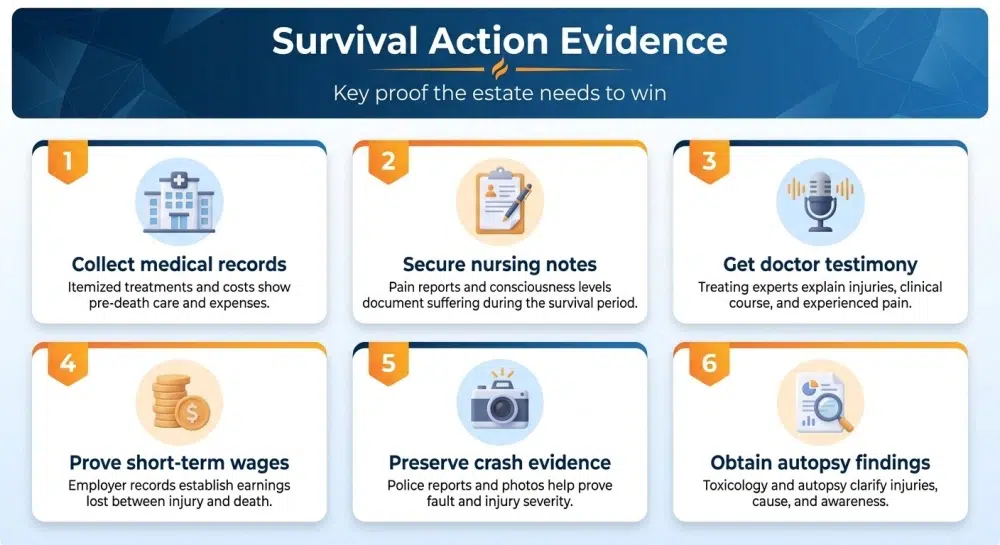
- Medical records and billing: Documentation of every treatment, procedure, medication, and associated cost from the time of injury to the time of death. These records establish pre-death medical expenses and, where relevant, the nature and duration of the decedent’s pain and suffering.
- Nursing and hospital records: Nursing notes describing the decedent’s reports of pain, their level of consciousness, their ability to communicate, and their physical condition over time. These are often central to pre-death pain and suffering damages.
- Treating physician testimony: Expert medical testimony regarding the decedent’s clinical course, the injuries sustained, and the likely experience of pain and suffering during the survival period.
- Employer and wage records: Payroll records, tax returns, and employment contracts to establish lost earnings during the period between injury and death.
- Police and accident investigation reports: Documents describing the circumstances of the incident, fault, and the sequence of events leading to injury and death.
- Photographs and video: Scene photographs, surveillance footage, or dashcam recordings that help establish liability and the severity of the initial impact.
- Toxicology and autopsy reports: May be relevant to cause of death, the nature and extent of injuries, and the decedent’s awareness during the survival period.
- Communications and personal accounts: Statements made by the decedent to family or medical staff about their pain or condition, documented promptly, may carry evidentiary weight.
Evidence collection should begin as soon as possible. Medical records, accident-scene evidence, and electronic data can be lost, overwritten, or destroyed quickly. Understanding what happens legally when someone is killed in a car accident is a useful starting point for families who are uncertain which records to preserve.
What Damages May Be Available in a Survival Action
The recoverable damages in a California survival action depend on the facts of the case and, as described above, on the version of CCP section 377.34 that applies. The following categories are generally recognized:
Economic Damages (Survival Action)
- Pre-death medical expenses: Hospital charges, emergency treatment, surgery, intensive care, pharmacy costs, and related expenses from the time of injury to death.
- Lost earnings: Income the decedent would have earned during the period between injury and death, based on their wage history and employment situation.
Non-Economic Damages (Subject to Filing Window)
- Pre-death pain and suffering: Compensation for the physical pain, discomfort, and mental anguish the decedent endured before dying, available for cases filed within the statutory window under CCP § 377.34(b).
- Disfigurement: Where applicable, the disfiguring nature of injuries sustained before death, also subject to the same filing-window limitation.
Punitive Damages
Section 377.34(a) expressly preserves the ability of the estate to recover any punitive or exemplary damages the decedent would have been entitled to claim. This means that if the defendant’s conduct was oppressive, fraudulent, or malicious under California Civil Code section 3294, the estate may seek punitive damages in the survival action, just as the decedent could have done had they survived. Nothing in section 377.34 alters Civil Code section 3333.2, which limits non-economic damages in certain professional negligence claims. [2]
Recoverability of any of these items depends on applicable law, the specific facts of the case, and how damages are proven at trial or negotiated in settlement. No outcome can be guaranteed.
How Long Does the Estate Have to Act?
The statute of limitations for a survival action in California is generally the same limitations period that applied to the decedent’s underlying personal injury claim. Under CCP section 335.1, personal injury claims must ordinarily be filed within two years of the date the cause of action accrued. Death of the plaintiff can affect the running of the statute under CCP section 366.1, which generally provides that when the plaintiff dies before the limitations period expires, the period for the estate or successor in interest is tolled for six months from the date of death if less than six months remain on the original period.
In addition to the statute of limitations, the sunset date in CCP section 377.34(b) imposes a separate deadline on eligibility for pre-death pain and suffering damages: the action must have been filed before January 1, 2026, under the text as amended by AB 1754. If extended or replaced by further legislation, this date may shift. [DEADLINE REQUIRES LEGAL VERIFICATION]
Government entity defendants introduce additional complexity. Claims against a California public entity must ordinarily be preceded by a government tort claim filed within six months of the accrual of the cause of action under the Government Claims Act. Missing the government claims deadline can bar the lawsuit entirely, regardless of the merits.
Because multiple overlapping deadlines may apply, families should not delay in consulting wrongful death lawyers after a fatal injury.
What If Insurance Is Involved?
Most fatal-injury cases involve one or more insurance policies. The at-fault party’s liability insurance covers claims up to its policy limits. Where the at-fault party has insufficient coverage, the decedent’s own uninsured or underinsured motorist (UM/UIM) coverage may be available to supplement the recovery, subject to the terms of that policy and California law.
In survival actions, insurance coverage disputes can arise over whether the estate’s claim triggers the same policy limits as a wrongful death claim, and how those limits are allocated between the two types of claims when both are asserted. For serious fatal-injury cases, there may also be excess or umbrella policies, or multiple defendants with separate insurers, that require investigation.
California’s Insurance Code imposes duties of good faith on insurers. If an insurer unreasonably delays or denies payment of a valid survival action claim, additional remedies may be available under California’s bad faith doctrine, separate from the underlying injury recovery.
What Should I Do Next?
If you are a surviving family member or the appointed administrator of a decedent’s estate and you believe the death resulted from another party’s wrongful conduct, the following steps are important:
- Secure and preserve records immediately. Request the decedent’s complete medical records from every facility that provided treatment. Preserve accident-scene photographs, police reports, and any physical evidence.
- Do not dispose of or alter evidence. Vehicles, clothing, electronic devices, and records involved in the incident should be preserved pending legal review.
- Identify all potential defendants. In a traffic collision, this may include individual drivers, vehicle owners, employers of a at-fault driver, and in some cases government entities responsible for road design or maintenance.
- Track all deadlines. Consult with counsel promptly to identify the applicable statute of limitations, any government claim deadlines, and whether the section 377.34(b) filing window applies to your situation.
- Do not give recorded statements to the other party’s insurer without first speaking with legal counsel.
- Understand the distinction between claims. Know whether you are pursuing the estate’s survival claim, a wrongful death claim as an heir, or both, and who has authority to pursue each.
A fatal-injury case involves medical evidence, insurance coverage questions, probate considerations, liability disputes, and strict filing deadlines. If you are dealing with the loss of a loved one in the Irvine or broader Orange County area, our Irvine personal injury lawyers can review the circumstances and explain the legal options available to the estate and to the heirs.
Schedule a free consultation with a GoSuits attorney to discuss your situation.

Talk With a GoSuits Attorney
Survival actions are complicated. There’s medical evidence to gather, probate questions to sort through, insurance coverage to untangle, and strict deadlines that shift depending on when the case gets filed and who the defendants actually are. If you’re a surviving family member or an estate representative dealing with a fatal injury somewhere in Orange County, maybe a crash on the SR-73, maybe a workplace incident in the Irvine Spectrum area, maybe something else entirely, our Irvine personal injury team can walk through the circumstances with you and lay out what options the estate and the heirs probably have.