A Texas car accident settlement usually takes a long time because it is a negotiated agreement, not a payment with a fixed deadline. Under Texas law, the at-fault driver’s liability insurer has no statutory clock for paying an injured third party, because the state’s prompt-payment statute covers first-party claims under your own policy [5]. Delays typically come from unfinished medical treatment, a dispute over who was at fault, lien and Medicare reimbursement issues, limited policy coverage, or an underinsured motorist claim that cannot be paid until liability and damages are established [6]. The two-year filing deadline keeps running while talks continue [1]. This article is general legal information, not advice about your claim.
Legal Snapshot
-
Legal Topic: Delay in resolving a Texas motor vehicle injury claim (third-party liability claim, plus first-party UM/UIM claims)
-
Case Stage: Pre-suit negotiation, or pending litigation after a lawsuit has been filed
-
Primary Legal Issue: Why settlement timing is not controlled by a statutory payment deadline, and which Texas and federal rules commonly extend it
-
Primary Authority: Tex. Civ. Prac. & Rem. Code chs. 16, 33 and 41; Tex. Prop. Code ch. 55; Tex. Ins. Code ch. 542; Brainard v. Trinity Universal Insurance Co., 216 S.W.3d 809 (Tex. 2006); 42 U.S.C. § 1395y(b)
-
Date Legal Authority Last Reviewed: November 11, 2026 (research review only; attorney review pending, see verification notes below)
What Does a Delayed Car Accident Settlement Mean in Texas?
A settlement is a voluntary agreement in which the injured person releases a claim in exchange for payment. Because it is voluntary, neither side can be forced to agree by a particular date. A claim may feel stalled when the insurer has not made an offer, when an offer is far below what the injured person expects, or when an agreed amount has not been paid out.
Those are different problems with different causes. A slow offer usually points to investigation, liability or medical-record issues. A slow payout after agreement often points to liens, Medicare, release paperwork or the settlement of multiple claims against one policy.
What Does Texas Law Say About Settlement Timing?
Texas law does not set a deadline for the at-fault driver’s insurer to settle with an injured third party. The Texas Prompt Payment of Claims statute, Insurance Code chapter 542, sets deadlines for first-party claims, which are claims made by an insured or policyholder under their own insurance policy [5]. Courts have described the prompt-payment remedy as aimed at first-party claims [5]. Your own collision, personal injury protection, MedPay, or uninsured/underinsured motorist coverage may fall under those first-party rules, depending on the policy and the facts. For underinsured motorist claims, however, the Texas Supreme Court has held that the insurer generally does not have to pay until a judgment establishes the other driver’s fault and underinsured status (Brainard v. Trinity Universal Ins. Co., 216 S.W.3d 809 (Tex. 2006)).
Other authorities shape the pace of a case even though none of them sets a payment date:
|
Authority |
What it addresses |
How it can affect timing |
|---|---|---|
|
Tex. Civ. Prac. & Rem. Code § 16.003 |
Two-year limitations period for personal injury suits |
Sets the outer limit for filing; negotiating does not pause it [1] |
|
Tex. Civ. Prac. & Rem. Code ch. 33 |
Proportionate responsibility |
Fault disputes can prolong negotiation [2] |
|
Tex. Civ. Prac. & Rem. Code § 41.0105 |
Recovery of medical expenses limited to amounts actually paid or incurred |
Billing and payment records must be gathered and reconciled [3] |
|
Tex. Prop. Code ch. 55 |
Hospital and emergency medical services liens |
Liens must be addressed before funds are distributed [4] |
|
42 U.S.C. § 1395y(b) (federal) |
Medicare Secondary Payer rules |
Medicare’s conditional payments must be repaid from a settlement [11] |
What Are the Most Common Reasons for Delay?
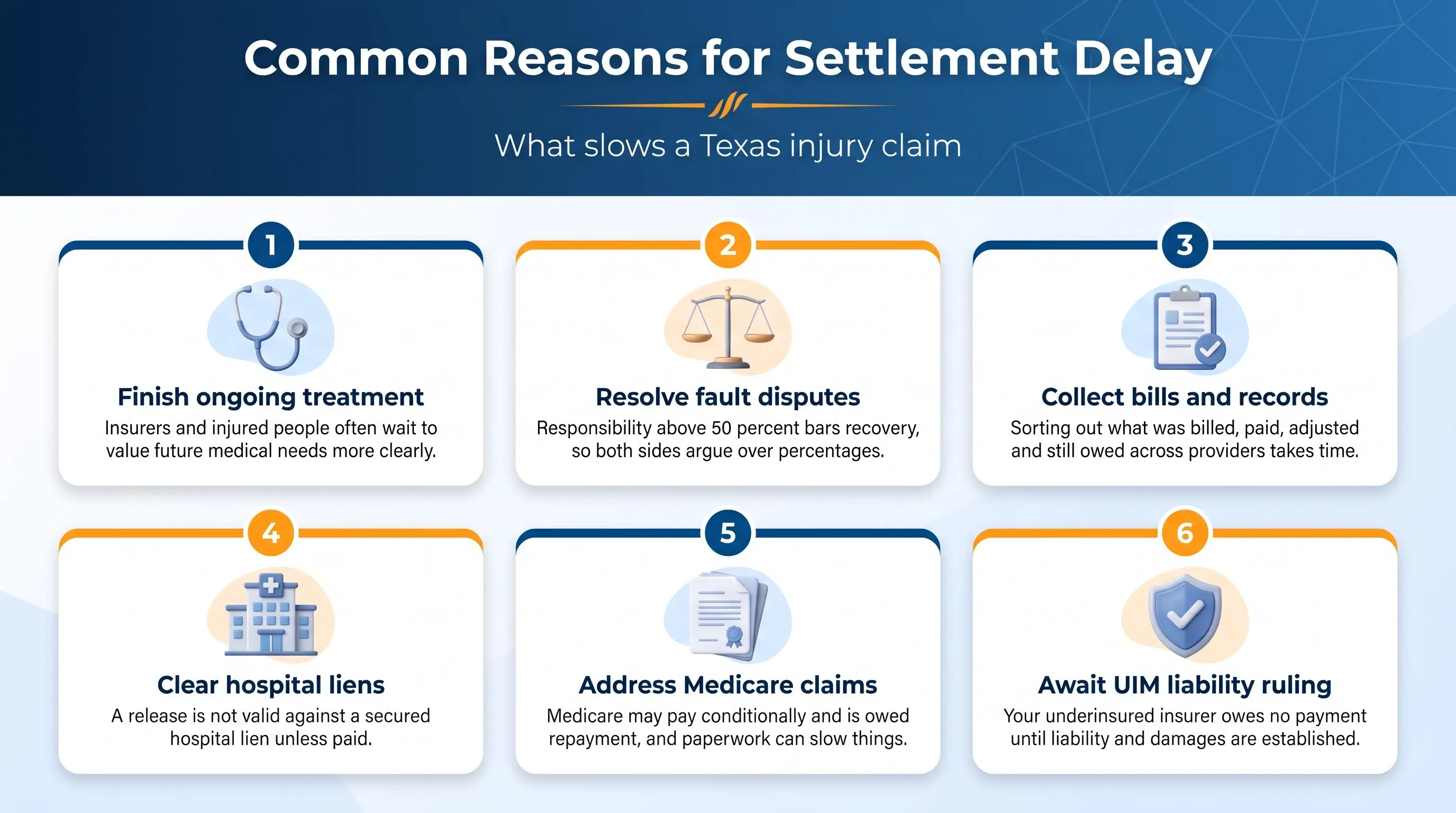
Most delays trace back to one or more of the following causes.
-
Treatment is still ongoing: Insurers and injured people often wait until the course of treatment is clearer before valuing future medical needs. Settling too early can leave future care unpaid, because a release generally ends the claim.
-
Fault is disputed: A claimant whose share of responsibility is greater than 50 percent cannot recover damages, and a lower share reduces the recovery [2]. That gives both sides reason to fight over the percentages.
-
Medical bills and records are incomplete: Past medical recovery is limited to the amount actually paid or incurred by or on behalf of the claimant [3]. The Texas Supreme Court applied that rule in Haygood v. Escobedo, 356 S.W.3d 390 (Tex. 2011) [13]. Reconstructing what was billed, paid, adjusted and still owed from several providers takes time.
-
Liens must be resolved: A hospital may hold a statutory lien on the injury claim and settlement money if the patient was admitted within 72 hours of the accident, and the lien is capped by statute [4]. A release is not valid against a properly secured hospital lien unless the hospital is paid or agrees to the release, which is why insurers insist on resolving liens first [4].
-
Medicare is involved: Medicare may pay conditionally while a liability claim is pending, and it is entitled to repayment from a settlement [9]. A congressional research report notes that paperwork burdens and slow CMS accounting have delayed some liability settlements [10].
-
Policy limits and multiple claimants: When several people were hurt, or damages appear to exceed the at-fault driver’s coverage, the claim may turn on coverage questions rather than fault.
-
Underinsured motorist claims: A UIM insurer is under no contractual duty to pay until a judgment establishes the other driver’s liability and underinsured status [6]. The Texas Supreme Court later held that a declaratory judgment suit is an appropriate way to resolve that contract dispute [8], which can add court time.
How Does This Apply to a Real Case?
Hypothetical example (not a GoSuits case): A driver is rear-ended in stop-and-go traffic on I-35E near the I-635 interchange in the Dallas area. She has an emergency room visit, then months of physical therapy. The other driver’s insurer acknowledges the crash but asks for all treatment records before making an offer. Her health plan, which paid part of the bills, also asserts a reimbursement claim. The case is not stalled in a legal sense. It is waiting on records, a lien figure and a clear view of future care.
Hypothetical example (not a GoSuits case): A driver on I-45 in Houston is hit in a lane-change collision. Each driver blames the other. The insurer argues the injured driver was mostly at fault. Because Texas bars recovery only when a claimant’s responsibility is greater than 50 percent [2], the percentage argument drives the negotiation. If talks fail, the injured person may need to file suit in a county where venue is proper, such as the Harris County district courts for a crash in Houston (Tex. Civ. Prac. & Rem. Code § 15.002(a)(1)).
What Evidence Can Matter?
Evidence does not automatically prove liability or damages, but gaps in it commonly slow a claim. Categories that often matter include:
-
Crash report and photographs: They help document the vehicles’ positions, road conditions and damage.
-
Video and vehicle data: Dashcam, traffic or surveillance footage and electronic vehicle data may show how the crash happened.
-
Witness statements: Independent accounts can bear on a fault dispute.
-
Medical records and bills: They connect the crash to the injuries and document paid and incurred amounts [3].
-
Employment and wage records: They support claims for lost income or reduced earning capacity.
-
Insurance documents: Declarations pages, UM/UIM coverage and lien or reimbursement notices show who may be owed money.
-
Accident reconstruction analysis: In serious or disputed crashes, a qualified reconstruction witness may be retained to address speed, braking and impact angles.
What Damages or Remedies May Be Available?
Recoverable damages depend on Texas law and the facts of the case. Categories that may be claimed include past and future medical expenses, lost income, loss of earning capacity, physical pain, mental anguish, physical impairment, disfigurement, and vehicle damage. Past medical expenses are limited to amounts actually paid or incurred [3], and scholarly commentary describes the language of § 41.0105 as unclear, which is one reason medical-expense evidence is contested [12]. Exemplary damages are available only in limited circumstances under Texas Civil Practice and Remedies Code section 41.003 and are not typical in ordinary negligence claims.

What If the Other Party Disputes Liability?
A liability dispute is the most common reason an offer is slow or low. In Texas, the fact finder assigns each person a percentage of responsibility; a claimant is barred above 50 percent, and otherwise the recovery is reduced by the claimant’s percentage [2]. A defendant may also seek to designate a responsible third party under chapter 33, which can shift part of the blame away from the defendant [2].
From the defense side, a delay may reflect a legitimate need to investigate. Defendants and their insurers typically want the crash report, treatment records and billing history before valuing the claim, and they want liens satisfied so the release will protect their insured. A defendant who is sued will have the case handled by counsel, and an insurer that controls settlement owes its insured a duty of ordinary care when a settlement demand within policy limits is made, under the common-law Stowers doctrine from G.A. Stowers Furniture Co. v. American Indemnity Co., 15 S.W.2d 544 (Tex. Comm’n App. 1929) [14].
What If Insurance Is Involved?
Insurance is almost always involved, and the type of coverage determines the rules. A third-party claim against the at-fault driver’s liability policy is not governed by the prompt-payment deadlines in chapter 542 [5]. A claim under your own policy may be treated differently. An insurer that rejects a valid within-limits demand may face exposure beyond its limits under Stowers, but that doctrine depends on the demand meeting specific requirements, so it is not a shortcut for every delayed claim [14].
If the at-fault driver is uninsured or underinsured, your own UM/UIM carrier may become the opposing party. Brainard holds that the UIM insurer’s contractual duty to pay does not arise until liability and the amount of damages are determined [6]. Insurance companies may request statements, records and authorizations. Because those communications can affect the claim, many people want a lawyer involved before responding in detail.
How Long Do I Have to Act?
For most Texas personal injury claims, a lawsuit must be filed no later than two years after the day the claim accrues, under Tex. Civ. Prac. & Rem. Code § 16.003(a) [1]. In a car crash, that is generally the date of the crash. Continuing to negotiate does not stop the clock, and only filing a lawsuit protects the claim. Special rules can apply, for example for minors under § 16.001 and for deaths under § 16.003(b). An attorney can confirm the exact deadline for your situation.
Other time-sensitive items include Medicare’s notice and repayment process after a settlement [9], notice requirements in your own insurance policy, and any claim involving a government vehicle, which can carry shorter notice rules (Tex. Civ. Prac. & Rem. Code § 101.101).
What Should I Do Next?
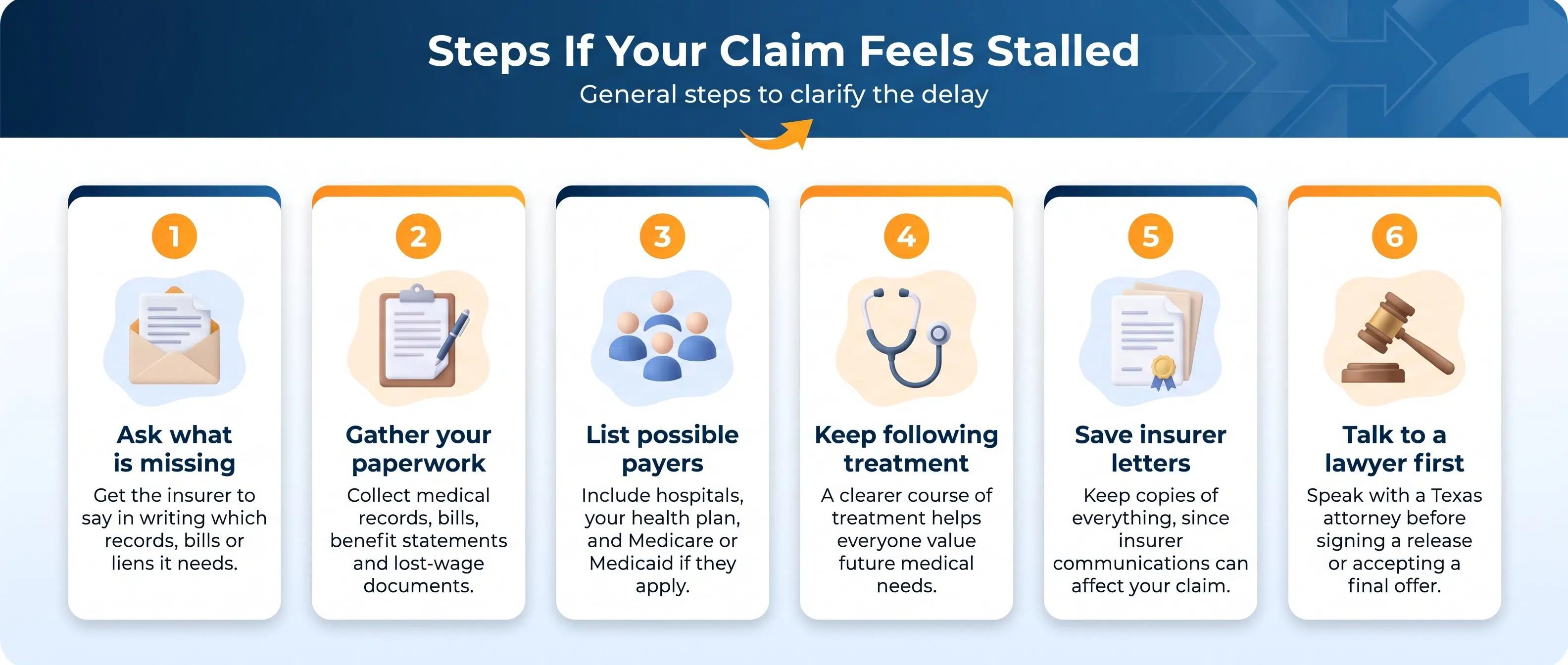
If your settlement feels stalled, these general steps can help clarify why:
-
Write down the date of the crash and calculate when two years will run, then have an attorney confirm it.
-
Find out in writing what the insurer says it still needs, such as records, bills or a lien amount.
-
Gather medical records, bills, explanation-of-benefits statements and lost-wage documents.
-
List every payer that may seek reimbursement: hospitals, your health plan and Medicare or Medicaid, if applicable.
-
Keep following your treatment plan, and keep copies of all insurer correspondence.
-
Speak with a Texas personal injury attorney before signing a release, accepting a final offer or letting the filing deadline approach.
Representing yourself against an insurer carries real risk, because a signed release generally ends the claim. Legal help is strongly advisable.
Related Texas Personal Injury Resources
For an overview of how GoSuits approaches injury claims in this state, see the GoSuits Texas personal injury team page. Readers in the Dallas-Fort Worth area, including Plano, Frisco, McKinney and Carrollton, can use the same resource to learn how an injury claim is reviewed.

Talk With a GoSuits Attorney
A stalled claim can involve medical evidence, insurer investigations, liens, Medicare and a filing deadline that keeps running. Texas personal injury lawyers can review the circumstances, explain the options and help identify which delays are routine and which may signal a problem. Car accident lawyers cannot promise a result or a timeline, but a review can clarify where your claim stands. To discuss your situation, schedule a free consultation.
This article provides general legal information about Texas law and is not legal advice. Reading it does not create an attorney-client relationship. Every claim depends on its own facts, and outcomes are never guaranteed.
References
-
Brainard v. Trinity Universal Insurance Co., 216 S.W.3d 809 (Tex. 2006) – Justia
-
Allstate Insurance Co. v. Irwin, opinion discussing Brainard – Texas Judicial Branch
-
Conditional Payment Information – Centers for Medicare & Medicaid Services
-
Medicare Secondary Payer: Coordination of Benefits – Congressional Research Service, Congress.gov
-
Texas Civil Practice & Remedies Code Sec. 41.0105: A Time for Clarification – St. Mary’s Law Journal
-
Medical Expense Challenges, discussing Haygood v. Escobedo – Hanna Plaut
-
Insurance Texas Style: Stowers Liability and Insurance Towers – It Pays to Be Covered