In California, wrongful death money goes to the family members the statute allows to recover, not to the estate and not according to the decedent’s will. Under Code of Civil Procedure section 377.60, those people are generally the surviving spouse or registered domestic partner, the children, and the issue of any deceased child. If none of them survive, the right passes to those who would inherit under intestate succession. Certain dependents, such as stepchildren, may also qualify. The jury or court awards one sum for all heirs, and if the family cannot agree on a split, the court divides it based on each heir’s own loss [1][11]. A separate “survival” claim, which belongs to the estate, covers the decedent’s own pre-death losses [4].
Legal Snapshot
-
Legal Topic: Distribution of wrongful death recoveries among family members and the estate under California law
-
Case Stage: Pre-filing, litigation, settlement and post-settlement allocation
-
Primary Legal Issue: Who has standing to recover under Code of Civil Procedure section 377.60, and how a single recovery is divided among heirs
-
Primary Authority: Cal. Code Civ. Proc. §§ 377.60, 377.61, 377.62, 377.34; Cal. Prob. Code §§ 6401, 6402; Corder v. Corder (2007) 41 Cal.4th 644
-
Jurisdiction: California state law and California court rules only
-
Date Legal Authority Last Reviewed: November 18, 2026 (research date; attorney confirmation still recommended)
What Does “Who Gets the Money” Mean in a California Wrongful Death Case?
The question usually involves two different pots of money. The first is the wrongful death recovery, which compensates surviving family members for their own losses caused by the death. The second is the survival recovery, which compensates for losses the decedent personally sustained between injury and death, and which belongs to the decedent’s estate [4].
California treats these as separate causes of action that can be joined in one lawsuit [3]. Which family members receive money, and how much, depends on which pot is involved, who qualifies under the statute, and what each person lost. This article is general legal information about California civil claims, not advice about a specific situation.
What Does California Law Say About Who Can Recover?
Wrongful death actions in California are statutory. Section 377.60 creates the cause of action and lists who may assert it, either directly or through the decedent’s personal representative [1][11]. The list is narrower than many families expect, and courts apply it as the Legislature wrote it.
|
Who |
When they may recover |
Authority |
|---|---|---|
|
Surviving spouse or registered domestic partner |
Included in the primary class of claimants |
CCP § 377.60(a) |
|
Children and issue of deceased children |
Included in the primary class of claimants |
CCP § 377.60(a) |
|
Intestate heirs (for example, parents or siblings) |
Only if the decedent left no surviving issue; the order of heirs follows the Probate Code |
CCP § 377.60(a); Prob. Code §§ 6401, 6402 |
|
Putative spouse, children of a putative spouse, stepchildren, parents |
If they were financially dependent on the decedent |
CCP § 377.60(b) |
|
Minor who lived in the decedent’s household for the prior 180 days |
If dependent on the decedent for one-half or more of the minor’s support |
CCP § 377.60(c) |
|
Personal representative |
May assert the claim on behalf of the qualifying persons |
CCP § 377.60 |
The intestate path matters most when the decedent had no children or grandchildren. Probate Code section 6402 sends the non-spouse share of an intestate estate first to the decedent’s parents equally if there is no surviving issue, and then outward to other relatives in a set order [7]. Section 6401 governs the surviving spouse’s share when there is no will, and it treats community property and separate property differently [6]. For wrongful death purposes, courts look at who would inherit under these rules, not what property the person actually left (Phraner v. Cote Mart, Inc. (1997) 55 Cal.App.4th 166). How those rules apply to a particular family can be fact-specific.
A will generally does not decide who can bring a wrongful death claim, because the statute relies on its own list and on intestate succession rather than on the beneficiaries the person chose (Phraner v. Cote Mart, Inc. (1997) 55 Cal.App.4th 166). Wrongful death damages are measured by the family members’ own losses, which is different from property passing under an estate plan.
What Legal Rules Apply to Dividing the Money?
One action, one sum
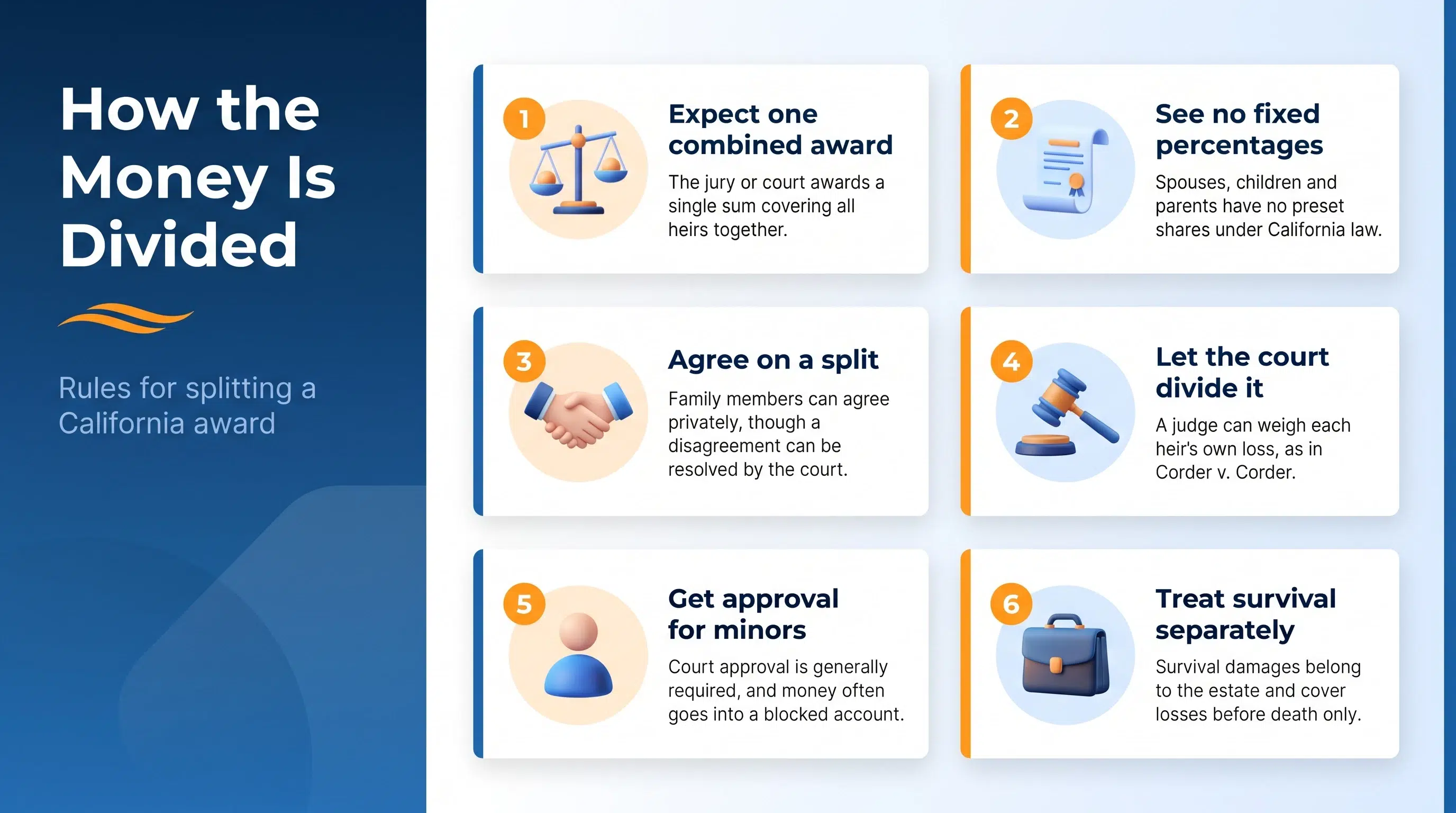
California generally allows only one wrongful death lawsuit for each death, and all known heirs should be included in it (Cross v. Pacific Gas & Electric Co. (1964) 60 Cal.2d 690; Smith v. Premier Alliance Ins. Co. (1995) 41 Cal.App.4th 691). The jury or court considers each heir’s loss and returns one total award. Section 377.61 provides that damages may be awarded that are just under all the circumstances, but may not include damages recoverable under section 377.34 [2].
Court apportionment among heirs
California law sets no fixed percentages for spouses, children or parents. In Corder v. Corder (2007) 41 Cal.4th 644, the California Supreme Court recognized that a trial court may determine the allocation of settlement proceeds between competing heirs in the wrongful death action itself [11]. In that case, the trial court heard evidence about each heir’s loss and allocated the settlement between a widow and an adult daughter [11]. Heirs can also agree on a split, but a disagreement can be resolved by the court.
Minor children’s shares
When a minor is among the recipients, court approval is generally required. Probate Code sections 3500 and 3600 through 3613, Code of Civil Procedure section 372, and California Rules of Court, rule 7.950 govern the petition and how the money is handled [10][12]. The expedited petition procedure in rule 7.950.5 does not apply to claims for the wrongful death of a person [13]. Orange County Superior Court’s guidance explains that proceeds for a minor are in most cases ordered into a blocked account, and that the minor’s appearance is not required when the petition arises from a wrongful death [14].
The estate’s survival recovery
Survival damages belong to the estate and are limited to losses the person suffered before death. For survival actions filed on or after January 1, 2026, pain, suffering, and disfigurement are generally not recoverable, because the temporary window added by SB 447 for actions filed from January 1, 2022, through December 31, 2025, expired [4]. Certain claims, such as qualifying elder abuse claims, may be treated differently (Welf. & Inst. Code § 15657(b)). Survival money is handled through the estate and goes to beneficiaries under a will or intestacy rules.
|
Question |
Wrongful death claim |
Survival action |
|---|---|---|
|
Whose claim is it? |
The qualifying family members |
The decedent’s estate |
|
What does it cover? |
The family’s own losses from the death |
The decedent’s losses between injury and death |
|
Who receives the money? |
Heirs, in the shares agreed on or set by the court |
The estate’s beneficiaries |
|
Statute |
CCP §§ 377.60, 377.61 |
CCP § 377.34 |
How Does This Apply to a Real Case?
Example (hypothetical, not a GoSuits case): A married driver is killed in a rear-end collision in stop-and-go traffic on the I-405. The driver leaves a spouse and two adult children. The spouse and both children are in the primary class under section 377.60(a). If the case settles for a lump sum and the three cannot agree on a split, the court may allocate it based on each person’s financial and relational loss [11].
Example (hypothetical): An unmarried adult with no children dies in a fall at a commercial property. Intestate succession may bring the decedent’s parents into the class of claimants under the Probate Code order [7]. If the parents are also financially dependent, section 377.60(b) may independently support their standing.
Example (hypothetical): A worker dies and leaves a spouse and a young stepchild who lived in the household and relied on the worker for most of the child’s support. The stepchild may qualify under the dependency provisions, and a court would need to approve any share paid to the child [1][10].
These cases are often filed in the superior court of the county where the death occurred or where a defendant is located, such as Los Angeles County Superior Court or Orange County Superior Court. Venue is a case-specific question.
What Evidence Can Matter?
Evidence in a wrongful death case supports two questions: who caused the death, and what each family member lost. None of it proves liability or value automatically.
-
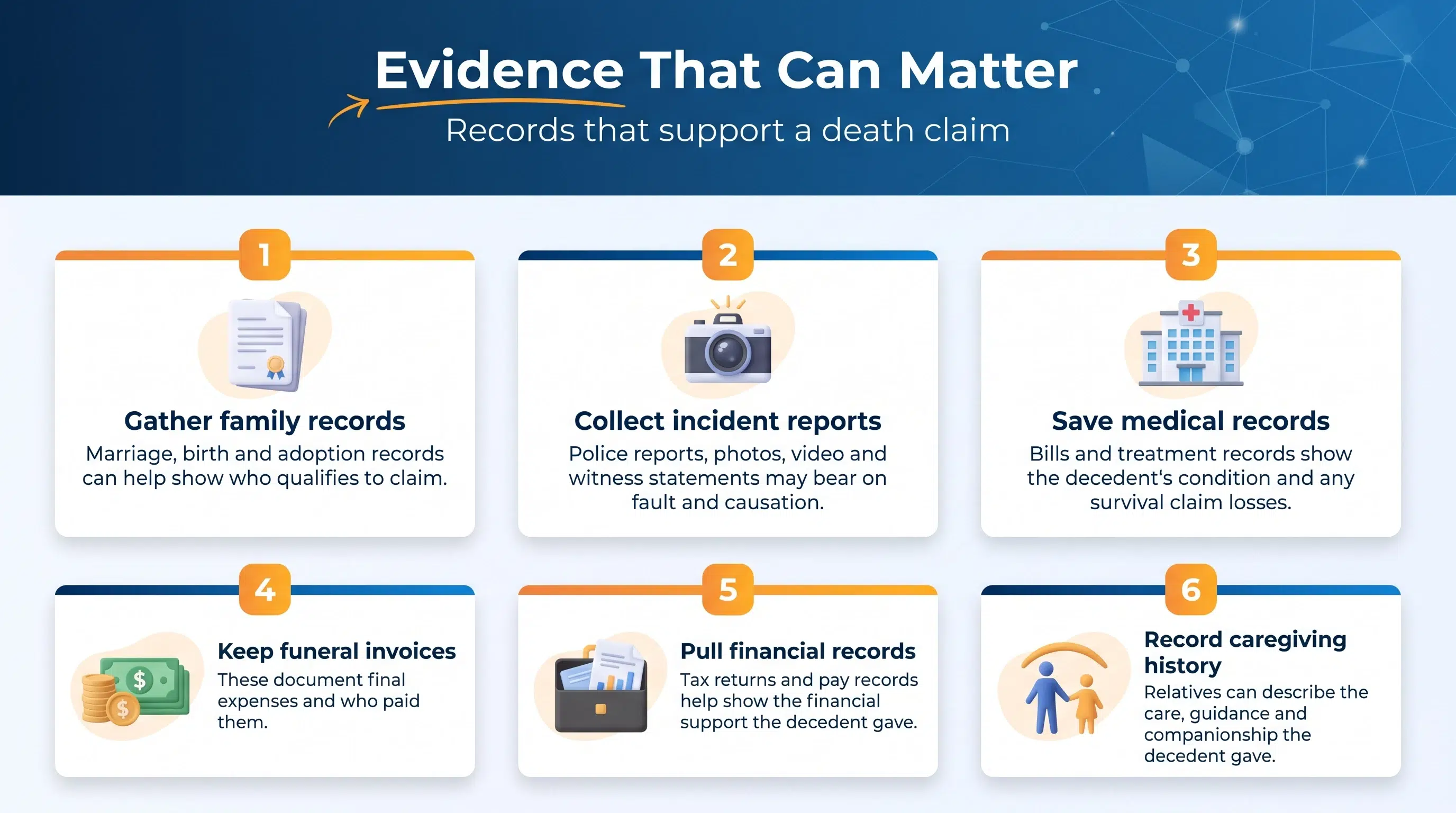
Death certificate and family records: Marriage, domestic partnership, birth and adoption records may help show standing.
-
Police and incident reports, photographs, video and witness statements: These may bear on fault and causation.
-
Medical and hospital records and bills: They show the decedent’s condition, treatment and any survival-claim losses.
-
Funeral and burial invoices: They document final expenses and who paid them.
-
Tax returns, pay records and benefits information: They help show the financial support the decedent provided.
-
Household and caregiving history: Testimony from relatives and friends can show the services, guidance and companionship the decedent gave.
-
Economists and reconstruction analysts: Qualified witnesses may be used to estimate lost support or explain how a collision occurred.
What Damages or Remedies May Be Available?
Recoverable damages depend on the applicable law and the facts of the case. In a wrongful death claim, heirs may seek economic losses such as lost financial support, the value of household services, and funeral and burial expenses. They may also seek non-economic losses, such as the loss of the person’s love, companionship, comfort, care, protection, and moral support (CACI No. 3921). The statute excludes damages recoverable under section 377.34 from the wrongful death award [2].
California generally does not pay survivors for their own grief or sorrow as a separate item, as distinct from the loss of the relationship (CACI No. 3921; Krouse v. Graham (1977) 19 Cal.3d 59, 72).
Punitive damages are generally not recovered as part of the wrongful death claim itself. They may be recovered in the estate’s survival action under Code of Civil Procedure section 377.34. Civil Code section 3294(d) also allows punitive damages in a wrongful death action when the death resulted from a homicide for which the defendant was convicted of a felony [9].
The estate’s survival recovery may include the decedent’s medical expenses and lost earnings before death, but generally not pre-death pain and suffering in actions filed on or after January 1, 2026 [4].
What If the Other Party Disputes Liability?
Defendants may dispute fault, causation, or the value of the claim. They may argue that the person who died was partly at fault. California applies comparative fault principles that can reduce the family’s recovery by that person’s share of fault (Li v. Yellow Cab Co. (1975) 13 Cal.3d 804; Atkins v. Strayhorn (1990) 223 Cal.App.3d 1380, 1395).
Defendants may also challenge whether a particular claimant qualifies under section 377.60. Family members may dispute standing or allocation among themselves, as in Corder, where the heirs asked the court to divide the settlement [11]. These disputes are one reason to involve a lawyer before any family member signs a release or agrees to a split.
What If Insurance Is Involved?
Insurance often determines how much money is actually available. If the at-fault party’s policy limits are lower than the family’s total losses, the amount to divide may be less than the sum of all individual claims. In Corder, the Court noted that heirs may have competing interests in a fund that is less than the sum of their claims [11].
Other sources may include the uninsured or underinsured motorist coverage of the person who died, depending on the policy. Health plans, hospitals, or public programs may seek repayment from part of a recovery. A recorded statement to an insurer can affect a later claim, so speak with a lawyer first.
How Long Do I Have to Act?
Most California wrongful death lawsuits against private parties must be filed within two years from the date of death under Code of Civil Procedure section 335.1 [5].
If a city, county, state agency, or other public entity may be responsible, a written claim generally must be presented within six months under Government Code section 911.2 before a lawsuit can be filed [8]. A limited late-claim process exists in some situations (Gov. Code § 911.4).
Survival-action deadlines can differ from the two-year wrongful death period, and the January 1, 2026 filing-date rule in section 377.34 turns on when the action was filed [4]. A lawyer should calculate each deadline from the specific facts.
What Should I Do Next?
-
Keep the death certificate, funeral bills, medical records and any insurance letters in one place.
-
Write down the names of the spouse, children, parents and any dependents who relied on the decedent, since each may affect standing.
-
Do not sign releases, accept a settlement offer, or give a recorded statement to an insurer before speaking with a lawyer.
-
Note whether a government vehicle, road, building or employee may have been involved, because shorter deadlines can apply.
-
Speak with wrongful death lawyers early, since heirs’ interests can conflict and the claim involves court-supervised allocation, and sometimes minor’s compromise approval.
Related California Personal Injury Resources
For an overview of injury and fatal accident claims across the state, see the GoSuits California personal injury team. The distribution questions above often arise alongside a decedent’s own personal injury claim, which is why survival and wrongful death actions are frequently filed together.
Talk With a GoSuits Attorney
A wrongful death claim can involve statutory standing, insurance limits, liens, family disagreements and filing deadlines. If you have lost a family member because of someone else’s conduct in California, you can schedule a free consultation to have a GoSuits personal injury attorney review the circumstances and explain your options. No outcome or amount can be promised.
References
-
Code of Civil Procedure Section 377.60 – California Legislative Information
-
Code of Civil Procedure Section 377.61 – California Legislative Information
-
Code of Civil Procedure Section 377.62 – California Legislative Information
-
Code of Civil Procedure Section 377.34 – California Legislative Information
-
Code of Civil Procedure Section 335.1 – California Legislative Information
-
Probate Code Section 6401 – California Legislative Information
-
Probate Code Section 6402 – California Legislative Information
-
Government Code Section 911.2 – California Legislative Information
-
Civil Code Section 3294 – California Legislative Information
-
Probate Code Section 3600 – California Legislative Information
-
Minor’s Compromise – Superior Court of California, County of Orange
This article provides general legal information about California law and is not legal advice. Reading it does not create an attorney-client relationship. Laws and deadlines change, and every case depends on its own facts.