





































What should Irvine riders and parents know about California’s rules?
California law draws lines that matter in a claim. An e-scooter rider must hold a valid driver’s license or instruction permit, stay at or under 15 mph, avoid sidewalks except to enter or leave a property, and ride alone. Anyone under 18 on an e-scooter needs a helmet.
E-bikes are sorted into three classes. A helmet is required for riders under 18 on every class. A Class 3 e-bike, which assists up to 28 mph, requires the rider to be 16 or older and wear a helmet regardless of age.
| Rule | What California law says | Code section |
|---|---|---|
| E-scooter license | A valid driver’s license or instruction permit is required to ride a motorized scooter. | VC 21235(d) |
| E-scooter helmet | Riders under 18 must wear a properly fitted bicycle helmet. | VC 21235(c) |
| E-scooter speed | 15 mph maximum, even where the posted limit is higher. | VC 22411 |
| Where e-scooters may ride | Not on sidewalks, except to enter or leave a property. On streets posted above 25 mph, only in a bike lane, unless the city allows riding on streets posted up to 35 mph. | VC 21235(b), (g) |
| E-scooter passengers | None. Only the rider may be on the scooter. | VC 21235(e) |
| E-bike classes | Class 1: pedal assist only, up to 20 mph. Class 2: can run on the motor alone, up to 20 mph. Class 3: pedal assist up to 28 mph. | VC 312.5 |
| E-bike helmets | Required for riders under 18 on every class, and for all riders and passengers on a Class 3. | VC 21212, 21213 |
| Class 3 minimum age | No one under 16 may operate a Class 3 e-bike. | VC 21213 |
| E-bike rear light (2026) | A rear red reflector, or a red light with a built-in reflector, at all hours. | AB 544 |
| Battery safety (2026) | E-bike and e-scooter batteries must be tested and labeled to recognized safety standards before sale. | SB 1271 |
This table summarizes California state law as of October 2026. Cities can add their own rules, and the rules in effect on the date of a crash are the ones that apply.
Those rules can hurt or help, depending on the facts. If a 15 year old was on a Class 3 bike, an insurer will say so loudly. But California uses pure comparative fault, so a rider who is partly to blame can still recover, reduced by that share. And a rule violation counts only to the extent it played a part in the crash. A driver who failed to yield at a driveway is still responsible for that failure.
Where do crashes happen around Irvine?
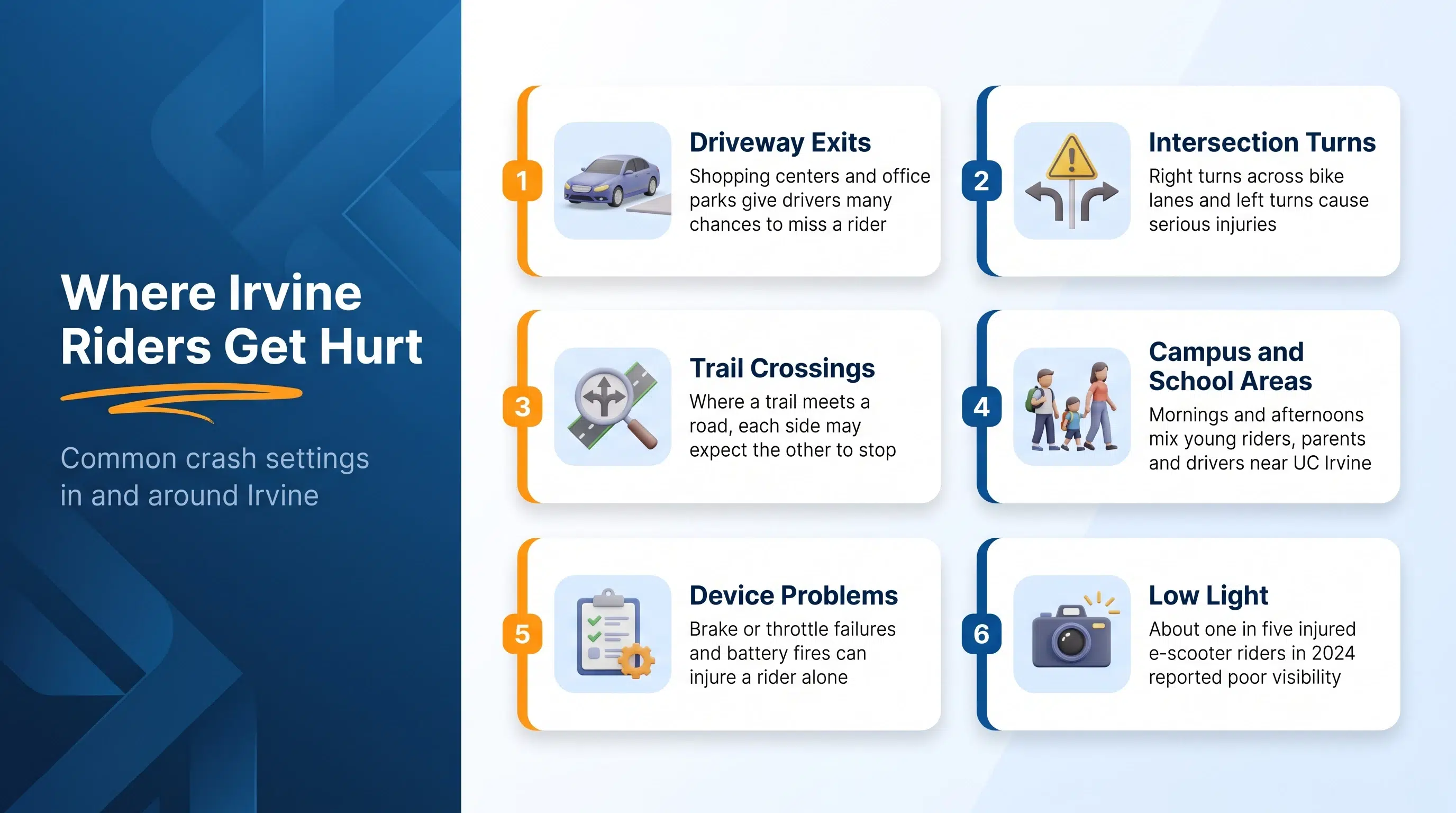
Irvine’s wide arterial streets and its bikeways meet at many points, and riders cross between them constantly. Conflicts tend to cluster in a few places:
- Driveways and parking lot exits: Shopping centers and office parks along Jamboree Road, Michelson Drive and Culver Drive give drivers many chances to pull out without seeing a rider in the bike lane.
- Intersection turns: Right-turning cars crossing the bike lane and left-turning cars cutting in front of oncoming riders cause some of the most serious injuries.
- Trail crossings: Where an off-street route such as the San Diego Creek Trail meets a roadway, a rider and a driver may each assume the other will stop.
- Campus and school areas: Mornings and afternoons near UC Irvine and the city’s schools mix young riders, parents and drivers on a short schedule.
- Device problems: Brake or throttle failures and lithium-ion battery fires can injure a rider with no other vehicle involved. California requires batteries sold for e-bikes and e-scooters to meet recognized safety standards under SB 1271.
- Low light: CPSC reported that roughly one in five injured e-scooter riders in 2024 said it was dark or hard to see.
Summer evenings stay light late and winter afternoons do not, so the commute home can be a different crash environment depending on the month.
Who may be liable beyond the driver?
The U.S. Consumer Product Safety Commission (CPSC) found that motor vehicles were involved in 140 of 206 e-scooter deaths and 170 of 310 e-bike deaths it reviewed from 2017 through 2024, so the driver is the first question. After that, the list depends on the facts.
A shared-scooter operator may be responsible if the device was poorly maintained. CPSC identified brake problems in 40 of the 189 e-scooter incidents it investigated. A manufacturer or seller may be liable for a defective product. A property owner or contractor may bear responsibility for a hazard at an entrance or construction zone. A public agency may be responsible for a dangerous road, but a claim against one generally requires a formal claim within six months.
When the rider is a minor, there can be one more layer: other drivers’ coverage, the family’s own auto policy and, in some cases, a parent’s role. We review each policy to learn what applies. California requires drivers to carry at least $30,000 in bodily injury coverage per person, and a serious injury often exceeds it.
What is an Irvine scooter or e-bike claim worth?
The figure depends on the injury and the life it disrupts. CPSC reports that fractures are the most common emergency-room diagnosis, with the head and neck among the most injured areas. In its 2024 follow-up, 18% of injured e-scooter riders and 40% of injured e-bike riders wore helmets.
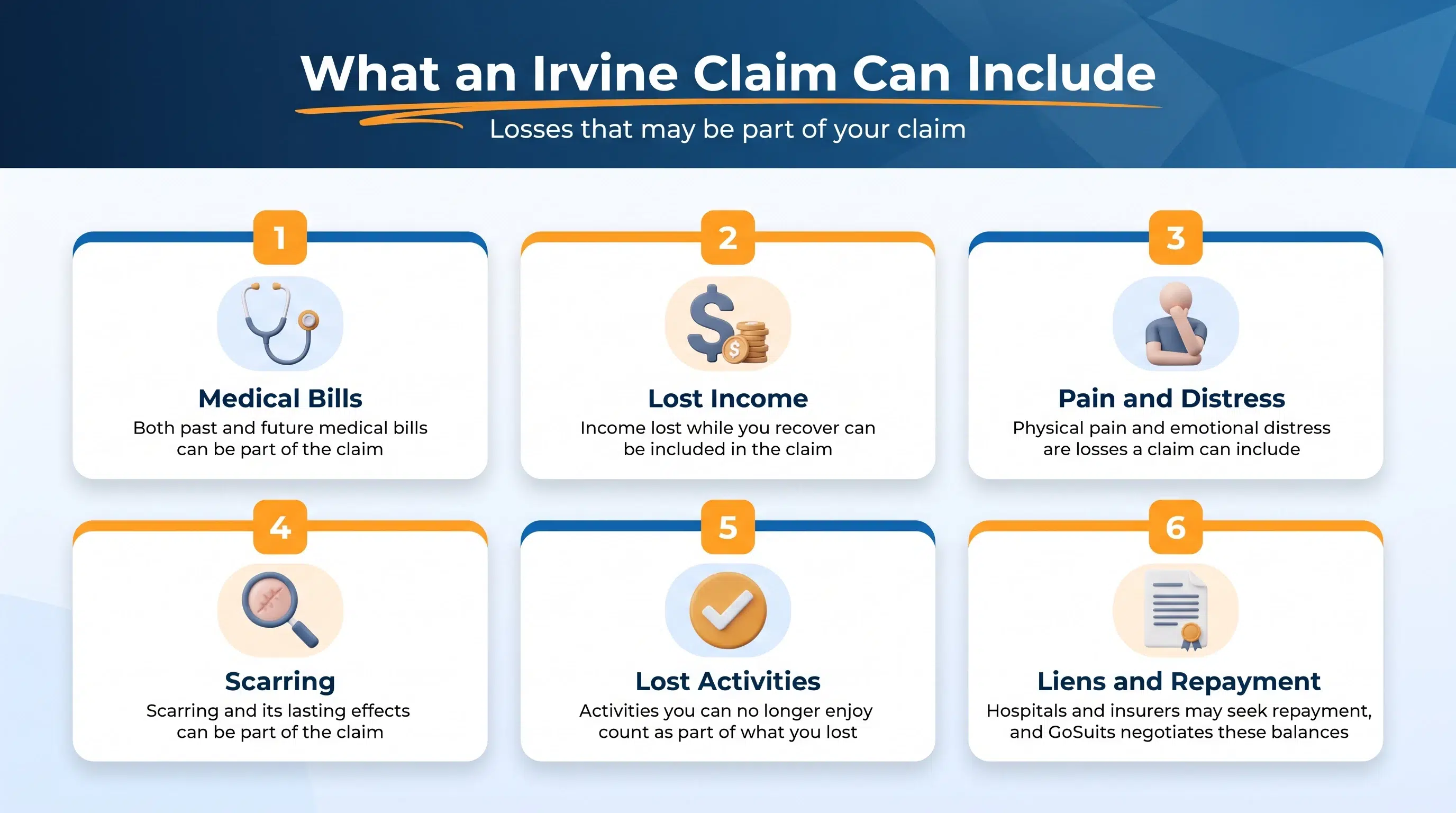
A claim can include medical bills past and future, lost income, pain and emotional distress, scarring and lost activities. California does not cap non-economic damages in a standard injury case. For a student, the claim can also reflect missed classes, lost job hours and delayed plans. Documentation over time is what gives those losses weight.
Liens come out of the recovery, too. Hospitals, treating providers and health insurers may seek repayment, and GoSuits negotiates these balances at settlement so more of the money reaches our client.
How quickly does evidence disappear?
Quickly. Rental scooters are collected and serviced; owner devices are repaired or replaced. Shopping center and campus-area cameras record over footage, and app data is not stored forever. Send or ask us to send preservation letters early, keep the device unrepaired, and photograph injuries in the first days. Ask for a copy of any report. The statute of limitations for most injury claims is two years in California.
After a crash, what are the right next steps?
Start with care. Get medical attention the same day, even for a crash that seems minor. If a driver was involved, take their name, plate and insurance details and call the police. Photograph the scene, the road surface and the device. For a rental, screenshot the ride receipt and report the crash in the app with a short, factual note.
Do not accept a quick settlement offer or give a recorded statement without advice. Contact our team for a free consultation, and we will review the facts and explain your options. See also our Irvine personal injury team, Irvine rideshare accident lawyers, pedestrian accident lawyers, car accident lawyers, product liability lawyers and wrongful death lawyers.
