


















































What to do quickly after a dog bite in Dallas
Report the bite. Dallas Animal Services states that a person bitten or scratched by an animal must report the incident, by calling 311 or using the Dallas 311 app. Medical providers must also report dog bites to Dallas Animal Services, which investigates. That report becomes an official record of the dog, the owner and the incident.
Look at what the city already knows. Dallas keeps records on bite reports and on dogs found to be dangerous. A history of complaints or an earlier designation can show what the owner knew, and requests are easier to fulfill soon after the attack.
Secure video early. Doorbell cameras, apartment entry cameras and neighboring businesses may hold footage, but many systems write over it within days or keep nothing without a paid plan. We send preservation requests right away.
Photograph the injury. Early pictures and treatment notes capture the severity before swelling and healing change how the wound looks.
Texas generally allows two years from the date of the attack to file a personal injury suit. If the defendant is a government body, such as a city, notice is generally due within six months under the Texas Tort Claims Act. Gather evidence now and confirm your deadline with a lawyer.
How Texas law applies to a Dallas dog bite
Texas has no statute making every owner automatically liable for a bite. Under the common-law one-bite rule, an owner is responsible if the owner knew or had reason to know the dog tended to injure people. A prior bite is the clearest example. Aggression toward others, repeated lunging, neighbor complaints or a sign warning visitors can also support the point.
Negligence is the second path. An owner who allows a dog to run loose, leaves a gate open or ignores restraint rules may be found negligent even if the dog never hurt anyone before. In Dallas, the city code makes it an offense for an owner to fail to secure a dog that then makes an unprovoked bite causing bodily injury away from the owner’s property, and that violation can support a negligence argument.
State law also has a dangerous dog process in chapter 822 of the Health and Safety Code, and section 822.005 makes it a felony when an owner’s failure to secure a dog, or a known dangerous dog left unsecured, leads to an unprovoked attack causing serious bodily injury or death. A criminal case is separate from a claim for compensation.
Texas uses proportionate responsibility. If a jury assigns you more than 50 percent of the fault, you cannot recover, and any lower percentage reduces the award. That is why insurers press provocation.
Who may be responsible in Dallas
The owner is usually the main defendant. Dallas has a large rental market, so other parties may be involved. A landlord or property manager who knew about a dangerous dog and had the ability to act could share responsibility, and a sitter or walker is judged by whether they used reasonable care.
Homeowners or renters insurance often pays the claim. Some policies exclude breeds or limit dog liability, and an umbrella policy may add coverage. We identify each policy that might apply.
How Dallas rules treat dangerous dogs
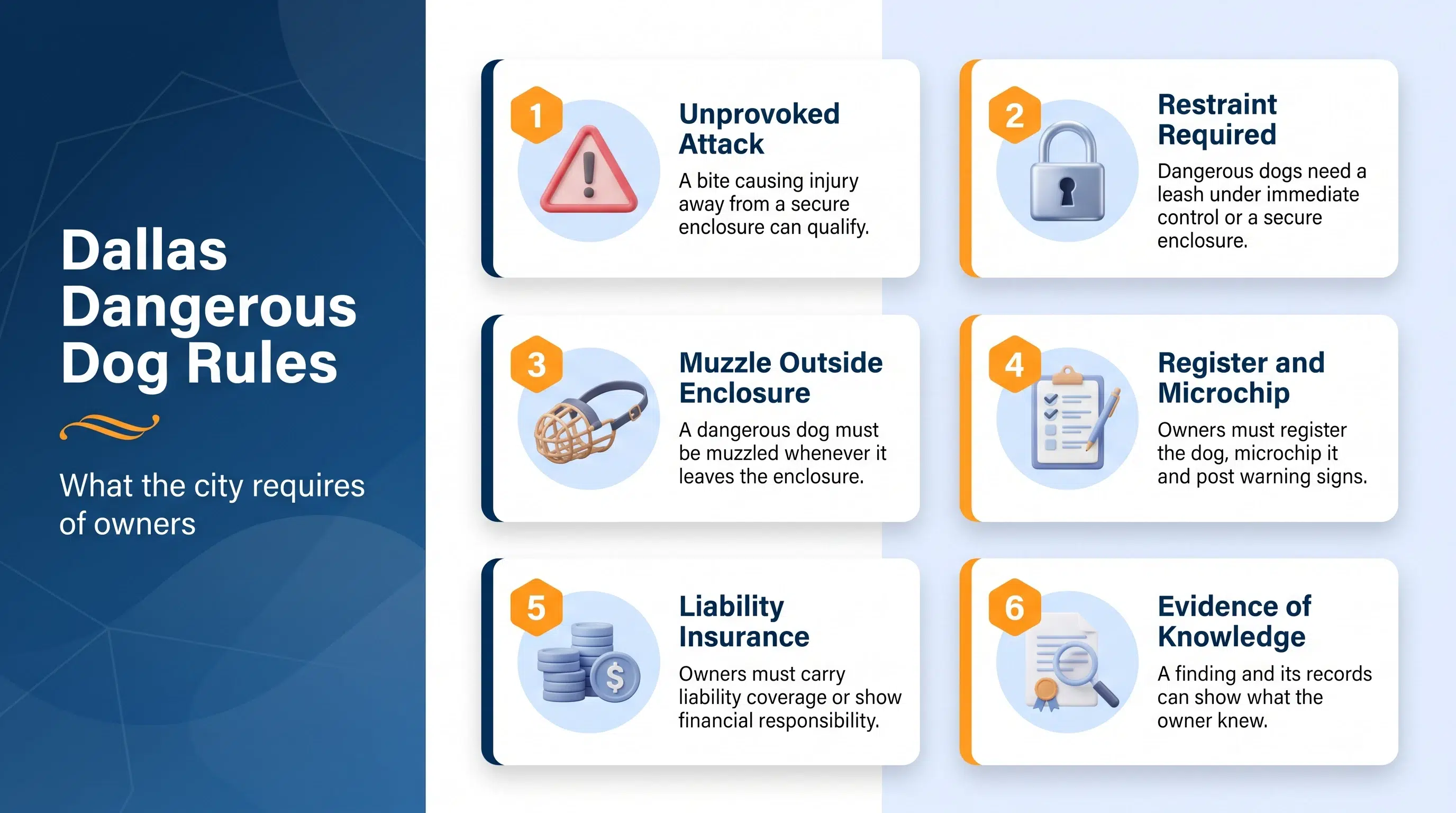
Dallas Animal Services describes a dangerous dog as one that makes an unprovoked attack causing bodily injury away from a secure enclosure, or whose unprovoked acts lead a person to reasonably believe it will attack. Dangerous or aggressive dogs must be restrained at all times, either on a leash under a person’s immediate control or in a secure enclosure, and muzzled outside the enclosure.
The city also requires the owner of a dog found dangerous or aggressive to register it, microchip it and post warning signs, and to carry liability insurance or show financial responsibility of at least $100,000. A finding like this, and the records behind it, can be strong evidence in a civil claim about what the owner knew.
Where dog attacks happen around Dallas
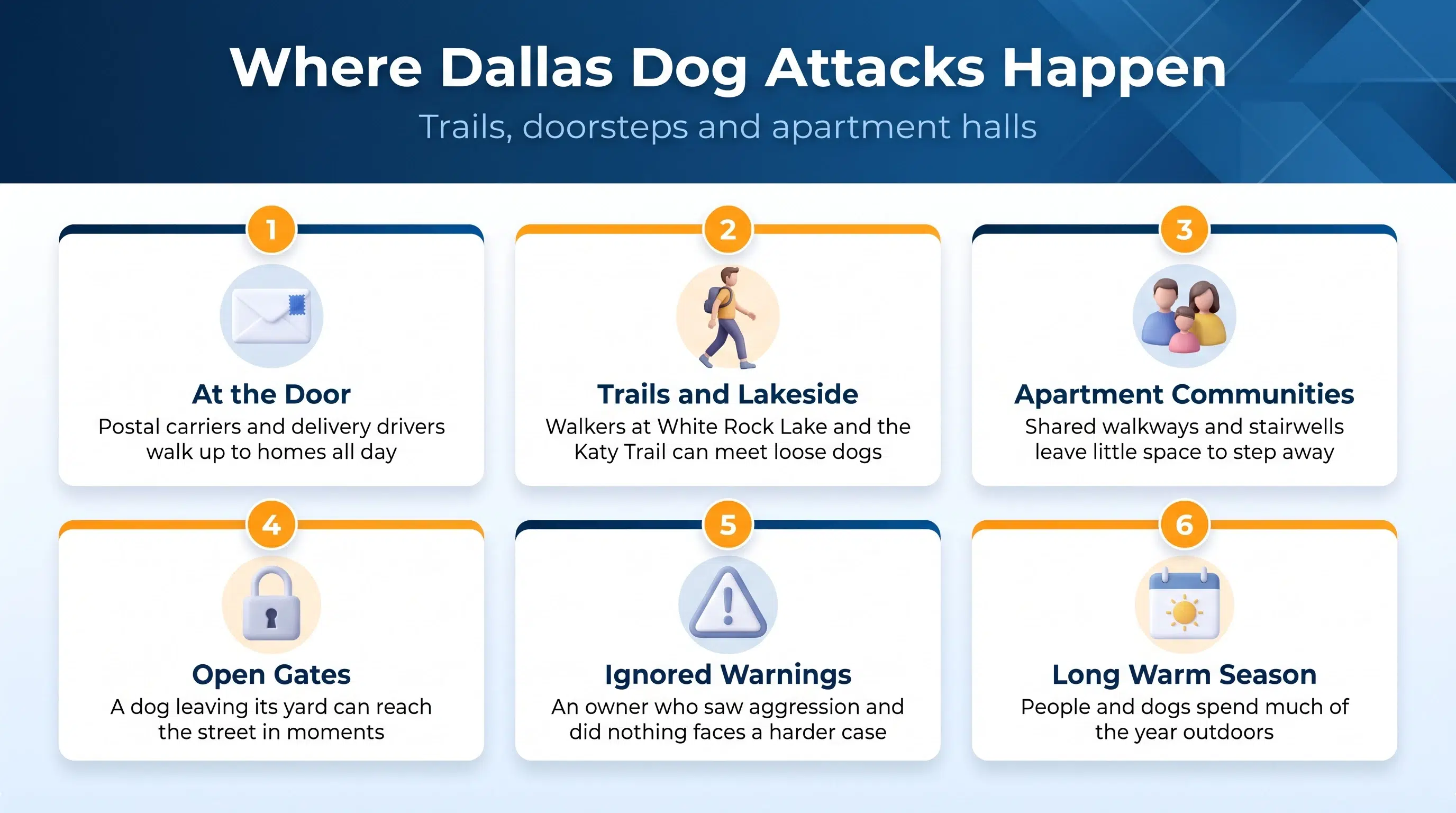
Dallas has busy neighborhoods, apartment communities and popular walking areas such as White Rock Lake and the Katy Trail. A long warm season means people and dogs are outside for much of the year. These situations come up often:
- At the door: Postal carriers and delivery drivers walk up to homes all day. The U.S. Postal Service reported more than 5,200 dog attacks on its employees in 2025. Dallas had 50 of them, the second-highest count of any U.S. city, and Texas had 358.
- On walks and trails: Joggers, cyclists and people with their own dogs can meet a loose dog suddenly.
- In apartment communities: Shared walkways, stairwells and entrances leave little space to step away.
- Through open gates: A dog that gets out of a yard can reach the street in moments.
- When warnings were ignored: An owner who saw earlier aggression and did nothing faces a harder case.
How do dog bite injuries differ from other personal injury cases?
The American Veterinary Medical Association (AVMA) estimates about 4.5 million people are bitten by dogs in the United States each year, and about 800,000 of them need medical care.
A bite can appear minor and still harm tendons, nerves or joints. If a dog’s rabies vaccination cannot be confirmed, doctors may advise preventive shots, and bacteria in a dog’s mouth can lead to infection that needs antibiotics or further care.
Scars on the face, hands and arms can be lasting, and children may stay afraid of dogs long after they heal. Medical records that begin the day of the attack and follow your recovery are the foundation of the claim.
How is a Dallas dog bite claim valued?
Value depends on the injury, the treatment and the change to your daily life and work. The main elements are:
- Medical expenses: Emergency care, wound treatment, rabies prevention, follow-up, surgery and future care such as scar revision.
- Lost income: Pay missed during recovery and any lasting effect on your ability to work.
- Non-economic damages: Pain, emotional distress, scarring and fear of dogs. Texas does not cap these in an ordinary dog bite case.
- Shared fault: A share of responsibility assigned to you reduces the award, and more than 50 percent bars recovery.
- Medical liens: Providers and health plans may seek repayment from your recovery. We work to reduce those balances.
Schedule a free consultation to learn what your claim may be worth.
Steps to take in the days after a dog bite
Get medical care. Move away from the dog and see a doctor the same day, even if the injury looks small. This lowers infection risk and ties the injury to the attack.
Call 311. Report the bite through the Dallas 311 line or app, and gather the owner’s name and address if you can. Ask whether the dog’s rabies shots are current.
Keep evidence. Photograph your injuries as they heal, save damaged clothing and note nearby cameras. Write down what you remember, including anything you know about the dog’s past.
Be careful with the insurer. You do not have to give a recorded statement, and casual remarks can be used to argue that you provoked the dog.
Contact us first. The consultation is free, and we handle the insurance company while you recover.
Related pages: Texas dog bite lawyers, our Dallas personal injury team, slip and fall accident lawyers, and wrongful death lawyers.