
Written by GoSuits Team | Reviewed by Sean Chalaki, Attorney · State Bar of California No. 361185
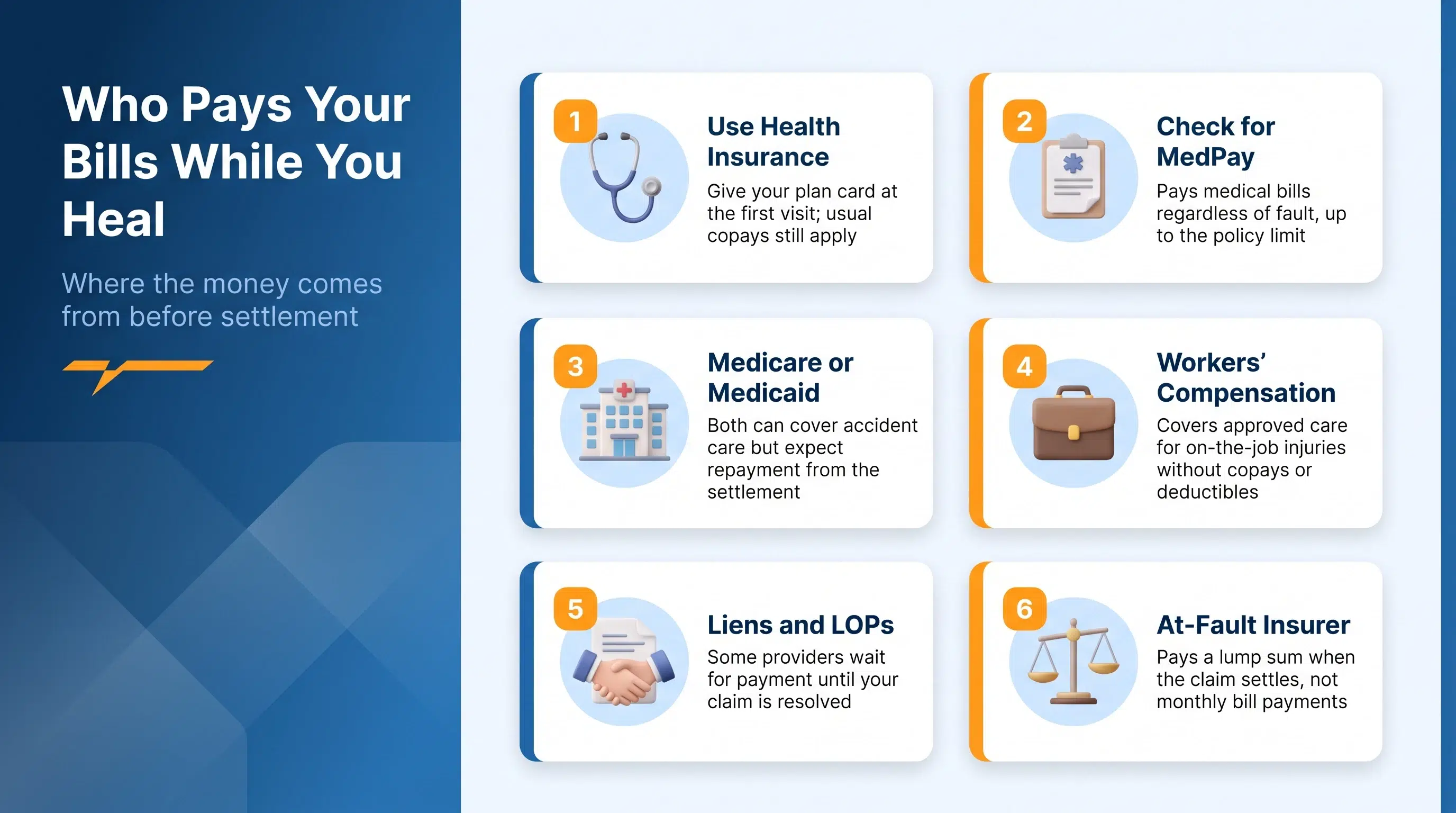
Quick Answer: After an injury caused by someone else, your own coverage usually pays your medical bills first. That can include health insurance, Medicare, Medicaid, medical payments coverage (MedPay), or workers’ compensation if you were hurt on the job. The at-fault party’s insurer typically pays only when the claim settles, and accident-related bills, liens, and reimbursement claims are generally paid from that settlement. If coverage isn’t available, some providers will defer payment under a lien or letter of protection until the claim is resolved.
After an accident or injury, medical bills often start arriving weeks or months before an injury claim is resolved. Even when another person or business clearly caused the harm, their insurance company generally does not pay your bills as you receive treatment. Any payment from the at-fault side usually comes later, through a settlement or a court award.
Until then, your bills are typically paid through your own coverage. Which coverage applies depends on the state where you were hurt, the policies you carry, and how the injury happened: a car crash, a fall on someone’s property, a dog bite, a construction site accident, or a defective product. This guide explains how each coverage option works, then how it applies to each type of case GoSuits handles in California, Texas, and Illinois.
Start With Your Own Coverage
Your own insurance is usually the first place to turn. Check what you carry before the bills pile up. However, using your own insurance may be complicated and you want to read the rest of this article.
Medical Payments Coverage (MedPay)
Many auto policies include optional medical payments coverage, known as MedPay. MedPay pays medical bills regardless of who caused the crash, up to the policy limit, which is often a few thousand dollars. It can also cover passengers in your car. Some homeowners and business liability policies carry a similar “medical payments to others” coverage that pays modest medical bills for a guest who is hurt on the property, without anyone having to prove fault.
Check your declarations page or call your insurer to confirm what you carry. Many people have MedPay and don’t realize it. However, Medpay is subject to subrogation. What is subrogation in a personal injury case?
Using Your Health Insurance
For many people, health insurance is the main way to keep up with medical bills after an injury. Give your provider your health insurance information at your first visit, the same way you would for any other care. Your usual copays, deductibles, and network rules still apply.
If you are covered by Medicare or Medicaid, those programs can pay for accident-related treatment as well. Some health plans coordinate with auto coverage, so your plan may ask about the accident or expect MedPay to pay first.
Keep in mind that a health plan, Medicare, or Medicaid that pays accident-related bills usually has a right to be paid back from any later settlement. This is called reimbursement or subrogation, and the amount owed can often be negotiated as part of resolving the claim. California readers can learn more in our guide on whether a health plan can take part of a California injury settlement.
When Coverage Isn’t Available: Liens and Letters of Protection
Some people have no health insurance, reach their coverage limits, or have a plan that denies accident-related care. In these situations, some medical providers agree to delay collecting payment while an injury claim is pending.
This arrangement is usually set up in one of two ways:
-
Medical lien: The provider holds a claim against any future settlement or award for the cost of treatment.
-
Letter of protection (LOP): A written agreement in which the provider agrees to wait for payment, with the expectation that the bill will be paid from the case proceeds.
Either way, the bill is postponed rather than waived, and the provider’s charges are typically paid out of the settlement before the remaining funds are distributed. Treatment decisions should always come from you and your doctor, based on your medical needs.
Where the At-Fault Party’s Insurance Fits In
If another person or business caused your injury, their liability insurance may be responsible for your accident-related losses, including reasonable medical expenses. Depending on the case, that may be a driver’s auto policy, a trucking company’s commercial policy, a property owner’s or business’s liability policy, a homeowner’s or renter’s policy, or a manufacturer’s product liability coverage. That payment typically comes as a lump sum when the claim settles or a verdict is reached, not as monthly bill payments.
The outcome of any claim depends on the facts, the available insurance, and the law in your state. If you share some of the blame for what happened, your state’s fault rules may also affect what can be recovered.
Who Pays Medical Bills in Each Type of Injury Case
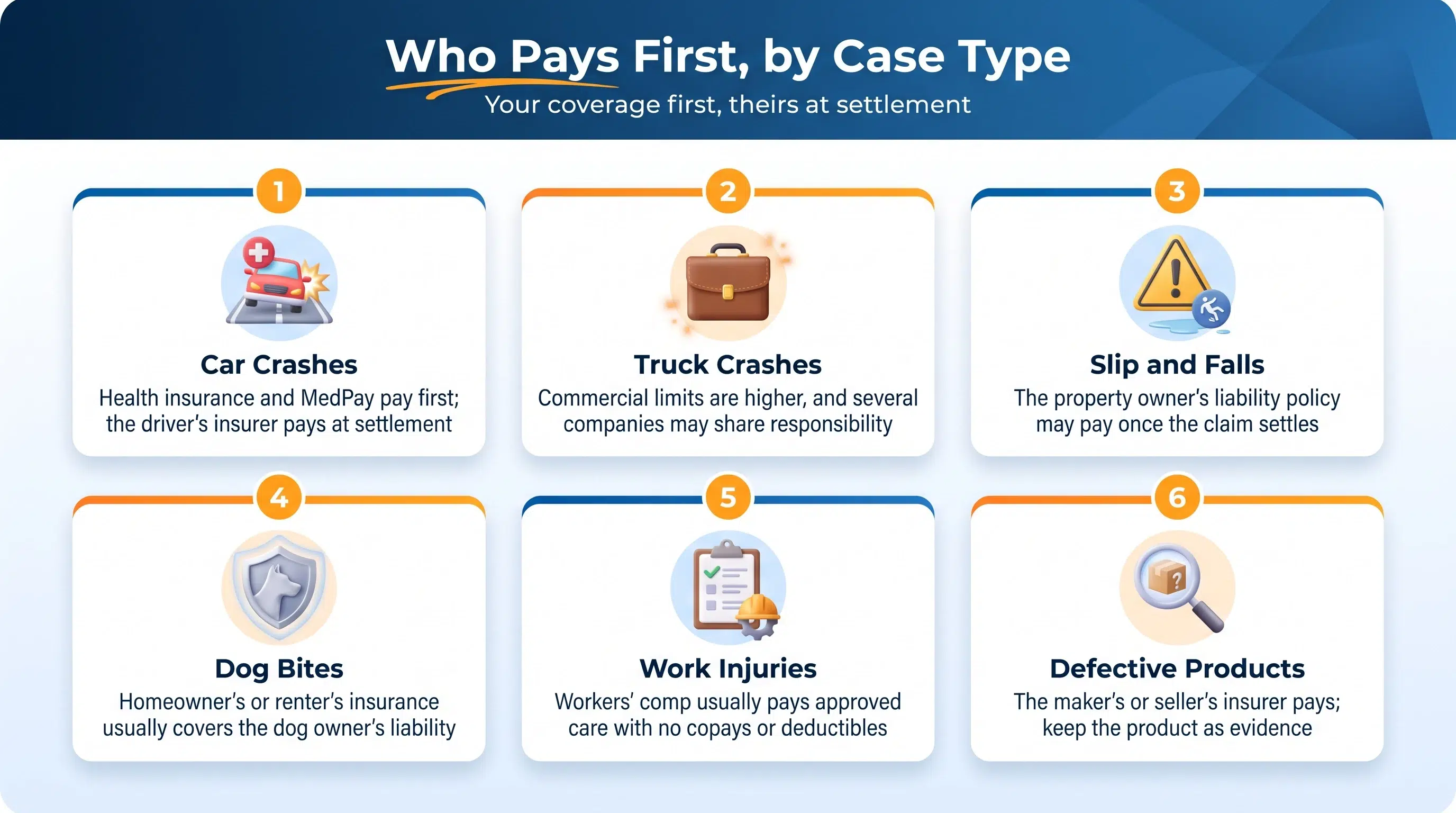
The basic order is the same in most cases: your own coverage first, the at-fault party’s insurance at settlement. What changes from case to case is which policies are in play.
Car Accidents
Your health insurance and any MedPay on your auto policy usually pay first, and the at-fault driver’s liability insurer pays at settlement. The same applies to SUV rollovers and crashes caused by a drunk driver. If your crash just happened, our guide on what to do after a California car accident covers the first steps to take. Learn more about our car accident lawyers.
Truck Accidents
Commercial trucks generally carry much higher liability limits than passenger cars, and more than one company may share responsibility: the driver, the motor carrier, the cargo loader, or a maintenance company. Your own coverage still pays first, and the trucking company’s insurer typically pays at settlement. See our truck accident lawyers.
Motorcycle Accidents
Motorcycle injuries are often serious, so health insurance limits and deductibles can be reached quickly. MedPay on your motorcycle policy, if you carry it, can help with early bills, and the at-fault driver’s insurer pays at settlement. See our motorcycle accident lawyers.
Rideshare Accidents (Uber and Lyft)
Whether you were a passenger, another driver, or a pedestrian, your health insurance usually pays first. Which liability policy pays at settlement depends on what the rideshare driver was doing at the time: driving with a passenger, waiting for a ride request, or off the app. See our rideshare accident lawyers.
Bus Accidents
Your health insurance pays first, and the bus company’s or transit agency’s insurer pays at settlement. When a public transit agency is involved, short written notice deadlines often apply, so it helps to act quickly. See our bus accident lawyers.
Pedestrian, Scooter, and E-Bike Accidents
If a vehicle hit you while you were walking or riding, your health insurance usually pays first, and MedPay on your own auto policy may also apply even though you weren’t in your car. The driver’s liability insurer pays at settlement. See our pedestrian accident lawyers and scooter and e-bike accident lawyers.
Slip and Fall and Premises Injuries
After a fall at a store, apartment complex, or other property, your health insurance usually pays first. The owner’s or business’s liability insurer may pay at settlement if the property was unsafe. Some of these policies include medical payments coverage that pays a limited amount of a guest’s medical bills regardless of fault. See our slip and fall lawyers.
Dog Bites
Dog bite claims are most often paid by the dog owner’s homeowner’s or renter’s insurance. Those policies may include medical payments coverage for a guest’s early bills, and the liability coverage pays at settlement. In California, a dog owner can be held responsible for most bites without proof of carelessness under Civil Code section 3342. See our dog bite lawyers.
Construction Accidents and Work Injuries
An injury on the job is often covered by workers’ compensation. In most cases, workers’ comp pays for approved, work-related medical care without copays or deductibles. Many states also reimburse mileage and other travel costs for medical appointments. In Texas, private employers can choose not to carry workers’ compensation, so an injured worker may need to look to the employer’s other insurance or a claim against the employer instead.
If a third party, such as a subcontractor, equipment maker, or another driver, caused the injury, you may have a separate injury claim in addition to your workers’ comp benefits. The workers’ comp carrier usually has a right to be repaid from that third-party recovery. California readers can learn more about suing beyond workers’ compensation. See our construction accident lawyers.
Defective Products
When a defective product causes an injury, your health insurance usually pays first, and the manufacturer’s, distributor’s, or seller’s liability insurance pays at settlement. Keep the product and its packaging, because it is often the key evidence. See our product liability lawyers.
Brain Injuries and Other Catastrophic Injuries
Serious injuries can require years of care, so the claim often includes future medical costs, not just bills already received. Medicare or Medicaid may become involved over time, and their reimbursement rights must be handled at settlement. Learn how future care is calculated in California and Texas, or see our brain injury lawyers.
Wrongful Death
When an injury is fatal, the medical bills from the final injury and funeral and burial expenses may be part of the family’s claim, depending on state law. A health plan or government program that paid for the care may still seek reimbursement from the recovery. Families are not usually required to pay a loved one’s medical debts from their own money; those debts are generally handled through the estate. See our wrongful death lawyers.
How Medical Bills Are Paid From a Settlement
When a claim settles, the medical bills tied to the injury are generally resolved from the settlement funds before you receive your share. Depending on how your care was paid for, these may include:
-
Reimbursement (subrogation) claims: Repayment to a health plan that paid your bills
-
Liens: Claims by Medicare, Medicaid, hospitals, or providers who deferred payment
-
Outstanding balances: Amounts still owed to your providers
Some states also limit medical damages to what was actually paid or owed, and some cap how much of a recovery medical liens can take:
-
Texas: Under Texas’s “paid or incurred” rule, amounts a health insurer adjusted or wrote off generally can’t be recovered, while balances you still owe can be.
-
California: Recovery for past medical bills is generally limited to the amount actually paid or owed, not the full billed amount. A hospital lien can take no more than 50 percent of what is due under a judgment or settlement after earlier liens are paid.
-
Illinois: Injured people can generally seek the reasonable value of their care, even if insurance paid a discounted rate. Under the Health Care Services Lien Act, all health care liens together are capped at 40 percent of the recovery, and no single type of provider can take more than one-third.
If you have an attorney, the settlement check is typically deposited into a client trust account, often called an IOLTA account. The attorney then pays providers and lienholders from those funds, and some liens may be paid directly by the insurance company.
Handling this step correctly matters. Settlement releases often include a hold harmless or indemnity clause, meaning you agree to cover any valid lien or reimbursement claim left unpaid. A provider or plan that isn’t paid back may pursue you for the balance.
If a Claim Doesn’t Result in a Recovery
Not every injury leads to a settlement or award. As with any medical care, you remain responsible for your treatment costs, including balances that were deferred under a lien or letter of protection. Many providers are willing to discuss payment plans or reduced balances, so it helps to reach out early rather than letting bills go unanswered.
Talk With a Personal Injury Lawyer in California, Texas, or Illinois
Sorting out who pays which bill, and in what order, can be confusing while you are trying to recover. A personal injury lawyer can review your policies, explain how your state’s rules apply, and handle communication with insurers and medical providers about your claim.
If your case resolves, a lawyer can also help confirm that liens and reimbursement claims are addressed before settlement funds are distributed.
GoSuits has offices in Los Angeles, Irvine, Dallas, and Chicago. If you were hurt and have questions about your medical bills, contact GoSuits today to schedule a free consultation. Our team can review your situation and explain your options. No attorney fee unless we recover; case costs and medical bills may still be owed.