
When Medi-Cal or Medicare pays for medical treatment that resulted from someone else’s negligence, California law and federal law give those programs the right to recover their costs from any money you receive in a personal injury settlement, judgment, or award. Neither program simply keeps everything it paid. California Welfare and Institutions Code section 14124.72 caps the Medi-Cal (DHCS) lien at a statutory formula that limits recovery to roughly fifty percent of what remains after attorney fees and litigation costs are deducted from your recovery. Medicare operates under a separate federal framework called the Medicare Secondary Payer statute, which uses its own procurement-cost reduction formula found at 42 C.F.R. § 411.37 to reduce its conditional-payment demand before a case can close. Both figures are negotiable, and the process of pinning down each final number is one of the main reasons personal injury settlements can take longer to close than injured parties expect.
Legal Snapshot
- Legal Topic: Government Health-Care Liens in California Personal Injury Settlements
- Case Stage: Settlement / Pre-Distribution / Lien Resolution
- Primary Legal Issue: Repayment obligations to Medi-Cal (DHCS) and Medicare out of personal injury recoveries
- Primary Authorities:
- California Welfare and Institutions Code §§ 14124.70–14124.94 (Medi-Cal Third-Party Liability)
- 42 U.S.C. § 1395y(b) (Medicare Secondary Payer statute)
- 42 C.F.R. § 411.37 (Medicare procurement-cost reduction formula)
- Jurisdiction: California (state law – Medi-Cal); Federal (Medicare Secondary Payer)
- Date Legal Authority Last Reviewed: July 2025
What Are Government Health-Care Liens in a Personal Injury Case?
A lien, in this context, is a legal claim a government program asserts against the money you recover in a personal injury case. When Medi-Cal or Medicare pays hospital bills, surgical costs, rehabilitation charges, or other medical expenses arising from your injury, both programs become what the law calls “secondary payers”, they stepped in and covered costs that should ultimately have been paid by the party responsible for your injury or by a liability insurer. Once you reach a settlement or obtain a judgment, the program that paid your bills has a right to be reimbursed from that money before the net proceeds reach you.
The two programs operate under entirely different legal frameworks, involve separate government entities, follow different timelines, and require different paperwork. Many injured people in Southern California, including people injured in the Newport Beach and Irvine corridors where managed care enrollment is very common – find that they are dealing with both at the same time, which can make the final distribution of settlement funds unexpectedly complex.
If you have been injured and are working through a personal injury claim, personal injury lawyers can help you understand how lien repayment interacts with your overall recovery. The Irvine personal injury team at GoSuits handles cases throughout Orange County and is familiar with lien resolution at the Orange County Superior Court’s Central Justice Center in Santa Ana.
The Medi-Cal (DHCS) Lien Under California Welfare and Institutions Code § 14124.70 and Following
What the Statute Creates
California Welfare and Institutions Code section 14124.70 defines the key terms used throughout Article 3.5 of Chapter 7, which governs Medi-Cal’s rights against third-party recoveries. The statute defines a “lien” as the California Department of Health Care Services (DHCS) director’s claim for recovery, from a beneficiary’s tort action or claim, of the “reasonable value of benefits” provided on behalf of the beneficiary. The “reasonable value of benefits” is generally the Medi-Cal rate of payment for the services rendered, not the billed charges, which are typically much higher. [1]
Section 14124.70 also defines who counts as a “beneficiary” for these purposes: any person who received or will receive Medi-Cal benefits because of an injury for which another party may be liable, including guardians, conservators, personal representatives, and survivors. If you were injured in a crash on the SR-73 Toll Road or on Interstate 405, and Medi-Cal paid for your emergency room treatment at a local hospital, DHCS has a lien against whatever you recover from the at-fault driver’s insurer.
The Notice Duty
Section 14124.71 of the Welfare and Institutions Code imposes an affirmative duty on the beneficiary and on any attorney representing the beneficiary to notify DHCS promptly of any action or claim against a third party. Failure to provide proper notice can complicate or delay lien resolution and may affect how the statutory formula is applied. In practice, the notification is directed to the DHCS Third Party Liability and Recovery Division.
The Fifty-Percent Statutory Reduction Formula
California Welfare and Institutions Code section 14124.72(d) is the provision that actually limits what DHCS can recover. The statute caps the DHCS reimbursement at a figure calculated as follows:
- Start with the full settlement, judgment, or award amount.
- Subtract attorney fees. When the beneficiary hired a private attorney, section 14124.72(d) directs that the director’s lien be reduced by 25 percent to represent DHCS’s share of attorney fees paid by the beneficiary.
- Subtract litigation costs. The remaining lien is further reduced by the portion of actual litigation costs that is proportional to the share of the recovery that goes to DHCS before deducting fees and costs, compared to the full recovery.
The practical effect of this formula is that DHCS cannot recover more than approximately 50 percent of the net settlement after attorney fees and litigation expenses are taken into account and in cases with substantial costs, the effective recovery can be even lower. [2]
It is important to understand that this cap operates as a ceiling, not a floor. DHCS cannot recover more than the formula allows, but the lien can also be reduced further through negotiation. DHCS has authority to compromise a lien in appropriate circumstances, including cases where the settlement does not fully compensate the injured person for their losses.
Example – How the Formula Works
Hypothetical (for illustrative purposes only – not a GoSuits case result):
Suppose a person was injured in a crash near the Irvine Spectrum, Medi-Cal paid $80,000 in medical bills at the Medi-Cal rate, and the case settled for $200,000. The attorney charged a 33 percent contingency fee ($66,000) and incurred $4,000 in litigation costs, for total procurement costs of $70,000.
- The DHCS lien before any reduction is $80,000 (the Medi-Cal rate of payment).
- The 25 percent attorney-fee reduction applied to the lien: $80,000 × 25% = $20,000 reduction.
- The lien after the attorney-fee reduction is $60,000.
- The litigation-cost share: ($80,000 / $200,000) × $4,000 = $1,600 further reduction.
- DHCS’s maximum recovery under the formula: approximately $58,400.
The exact arithmetic under section 14124.72(d) requires careful calculation, and the outcome varies with each case’s specific numbers. This example is presented only to illustrate the structure of the formula, not to predict any particular outcome.
Wrongful Death Claims
Section 14124.72(c) provides that when an action or claim is brought by persons entitled to bring wrongful death claims against a third party who may be liable for causing the death of a beneficiary, any settlement or judgment obtained is subject to DHCS’s right to recover the reasonable value of benefits provided. The wrongful death context introduces additional considerations about who is entitled to bring the action and how the recovery is apportioned. If a fatality occurred and Medi-Cal was paying for care up to the time of death, wrongful death lawyers in Irvine familiar with DHCS lien resolution will need to address that claim as part of the settlement process.
The Medicare Secondary Payer Framework
How Medicare Becomes a Lien Holder
When Medicare began in 1966, it was the primary payer for nearly all covered claims. Congress subsequently passed legislation making Medicare the secondary payer in various circumstances, including situations where liability insurance, no-fault insurance, or workers’ compensation is responsible for the injury. Under 42 U.S.C. § 1395y(b), which governs the Medicare Secondary Payer (MSP) provisions, Medicare may pay medical bills on a conditional basis when there is reason to believe that another payer is or may be responsible. [3]
A conditional payment is exactly what it sounds like: Medicare pays so the beneficiary can receive care without delay, but the payment is “conditional” because it must be repaid to Medicare once a settlement, judgment, award, or other payment is made. The moment a settlement is reached or a judgment entered, the obligation to repay Medicare’s conditional payments arises.
The Benefits Coordination and Recovery Center (BCRC)
For liability cases involving individual Medicare beneficiaries as opposed to group health plan situations the Benefits Coordination and Recovery Center (BCRC) is the contractor that identifies, investigates, and resolves Medicare’s recovery claims. When an injured Medicare beneficiary files a personal injury lawsuit or pursues a claim, the beneficiary and any attorney should notify the BCRC promptly. The BCRC will open a case, begin reviewing Medicare’s payments, and eventually issue correspondence about the conditional payment amount. [4]
Two key documents emerge from the BCRC process:
- Conditional Payment Letter (CPL): This is an interim document that lists the Medicare payments the BCRC has identified as potentially related to the injury as of the date the letter is generated. The figure in a Conditional Payment Letter is not final. It may include payments for conditions unrelated to the injury, and it does not yet reflect the procurement-cost reduction that will be applied at settlement.
- Final Demand Letter: After you notify the BCRC that a settlement has been reached and provide the settlement amount and procurement-cost information, the BCRC issues a Final Demand Letter showing the amount Medicare actually expects to be repaid. This is the figure that must be paid or formally disputed – before a case can be fully closed.
The Procurement-Cost Reduction at 42 C.F.R. § 411.37
Federal regulation 42 C.F.R. § 411.37 governs the amount of Medicare’s recovery when a settlement or judgment is reached after the claim was disputed. The regulation provides a procurement-cost reduction that parallels, in purpose if not identical in mechanics, the attorney-fee reduction available under California law for Medi-Cal liens. [5]
The reduction works as follows under the regulation:
- When Medicare’s payments are less than the settlement amount: Calculate the ratio of total procurement costs (attorney fees plus litigation expenses) to the total settlement. Apply that ratio to Medicare’s payments to determine Medicare’s proportionate share of procurement costs. Subtract that share from Medicare’s payments to arrive at the recovery amount.
- When Medicare’s payments equal or exceed the settlement amount: The recovery is the total settlement minus total procurement costs.
In simpler terms: Medicare reduces its demand by the share of attorney fees and costs that is proportionate to its share of the overall settlement pie. The more the settlement is dominated by items other than the medical bills Medicare paid, such as pain and suffering or lost wages, the smaller Medicare’s proportionate share of the procurement costs, and the less the reduction benefits the injured person.
Hypothetical (illustrative only):
A Medicare beneficiary settles a personal injury claim for $150,000. Medicare paid $30,000 in conditional payments. Attorney fees and costs total $52,500 (35 percent of the settlement).
- Ratio of procurement costs to settlement: $52,500 / $150,000 = 35%.
- Medicare’s share of procurement costs: 35% × $30,000 = $10,500.
- Medicare’s recovery after reduction: $30,000 – $10,500 = $19,500.
This is the maximum recovery. Medicare retains the right to dispute the calculation, and the final figure is determined through the BCRC process.
Disputing Unrelated Charges and Challenging the CPL Amount
Conditional Payment Letters often include charges that are not related to the injury at issue. A Medicare beneficiary with diabetes who is injured in a car accident may see Medicare’s payments for ongoing diabetes management included in the CPL, those charges are not related to the accident and should not be repaid. The BCRC has a process for disputing the inclusion of unrelated charges, and this can significantly reduce the final demand. Contesting unrelated charges is a common and important step in the MSP resolution process.
Medicare Set-Asides in Liability Cases
In workers’ compensation cases, Medicare Set-Aside Arrangements (WCMSAs) are well established: a portion of the settlement is set aside in a dedicated account to fund future Medicare-covered medical expenses related to the injury, protecting Medicare’s interests going forward. In liability cases, the legal requirement for a formal set-aside is a subject of ongoing debate. The Centers for Medicare and Medicaid Services (CMS) has indicated that consideration of Medicare’s future interests is appropriate in liability settlements, but unlike the workers’ compensation context, CMS has not established a mandatory formal review process for liability settlements as of the date this article was last reviewed. Nonetheless, when a settlement involves future medical expenses related to the injury and the claimant is already a Medicare beneficiary or will become one within 30 months, the parties and their attorneys typically consider what provision, if any, should be made for future Medicare-covered expenses. This is one of the more legally unsettled areas in personal injury settlement practice and warrants careful attention in larger cases.
Timelines for Obtaining a Final Figure and Why Settlements Can Stall
One of the most common sources of frustration for injured people is the length of time it takes to actually receive settlement funds after a case has technically settled. Government liens are a primary reason for this delay. Here is what typically happens on each track:
Medi-Cal / DHCS Timeline
- After notification of a potential third-party recovery, DHCS will begin tracking the case and can take several months to respond with a lien figure.
- Once a settlement is reached, a formal request is made to DHCS to confirm the final lien amount and to apply the statutory reduction formula.
- Negotiation – whether over the formula itself or over a compromise reduction beyond what the formula requires – adds additional time.
- DHCS has been known to take several months from notification of settlement to issuance of a final reduced lien figure, though the timeline varies.

Medicare / BCRC Timeline
- After the BCRC is notified of a represented case, the BCRC will issue a Rights and Responsibilities Letter followed by a Conditional Payment Letter.
- After settlement, the attorney submits a Final Settlement Agreement and procurement-cost information to the BCRC to trigger the Final Demand Letter.
- Historically, the BCRC has taken 60 to 120 days from notification of settlement to issuance of a Final Demand Letter, though the agency encourages use of its Medicare Secondary Payer Recovery Portal to streamline the process. [6]
- Disputes over unrelated charges or over the calculation itself add time beyond the baseline.
When both a DHCS lien and a Medicare conditional-payment obligation are outstanding, a frequent situation in Southern California’s large Medicare and Medi-Cal enrolled population, the settlement cannot be fully distributed until both figures are resolved and both programs are paid. This is why a case that the parties consider “settled” can remain in limbo for months while government lien paperwork moves through bureaucratic channels.
The courts in Orange County, including the Central Justice Center in Santa Ana, do not have specialized procedures that automatically accelerate this process. The timeline is primarily driven by the responsiveness of DHCS and the BCRC, the completeness of the information submitted to each, and whether disputes arise over the claimed amounts.
What Documentation Matters in the Lien Resolution Process?
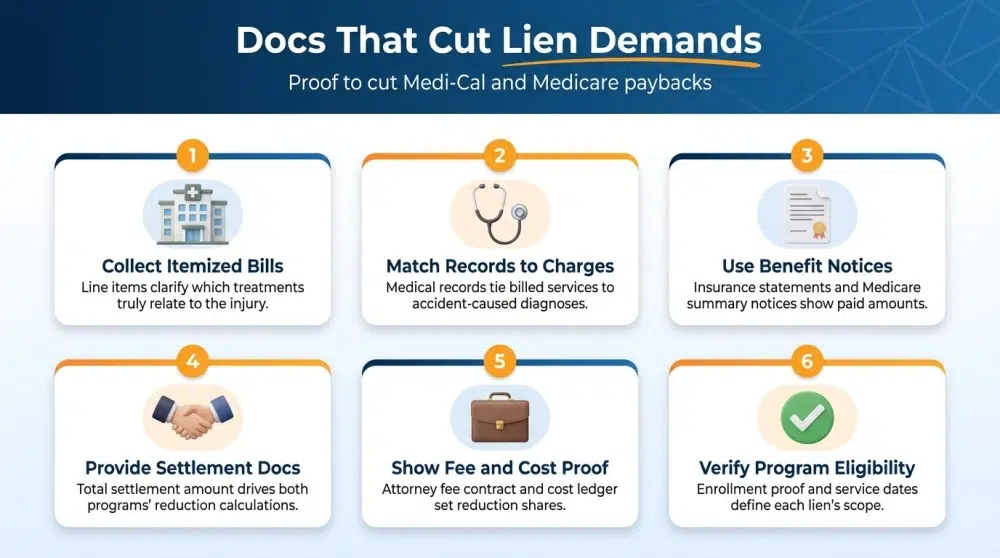
Resolving government health-care liens requires organizing and presenting specific categories of information. The following types of documentation commonly come into play:
- Medical records and itemized bills: These allow for identification of which treatment was related to the injury versus pre-existing or unrelated conditions. Unrelated treatments paid by Medi-Cal or Medicare should be excluded from the lien amount.
- Explanation of Benefits (EOB) / Medicare Summary Notice (MSN): These documents list what Medicare paid, for which services, and on what dates. They are the starting point for verifying and disputing the Conditional Payment Letter.
- The settlement agreement: Both DHCS and the BCRC require documentation of the total settlement amount to calculate the procurement-cost reduction.
- Attorney fee agreement and cost records: The fee percentage and itemized litigation costs are inputs to both the Medi-Cal statutory formula and the Medicare procurement-cost calculation.
- Proof of Medi-Cal enrollment and dates of service: Confirms which claims fall within the scope of the DHCS lien period.
- Medicare eligibility documentation: Confirms that the person was a Medicare beneficiary at the time of the services in question.
Documentation of the injury mechanism, police reports, crash reports from the California Highway Patrol, medical records linking the diagnosis to the incident, can also be relevant when disputing whether specific charges were caused by the accident rather than by a pre-existing condition.
What If Insurance Is Involved?
Liability insurance is almost always present in personal injury cases that also involve Medi-Cal or Medicare. The liability insurer’s policy limits, and whether those limits are adequate to compensate the injured person and repay government liens, is a critical threshold question. In cases where limits are low relative to the total damages and the combined lien amounts, the injured person may face a difficult allocation among competing claims on the available funds.
When a liability policy is exhausted without fully compensating the injured person and without fully satisfying government liens, both DHCS and Medicare may consider reduced settlements in recognition of the limitation. Neither program is obligated to forgive its lien, but both have administrative processes for considering lien compromises in hardship or inadequate-recovery situations.
Uninsured and underinsured motorist coverage adds another layer. If an injured person’s own automobile policy includes UM or UIM coverage, and a recovery is made under that coverage, the same lien-repayment obligations apply to that recovery as to any other. The source of the money – whether from a third-party liability insurer or from the injured person’s own UM carrier , does not eliminate the government’s right to reimbursement.
California law also addresses coordination between health plans and liability recoveries. When a managed care organization paid on behalf of a Medi-Cal beneficiary under a managed care contract, the “reasonable value of benefits” under section 14124.70(c)(2) is defined as the rate of payment the plan made to the provider potentially a different and more negotiable number than the standard Medi-Cal fee schedule rate.
How Long Do I Have to Act?
The statute of limitations for a personal injury claim in California is generally two years from the date of injury under California Code of Civil Procedure § 335.1. This deadline governs the underlying tort claim, not the lien process itself.
Regarding the DHCS lien specifically: section 14124.72(a) provides that a lawsuit brought by the director to enforce the lien must be commenced within the period prescribed in Code of Civil Procedure section 338 (generally three years for obligations created by statute). The death of a beneficiary does not extinguish the lien right.
On the Medicare side, the MSP statute does not create a statute of limitations in the traditional sense for the government’s right to recover conditional payments, but practical deadlines matter: the obligation to repay Medicare arises when a settlement, judgment, or award is made, and failure to repay in a timely fashion can expose responsible parties to additional liability under the MSP statute.
Important: Specific deadlines depend on the facts of each case, including dates of injury, applicable government program enrollment, and the type of claim being pursued. These are general observations and do not constitute legal advice for any particular situation. [DEADLINE REQUIRES LEGAL VERIFICATION FOR YOUR SPECIFIC CASE]
What Should I Do Next?
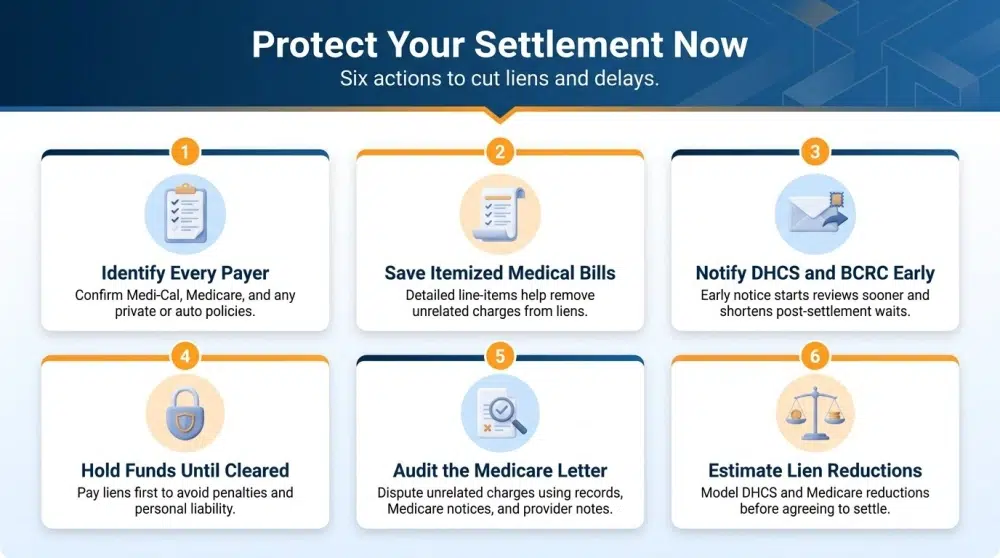
If you have been injured and are receiving or have received Medi-Cal or Medicare benefits related to your injury, these practical steps are relevant to protecting your recovery:
- Identify all payers: Gather your insurance cards and confirm whether you are enrolled in Medi-Cal, Medicare, or both. Understanding which programs paid for your treatment is the first step toward anticipating lien obligations.
- Preserve medical records and bills: Obtain itemized bills from every provider, not just summary totals. Itemized records allow you and your attorney to identify which charges relate to the injury and which do not.
- Notify DHCS and/or the BCRC promptly: California law requires notice to DHCS, and prompt notification to the BCRC benefits Medicare beneficiaries by allowing the government to begin its review early, which can shorten the post-settlement wait time.
- Do not distribute settlement funds before liens are resolved: Distributing money from a settlement before satisfying Medicare’s conditional-payment obligation can create significant legal exposure. A personal injury claim involves potentially complex lien obligations that should be addressed in coordination with qualified legal counsel.
- Review the Conditional Payment Letter carefully: Compare the BCRC’s list of claimed payments against your actual medical records to identify any unrelated charges that should be removed.
- Understand the formula before accepting a settlement: Knowing your approximate DHCS and Medicare obligations before finalizing a settlement helps you evaluate whether the proposed amount is adequate after lien repayment.
If you were injured in an accident in Irvine, Newport Beach, Costa Mesa, Fullerton, or anywhere in Orange County and Medi-Cal or Medicare paid for your care, the personal injury attorneys at GoSuits are familiar with lien resolution in this region. Contact us for a free consultation to discuss how government liens may affect your specific situation.
Talk With a GoSuits Attorney
Medi-Cal and Medicare liens add a layer of complexity to California personal injury claims that can significantly affect how much money you actually receive after a settlement. The statutory formula under Welfare and Institutions Code section 14124.72 and the federal procurement-cost reduction under 42 C.F.R. § 411.37 provide real protections, but applying them correctly and negotiating effectively with DHCS and the BCRC requires careful attention to detail.
If you have been injured in Orange County, whether in a crash on Interstate 405, on the SR-55, on the SR-73 Toll Road, or anywhere else in the Irvine area, and you have questions about how government liens might affect your personal injury claim, the GoSuits team is available to review the circumstances of your case and explain your options.
No fee unless you recover. Schedule a free consultation with our Irvine personal injury team today.
References and Primary Sources
- California Welfare and Institutions Code § 14124.70 – California Legislative Information (leginfo.legislature.ca.gov)
- California Welfare and Institutions Code § 14124.72 – California Legislative Information (leginfo.legislature.ca.gov)
- Medicare Secondary Payer – Centers for Medicare and Medicaid Services (cms.gov)
- Non-Group Health Plan Recovery (Liability, No-Fault, Workers’ Compensation) – CMS (cms.gov)
- 42 C.F.R. § 411.37 – Amount of Medicare Recovery When a Primary Payment Is Made as a Result of a Judgment or Settlement – Cornell Law School Legal Information Institute (law.cornell.edu)
- Medicare Secondary Payer Recovery Portal – CMS (cms.gov)
- 42 U.S.C. § 1395y – Medicare Secondary Payer Statutory Provision – Cornell Law School Legal Information Institute (law.cornell.edu)
- California Welfare and Institutions Code § 14124.71 – Third-Party Notice Requirement – California Legislative Information (leginfo.legislature.ca.gov)
- 42 C.F.R. Part 411 – Exclusions from Medicare and Limitations on Medicare Payment – Cornell Law School Legal Information Institute (law.cornell.edu)
- California Codes – California Legislative Information (leginfo.legislature.ca.gov)