





































What are the Texas and Dallas rules for scooters and e-bikes?
Under Texas law, e-scooters are generally allowed on streets with a posted limit of 35 mph or less, and on sidewalks unless a city restricts them. Bicycle rules apply to riders. E-bikes are generally treated as bicycles, and Texas has no statewide helmet law.
Dallas adds its own rules for the shared dockless fleet. According to the City of Dallas, Bird and Lime are among the companies permitted for 2026 and 2027, and a rule update took effect April 28, 2026. Riders must be at least 16, devices are capped at 20 mph, and shared devices may not be ridden on sidewalks, trails, parks or plazas, or on roads posted 35 mph or higher. Slow-Ride Zones lower the limit to 10 mph, and rentals end at 9:00 p.m. A rider who breaks a city rule is not barred from a claim, but an insurer will use it as an argument about fault.
That leads to the rule that matters most in Texas. If a jury finds you more than 50% responsible, you cannot recover. Below that line, your award is reduced by your share. Drivers who turn without checking, or open a car door into a rider, should be held to account for that conduct, not given credit for what you did or did not wear.
Where do these crashes happen in Dallas?
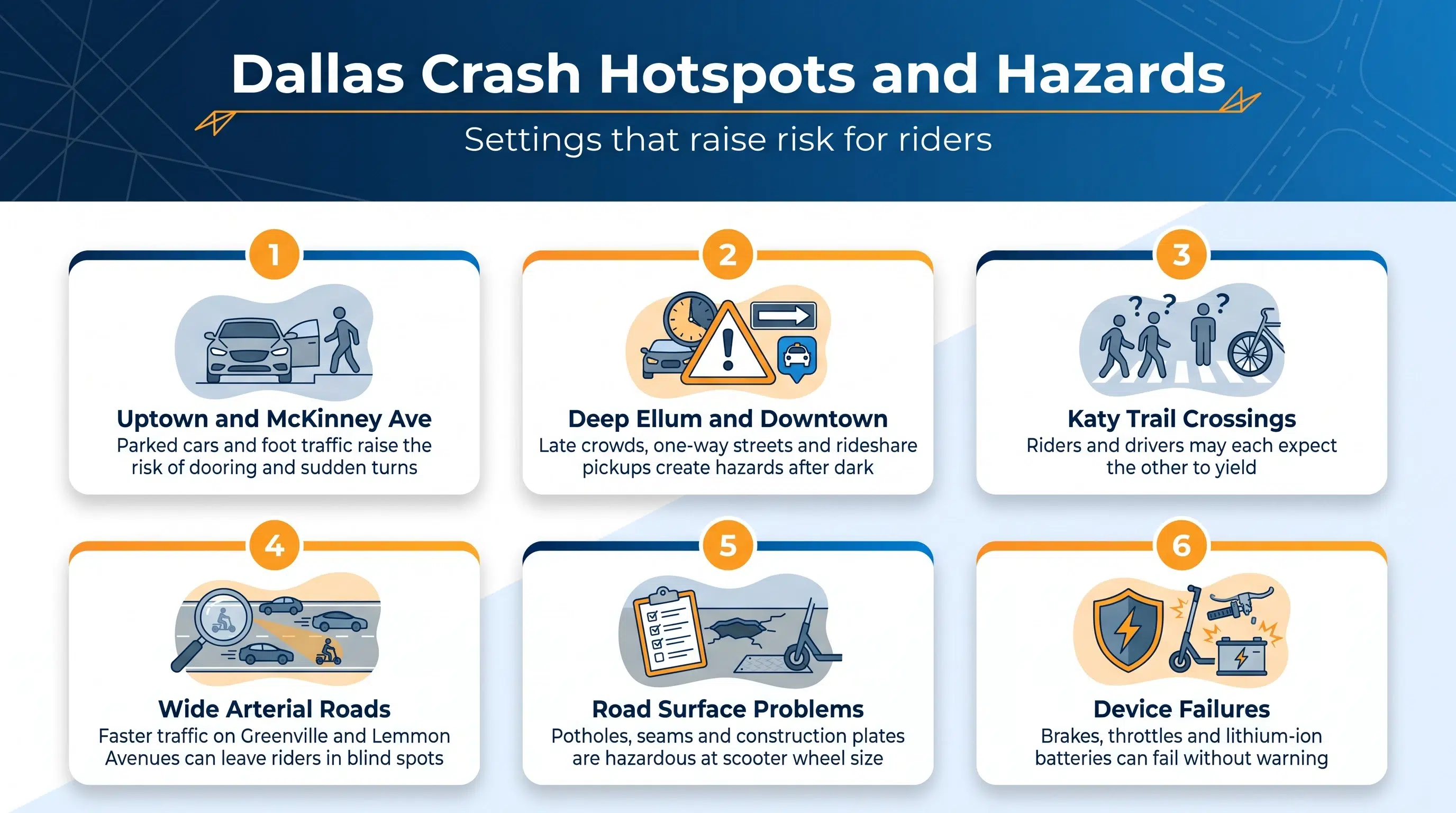
Dallas riders pass through very different kinds of streets within a few miles. Common settings include:
- Uptown and McKinney Avenue: Heavy foot traffic, parked cars and drivers looking for parking raise the risk of dooring and sudden turns.
- Deep Ellum and downtown: Late-night crowds, one-way streets and rideshare pickups create hazards after dark. CPSC reported that about one in five injured e-scooter riders in 2024 said it was dark or hard to see.
- Trail crossings near the Katy Trail: Where a trail meets a street, a rider and a driver may each expect the other to yield.
- Wide arterial roads: Roads like Greenville Avenue and Lemmon Avenue carry faster traffic, and a small rider can be missed in a driver’s blind spot.
- Road surface problems: Potholes, seams, patches and construction plates are hazardous at scooter wheel size.
- Device failures: Brakes, throttles and lithium-ion batteries can fail without warning.
Summer heat is real in Dallas. Riders may be tired or overheated. A crash does not become the rider’s fault because of the weather, but an insurer may try to suggest it.
Who may be responsible besides the driver?
The U.S. Consumer Product Safety Commission (CPSC) reviewed e-scooter and e-bike deaths from 2017 through 2024 and found motor vehicles involved in 140 of 206 e-scooter deaths and 170 of 310 e-bike deaths. So the driver comes first. Beyond that:
- A shared-scooter operator, if the device was poorly maintained. CPSC identified brake problems in 40 of 189 e-scooter incidents it investigated.
- A manufacturer, seller or battery maker, if a defect caused the crash or a fire.
- A rideshare or delivery company, if the driver was working at the time.
- A property owner or contractor, if a hazard at an entrance or work zone contributed.
- A public entity, if a dangerous road condition was the cause. Texas requires notice of a claim within six months under the Tort Claims Act.
Texas requires drivers to carry at least $30,000 in bodily injury coverage per person, which a serious injury can exceed. Personal injury protection (PIP) can pay medical bills and lost wages in some situations, depending on the policy. Whether a rider on a scooter or e-bike can use it depends on the wording, so we read each policy.
How are Dallas scooter and e-bike claims valued?
Injuries tell most of the story. CPSC data shows fractures are the most common emergency-room diagnosis, and the head and neck are frequently hurt. In 2024, 18% of injured e-scooter riders and 40% of injured e-bike riders wore helmets, according to CPSC.
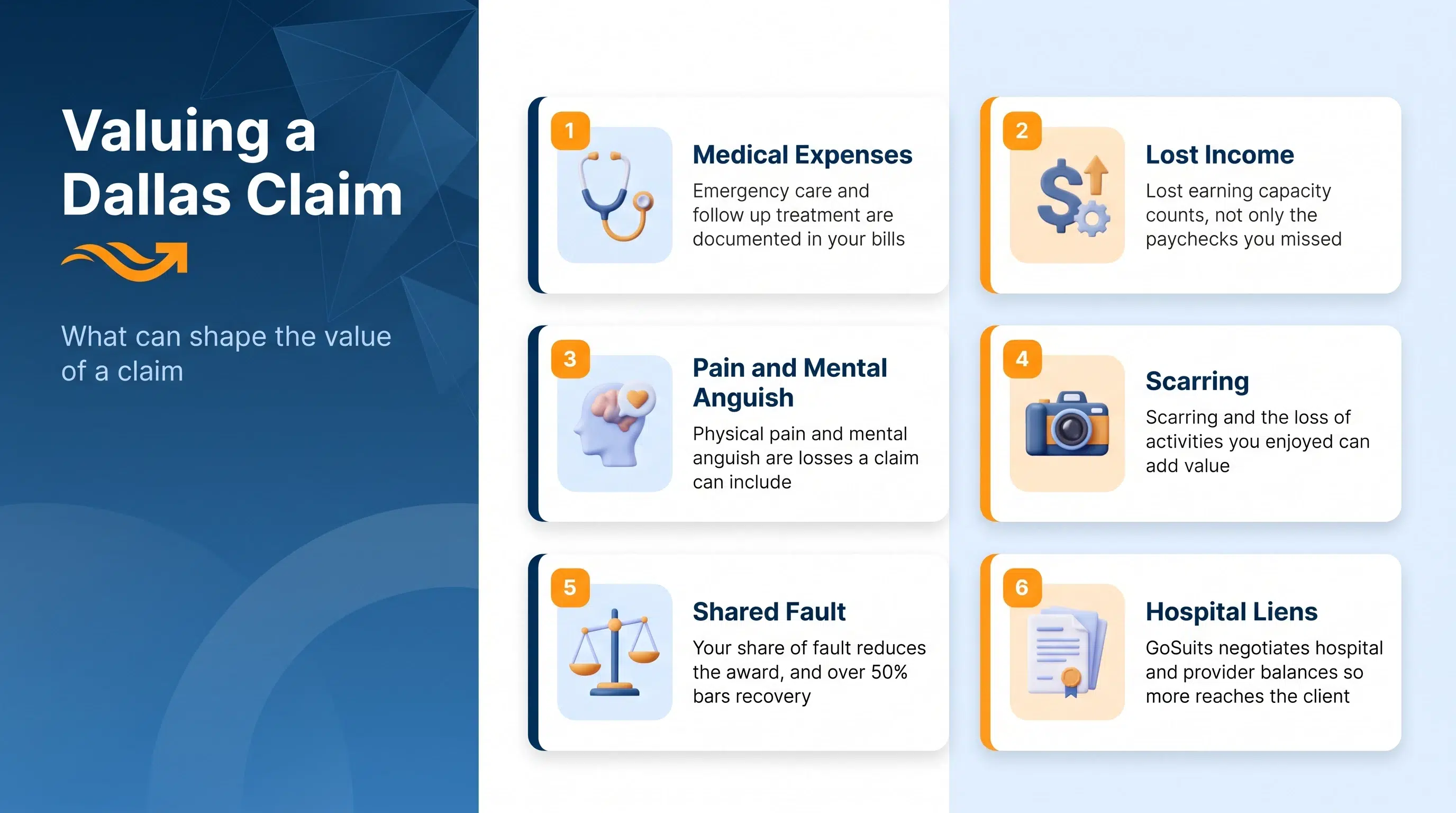
A claim can include medical expenses, lost income and earning capacity, physical pain, mental anguish, scarring and the loss of activities. For someone who delivers food by e-bike or commutes by scooter, the damage may include losing both the income and the transportation. Shared fault reduces the award, which is why an insurer’s helmet and speed arguments carry real weight in Texas negotiations.
Hospital and provider balances come out of a recovery too. GoSuits negotiates with hospitals, ER groups and lien holders at settlement to reduce what the client owes, so more of the money reaches the client.
What should you do in the first days?
Get medical care the same day. Texas hospitals such as Parkland Memorial and Baylor University Medical Center treat many riders, and an early record links your injuries to the crash. Call the police if a vehicle was involved, and collect the driver’s information.
If you rented, take a screenshot of the receipt and report the crash in the app in plain, factual terms. Photograph the device before it is picked up. If it is yours, leave it as it is. Photograph the road, the intersection and any hazard, and get witness names. Note nearby businesses with cameras.
Texas gives injured people two years to file a lawsuit in most cases, but some claims have much shorter notice periods, and evidence does not last that long. Do not give a recorded statement before you have advice. Schedule a free consultation with our team, and we will walk you through the next step. You can also read about our Dallas personal injury team, rideshare accident lawyers, pedestrian accident lawyers, car accident lawyers, product liability lawyers and wrongful death lawyers.