




























Why you should not wait to act after a pedestrian accident
The police crash report sets the first version of events. In most pedestrian accidents, the first official account of what happened is the police crash report. Officers typically note where the pedestrian was, what the traffic signals showed, statements from both sides and their own view of who failed to yield. Insurers lean on that report early. If something in it is wrong, like your position in the roadway, it is far easier to address while the officer and witnesses still remember the scene.
Camera footage is often gone within days or weeks. Traffic cameras, storefronts, city buses and nearby homes may all have caught the collision. Many of those recordings are overwritten automatically on a short cycle. A written request sent early, sometimes paired with a formal preservation letter, gives that footage a much better chance of surviving.
The vehicle itself holds evidence. Many newer cars have an event data recorder that logs speed and braking in the seconds before a crash. Damage to the hood, bumper or windshield can also help show where the pedestrian was struck. Once the car is repaired or sold for salvage, much of that may be lost for good.
Injuries change as they heal. Bruising and road rash fade, and swelling goes down. Photographs from the first few days, along with consistent medical records, help show how serious the injuries were before healing changes how they look. Insurers often point to gaps between the accident and the start of treatment, so early care matters for the claim as well as your health.
The statute of limitations for most pedestrian injury claims is two years in California, Texas and Illinois. Claims involving a government vehicle or a dangerous public road can carry much shorter notice deadlines, though, and evidence rarely waits for either one.
Who can actually be held responsible?
In most pedestrian accidents, primary responsibility falls on the driver who failed to yield or was not paying attention. The driver is not always the only one, though. Depending on why the driver was on the road and where the crash happened, other parties may share the blame.
An employer can be held responsible when the driver was on the job, such as a delivery driver or a contractor in a company truck. Rideshare crashes add another layer, since companies like Uber and Lyft must carry higher liability coverage while a driver is heading to a pickup or has a passenger on board. A city or county may also be involved when a poorly designed intersection or a broken walk signal contributed to the crash. Those government claims come with their own notice rules and much shorter deadlines.
Most pedestrian claims are paid through the driver’s auto liability insurance. When that coverage is too small, or the driver had none, your own auto policy may help even though you were not driving. Uninsured and underinsured motorist coverage often applies to a policyholder struck on foot, and in Texas, personal injury protection (PIP) coverage can help with medical bills and lost wages regardless of fault. Reviewing every policy that might apply is part of the process.
What situations lead to pedestrian accidents?
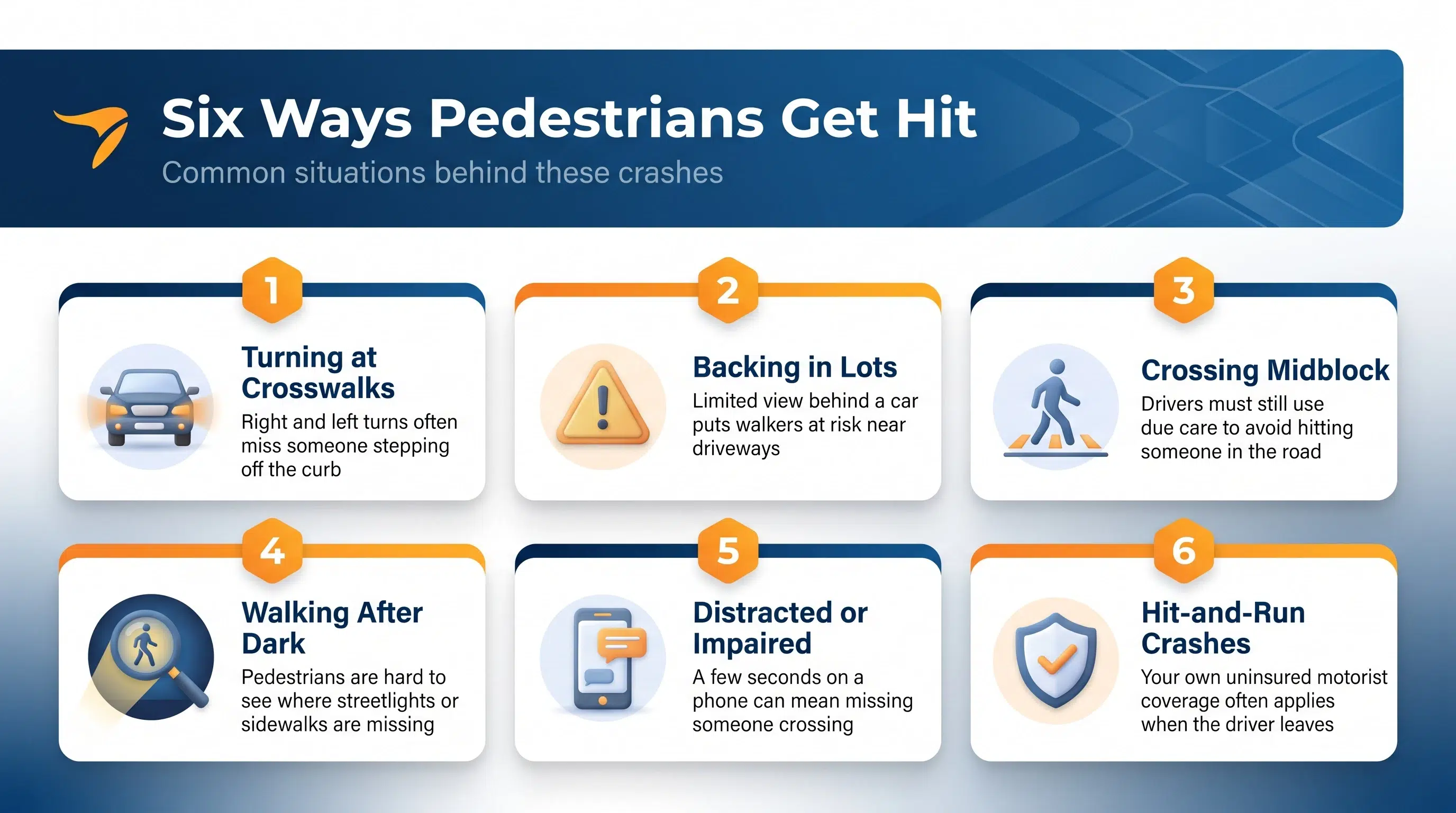
Most pedestrian accidents come down to a driver who did not see someone they should have seen. Some of the most common situations include:
- At intersections and crosswalks: Drivers turning right on red often look left for oncoming traffic and never check for someone stepping off the curb to their right. Left turns carry a similar risk. California, Texas and Illinois all require drivers to yield to pedestrians in a crosswalk, and Illinois goes further by requiring drivers to come to a full stop.
- In parking lots and driveways: A car backing out of a space or pulling out of a driveway moves slowly, but the driver’s view is limited. People walking to and from their cars are especially exposed here.
- Outside a crosswalk: Pedestrians crossing midblock are generally expected to yield to traffic, but that does not give drivers a free pass. All three states still require drivers to use due care to avoid hitting someone in the road. In California, the Freedom to Walk Act, effective since 2023, also limits when police can ticket someone for crossing outside a crosswalk.
- After dark: Pedestrians can be hard to see at night, particularly on roads without streetlights or sidewalks. Drivers are still expected to adjust their speed to what they can actually see ahead.
- When a driver is distracted or impaired: A few seconds spent looking at a phone can be enough to miss someone in a crosswalk. Alcohol and drugs slow reaction time even further, and these cases may also involve a criminal investigation that runs alongside the injury claim.
- In a hit-and-run: When the driver leaves the scene, the claim often shifts to the injured person’s own uninsured motorist coverage. Prompt police reports and camera footage are especially important for identifying the vehicle.
How do pedestrian accident injuries differ from other personal injury cases?
A driver in a crash has a seat belt and a steel frame around them. A pedestrian has nothing between them and the car. According to NHTSA, pedestrians made up 18% of all U.S. traffic deaths in 2023, even though most crashes never involve one.
Pedestrian collisions also tend to injure people twice: once on impact with the vehicle and again on impact with the pavement. The bumper often strikes at leg level, which is why fractures to the knee, shin and ankle are common. The second impact can cause head and spine injuries. A traumatic brain injury may not show clear symptoms in the first hours, so a medical evaluation matters even when you feel fine at the scene.
Recovery can stretch on for months. Some people need surgery followed by weeks of physical therapy. Others need help with daily tasks they used to handle on their own, and a few never return to the same type of work.
Insurers tend to defend pedestrian claims in two main ways. They argue that the pedestrian caused or contributed to the crash, and they question how much of the injury came from the collision rather than an earlier condition. Clear evidence about where you were standing, combined with complete medical records from the start, is often the strongest answer to both.
How is a pedestrian accident case valued?
The value of a pedestrian accident claim depends on how badly someone was hurt, the treatment they need, and how the crash has changed their daily life and work. A few key factors shape the number:
- Medical expenses: Ambulance transport, emergency care, surgery, hospital stays and rehabilitation are documented through medical records and itemized bills. Future care, such as another surgery or long-term therapy, is estimated with input from the client’s doctors.
- Lost income: Lost wages cover the paychecks missed during recovery. When an injury limits what someone can do going forward, such as a leg fracture that keeps a warehouse worker off their feet, the claim may also include future lost earning capacity.
- Non-economic damages: Pain, emotional distress and the loss of activities a person used to enjoy all count toward a claim’s value. California, Texas and Illinois do not cap these damages in a standard pedestrian case, but how much weight they carry depends on how well they are documented over time.
- Shared fault: In all three states, compensation is reduced by the pedestrian’s share of responsibility. Texas and Illinois go a step further and bar recovery once that share passes 50%, which is why insurers push so hard on where the pedestrian was and what they were doing.
- Available insurance: The minimum bodily injury coverage a driver must carry is $30,000 per person in California and Texas, and $25,000 per person in Illinois. Serious injuries can easily exceed those limits, so finding every other policy that applies, including your own underinsured motorist coverage, can make a real difference.
- Medical liens: Hospitals, providers who treated on a lien and health insurers that paid for care may be entitled to repayment from the recovery. GoSuits negotiates these balances before the case closes, because every dollar saved on a lien goes to our client. In Illinois, many of these hospital and provider liens fall under the Health Care Services Lien Act.
Find out what your claim may be worth. Schedule a free consultation with our team, and we will review your case and walk you through your options.
What should you do in the days after a pedestrian accident?
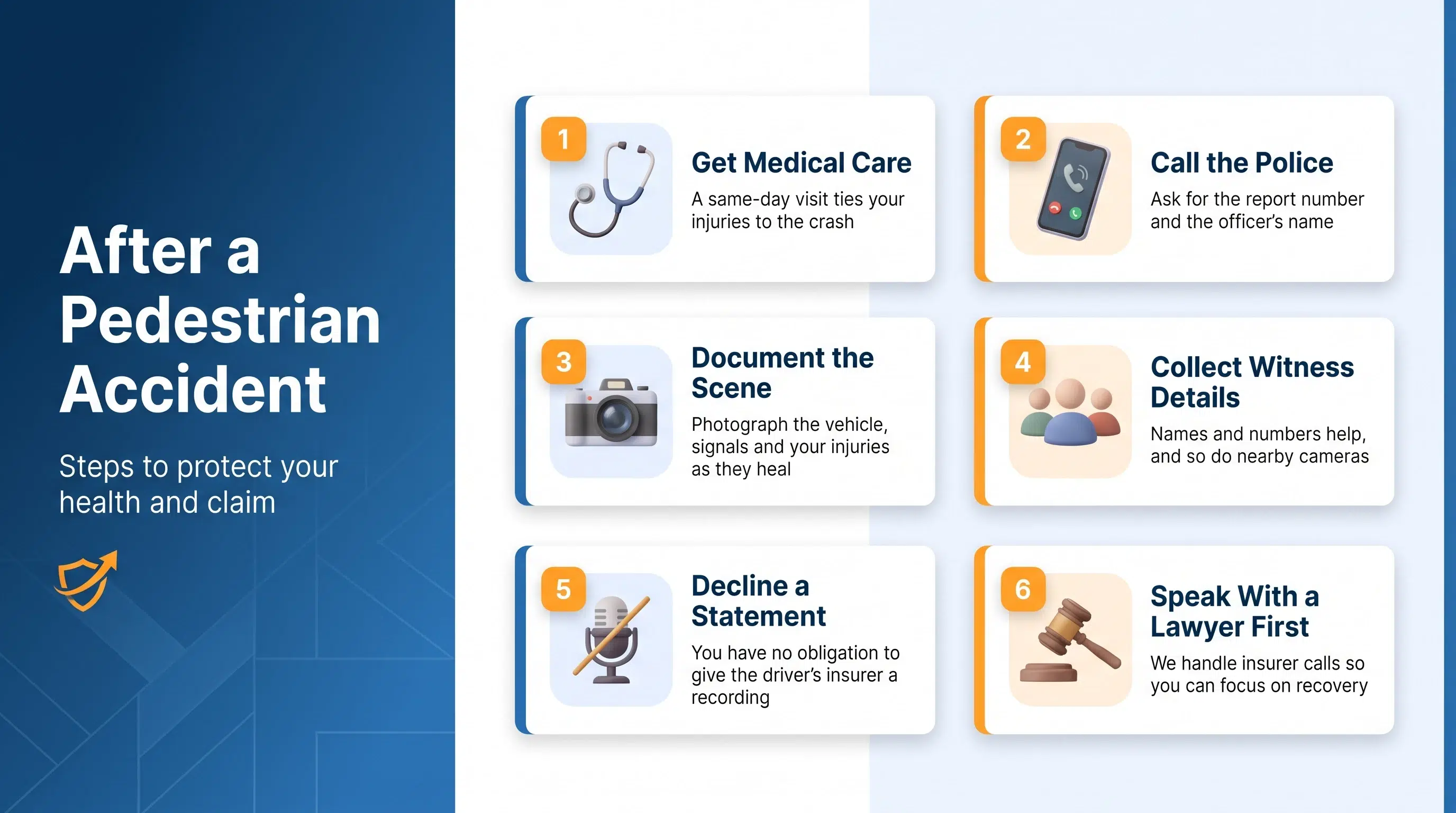
Get medical care right away. Your health comes first. Get checked out the same day, even if you walked away from the scene. Some fractures and head injuries do not show their full effect for hours. A same-day visit also creates a record that ties your injuries to the crash, which makes it harder for an insurer to argue they came from somewhere else.
Call the police and get the report number. Call 911 or the local police so an officer can document the scene. Before you leave, ask for the report number and the officer’s name, and get the driver’s name, license plate and insurance information if you can. If the driver left, note anything you remember about the vehicle, even a partial plate or a color.
Document the scene and your injuries. If you are able, or if someone with you can help, photograph the vehicle, the intersection, the traffic signals, and anything that blocked your view or the driver’s. Keep taking photos of your injuries as they heal. Write down the names and phone numbers of witnesses, and note which nearby businesses or homes might have cameras.
Decline a recorded statement to the driver’s insurer. An adjuster from the driver’s insurance company may call within days and ask for a recorded statement. You have no legal obligation to give one. Even simple comments, like guessing how fast you were walking or saying you did not see the car, can later be used to argue that you share the blame.
Speak with a pedestrian accident lawyer first. Before you talk to any insurer about what happened, schedule a free consultation with our team. We will review the details, explain your options, and handle the communication with insurance companies so you can focus on getting better.
Related pages: car accident lawyers, truck accident lawyers, wrongful death lawyers, rideshare accident lawyers, scooter and e-bike accident lawyers and rideshare accident lawyers in Los Angeles.