






































The days after a pedestrian crash in Illinois
Picture the aftermath: an ambulance ride, a hospital, a police officer taking a few quick statements on a cold curb. Whatever is written down in that first hour tends to stick. In Illinois, the crash report is often the first version of events an insurer sees, and it can describe where you were standing, what the signal showed and who the officer thinks failed to yield. When something in it is off, it is far easier to challenge while witnesses can still be found.
Evidence does not wait. Cameras on buses, storefronts, parking structures and homes may have recorded the crash, and many systems overwrite themselves within days. A vehicle may log its speed and braking before impact, and that data can be lost after repair. We send preservation requests early for this reason.
Injuries also change. Early photographs and consistent medical records show what you went through before healing softened it. A visit on the day of the crash, even if you walked away, ties your symptoms to the collision and makes it harder for an insurer to blame an older condition.
Illinois generally gives two years from the crash to file an injury lawsuit. Public entities are different. A suit against a local government is generally subject to a one-year limit under the Tort Immunity Act, and a claim involving a Chicago Transit Authority bus requires written notice within six months. These short windows catch people off guard.
What do Illinois traffic laws require of drivers?
Illinois puts clear duties on drivers. Under 625 ILCS 5/11-1002, when no signal controls a crosswalk, a driver must stop and yield to a pedestrian who is in the driver’s half of the road or approaching so closely as to be in danger. A car stopped for a pedestrian also creates a duty for drivers behind it: they may not pass. Section 11-1003.1 sets a broader rule. Drivers must use due care to avoid hitting a pedestrian, sound the horn when it helps, and take extra care around children and people who seem confused or impaired.
Pedestrians have obligations as well. Under section 11-1003, a person crossing outside a crosswalk must yield to vehicles, and nobody may step suddenly into the path of a car too close to stop. Insurers lean on those provisions. We look at what the driver could see, how fast the car was going and whether the driver was paying attention.
Illinois uses modified comparative fault. A jury assigns percentages, your award is reduced by your share, and a share above 50 percent bars recovery. Because the cutoff is sharp, a dispute over a few points can decide a case.
Where and how Illinois pedestrians get hurt
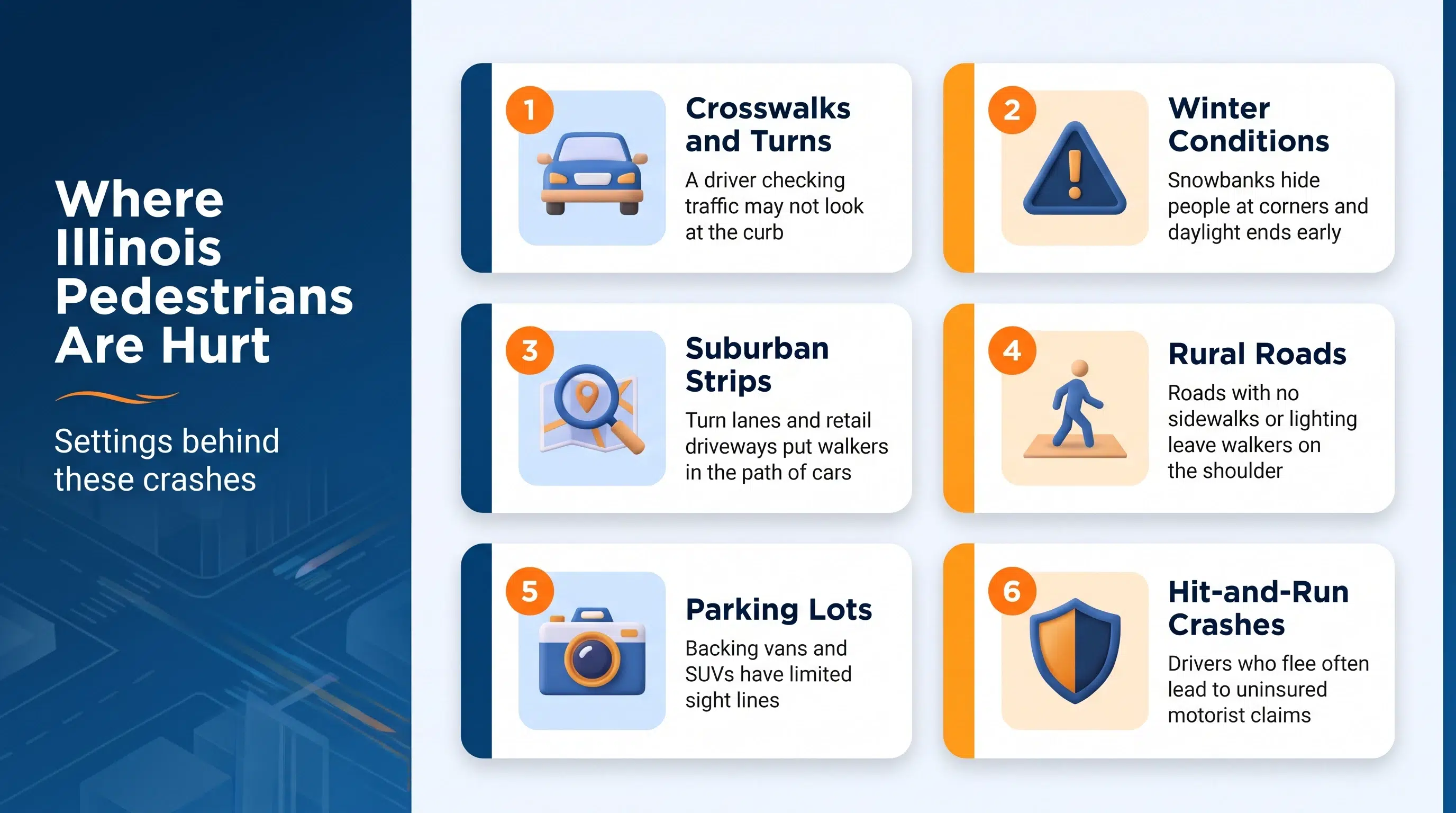
Illinois combines dense city blocks, suburban strips and rural highways, and each produces a different kind of crash.
- Crosswalks and turns: A driver checking for oncoming traffic before turning may not look at the curb. Illinois law requires a full stop for a pedestrian in a crosswalk, so a driver who rolled through has a hard time defending that.
- Winter conditions: Snow and ice narrow crossings, plowed snowbanks hide people at corners, and salt-streaked windshields cut visibility. Daylight ends early for months.
- Suburban arterials and strip malls: Wide roads with turn lanes and driveways to retail lots put people on foot in the path of cars entering and leaving.
- Rural roads: Roads with no sidewalks and no lighting leave people walking on the shoulder, where a drifting or distracted driver can be fatal.
- Parking lots and driveways: Backing vehicles have limited sight lines, particularly vans, SUVs and delivery trucks.
- Hit-and-run and drunk or distracted driving: A driver who leaves leads to uninsured motorist claims. Impaired and distracted drivers raise issues beyond the injury claim, including a possible criminal case.
According to Illinois Department of Transportation data reported by 25 News Now in February 2024, 204 pedestrians died on Illinois roads in 2023.
Who may be responsible besides the driver?
The driver is the first place to look, but the employer of a driver on the job may be responsible too. So may a rideshare or delivery company, a business whose parking lot was unsafe, or a property owner who let ice build up on a walkway the public used. A city, county or transit agency can be a defendant if an unsafe crossing or broken signal helped cause the crash. The Local Governmental and Governmental Employees Tort Immunity Act gives those defendants defenses and shorter deadlines that private defendants do not have.
Insurance rules in Illinois lean in the injured person’s favor in one respect. The state requires uninsured motorist coverage on every auto policy, and that coverage can respond when a driver has no insurance or flees. The minimum liability limit is $25,000 per person, which a serious injury can exceed quickly. We review every policy that could apply, including a household member’s, and consider how much underinsured coverage may add.
Why pedestrian injuries are often severe
A person in a car is protected by metal, belts and airbags. A person on foot is not. NHTSA reports that pedestrians accounted for 18 percent of all traffic deaths in the United States in 2023, a heavy share given how few crashes involve them.
Most pedestrian injuries come in two parts. First the bumper strikes the legs, which is why knee, shin, pelvis and ankle fractures are common. Then the body hits the hood or the pavement, and that second impact is behind many head and spine injuries. Brain injuries can be quiet at first, which is one reason emergency doctors encourage an evaluation even after a seemingly minor crash.
The physical recovery can take months and the effects on work last longer. A construction worker with a shattered ankle, a nurse who cannot stand a twelve-hour shift, a student who misses a semester: each has a different claim, and each deserves one that reflects the actual damage.
How compensation is calculated in an Illinois pedestrian claim
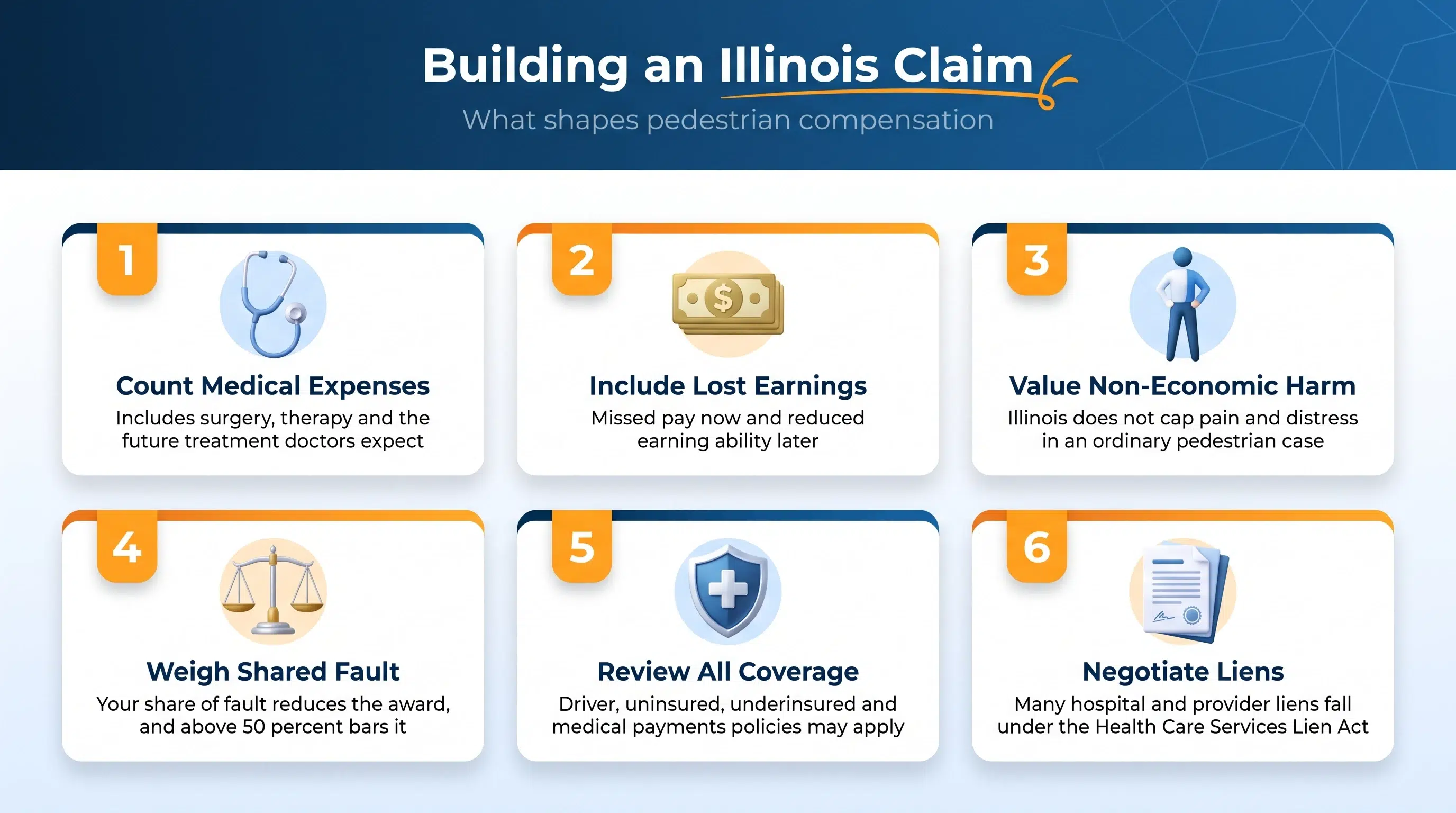
Value comes from the specifics of your case. These are the main pieces:
- Medical expenses: Emergency care, surgery, hospital stays, therapy and the future treatment your doctors expect.
- Lost earnings: Missed pay now and reduced earning ability later.
- Non-economic damages: Pain, distress and the loss of ordinary activities. Illinois does not cap these damages in an ordinary pedestrian case.
- Fault: Reductions for your share of responsibility, and no recovery above 50 percent.
- Coverage: The driver’s liability policy, your own uninsured and underinsured coverage, medical payments coverage if you carry it, and any employer policy.
- Liens: Many hospital and provider liens fall under the Health Care Services Lien Act. We negotiate balances before closing, and each dollar saved goes to our client.
If a pedestrian crash took the life of someone in your family, the Illinois Wrongful Death Act allows a claim for the family, with a two-year deadline in most cases. Our wrongful death lawyers can walk you through the process.
What to do if you are hit on foot in Illinois
See a doctor the same day. Call 911 and ask the officer for a report number and the names of any witnesses. Photograph the vehicle, the intersection, the signals, the snow or ice if any, and your injuries, and keep photographing as you heal. If the driver left, write down whatever you remember about the vehicle before it fades.
When the driver’s insurer calls, you may decline a recorded statement. An offhand answer about your speed or whether you saw the car can come back as a fault argument. Speak with a lawyer first. We handle insurer contact so you can concentrate on treatment, and you can contact our team for a free consultation.
Our Chicago team has also written a page on the city’s streets, Chicago pedestrian injury lawyers, and our Illinois personal injury team covers other injury cases. Related practice areas include car accident lawyers, truck accident lawyers and the slip and fall lawyers who handle unsafe walkways.