- What we know about the Savanna train and pickup collision
- Location and community context near Route 84 and Savanna Tri-Township Airport
- What investigators will analyze at a private railroad crossing
- Safety and legal duties at Illinois railroad crossings
- Key records to request and where to get them in Carroll County
- Insurance and liability issues families commonly face
- Rights of surviving family under Illinois law
- Timelines, statutes, and preserving evidence
- Community safety reflections for rural and private crossings
- Practical next steps and why timing matters
- Commentary from Gosuits Savanna, Illinois Personal Injury Attorney
- References
What we know about the Savanna train and pickup collision
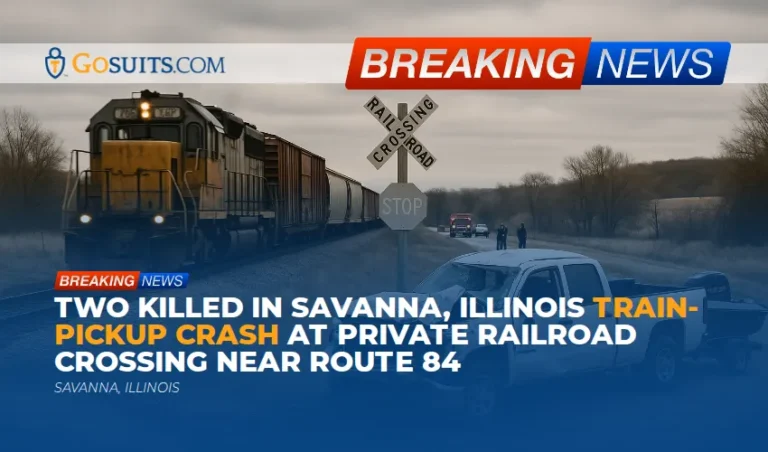
Authorities have identified two members of a Whiteside County family who tragically lost their lives in a train versus pickup crash near Savanna in Carroll County. According to information released by the Carroll County Sheriff’s Office, Connor L. Sandrock, 21, and his father, Benjamin G. Sandrock, 50, both from rural Lyndon, were in a pickup truck towing a boat and trailer when the vehicle was struck by a southbound train around 3 p.m. The crash occurred at a private railroad crossing just off Illinois Route 84, across from the Savanna Tri-Township Airport. Multiple agencies responded, including fire departments from Thomson, Savanna, and Clinton, Iowa, local police, conservation police, and the Illinois Department of Transportation.
Public remembrances shared by family and friends reflect a deep connection to agriculture, education, and community service across the Sauk Valley area. Funeral arrangements were scheduled in Prophetstown, with burial in Tampico. Our thoughts are with everyone grieving through this unimaginable loss.
Location and community context near Route 84 and Savanna Tri-Township Airport
Residents in Carroll and Whiteside counties know Illinois Route 84 as a scenic but busy corridor that closely parallels the Mississippi River. The route serves local farms, river access points, and the Savanna Tri-Township Airport. In warm months, traffic often includes pickups towing fishing boats and trailers. That mix of vehicles, farm equipment, and rail lines creates moments of added caution, especially where private crossings meet local driveways, field roads, and airport-adjacent routes.
Savanna and Thomson are tight-knit river towns where neighbors show up for each other. When a major incident happens, community responders converge rapidly, and regional partners like IDOT and conservation police often assist. Even with quick and coordinated response, the physics of a train strike at any crossing are severe. Federal rail safety materials note that trains require a long distance to stop and that even modest-speed collisions can be catastrophic because of the train’s mass and momentum [1][14].
What investigators will analyze at a private railroad crossing
Private railroad crossings differ from public crossings in important ways. Public crossings are generally maintained by the railroad with oversight from state and federal regulators, and many have active warning devices like flashing lights and gates. Private crossings, by contrast, are owned by private parties or entities and typically serve specific land access needs. They may have limited or no active warning systems and can vary widely in sightlines, signage, and maintenance responsibilities [13][4].
When a crash occurs at a private crossing, investigators commonly evaluate:
- Crossing type and protections such as passive signage, stop or yield signage, pavement markings, or any active protection if installed.
- Visibility and sight distance at the approach, including vegetation, structures, grade, and curvature.
- Warning time and train operations including horn use, train speed, crew actions, and event recorder data.
- Vehicle movement including approach speed, stopping distance for a towed trailer, and trailer tracking across the rails.
- Ownership and maintenance responsibilities for the crossing and approach, which can be shared or assigned by agreement in a private setting [13].
- Compliance with state and federal rules for signals, signage, and reporting.
Railroads must report highway-rail grade crossing accidents to the Federal Railroad Administration. Those reports and crossing inventory data are accessible through the FRA’s public portal and help inform safety improvements statewide [2]. In larger or particularly complex events, the National Transportation Safety Board may examine circumstances and issue safety recommendations. NTSB shares preliminary reports and final findings publicly, which can be invaluable context for families and communities after rail-related tragedies [3].
Safety and legal duties at Illinois railroad crossings
Illinois law sets out driver responsibilities at railroad crossings, including duties to obey active signals and to stop under certain conditions. The Illinois Vehicle Code requires drivers to stop when signals indicate an approaching train, when a train is plainly visible and in hazardous proximity, or when a flagger directs a stop [6]. Specific vehicle categories, like certain buses and hazardous material carriers, must make mandatory stops at all crossings regardless of signals [7].
At a private crossing, the legal picture can be more complicated since the crossing is not part of the general public roadway. Still, the basic safety principles are the same: never attempt to cross when a train is approaching, ensure sufficient clearance for a vehicle and trailer, and account for additional stopping distance and trailer swing. Federal guidance underscores that trains cannot stop quickly and that drivers should expect a train on any track at any time [1][14].
On the infrastructure side, Illinois has an active rail safety program through the Illinois Commerce Commission and collaborates with IDOT on crossing improvements, separations, and signal projects designed to reduce crash risk. These programs consider usage, crash history, sightlines, and other risk factors when prioritizing improvements across the state’s rail network [4][5].
Key records to request and where to get them in Carroll County
Families seeking answers often benefit from getting official documents as the investigation proceeds. Most of the time, these records are not immediately available. Agencies complete their work, compile findings, and then release reports. Generally speaking, these are the key records and how they are obtained:
1) Law enforcement crash report and scene documentation
Because the Carroll County Sheriff’s Office responded, start there for the primary crash report. Ask about the report number, availability timeline, scene diagrams, and any supplemental narratives. In Illinois, some agencies route requests through a records division. If the Illinois State Police assisted or took over aspects of the investigation, the Illinois State Police Crash Reports portal may also be relevant for certain records [12].
In addition to the standard crash report, families can consider requesting dispatch logs and 911 audio where available. Those are typically requested through the Illinois Freedom of Information Act, subject to redactions and exemptions for ongoing investigations or privacy [11].
2) Coroner’s records, autopsy, and death certificates
The Carroll County Coroner leads the medicolegal death investigation. Families can ask the coroner about the autopsy report timeline, toxicology if ordered, and inquest procedures where applicable. While autopsy reports may not be immediately available, certified copies of death certificates are issued through local authorities and the Illinois Department of Public Health’s Vital Records once cause and manner of death are certified [12].
3) Railroad and federal safety data
Railroads must file a Highway-Rail Grade Crossing Accident/Incident Report with the Federal Railroad Administration. Those filings and the site-specific crossing inventory data become available in the FRA’s online databases. Although these databases are technical, they can provide objective details about the crossing location, protection type, and reported circumstances [2].
4) State rail safety agencies
The Illinois Commerce Commission’s Rail Safety Section administers rail-crossing safety programs and may have project histories or planned improvements relevant to a particular crossing. While not all materials are public, the ICC can be a resource for understanding how crossings are classified and prioritized statewide [4]. IDOT offers safety information and educational guidance for motorists approaching crossings as well [5].
Insurance and liability issues families commonly face
In a highway-rail crossing crash, the liability picture can involve many actors. Potentially implicated parties can include the vehicle driver, the railroad, a crossing owner on private property, and third parties responsible for design, maintenance, visibility, or warning devices. Illinois follows a comparative fault framework, which means that a finder of fact may apportion responsibility among multiple parties based on the evidence [9].
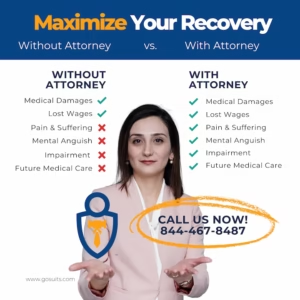
It is unfortunately common for large insurers and corporate claims departments to contact families quickly after a fatality. Statements given in the raw aftermath are often incomplete, may be taken out of context, and can be used to limit or deny claims later. When a potentially complex investigation is still underway, it is prudent to speak with counsel before sharing statements or documents with any insurer or corporate representative. Families considering claims may benefit from consulting with wrongful death attorneys first to understand rights and obligations before any recorded conversation with an insurance adjuster.
Other issues that sometimes arise in rural and private crossing crashes include trailer handling dynamics and load weight, private agreements governing the crossing, and whether warning devices were adequate relative to risk. These are fact-specific questions that often require prompt preservation of evidence from the vehicle, trailer, the train’s event recorder, and the crossing itself.
Rights of surviving family under Illinois law
Illinois provides two separate but related civil claims in fatal incident scenarios. First, the Wrongful Death Act allows designated family members to recover certain damages because of the death itself, including loss to survivors and recognized elements of grief and sorrow under current Illinois law [8]. Second, the Survival Act allows the decedent’s estate to pursue claims the decedent could have brought had they lived, such as conscious pain and suffering, medical expenses incurred before death, and property damage [10].
Because multiple insurance policies may be implicated, including auto liability, underinsured motorist coverage, or corporate policies held by a railroad or property owner, families often face a patchwork of notice requirements and coverage defenses. A careful strategy helps prevent an insurer from using procedural missteps to curtail a valid claim. That is one reason many families choose to consult with wrongful death attorneys in Chicago who routinely coordinate multi-carrier communications and evidence preservation in Illinois fatal-incident cases.
If you are wondering how long these cases can take and what drives the timeline, this resource offers a plain-language roadmap: How Long Does It Take to Settle a Wrongful Death Lawsuit? The general pace depends on the investigation, evidence availability, insurer reviews, and whether litigation becomes necessary.
Timelines, statutes, and preserving evidence
Time limits are critical. In most Illinois wrongful death cases against private parties, the filing deadline is two years from the date of death, subject to specific exceptions in the statute and special rules for certain claim types [8]. Claims involving a local public entity or its employees, if any are implicated, can have shorter limitations periods under the Local Governmental and Governmental Employees Tort Immunity Act [15]. Evidence can also be lost quickly at a rail crossing because traffic resumes, seasonal vegetation changes sightlines, and physical markings fade.
Preservation letters, sometimes called spoliation letters, can be sent early to put the railroad, crossing owners, and other potentially responsible parties on notice to retain critical materials. Those materials may include train event recorder data, crew reports, locomotive video, dispatch audio, track warrants, maintenance and inspection logs, vegetation control records, crossing configuration plans, and any available third-party video. Families exploring claims should consider engaging counsel early to coordinate preservation while the investigation is ongoing.
Federal and state data sources can be important as well. The FRA maintains accident reports and crossing inventory records that describe the presence or absence of lights, gates, signage, and track characteristics [2]. The NTSB can issue preliminary summaries that offer high-level timelines and initial facts, followed later by analysis and recommendations where appropriate [3].
Community safety reflections for rural and private crossings
For those who drive Route 84 between Savanna and Thomson, the rail lines feel like part of everyday life. When towing a boat or livestock trailer, crossing rails can add a second of anxiety. Safety agencies emphasize a few reminders that are worth repeating in our river communities:
- Expect a train at any time even on tracks that feel lightly used. Schedules change, and special movements occur without public notice [1].
- Stop, look, and listen where sightlines are limited. Use windows down and radios off for a moment if necessary.
- Know your trailer length and clearance and avoid stopping on the tracks. If traffic backs up, wait before crossing so you have room to clear fully.
- Do not rely on train speed estimates. Trains are often moving faster than they appear and cannot stop quickly [14].
- Report sightline hazards such as vegetation or obstructed signage to local authorities or the railroad’s emergency number posted at the crossing.
Illinois also continues to invest in grade-crossing improvements, with ICC and IDOT collaborating to target locations where risk is highest. Public participation and local reporting help inform where those investments can save lives [4][5].
Practical next steps and why timing matters
When a fatal collision upends a family, taking even small steps can feel overwhelming. Here is a concise plan that balances compassion with the practical need to protect rights and preserve answers.
- Start a central file that secures funeral paperwork, any medical or emergency paperwork received, and correspondence from insurers or the railroad. Organizing early prevents missed deadlines later.
- Request the basic reports. Ask the Carroll County Sheriff’s Office for the crash report timeline and whether diagrams, photos, or supplements will be available. Ask the Coroner about autopsy timing and obtaining certified death certificates through local channels or IDPH Vital Records [12].
- Gather media and personal records. Save any photos of the vehicle, trailer, and crossing, as well as GPS data or phone records that may capture timing. If you have dashcam or farm equipment video, preserve it in original format.
- Hold off on detailed statements to insurers until you understand your rights. What is said in a recorded call can be used against a claim later. Consider speaking with an attorney before giving any statement to any insurer or corporate representative.
- Preserve vehicle and trailer if possible. Do not authorize disposal until counsel has evaluated whether inspections or downloads are indicated.
- Document financial impacts. Track funeral expenses, travel, lost income, and support services. These records can be important for later claims.
- Use Illinois FOIA thoughtfully to request 911 and dispatch records once the agency advises they are releasable. Clarify that you seek logs and audio for a defined timeframe surrounding the incident [11].
Why move promptly? Evidence at the crossing environment can change quickly, railroads cycle data systems, and legal deadlines begin running right away. Early clarity preserves options, whatever path a family ultimately chooses.
Commentary from Gosuits Savanna, Illinois Personal Injury Attorney
We are deeply sorry for the loss of Connor and Benjamin Sandrock. To the family, friends, and the Sauk Valley community who are grieving, please accept our heartfelt condolences. This article is intended for general information and education.
From a civil injury perspective, private railroad crossing cases require a close look at sightlines, warning devices or signage, train operations, and the realities of towing a trailer across tracks. Multiple parties can share responsibility, and the facts often live in data systems held by the railroad, in law enforcement scene documentation, and in federal safety filings. Securing that evidence early can make a significant difference in understanding what happened and why.
It is unfortunately common for insurers and large corporations to move quickly after a fatal incident. They may request recorded statements or offer early resolutions before a full picture develops. Those conversations can be stressful, and statements given without context can be used to limit or deny claims later. Taking time to understand rights, insisting on evidence preservation, and consulting with a seasoned and skilled advocate before speaking on the record can level the playing field.
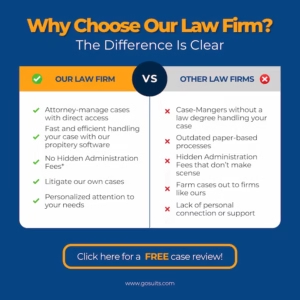
Free consultations matter because families deserve to know the rules, the deadlines, and the options available to them without added pressure. Speaking with a knowledgeable professional first can help avoid missteps that insurers might later use against a claim.
References
- Highway-Rail Grade Crossing and Trespasser Programs – Federal Railroad Administration
- Highway-Rail Crossing Accident/Incident Data Portal – Federal Railroad Administration
- Investigations Overview – National Transportation Safety Board
- Rail Safety Program – Illinois Commerce Commission
- Highway-Rail Grade Crossing Safety – Illinois Department of Transportation
- 625 ILCS 5/11-1201 – Obedience to signal indicating approach of train – Illinois General Assembly
- 625 ILCS 5/11-1205 – Vehicles required to stop at railroad grade crossings – Illinois General Assembly
- 740 ILCS 180 – Wrongful Death Act – Illinois General Assembly
- 735 ILCS 5/2-1116 – Comparative negligence – Illinois General Assembly
- 755 ILCS 5/27-6 – Survival Act – Illinois General Assembly
- 5 ILCS 140 – Illinois Freedom of Information Act – Illinois General Assembly
- Death Records – Illinois Department of Public Health
- Private Highway-Rail Crossings – Federal Railroad Administration
- Railroad-Highway Grade Crossing Safety – Federal Highway Administration
- 745 ILCS 10/8-101 – Local Governmental and Governmental Employees Tort Immunity Act, statute of limitations – Illinois General Assembly