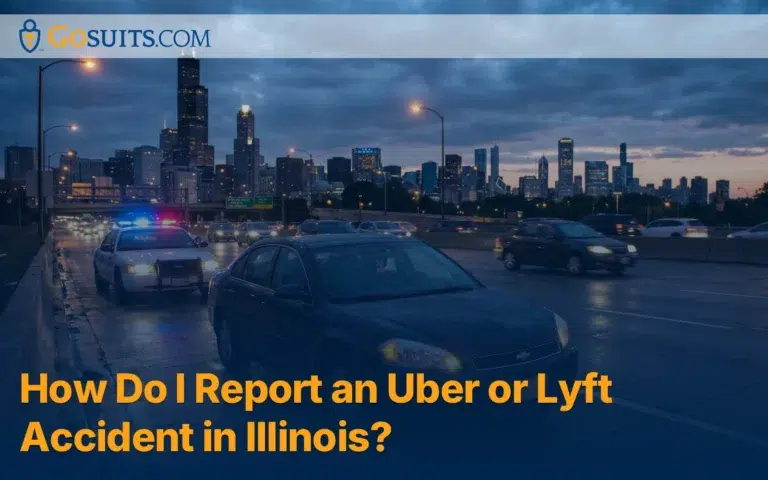
You report an Uber or Lyft accident in Illinois through three separate channels: the police, the rideshare company, and the relevant insurers. Illinois law requires drivers to stop, exchange information and render aid after a crash, and police should be called when someone is hurt. Uber and Lyft each have their own in-app crash reporting tools that start the company’s claim process. Since Public Act 102-0560, private motorists no longer have to file a separate written motorist report with the Illinois Department of Transportation [1][2]. Reporting is only the first step. A civil injury claim has its own legal deadline, generally two years [3]. This article is general legal information for Illinois, not legal advice.
Legal Snapshot
-
Legal Topic: Reporting a rideshare (Uber or Lyft) crash in Illinois
-
Case Stage: Immediate aftermath of the crash through the early claim stage
-
Primary Legal Issue: Which reports are legally required, which are practically important, and how they affect a later civil injury claim
-
Primary Authority: Illinois Vehicle Code (625 ILCS 5/); Transportation Network Providers Act (625 ILCS 57/); Public Act 102-0560; 735 ILCS 5/2-1116; 735 ILCS 5/13-202
-
Date Legal Authority Last Reviewed: November 10, 2026 (attorney review pending)
What Does “Reporting” a Rideshare Accident Mean?
Reporting an Uber or Lyft accident in Illinois involves three separate steps: reporting the crash to police, notifying the rideshare company through its app or help center, and notifying the insurance companies involved. Each report serves a different purpose, and none replaces the others.
The in-app report goes to the platform and its insurance process, not to a state agency. Uber states that everyone involved in a crash should file a report with Uber, and it provides separate paths for riders, drivers and other parties [8]. Lyft likewise offers an accident reporting path for drivers, and riders can report through ride history in the app [10].
The people who may need to report include a rider hurt inside the vehicle, the occupant of another car, a pedestrian or cyclist struck by a rideshare vehicle, and the rideshare driver. A civil claim can involve each of them, and each may have different interests. For example, a rideshare driver, the rideshare company and an insurer may all dispute who was at fault.
What Does Illinois Law Say About Reporting a Crash?
Illinois law places several duties on drivers at the scene, and one old reporting duty was repealed. The Vehicle Code requires the driver of a vehicle involved in a crash with injury or death to stop and remain at the scene. Leaving the scene of an injury crash is a felony [12]. Drivers must also give their name, address, vehicle registration number and owner information, and render reasonable assistance to anyone injured, including arranging medical transport when it is needed [11].
Illinois also requires drivers to notify police after certain crashes. Under 625 ILCS 5/11-407, if no officer is at the scene, the driver must report the crash by the fastest available means when it causes injury, death, or more than $1,500 in property damage to any one person, or more than $500 if any vehicle involved is uninsured.
What changed in 2021 is the motorist’s separate written report. [2] Public Act 102-0560 repealed Sections 11-406 and 11-410 of the Vehicle Code. IDOT now states that a motorist does not need to complete the SR1B Illinois Motorist Report, although state employees in state vehicles still must [1][4]. Older websites that describe a mandatory 10-day motorist report to IDOT are outdated. Police agencies still submit their own crash reports to IDOT under 625 ILCS 5/11-408 [1].
What Legal Rules Apply to a Rideshare Crash Claim?
Several Illinois rules shape what happens after the reports are made. The table below summarizes them. Each depends on the facts, and an attorney should confirm how it applies.
|
Issue |
Illinois rule |
Authority |
|---|---|---|
|
Stopping and aiding |
Drivers must stop, share information and render reasonable aid after an injury crash |
625 ILCS 5/11-401, 11-403 |
|
State motorist report |
No longer required for private motorists |
Public Act 102-0560 |
|
Rideshare insurance |
Tiered coverage depending on the app status of the driver |
625 ILCS 57/10 |
|
Shared fault |
Recovery is barred if the plaintiff is more than 50% at fault, and reduced by the plaintiff’s percentage otherwise |
735 ILCS 5/2-1116 |
|
Filing deadline |
Generally two years for injury to a person |
735 ILCS 5/13-202 |
How Does This Apply to a Real Case?
Hypothetical example (not a GoSuits case). A rider is in the back seat of a Lyft on the Kennedy Expressway in stop-and-go traffic when another car rear-ends the Lyft. The rider has neck pain. The driver wants to “handle it between ourselves.”
In that situation, the rider can call 911 so that officers document the scene. The rider can also screenshot the app’s trip details, report the crash through Lyft’s app, and get medical care. The driver’s wish to skip a police report does not control the rider’s rights. Because the at-fault driver in this hypothetical was another motorist, the other driver’s liability insurance and the rideshare policy could both become relevant, which is why careful documentation matters.
Congestion is a common backdrop. Pickups in the Loop and trips along Lake Shore Drive or the Dan Ryan Expressway involve heavy, changing traffic, and many Illinois rideshare crashes involve disputes about who was moving, stopping or changing lanes.
What Evidence Can Matter?
Evidence does not automatically prove liability, but early documentation can matter a great deal when fault is disputed.
-
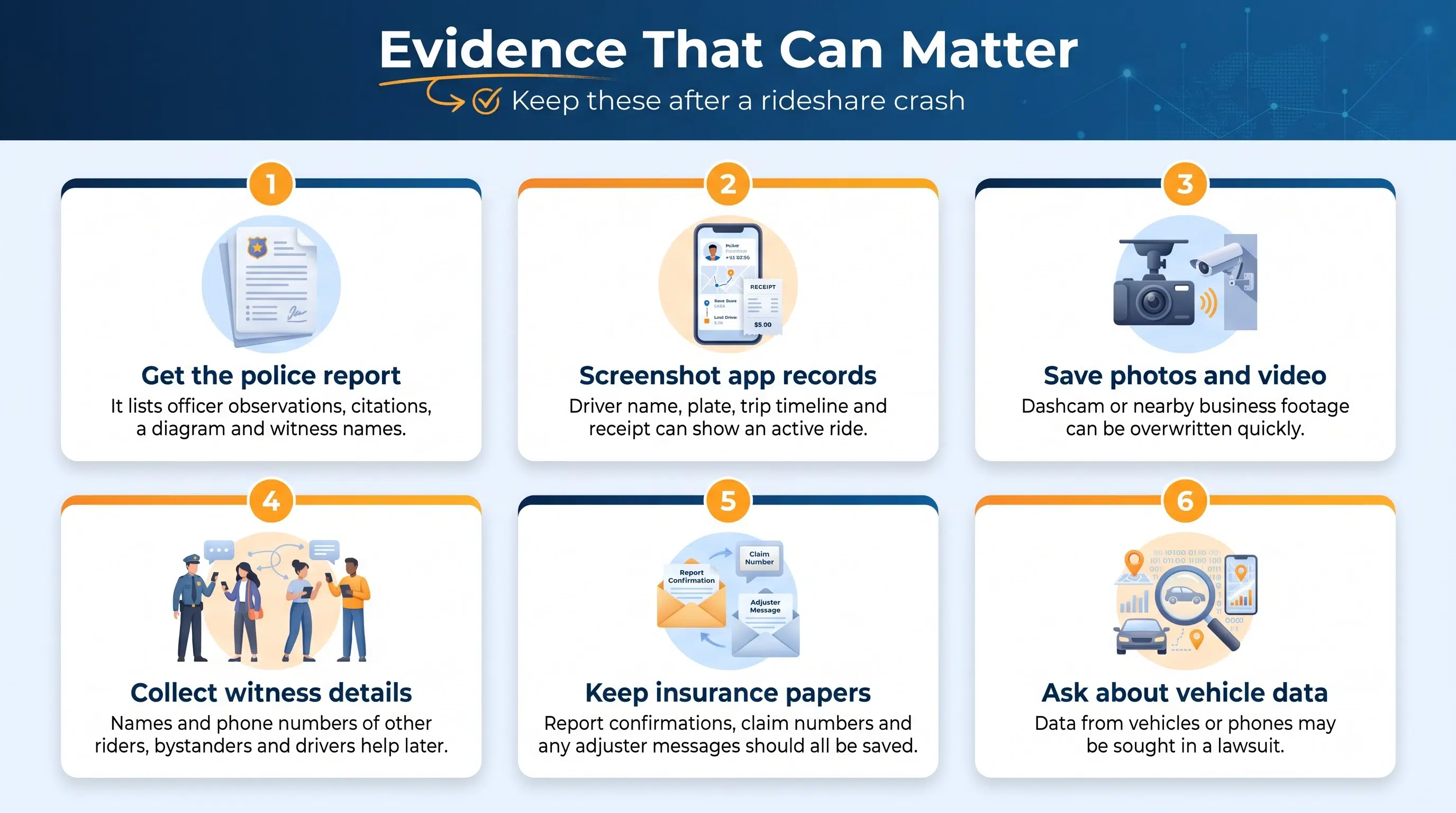
Police report: It records the officers’ observations, any citations, the diagram and witness names. Illinois State Police rarely handles crashes on municipal streets, so the “Investigated By” box on your report tells you which agency to contact for a copy [5]. Requests may be handled under the Illinois Freedom of Information Act and may return a redacted version [5].
-
App records: Screenshots of the driver name, plate, trip timeline and receipt help show that a rider was in an active ride, or that the driver was logged on.
-
Photos and video: Vehicle damage, road conditions, signals and injuries. Dashcam or nearby business footage can be overwritten quickly.
-
Witness information: Names and phone numbers of other riders, bystanders and drivers.
-
Medical records and bills: They connect injuries to the crash and document treatment.
-
Insurance documents and company communications: The report confirmation, claim numbers and any adjuster messages.
-
Vehicle and phone data: Where relevant, data from vehicles or devices may be sought in a lawsuit, sometimes with the help of accident reconstruction analysis.
How Do I Report to Uber or Lyft Step by Step?
Uber riders. Uber directs riders to its rider reporting path, and riders can reach the Safety Incident Reporting Line from the Ride Details screen in the app [8]. Menu labels change over time, so follow the current prompts for the specific trip.
Uber drivers. Uber says the easiest way for drivers is the Safety Toolkit, represented by a blue shield, followed by “Report a crash” [9]. Uber also directs drivers to save the police report number when there is one [9].
Lyft riders. A rider can open the Lyft app, go to ride history, select the trip and choose the option to report a safety issue or accident [10].
Other drivers, pedestrians and cyclists. Uber provides a separate path for other parties [8]. A person who was not in the rideshare vehicle may want legal guidance before giving a recorded statement to any insurer.
When you report, stick to the basic facts: where and when it happened, who was involved, and what you saw. Don’t guess about fault or downplay your injuries, because some symptoms appear later.
What Damages or Remedies May Be Available?
Recoverable damages depend on Illinois law and the facts of the case. In a rideshare crash claim, they can include medical expenses, future medical care, lost income, loss of earning capacity, pain and suffering, loss of a normal life, and property damage. Wrongful death claims have their own statutory framework. Punitive damages are available only in limited circumstances and are not routine. No outcome is guaranteed, and the value of any claim depends on the evidence, the insurance available, and how fault is allocated.
What If the Other Party Disputes Liability?
Disputes over fault are common, and they matter because of Illinois’s modified comparative fault rule. Under 735 ILCS 5/2-1116, a plaintiff is barred from recovering if the trier of fact finds the plaintiff’s contributory fault to be more than 50% of the proximate cause, and otherwise any damages are reduced in proportion to the plaintiff’s fault [6].
From the defense side, a rideshare driver, another motorist or an insurer may argue that the injured person caused or contributed to the crash, that the injuries were not caused by the crash, or that a different party is responsible. An injured passenger may still have claims against more than one party. Because statements made early on can later be used in these disputes, it is wise to speak with an attorney before giving a detailed account to an adjuster.
What If Insurance Is Involved?
Rideshare crashes often involve layered insurance, and Illinois sets minimums under the Transportation Network Providers Act. The coverage depends on what the driver was doing in the app at the moment of the crash [7].
-
Logged on, no ride accepted: The statute requires liability coverage of at least $50,000 per person, $100,000 per incident and $25,000 for property damage, as described in the sources reviewed [7].
-
Ride accepted through completion: Liability insurance must be primary and in the amount of $1,000,000 for death, personal injury and property damage [13].
-
Uninsured and underinsured motorist coverage: The statute provides $50,000 in coverage from the moment a passenger enters the vehicle until the passenger exits [7].
-
Driver insurance lapse: If the driver’s own policy has lapsed, the transportation network company must provide the required coverage from the first dollar of a claim [13].
Uber tells drivers they generally do not need to report a rideshare crash to their personal insurer unless their policy has a relevant endorsement[9]. Your own policy may still require notice, so read it. The Illinois Transportation Network Providers Act, which sets rideshare insurance requirements, is scheduled to be repealed on September 1, 2028, unless extended, so confirm the current version when a crash occurs.
Disputes over which policy applies are a frequent reason to consult rideshare accident lawyers, particularly when a rideshare driver was between rides or a third party’s insurance is inadequate.
How Long Do I Have to Act?
Reporting a crash and filing a lawsuit have separate deadlines, and the reporting deadline is much shorter. Uber and Lyft don’t publish a cutoff for in-app reports, but both say to report as soon as possible, so don’t wait [8]. For a lawsuit, 735 ILCS 5/13-202 generally requires a personal injury claim to be filed within two years after the cause of action accrued [3].
Shorter deadlines may apply when a government body or public transit agency is involved. A lawsuit against a local public entity, including the CTA, generally must be filed within one year (745 ILCS 10/8-101). A wrongful death claim generally must be filed within two years after the death (740 ILCS 180/2). Illinois cases are filed in the circuit court of the county where venue is proper. For Chicago-area crashes, that is often the Circuit Court of Cook County, at the Richard J. Daley Center or a suburban district courthouse.
What Should I Do Next?
-
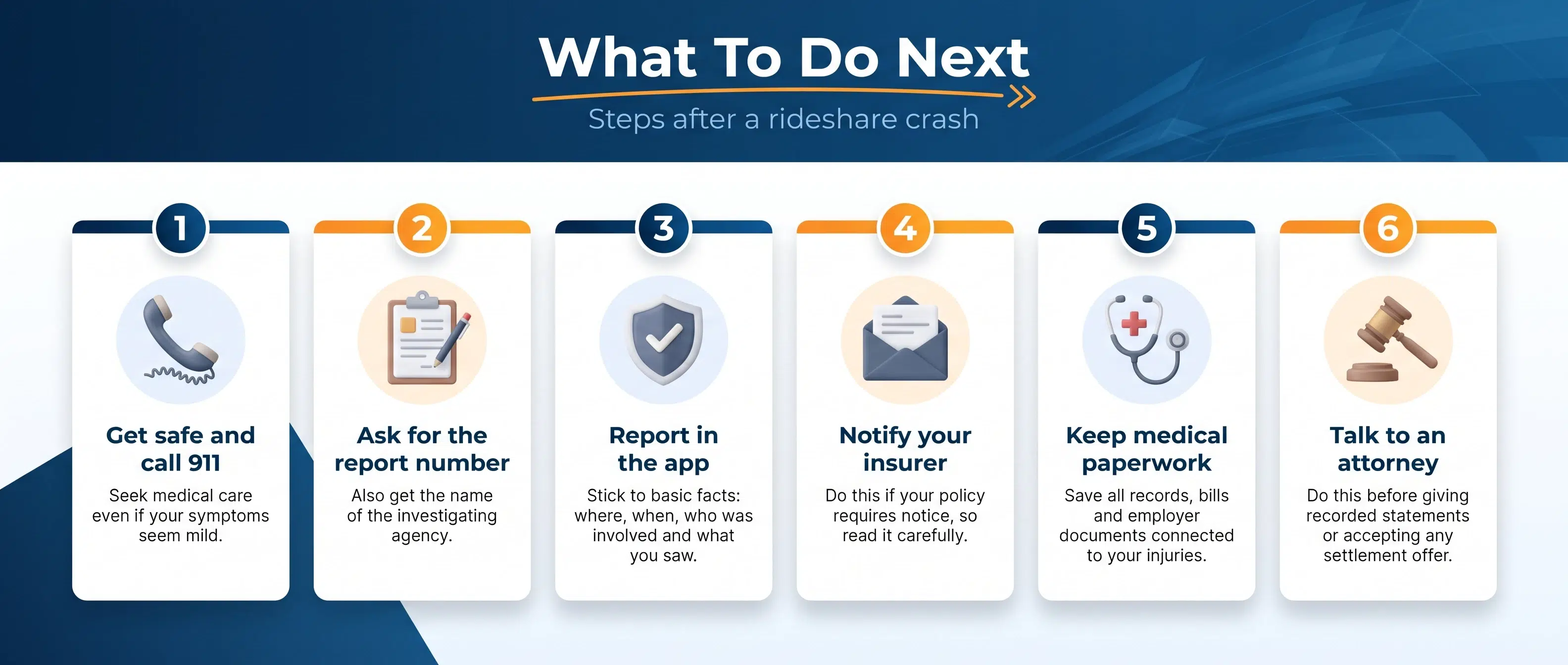
Get safe and call 911 if anyone is hurt. Seek medical care even if symptoms seem mild.
-
Ask for the police report number and the name of the investigating agency.
-
Photograph the scene, the vehicles and any injuries, and collect witness contacts.
-
Screenshot your trip details and receipt before closing the app.
-
Report the crash through the Uber or Lyft app, sticking to basic facts.
-
Notify your own insurer if your policy requires it.
-
Keep all medical records, bills and employer documents.
-
Speak with an Illinois personal injury attorney before giving recorded statements or accepting any settlement offer. Self-representation against a rideshare company and its insurer carries real risks.
Related Illinois Personal Injury Resources
An Illinois rideshare injury claim may overlap with other claim types. Our Illinois rideshare injury team page explains how these cases are handled, and the Illinois personal injury overview covers the broader process. If another motorist caused the crash, car accident lawyers may also review that driver’s liability. If a pedestrian was struck, see the Illinois pedestrian accident page.
Talk With a GoSuits Attorney
A rideshare injury claim can involve medical evidence, layered insurance, liability disputes and legal deadlines. If you were hurt in an Illinois crash involving Uber or Lyft, personal injury lawyers at GoSuits can review the circumstances and explain your options. You can schedule a free consultation to discuss your situation. Results depend on the facts of each case, and nothing in this article guarantees an outcome.
This article provides general information about Illinois law and is not legal advice. Laws change, and every case is different. Consult a licensed Illinois attorney about your situation.
References
-
Illinois Civil Statute of Limitations Laws (735 ILCS 5/13-202) – FindLaw
-
Illinois Motorist Report – Illinois Department of Transportation
-
Obtain a Copy of a Crash Report Online – Illinois State Police
-
Transportation Network Providers Act (625 ILCS 57/) – Illinois General Assembly
-
Illinois Vehicle Code, 625 ILCS 5/ (Section 11-403) – Illinois General Assembly
-
Steps to Take After a Commercial Truck Accident in Illinois (625 ILCS 5/11-401) – Collins Law Group