Before hiring a truck accident lawyer in Texas, ask how the lawyer handles commercial vehicle cases, who will personally work on your file, how the fee and case expenses are written, how quickly evidence will be preserved, and how the lawyer plans for Texas trial procedures that apply to commercial vehicles. Texas requires a contingent fee contract to be in writing and signed by both lawyer and client [6]. Most Texas injury lawsuits must be filed within two years [4]. In many commercial motor vehicle cases, a defendant may ask the court to split the trial into phases [1]. No lawyer can honestly promise a result.
Legal Snapshot
-
Legal Topic: Choosing and interviewing a lawyer for a Texas commercial truck crash injury claim (civil matters only)
-
Case Stage: Pre-retention, before a lawsuit is filed
-
Primary Legal Issue: Whether a lawyer can preserve evidence, meet Texas deadlines, and handle federal trucking rules and Texas commercial vehicle trial procedure
-
Primary Authority: Texas Civil Practice and Remedies Code Chapters 16, 33 and 72; Texas Government Code Section 82.065; Texas Disciplinary Rules of Professional Conduct Rule 1.04; 49 CFR Parts 387 and 395
-
Date Legal Authority Last Reviewed: November 11, 2026 (attorney review recommended before publication)
What Does “Vetting a Truck Accident Lawyer” Mean?
Vetting a lawyer means asking structured questions about experience, fees, staffing, strategy and communication before you sign anything. Truck cases differ from ordinary car crash claims. They can involve a driver, a motor carrier, a cargo loader, a maintenance vendor and several insurers. They also involve federal safety regulations and records that carriers are not required to keep forever. Questions that work for a fender-bender claim may not reveal whether a lawyer is prepared for a fully loaded tractor-trailer on I-35 or I-45.
This article is general legal information, not legal advice. It does not encourage anyone to handle a truck claim alone. A claim against a trucking company is document-heavy and deadline-driven, and legal help matters from the start.
What Does Texas Law Say?
Texas law shapes the questions worth asking because it controls fees, deadlines, fault allocation and trial structure. The table below connects each rule to a question you can raise in a consultation.
|
Topic |
Authority |
Why it matters when interviewing a lawyer |
|---|---|---|
|
Contingent fee contract |
Tex. Gov’t Code § 82.065; Tex. Disciplinary R. Prof’l Conduct 1.04(d) |
Must be in writing and signed by attorney and client, and must state how the fee is determined and how expenses are handled [5][6] |
|
Filing deadline |
Tex. Civ. Prac. & Rem. Code § 16.003 |
Generally two years for personal injury; wrongful death runs from the date of death [4] |
|
Shared fault |
Tex. Civ. Prac. & Rem. Code §§ 33.001, 33.012 |
A claimant more than 50 percent responsible may not recover; otherwise damages are reduced by the claimant’s percentage [3] |
|
Commercial vehicle trials |
Tex. Civ. Prac. & Rem. Code ch. 72, subch. B (§§ 72.051 to 72.055) |
On a defendant’s motion, the court shall provide a bifurcated trial in covered cases [1][2] |
|
Federal insurance floor |
49 CFR § 387.9 |
Sets minimum financial responsibility for covered carriers, $750,000 for for-hire non-hazardous freight [10] |
|
Driver log retention |
49 CFR § 395.8(k) |
Carriers must keep records of duty status and supporting documents at least six months [8][9] |
Federal law and Texas law work together here. Federal regulations set safety and insurance baselines for motor carriers, while Texas statutes and court rules control the lawsuit itself. Texas Transportation Code Chapter 644 (commercial motor vehicle safety standards) also appears in the Chapter 72 evidence provisions [1]. How these interact in a particular case should be reviewed by a licensed Texas attorney.
What Legal Rules Apply? The Questions to Ask
Experience and focus
-
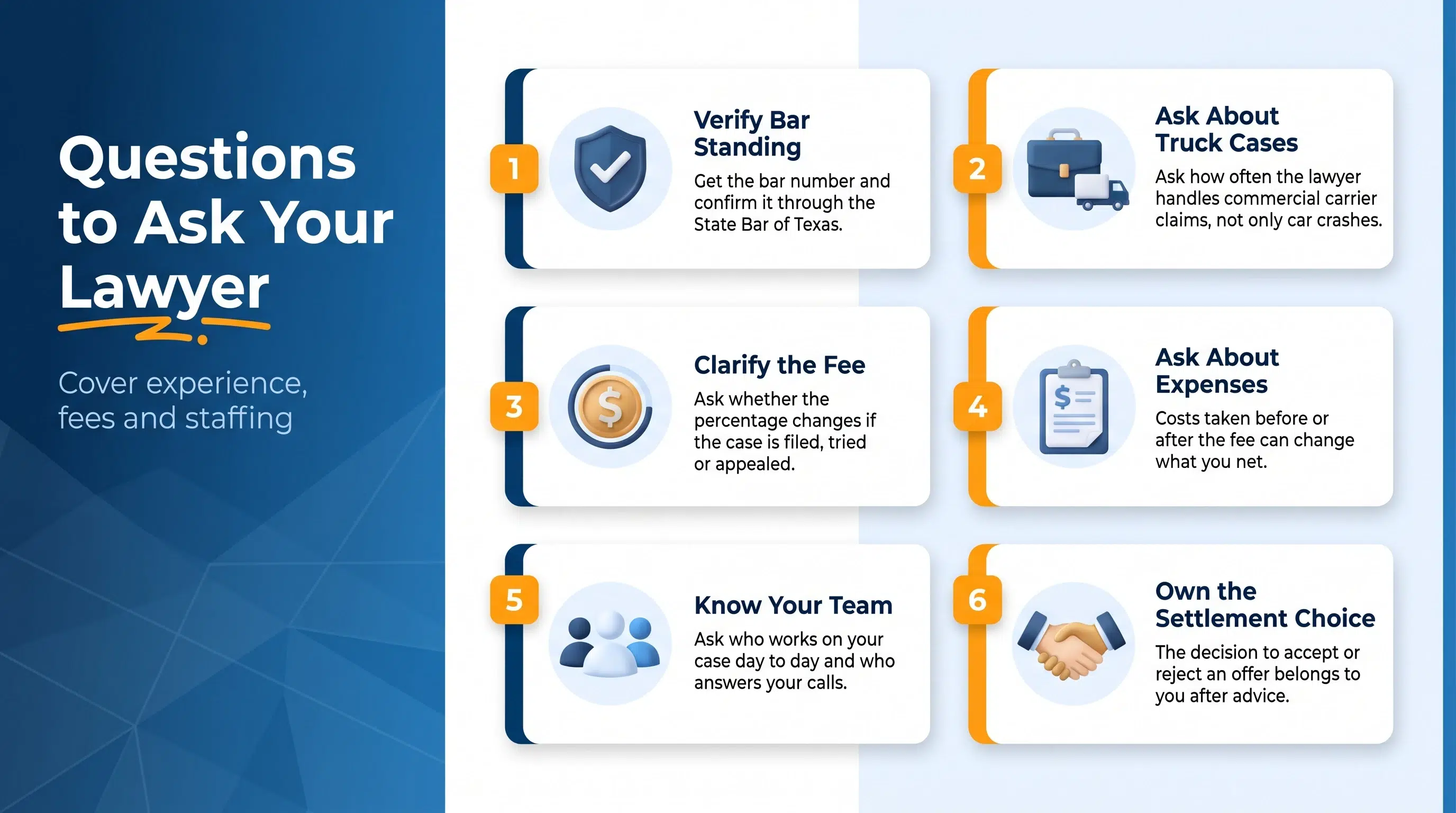
How often do you handle claims against commercial carriers? Ask about the lawyer’s actual involvement with commercial truck matters, not just car crashes. Ask for general descriptions only. Past results do not predict your outcome, and a lawyer should not promise one.
-
Are you licensed in Texas, and in good standing? Ask for the full name and bar number, then confirm through the State Bar of Texas [13].
-
Do you work with accident reconstruction engineers, medical providers and trucking-safety consultants? Heavy-truck cases often require outside technical analysis, and the cost of that analysis should be part of the fee discussion.
-
Do you have board certification or other credentials? The Texas Board of Legal Specialization offers certification in some areas, including personal injury trial law. You can confirm a lawyer’s certification on the board’s website. Credentials are one data point, not a guarantee.
Evidence preservation
-
What will you do in the first week to preserve evidence? Federal rules require carriers to keep driver duty-status records and supporting documents for at least six months [8], and electronic logging device data must also be backed up for six months [9]. Other evidence can disappear much sooner. No federal rule sets how long dashcam video or engine data must be kept, and both can be overwritten once the truck goes back into service. Ask how and when the lawyer will send a written preservation demand.
-
Who investigates the scene? Skid marks, debris and road conditions on a busy corridor can change quickly.
Fees and expenses
-
What is the fee percentage, and does it change if the case is filed, goes to trial, or is appealed? The agreement must state the method by which the fee is determined [5].
-
Are expenses deducted before or after the fee is calculated? Rule 1.04(d) requires the agreement to address this [12]. The difference can change what you net.
-
Who advances expenses, and what happens to them if there is no recovery? Ask for the answer in writing.
-
Will I receive a written closing statement? At the end of a contingent fee matter, the lawyer must give the client a written statement describing how the fee was calculated [12].
-
If another firm will share the fee, do I have to consent in writing? Rule 1.04(f) addresses division of fees between firms and requires the client’s written approval [12].
Staffing and communication
-
Who will actually work on my case day to day?
-
How often will I get updates, and who answers my calls?
-
Who makes the settlement decision? The decision to accept or reject an offer belongs to the client after advice from the lawyer.
Strategy and Texas procedure
-
How does Chapter 72 affect my case? A defendant may ask the court to split the trial into two phases, and if the trucking company admits the driver was its employee acting on the job, the statute can limit what evidence about the company comes in during the first phase [1][2]. Ask how the lawyer plans to prove the driver’s negligence and any separate claims against the company.
-
How will you handle a claim that I was partly at fault? See the proportionate responsibility rules below.
-
Which deadlines apply to my situation? Expect a specific answer based on your facts.

How Does This Apply to a Real Case?
Hypothetical example (not a GoSuits case): A driver is rear-ended by a tractor-trailer in stop-and-go traffic on I-635 near the High Five interchange in the Dallas area. The driver has fractures and misses months of work. Two weeks later, the driver interviews two lawyers. One says only that the fee is “standard” and that evidence can wait. The other explains the fee in writing, describes a plan to send a preservation demand to the carrier, asks about the driver’s medical treatment and employment, and explains the two-year filing deadline and Chapter 72. The second consultation gives the driver far more information to compare. It does not mean any outcome is guaranteed.
The same logic applies on I-45 between Houston and Dallas, on I-10 near Houston, or on the I-35 corridor through San Antonio and Austin. The roadway changes, but the questions about evidence, fees and deadlines stay the same.
What Evidence Can Matter?
Evidence in a truck case can come from several sources, and no single item automatically proves liability. A lawyer’s answer about evidence should be specific.
-
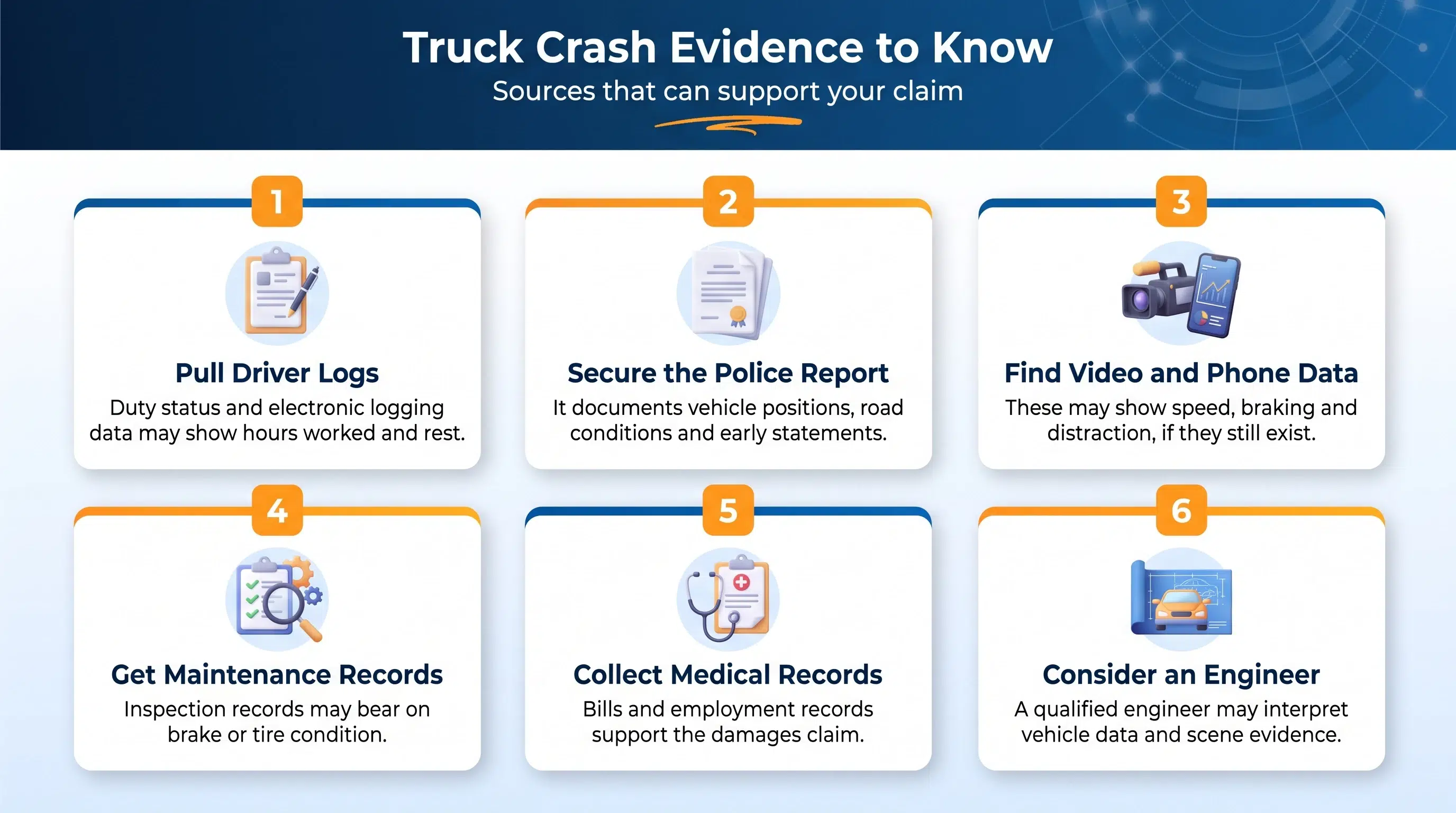
Driver records of duty status and electronic logging data: These may show hours worked and rest. Retention is limited, so timing matters [8].
-
Police crash report and photographs: They document positions, road conditions and early statements.
-
Dashcam, surveillance and cellphone records: They may show speed, braking and distraction, if they still exist.
-
Maintenance and inspection records: They may bear on brake or tire condition.
-
Driver qualification and hiring files: They may matter to claims about the company’s own conduct, though Chapter 72 may limit how and when they are presented [1].
-
Medical records, bills and employment records: They support the damages claim.
-
Accident reconstruction analysis: A qualified engineer may interpret vehicle data and scene evidence.
What Damages or Remedies May Be Available?
Texas law may allow recovery for medical expenses, future medical care, lost income, loss of earning capacity, physical pain, mental anguish, physical impairment, disfigurement, and property damage, depending on the facts. Wrongful death claims have separate categories of damages and different claimants. Exemplary (punitive) damages require clear and convincing evidence of fraud, malice, or gross negligence under Texas Civil Practice and Remedies Code § 41.003. What can be recovered depends on the law, the evidence, and the outcome of the case. A lawyer who names a dollar figure at the first meeting is guessing.
What If the Other Party Disputes Liability?
Trucking companies and their insurers commonly dispute fault, and Texas law makes the dispute consequential. Under Chapter 33, a claimant whose percentage of responsibility is greater than 50 percent may not recover damages [3]. If the claimant is not barred, the court reduces damages by the claimant’s percentage [3]. Defendants may also point to other parties. Ask any lawyer how they would respond if the carrier says you braked suddenly, merged unsafely, or shares blame with another driver.
From the defense side, a driver or company facing a claim should also seek legal counsel promptly. Both sides benefit from early legal guidance, and nothing here replaces advice from a Texas lawyer on your specific situation.
What If Insurance Is Involved?
Insurance often determines what is practically recoverable, so ask how the lawyer will identify every available policy. Federal rules require covered for-hire motor carriers to carry at least $750,000 for nonhazardous property in vehicles of 10,001 pounds or more in interstate or foreign commerce [10]. Proof of that coverage is public information and available on reasonable request [10]. A 2026 FMCSA report to Congress noted that this minimum has not changed since 1985 and that serious crash costs can exceed it [11]. The federal floor is a minimum, not a cap on a carrier’s actual coverage. Carriers operating only within Texas generally must carry at least $500,000 for vehicles over 26,000 pounds (43 Tex. Admin. Code § 218.16). Also ask about your own uninsured/underinsured motorist coverage, health insurance reimbursement claims, and medical liens.
How Long Do I Have to Act?
Most Texas personal injury lawsuits must be filed within two years after the cause of action accrues, under Civil Practice and Remedies Code Section 16.003 [4].For wrongful death, the two years generally run from the date of death [4]. Claims against a governmental entity, such as a city-owned truck, generally require written notice within six months under the Texas Tort Claims Act, and some cities require it sooner (§ 101.101). Exceptions can apply, such as for injured minors (§ 16.001). The evidence-retention window is often shorter than the filing deadline, which is why early contact matters. If a loved one died, the wrongful death lawyers you consult should be able to explain who may bring the claim.
What Should I Do Next?
-
Get medical care and follow treatment instructions.
-
Write down what you remember and keep photos, bills and the crash report number.
-
Avoid recorded statements to the trucking company’s insurer until you have legal advice.
-
Interview more than one lawyer using the questions above.
-
Read the fee agreement fully before signing, and ask for anything unclear to be explained.
-
Calendar the two-year deadline and any earlier notice deadlines with your lawyer.
Related Texas Personal Injury Resources
For a broader overview of injury claims in the state, see our Texas personal injury team. Readers dealing with a serious commercial truck collision can also learn how truck accident lawyers approach these claims. If a crash involved a fatality, the firm’s wrongful death resources may also apply.

Talk With a GoSuits Attorney
A truck injury claim can involve federal records, multiple insurers, liability disputes and Texas deadlines. If you were hurt in a Texas truck crash, you can schedule a free consultation with a GoSuits attorney who can review the circumstances and explain your options. Consult with personal injury lawyers about your specific situation, because outcomes depend on the facts and the law, and no result is guaranteed.
Disclaimer: This article provides general legal information about Texas civil law and is not legal advice. Reading it does not create an attorney-client relationship.
References
-
Texas Disciplinary Rules of Professional Conduct, effective March 7, 2025 – Texas Judicial Branch
-
Texas Government Code Section 82.065, Contract for Legal Services – State Bar of Texas
-
49 CFR 387.9, Financial Responsibility, Minimum Levels – GovInfo
-
Appropriateness of Current Financial Responsibility Requirements, 2026 Report to Congress – FMCSA