Liability for a Texas truck accident can fall on more than one party. Depending on the facts, responsibility may rest with the truck driver, the motor carrier that employed or dispatched the driver, the owner of the tractor or trailer, a maintenance provider, a cargo loader, or a freight broker. Texas law has the fact finder assign a percentage of responsibility to each person who contributed to the crash, and an injured person generally cannot recover damages if found more than 50 percent responsible [1]. Which parties are actually liable depends on proof of negligence, causation, and the employment or control relationship. This article is general legal information, not advice about any specific crash.
Legal Snapshot
-
Legal Topic: Liability for injuries caused by a commercial truck crash in Texas
-
Case Stage: Pre-suit investigation and early claim evaluation
-
Primary Legal Issue: Which parties were negligent, and whether their negligence was a proximate cause of the injuries
-
Primary Authority: Texas Civil Practice and Remedies Code chapters 16, 33 and 72; Werner Enterprises, Inc. v. Blake (Tex. 2025); 49 C.F.R. parts 387 and 395; Montgomery v. Caribe Transport II, LLC (U.S. 2026)
-
Jurisdiction: Texas state law, with applicable federal motor carrier regulations
-
Date Legal Authority Last Reviewed: November 11, 2026 (research date; attorney confirmation of current statutory text is pending)
What Does Liability Mean in a Texas Truck Accident?
In a civil case, liability means a party is legally responsible, through negligence or another recognized theory, for harm that party helped cause. A truck crash is different from an ordinary two-car crash because the vehicle is often part of a business operation. That brings in the employer, the vehicle owner, and sometimes the companies that arranged or loaded the shipment.
The table below lists common parties and the usual theory used against each. Whether any theory succeeds depends on evidence.
|
Possible party |
Common theory |
What usually matters |
|---|---|---|
|
Truck driver |
Negligent driving |
Speed, following distance, distraction, fatigue, compliance with traffic law |
|
Motor carrier / employer |
Respondeat superior; negligent hiring, supervision, entrustment or maintenance |
Employment, course and scope, driver qualification and safety practices |
|
Vehicle or trailer owner / lessor |
Negligent entrustment or maintenance |
Ownership, leases, who controlled the equipment |
|
Maintenance or repair shop |
Negligent repair |
Brake, tire and steering work records |
|
Shipper or loader |
Negligent loading or securing cargo |
Load documents, who loaded, who inspected |
|
Freight broker |
Negligent selection of an unsafe carrier |
Carrier vetting, safety data, broker contracts |
|
Another motorist or third party |
Contributing negligence |
Whether that conduct was a proximate cause |
What Does Texas Law Say?
Texas uses a proportionate responsibility system found in Chapter 33 of the Civil Practice and Remedies Code. Under section 33.001, a claimant may not recover damages if his or her percentage of responsibility is greater than 50 percent [1]. Section 33.003 directs the trier of fact to determine percentages of responsibility, and the list of persons includes responsible third parties designated under section 33.004 [1].
Under section 33.013, a liable defendant is generally liable only for the percentage of damages equal to its own percentage of responsibility. The only other exception covers a defendant who, with the specific intent to do harm, acted with another person to commit certain serious crimes listed in the statute, such as murder or aggravated kidnapping, which rarely applies to a truck crash.
Causation is a separate hurdle. In Werner Enterprises, Inc. v. Blake, 719 S.W.3d 525 (Tex. 2025), the Supreme Court of Texas reversed a verdict of roughly $90 million to $100 million against a trucking company and its driver. It held that proximate cause requires a substantial factor, not only a but-for connection [10]. The truck in that case was on I-20 near Odessa when a pickup that lost control on ice crossed the median. The Court concluded the truck driver’s conduct was not a proximate cause of the injuries [11]. The Court also held that an employer cannot be liable on direct or derivative theories if the employee’s conduct is not a proximate cause [11], while leaving in place Texas practice that lets plaintiffs pursue direct and vicarious theories together [10].
The practical lesson is that a truck’s involvement in a crash is not enough on its own. The claim must connect a specific negligent act or omission to the harm.
What Legal Rules Apply?
Several layers of law can apply to one truck crash. Keeping them separate helps explain who may be liable.
Texas state law, trial procedure. n a lawsuit involving a commercial truck, the trucking defendant can ask the court to split the trial into two phases [4]. Under section 72.052 of the Civil Practice and Remedies Code, the first phase decides fault and compensatory damages, and the second decides any exemplary (punitive) damages [5]. The defendant must ask early, generally within 120 days after filing its answer.
If the trucking company admits the driver was its employee acting on the job, and does so early in the case, the company is liable for the driver’s ordinary negligence only through that employment relationship [6]. This can keep some evidence, such as evidence about whether the company should have hired or trusted the driver, out of the first phase of trial, with exceptions for companies covered by federal or state trucking safety rules [6]. Claims based on the company’s own mistakes, such as poor truck maintenance, and claims for punitive damages can still go forward (§ 72.054(f)).
Federal law, safety regulations. Federal Motor Carrier Safety Administration rules set standards that can help show what a reasonable carrier or driver should have done. For drivers hauling property, 49 C.F.R. section 395.3 limits driving to 11 hours within a 14-hour window, after 10 consecutive hours off duty [7] [8]. A violation is important evidence, but it does not by itself prove that the violation caused the crash.
Federal law, brokers. On May 14, 2026, the U.S. Supreme Court unanimously held in Montgomery v. Caribe Transport II, LLC, No. 24-1238, that federal law does not block a state-law claim that a freight broker negligently hired an unsafe trucking company [12]. The decision does not make brokers automatically liable. An injured person still must prove the broker failed to use reasonable care in choosing the carrier [12] [13]. The Court also left open how the ruling applies to loads moved entirely within one state, so how a Texas court handles a broker claim depends on the facts and requires attorney review.
How Does This Apply to a Real Case?
Hypothetical example (not a GoSuits case). A tractor-trailer hauling retail freight is in stop-and-go traffic on I-35E near downtown Dallas. The driver, near the end of a long shift, fails to slow and strikes the back of a sedan. The driver was employed by a regional carrier. The load was arranged by a freight broker. The carrier had been cited previously for hours-of-service problems.
An injury lawyer would look at several questions. Was the driver negligent in following distance or attention? Was the driver acting in the course and scope of employment, so the carrier answers for that negligence? Did the carrier’s dispatch or supervision practices contribute? Did the broker have information that made the carrier an unreasonable choice? If the sedan driver braked suddenly for no reason, the defense may seek a percentage of responsibility against that driver under Chapter 33. Each answer turns on records and testimony, not assumptions.
Congestion on corridors such as I-35E, I-635 (LBJ Freeway) and US-75 in Dallas is a familiar setting for rear-end and lane-change collisions involving large trucks. Those general conditions do not decide fault in any particular crash.
What Evidence Can Matter?
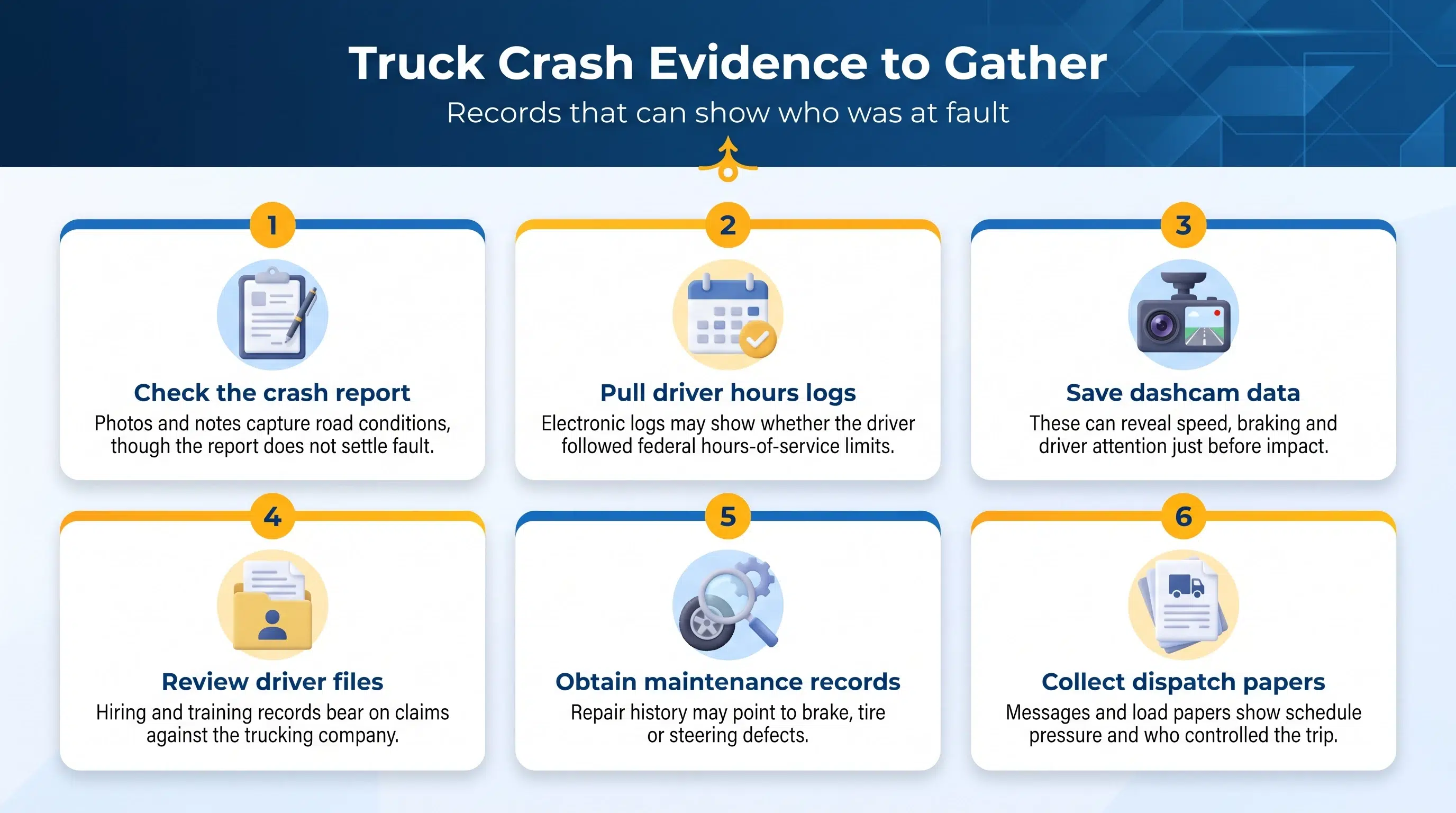
Truck cases often depend on records held by the defendants, and some of those records can be overwritten or discarded. Categories that may matter include:
-
Police crash report and scene photographs: They document positions, road conditions and initial statements, though the report is not conclusive on fault.
-
Electronic logging device and hours-of-service records: They may show whether the driver complied with 49 C.F.R. part 395 [7].
-
Vehicle event data and dashcam video: They can show speed, braking and driver attention in the seconds before impact.
-
Driver qualification and training files: They bear on negligent hiring, supervision and entrustment theories, which Chapter 72 may affect at trial [6].
-
Maintenance and inspection records: They may show brake, tire or steering defects and who was responsible for repairs.
-
Dispatch messages, load documents and carrier contracts: They show schedule pressure, who controlled the trip, and the relationship among carrier, broker and shipper.
-
Witness statements and surveillance video: They help establish how the collision happened.
-
Medical records, bills and employment records: They support the nature and cost of the injuries and income loss.
No single item proves liability. Evidence is weighed together, and a qualified accident reconstruction witness may be needed to interpret technical data.

What Damages or Remedies May Be Available?
Texas law recognizes compensatory damages that may include past and future medical expenses, lost income, loss of earning capacity, physical pain, mental anguish, physical impairment, disfigurement, and property damage. Recoverability depends on the facts and on the applicable law, and any award may be reduced by the claimant’s percentage of responsibility under Chapter 33 [1].
Exemplary (punitive) damages may be available only in limited cases, and Texas law sets strict standards and caps for them (Tex. Civ. Prac. & Rem. Code ch. 41). When a crash is fatal, the surviving spouse, children, and parents may bring a wrongful death claim, and the estate may bring a survival claim for what the person who died suffered before death (Tex. Civ. Prac. & Rem. Code §§ 71.004, 71.021). Families in that situation often consult wrongful death lawyers early because the evidence and deadlines overlap with the injury case.
What If the Other Party Disputes Liability?
Disputes are common in truck cases. Defendants may argue that the injured person was more than 50 percent responsible, that a third party caused the crash, or that their own conduct was not a proximate cause under Werner [10]. A defendant may designate a responsible third party under section 33.004, which can shift some percentage away from it [1].
An employer may also stipulate to employment and scope under section 72.054, then ask the court to limit phase one evidence [6]. If the driver was an independent contractor or leased to the carrier, the defense may argue the carrier lacked control. In interstate trucking, that defense often fails. Federal leasing rules require the carrier to take exclusive control of, and complete responsibility for, leased equipment (49 C.F.R. § 376.12(c)(1)), and Texas courts have treated drivers under such leases as the carrier’s statutory employees (Morris v. JTM Materials, Inc., 78 S.W.3d 28 (Tex. App.—Fort Worth 2002)). The outcome still depends on the lease and the actual working relationship.
What If Insurance Is Involved?
Insurance is usually a central issue because a truck crash may involve several policies. Federal regulations set a minimum level of financial responsibility. For a for-hire carrier moving nonhazardous property across state lines in a vehicle rated at 10,001 pounds or more, the minimum is $750,000 [9], with higher minimums for certain hazardous materials [3]. Carriers operating only within Texas generally must carry at least $500,000 for vehicles over 26,000 pounds (43 Tex. Admin. Code § 218.16). These figures are floors, not caps on what a court may award [3].
Other coverage may include excess or umbrella policies, policies held by a broker or shipper, and the injured person’s own uninsured or underinsured motorist coverage. Insurers may also assert liens or reimbursement rights tied to medical bills. Because adjusters evaluate claims with the defense in mind, many people choose to speak with a lawyer before giving recorded statements about a truck crash.
How Long Do I Have to Act?
Most Texas personal injury suits must be filed within two years after the cause of action accrues under Civil Practice and Remedies Code section 16.003(a). For injury resulting in death, section 16.003(b) also provides two years, measured from the date of death [3]. Exceptions can apply, such as for injured minors (§ 16.001), so confirm the deadline for your case with an attorney.
Shorter deadlines can apply in some situations. A claim against a city, county, or other governmental unit generally requires written notice within six months, and some cities require it sooner (Tex. Civ. Prac. & Rem. Code § 101.101). Insurance policies may also set reporting requirements. In addition, waiting can limit a defendant’s ability to name a responsible third party, which can change who is available to share fault [1]. A lawsuit is generally filed in the county where the crash happened or where a defendant lives or has its main Texas office (Tex. Civ. Prac. & Rem. Code § 15.002). For a crash in Dallas County, that is often Dallas County District Court, which sits in the George L. Allen Sr. Courts Building.What Should I Do Next?
-
Get medical care and follow the treatment plan so injuries are documented.
-
Keep photographs, the crash report number, insurance information and the names of witnesses.
-
Write down what you remember while it is fresh, and avoid posting about the crash on social media.
-
Keep records of medical bills, missed work and out-of-pocket costs.
-
Talk with a lawyer promptly so preservation requests can go to the carrier and other companies before records are lost. Truck cases involve many parties and technical rules, and handling them without a lawyer can put your claim at risk.
Related Texas Personal Injury Resources
GoSuits publishes information for people hurt in Texas crashes, including its Texas personal injury resources. For truck cases in North Texas, you can also review the Dallas truck-crash team page. Cities such as Plano, Frisco, Carrollton and Fort Worth are part of the same North Texas freight and commuter region. Related topics to read next include evidence preservation after a commercial vehicle crash, how Texas proportionate responsibility reduces recovery, and how insurance coverage is identified in multi-party crashes.
Talk With a GoSuits Attorney
A truck accident claim can involve federal safety records, several insurers, disputed fault and a short filing deadline. If you were injured in a Texas truck crash, a GoSuits attorney can review the circumstances and explain your options. Our Dallas truck accident lawyers handle these claims, and you can schedule a free consultation. Past outcomes do not guarantee a similar result in any other case.
This article provides general information about Texas and applicable federal law and is not legal advice. Reading it does not create an attorney-client relationship. Laws change, and a licensed attorney should review your specific facts.
References
-
Civil Practice and Remedies Code, Chapter 33, Proportionate Responsibility – Texas Statutes
-
Civil Practice and Remedies Code Section 33.013, Amount of Liability – Public.Law
-
Civil Practice and Remedies Code, Chapter 16, Section 16.003 – Texas Statutes
-
House Bill 19 Bill Analysis, 87th Legislature – Texas Legislature Online
-
House Bill 19 Fiscal Note (introduced version), 87th Legislature – Texas Legislature Online
-
49 CFR 387.9, Financial Responsibility, Minimum Levels – eCFR
-
The Road Ends at Proximate Cause: Werner Enterprises v. Blake – Cooper and Scully
-
Texas Supreme Court Clarifies Proximate Cause in Catastrophic Highway Accident – Akerman
-
From Preemption to Ordinary Care: Broker Liability After Montgomery – Cooper and Scully
-
Supreme Court Ruling Reshapes Freight Broker Liability – Adams and Reese