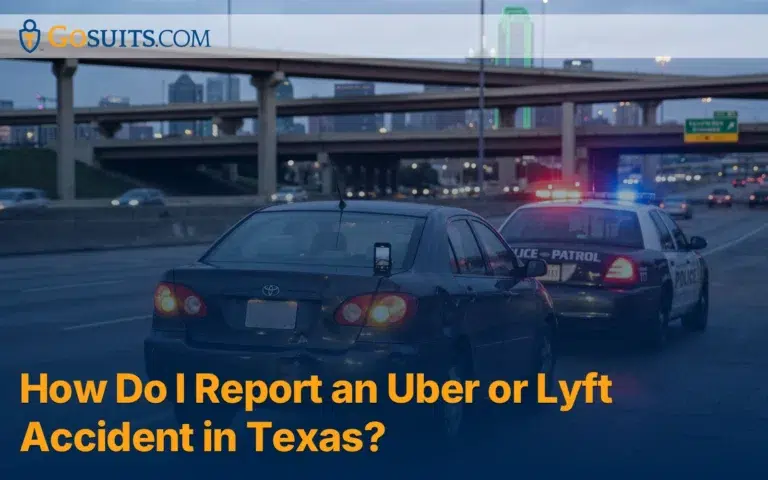
In Texas, a rideshare crash is generally reported in three separate places: to law enforcement, to Uber or Lyft through the company’s crash-reporting tools, and to the relevant insurers. Texas Transportation Code § 550.026 requires the driver of a vehicle involved in a collision that causes injury, death, or damage that keeps a vehicle from being driven normally and safely to notify police or the sheriff immediately [2]. Reporting to Uber or Lyft is a company process, not a statute, and it does not replace the police report. None of these steps decides who is legally at fault, and a report does not guarantee any recovery. This article covers civil claims only and is general information, not legal advice.
Legal Snapshot
-
Legal Topic: Reporting a rideshare (Uber or Lyft) collision in Texas
-
Case Stage: Immediately after the crash and the early claim-opening period
-
Primary Legal Issue: Police notification duties, crash-report access, and which rideshare insurance coverage applies
-
Primary Authority: Texas Transportation Code Chapter 550; Texas Insurance Code Chapter 1954; Texas Civil Practice and Remedies Code § 16.003
-
Date Legal Authority Last Reviewed: November 10, 2026 (secondary and official sources reviewed; attorney verification against current statutes recommended, see flags below)
What Does “Reporting” a Rideshare Accident Mean?
Reporting a rideshare accident means notifying three different audiences, each for a different reason. Police create the official crash record. Uber or Lyft opens an internal incident and insurance claim file. Insurers, including your own, may need notice under the terms of the policy. A person can complete one step and miss another, so it helps to treat them separately.
These steps apply whether you were a rider, a rideshare driver, the driver of another vehicle, a pedestrian, or a cyclist. Uber states on its crash page that everyone involved in a crash should file a report with the company [12].
What Does Texas Law Say About Reporting a Crash?
Texas law places a prompt-notification duty on drivers and a separate report-filing duty on investigating officers. Under Transportation Code § 550.026, the operator of a vehicle in a collision involving injury, death, or vehicle damage to the extent it cannot be normally and safely driven must immediately, by the quickest means of communication, notify the local police department if the crash occurred in a municipality, the police or sheriff if it occurred within 100 feet outside municipal limits, or otherwise the sheriff’s office or the
Separately, an officer who investigates a collision must write a report if it caused injury or death or at least $1,000 in apparent property damage, and must file it electronically with the Texas Department of Transportation (TxDOT) by the tenth day after the crash [1].
TxDOT has stated that it no longer retains the driver-completed form formerly known as the CR-2, so the officer’s CR-3 is the report people typically obtain [4]. The section that required drivers to file that written report, former § 550.061, was repealed effective September 1, 2017 [1].]
Who to notify, and when
|
Who |
Why |
Timing |
|---|---|---|
|
911 / local police or sheriff |
Medical help, scene safety, official crash report |
Immediately when injury, death, or a non-drivable vehicle is involved |
|
Uber or Lyft |
Opens the company incident and insurance claim file |
As soon as it is safe and reasonable |
|
Your own auto insurer |
Policy notice conditions; possible personal injury protection or uninsured/underinsured motorist coverage |
Check your policy; many require prompt notice |
|
A personal injury attorney |
Evidence preservation, insurer communications, deadline tracking |
Before giving recorded statements or accepting an offer |
How Do I Report the Crash to Uber or Lyft?
Both companies run reporting tools inside their apps and online, and menu names change, so confirm the current path in your app. As of the sources reviewed, Uber’s help center directs drivers to the Driver app’s “Report a crash” option, with a Safety Incident Reporting Line available for speaking with support staff [11]. Uber’s crash page also says riders can reach the Safety Incident Reporting Line from the Ride Details screen in the Activity section of the app [12].
Lyft offers a crash-report option through the Help section of its app and an online accident form.
When reporting, stick to verifiable facts: date, time, location, the vehicles involved, any police report number, and your injuries as you currently understand them. Avoid guessing about fault or speed. Notes you submit may later be requested by an insurer, so many people have a lawyer review what they plan to say if the crash was serious.
Uber’s help page says drivers generally do not need to notify a personal insurer unless they have a relevant policy endorsement [11]. That statement describes Uber’s process, not Texas law, and your policy’s notice terms may differ.
What Legal Rules Apply to Rideshare Insurance in Texas?
Texas Insurance Code Chapter 1954 sets insurance requirements for transportation network company (TNC) drivers, and the amount available often depends on what the driver was doing in the app at the moment of impact. A TNC driver, or the company on the driver’s behalf, must maintain primary automobile insurance covering the driver while logged on to the digital network or engaged in a prearranged ride [5].
|
Driver status at impact |
Coverage generally described in Texas law |
|---|---|
|
App off |
The driver’s personal auto policy only |
|
Logged on, available, no ride accepted |
Lower statutory minimums: $50,000 per person, $100,000 per incident, and $25,000 property damage under § 1954.052 |
|
Prearranged ride |
At least $1 million total for death, bodily injury, and property damage per incident under § 1954.053 [6] |
Texas lawmakers considered a 2025 bill (89th Legislature, HB 3520) to clarify how § 1954.052 and § 1954.053 apply when a driver is en route with no rider in the vehicle [9]. The bill passed the House but did not become law, and its Senate companion (SB 2319) did not advance, so both sections remain as originally enacted.
Two other provisions matter in practice. If a driver’s policy has lapsed or falls short of the required coverage, the TNC must provide the required coverage beginning with the first dollar of a claim against the driver [7]. And an insurer may exclude from a personal auto policy losses that occur while the driver is logged on to a TNC network or engaged in a prearranged ride [8]. The 2015 bill analysis for Chapter 1954 also notes drivers must carry proof of insurance and, on request, disclose whether they were logged on or in a ride at the time of an accident [10]. Both duties appear in Texas Insurance Code § 1954.056.
Proof of financial responsibility more broadly is governed by Transportation Code Chapter 601 [15].
How Does This Apply to a Real Case?
Hypothetical example (not a GoSuits case): A rider in an Uber is hit in stop-and-go traffic on I-35 in Austin and feels neck pain a few hours later. The driver has a minor scrape and wants to leave. Because the rider reports pain, the driver’s duty to notify police is triggered under § 550.026, and the rider can call 911 as well. The rider screenshots the trip receipt and driver details before leaving, reports the crash through Uber’s rider tools, and later buys the CR-3 once TxDOT has it. The rider’s trip status, accepted and in progress, points toward the higher coverage tier.
Hypothetical example (not a GoSuits case): A Lyft driver with no passenger is struck at the High Five interchange in Dallas while logged on and waiting for a request. A different tier of coverage could apply than if a ride had been accepted, which is why app data showing the exact status at impact can become important.
How Do I Get the Texas Crash Report?
Most Texas crash reports are purchased online through TxDOT’s Crash Records Information System (CRIS). The Texas Transportation Code sets the copy fee at $6, and TxDOT lists $8 for a certified copy, plus possible card processing fees [4]. Because officers have until the tenth day to file, a report may not appear right away.
Texas treats crash reports as confidential. Section 550.065 allows release of the full report to people directly concerned in the collision or with a proper interest, and TxDOT’s purchase system provides redacted versions to other buyers [3]. Rideshare crashes may involve multiple drivers, a passenger, and several insurers, so confirm which version you are eligible to receive.

What Evidence Can Matter?
Evidence matters because it helps show what happened, who was responsible, and what the injuries cost. No single item proves liability on its own.
-
Police report and officer information: records the officer’s observations, parties, insurers, and citations, though it is not the final word on fault.
-
App and trip data: timestamps, trip status, GPS, and receipts can show whether a ride was accepted or in progress, which affects coverage.
-
Photos and video: scene, vehicle damage, road conditions, dashcam footage, and nearby business or traffic cameras that may be overwritten quickly.
-
Witness details: names and phone numbers of other riders, drivers, and bystanders.
-
Medical records and bills: link injuries to the crash and document treatment costs.
-
Employment records: support claims for missed work or reduced earning ability.
-
Insurance documents: declarations pages and claim correspondence.
-
Vehicle data: event data recorder information, which may be lost if the vehicle is repaired or scrapped.
What Damages or Remedies May Be Available?
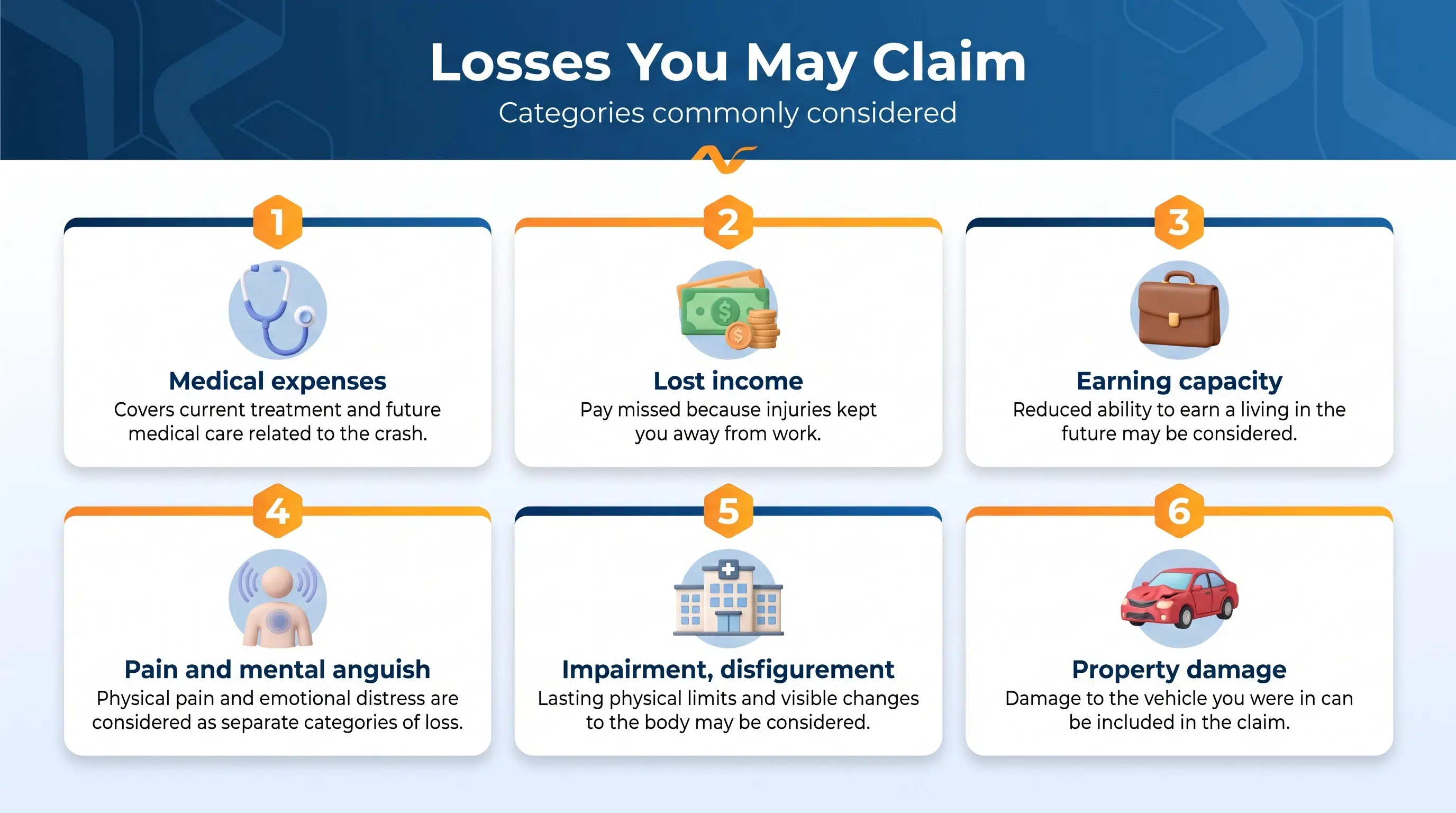
A civil claim after a Texas rideshare crash may seek compensation for several categories of loss, but what is recoverable depends on Texas law and the facts. Categories commonly considered include medical expenses, future medical care, lost income, loss of earning capacity, physical pain, mental anguish, physical impairment, disfigurement, and property damage. If a crash is fatal, a wrongful death claim by eligible family members may be available. Exemplary (punitive) damages are limited and require specific findings (Tex. Civ. Prac. & Rem. Code §§ 41.003, 41.008). Outcomes cannot be predicted or promised.
What If the Other Party Disputes Liability?
Disputes are common, especially when several drivers and a rideshare company are involved. Texas applies proportionate responsibility rules under Civil Practice and Remedies Code Chapter 33, which reduce recovery by a claimant’s percentage of fault and bar recovery if that percentage is greater than 50 percent [14].
Uber and Lyft may also argue that drivers are independent contractors. Texas Occupations Code Chapter 2402 addresses the relationship between TNCs and their drivers, and § 2402.114 treats a driver as an independent contractor when certain conditions are met. That framework can shape which parties may be responsible. Which parties a claim can reach, whether the company, the driver, another motorist, or several of them, is a fact-specific question for an attorney.
What If Insurance Is Involved?
Insurance is almost always involved, and more than one policy may be in play. Possible sources include the rideshare company’s coverage, the rideshare driver’s personal policy, the at-fault driver’s policy, and your own policy’s personal injury protection or uninsured/underinsured motorist coverage (Tex. Ins. Code §§ 1952.101, 1952.152).
An adjuster may request a recorded statement soon after your report. You are not required to simply accept early characterizations of your injuries or the crash. A lawyer can handle communications, which matters because early statements and quick settlement offers can affect a personal injury claim later.
How Long Do I Have to Act?
Most Texas personal injury lawsuits must be filed within two years after the claim accrues under Civil Practice and Remedies Code § 16.003(a), and wrongful death suits within two years after the death under § 16.003(b) [13]. Exceptions exist, for example for minors (§ 16.001). A report to Uber, Lyft, or an insurer does not stop that clock. Only filing suit protects the claim under the statute, so speak with a lawyer well before the second anniversary of the crash.
Insurance policies and company claim procedures may impose their own notice requirements that are much shorter. Check your policy and report the crash promptly.
What Should I Do Next?
-
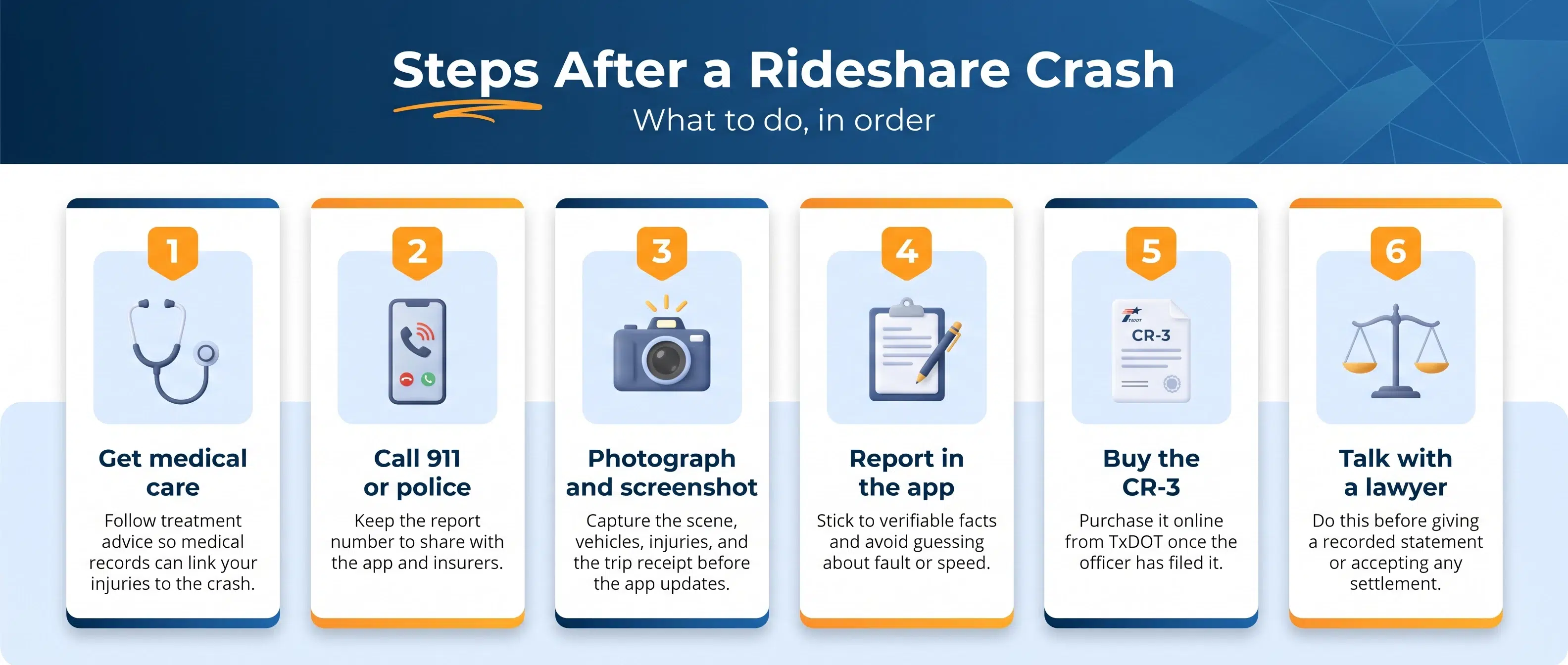
Get medical care and follow treatment recommendations.
-
Call 911 or the local police or sheriff, and save the report number.
-
Photograph the scene, vehicles, and your injuries, and collect witness contacts.
-
Screenshot the trip receipt, driver name, plate, and app status before the app updates.
-
Submit a factual crash report through the Uber or Lyft app or website.
-
Review your own policy’s notice terms.
-
Buy the CR-3 from TxDOT once it is available.
-
Talk with a lawyer before giving a recorded statement or accepting a settlement.
Representing yourself against a rideshare company and its insurers is risky. These cases can involve layered coverage and disputed liability, so getting legal help early is strongly advised.
Related Texas Personal Injury Resources
For a broader overview, see the GoSuits Texas personal injury resource page. If your claim arises from a rideshare crash, our Texas rideshare accident team page explains how these claims are typically evaluated. Texas personal injury lawyers can review how a rideshare crash fits within Chapter 1954, while rideshare accident lawyers can explain coverage tiers. Related situations include car accident lawyers for collisions with other drivers and wrongful death lawyers if a crash proves fatal.

Talk With a GoSuits Attorney
A rideshare crash can involve police records, app data, multiple insurers, liability disputes, and legal deadlines. If you were hurt in a Texas crash involving Uber or Lyft, you can schedule a free consultation so a GoSuits attorney can review the circumstances and explain your options. No outcome is guaranteed.
This article is general legal information, not legal advice, and does not create an attorney-client relationship.
References
-
Texas Transportation Code, Chapter 550 (Collisions and Collision Reports) – Texas Legislature
-
Texas Transportation Code § 550.026, Immediate Report of Collision – FindLaw
-
Crash Reports and Records – Texas Department of Transportation
-
Texas Insurance Code § 1954.051, General Insurance Requirement – Justia
-
Texas Insurance Code § 1954.053, Insurance Requirements During Prearranged Rides – FindLaw
-
Texas Insurance Code § 1954.054, Lapse of or Insufficient Coverage – FindLaw
-
Texas Insurance Code § 1954.151, Authorized Exclusions from Coverage – FindLaw
-
HB 3520 (89th Legislature) Bill Analysis – Texas Legislature
-
HB 1733 (84th Legislature) Bill Analysis – Texas Legislature
-
Texas Civil Practice and Remedies Code, Chapter 16 – Texas Statutes Online
-
Texas Civil Practice and Remedies Code, Chapter 33 – Texas Statutes Online
-
Texas Transportation Code, Chapter 601 – Texas Statutes Online