

















How pedestrian crashes happen in Dallas
Dallas is wide. It covers hundreds of square miles, it is crossed by freeways, tollways and a light rail system, and many of its busiest streets were designed for traffic first. A person on foot in Deep Ellum, on McKinney Avenue in Uptown, along Lower Greenville or in Bishop Arts is often fine, but a few blocks away the sidewalk may end, the lighting may fade and the speed limit may rise.
The city has looked at this directly. Dallas adopted a Vision Zero Action Plan in 2022 as part of a goal to reach zero traffic deaths and cut severe injuries in half by 2030. The City’s own briefing materials say about 8 percent of non-freeway streets account for 60 percent of severe crashes, and that crashes involving a person on foot make up 36 percent of the severe ones. Those are not the figures of a small problem.
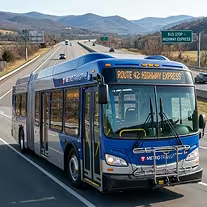
Some local settings come up often. Downtown, pedestrians cross Main, Elm and Commerce Streets near DART light rail stops, where trains, buses, cars and delivery vehicles share tight blocks. Deep Ellum and Lower Greenville fill with people on weekend nights, and drivers who have been drinking leave the same blocks. Around Fair Park, the State Fair of Texas draws large crowds each fall. Near the American Airlines Center and the Cotton Bowl, game-day crowds cross streets that were not built for them. On Oak Cliff arterials such as Jefferson Boulevard and Lancaster Road, residents cross wide, fast roads to reach bus stops and stores.
Weather plays a part. Summer heat pushes more walking into early mornings and late evenings, when light is low. A rare ice storm can leave drivers unable to stop, and daylight ends early in late fall and winter, when TxDOT has reported that pedestrian deaths rise statewide.
What Texas law says about drivers and pedestrians
The Transportation Code gives pedestrians a right of way in specific situations. Section 552.003 requires drivers to yield to a person in a crosswalk when no working traffic signal is controlling the crossing and the pedestrian is in the driver’s half of the road or close enough to be in danger. Section 552.008 adds a general duty to use due care to avoid hitting pedestrians.
A pedestrian who crosses at a point other than a crosswalk must yield to vehicles under section 552.005. That is the rule insurers cite, and it can become a fight over what the driver could have seen and avoided. A driver on Dallas’s wide streets who was speeding, distracted or looking down at a phone has not used due care just because the person was outside the lines.
Texas follows proportionate responsibility. A jury divides fault by percentage, your award is reduced by your share, and you recover nothing if your share is above 50 percent. In a close case, a few points of fault can decide everything.
Common situations in Dallas pedestrian cases
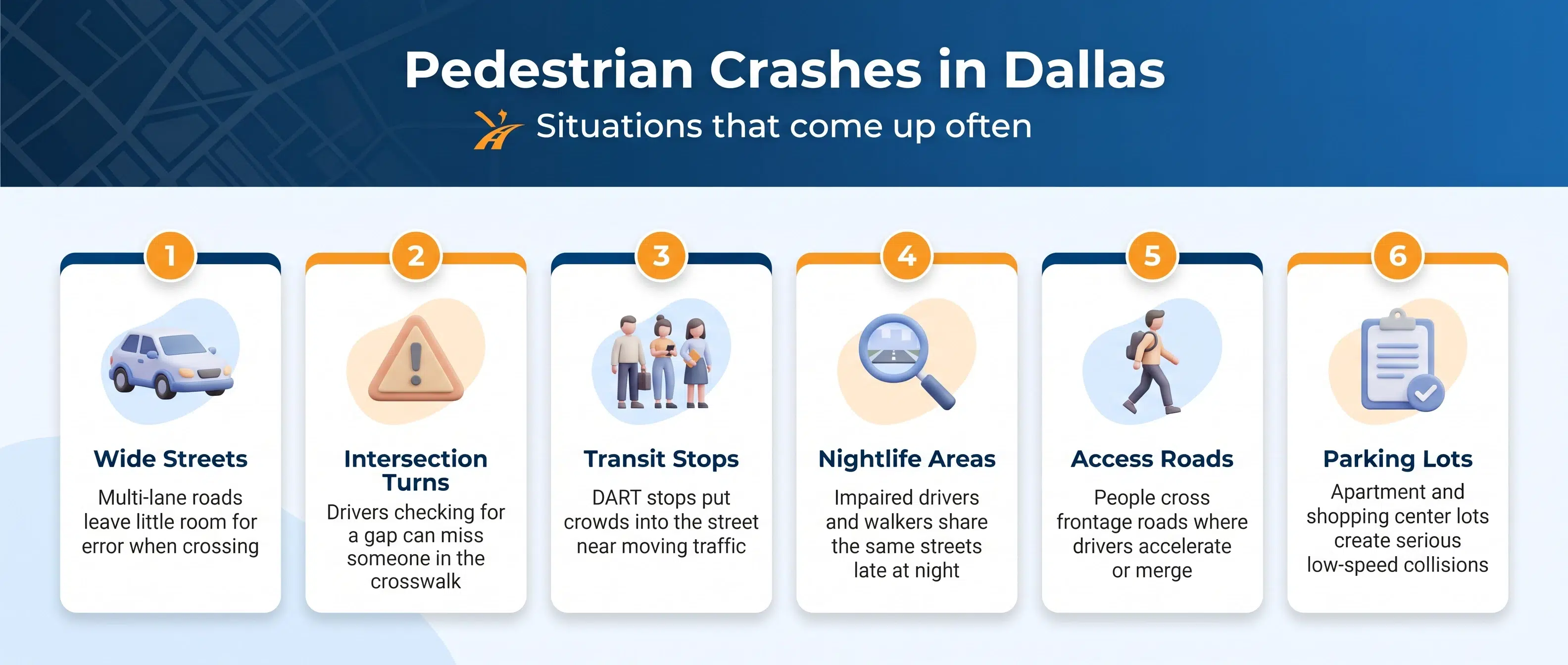
- Crossing wide streets: Multi-lane roads with 40 mile per hour traffic leave little room for error, and a driver in the second lane may not see someone who stepped out from behind a stopped vehicle.
- Turns at intersections: Drivers checking for a gap can miss someone in the crosswalk, a problem on busy downtown and Uptown corners.
- Light rail and bus stops: DART stops put crowds into the street. Claims involving a transit agency have special notice rules.
- Nightlife areas: Impaired drivers and impaired walkers share the same streets late at night. Fault can be argued both ways.
- Freeway access roads and frontage roads: Along I-35E, I-30, US-75 and I-635, people cross access roads where drivers are accelerating or merging.
- Apartment complexes and shopping centers: Parking lots and driveways create backing crashes and low-speed collisions with serious injuries.
- Hit-and-run: When a driver flees, the claim often turns to your own uninsured motorist coverage, and video from nearby businesses may be the only way to find the car.
We examine each of these settings differently. Lighting, signal timing, sight lines and the driver’s speed all come up.
Who may be responsible besides the driver
If a driver was working at the time, the employer may be responsible. That covers delivery drivers, contractors and anyone in a company vehicle, and rideshare companies carry added coverage in some circumstances. A property owner who ignored a broken light or a hazardous layout can share blame.
When a signal malfunctioned, a crossing was poorly designed or a road was in disrepair, a city or transit agency may be a defendant. Claims against a Texas governmental unit fall under the Tort Claims Act, which generally requires written notice within six months and puts limits on damages. A city charter may set its own notice period, and the City of Dallas has a Notice of Claim process, so confirm the requirements promptly.
Texas requires drivers to carry only $30,000 in liability coverage per person. A hospital stay can exceed that, so we look at other sources: your own uninsured and underinsured motorist coverage and personal injury protection (PIP), which Texas insurers must offer and you keep unless you rejected them in writing, plus a household member’s policy and an employer’s policy. PIP can pay medical bills and lost wages regardless of fault.
The injuries behind these cases
Someone on foot has nothing between them and a vehicle. NHTSA reports that pedestrians made up 18 percent of traffic deaths in the United States in 2023. Statewide, TxDOT counted 810 pedestrian deaths in Texas that year.
Most injuries come in two stages. The bumper strikes the legs, causing fractures to the shin, knee and pelvis. Then the body hits the hood or pavement, which is how head, neck and back injuries occur. Brain injuries can be subtle at first. A person who feels fine on the sidewalk can have a serious problem hours later.
The effects reach beyond the hospital stay. Someone who works on their feet in a restaurant, a warehouse or a construction site may not be able to return. Others lose the ability to drive for weeks. The claim should describe that, not just the first bills.
What goes into the value of a Dallas pedestrian claim
- Medical costs: Ambulance, emergency room, surgery, hospital stays, rehabilitation and the future treatment your doctors expect.
- Lost income: Time away from work and reduced earning ability.
- Pain and loss of normal life: Texas does not cap these damages in a typical pedestrian case. Consistent documentation gives them weight.
- Shared fault: Reduced by your percentage and barred above 50 percent.
- Coverage: The driver’s policy, employer coverage and your own PIP and UM/UIM.
- Liens: Health insurers and providers that treated on a lien may seek repayment. We negotiate these balances so more of the recovery goes to you.
When a pedestrian dies, a spouse, children or parents may bring a wrongful death claim in Texas. Our wrongful death lawyers can explain who may file and the deadline.
What to do after you are hit in Dallas
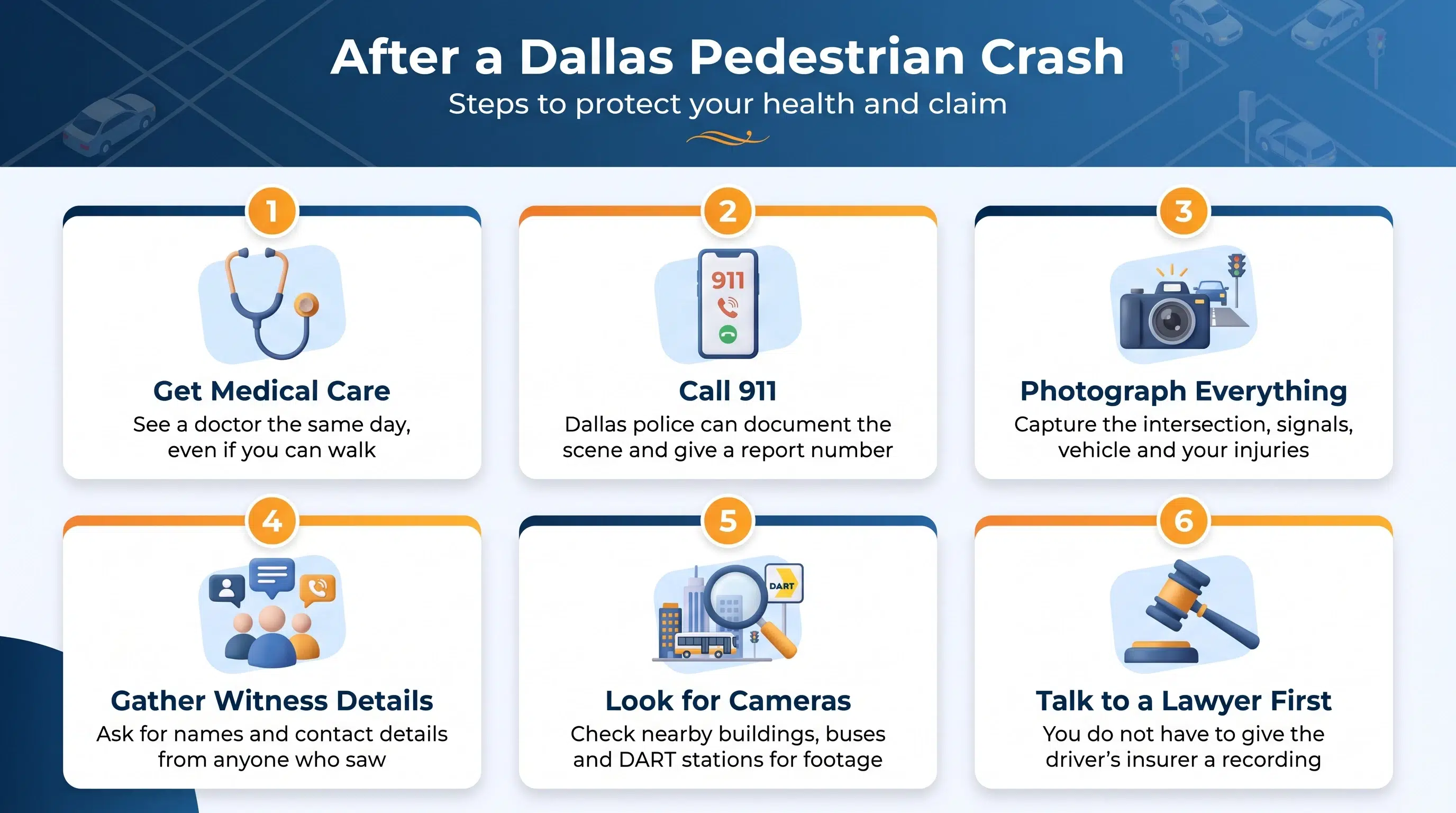
Get medical care the same day. Call 911 so Dallas police can document the scene, and ask for the report number. Take photographs of the intersection, the signals, the vehicle and your injuries, and ask witnesses for their contact details. Look for cameras on nearby buildings, buses and DART stations.
You do not have to give the driver’s insurer a recorded statement. Talk to a lawyer first. Our attorneys handle the insurer, and GoSuits investigators go to the scene to look for video. Our Texas office is in Carrollton, serving Dallas, at 3234 Commander Dr, Suite 800. You can read how fault gets argued in our guide on proving right of way after a Dallas intersection crash, and our Dallas personal injury team is available to talk with you.
Related pages include our car accident lawyers, truck accident lawyers and the statewide Texas pedestrian accident lawyers page.