





























Why the first weeks matter in a Texas pedestrian case
Texas drivers who hit someone on foot often tell the officer the same thing: the person came out of nowhere. That version goes into the CR-3 crash report, and insurers read it before they read anything else. If it is wrong, the time to correct it is early, while the intersection still looks the way it did and the people who saw the crash still remember it.
Video is the next problem. Businesses along a Texas arterial, school buses, city buses and doorbell cameras can all capture a crash, and most of them record over themselves on a short cycle. A written preservation request sent in the first days gives that footage a real chance of surviving. The car matters as well. Many newer vehicles log speed and braking in the seconds before impact, and that data can disappear once the car is repaired or sold for salvage.
Then there is your own health. Bruising fades, swelling goes down, and a head injury can look minor for a day or two. Photographs from the first week and steady medical records tell the story that your body will stop telling. Insurers look hard at gaps between the crash and the first appointment.
Texas gives most people two years from the date of the crash to file a personal injury lawsuit. Claims against a city, county or transit agency are different. Under the Texas Tort Claims Act, written notice generally has to reach the government within six months, and a city charter can set its own notice rules. If a public road, a missing signal or a government vehicle played a part, do not wait to find out which deadline applies.
What does Texas law say about drivers and people on foot?
The Transportation Code gives drivers specific duties. Under section 552.003, a driver must yield to a pedestrian in a crosswalk when there is no working traffic signal and the person is in the driver’s half of the road or close enough to be in danger. Section 552.008 adds a general duty to use due care to avoid hitting a pedestrian, and that duty does not disappear because the person was outside a crosswalk.
Pedestrians have duties too. A person crossing somewhere other than a crosswalk is expected to yield to vehicles under section 552.005. That rule is where insurers start, and it is also where many claims are won or lost, because the question is rarely whether the pedestrian was in the perfect spot. It is whether the driver was watching the road, driving at a safe speed and able to stop.
Texas uses proportionate responsibility. A jury assigns each person a percentage of fault, your recovery is reduced by your share, and you recover nothing if your share is more than 50 percent. A shift of ten or fifteen points can change the outcome, so the details about lighting, clothing, signals and speed deserve real attention.
Common ways pedestrians are hit in Texas
Texas is a state of long distances and wide roads, and the crashes reflect that. A few patterns come up again and again.
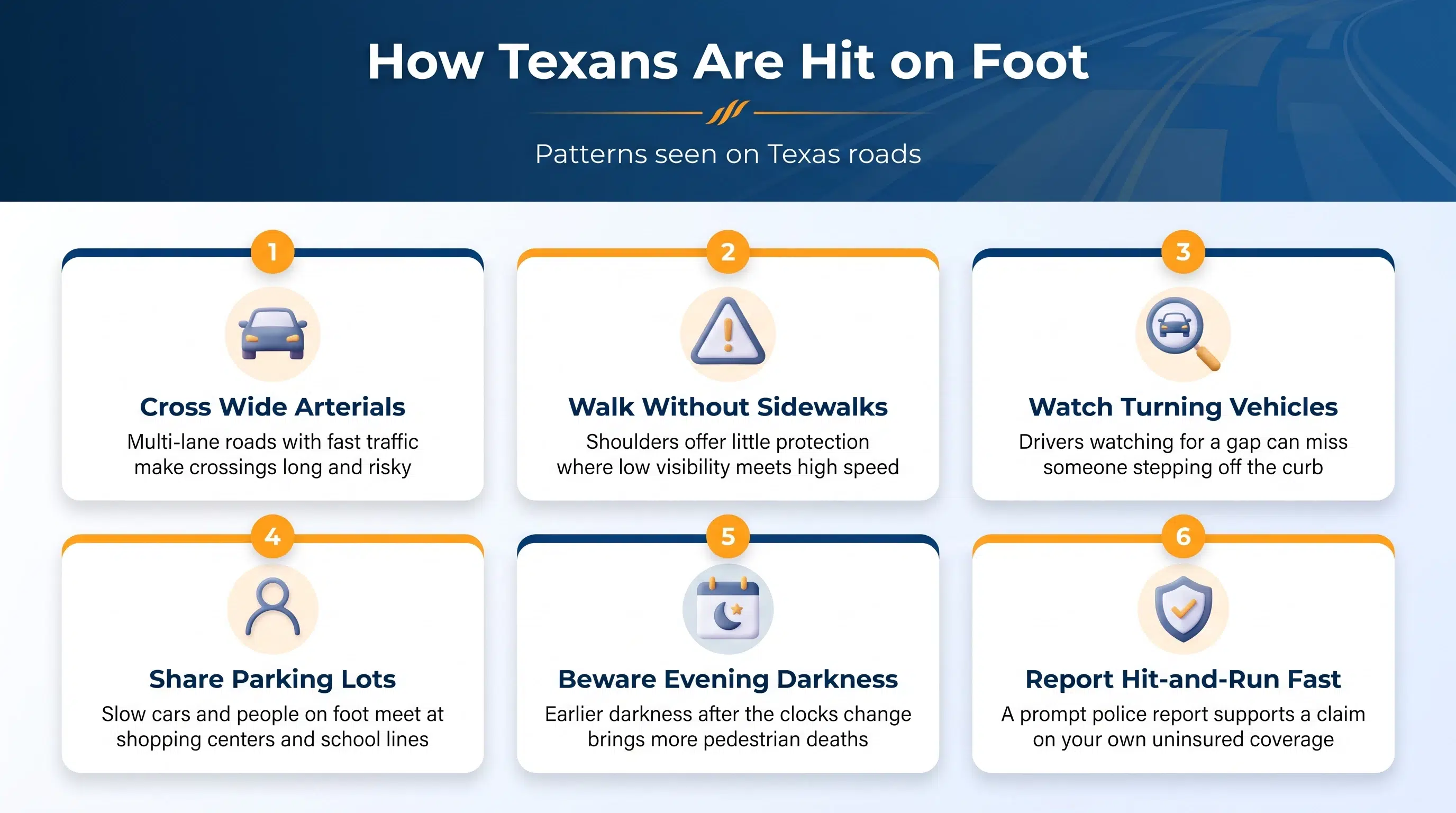
- Wide arterials and feeder roads: Multi-lane roads with 40 and 45 mile per hour traffic make for long crossings. A driver in the far lane may not see someone in the near one until it is too late, and a second car may not stop when the first does.
- Roads with no sidewalk: In parts of the state, people walk on the shoulder because nothing else exists. Drivers still owe them due care, but low visibility and speed make these some of the most serious crashes.
- Turning vehicles at intersections: A driver watching for a gap in oncoming traffic can miss someone stepping off the curb. This happens at signals and at stop signs.
- Parking lots and driveways: Shopping centers, apartment complexes and school pickup lines put slow cars and people on foot in the same space.
- Evening and night: TxDOT figures reported by KSAT-TV show October was the deadliest month for pedestrians in Texas in 2023, with 80 deaths, and the agency pointed to earlier darkness after the clocks change.
- Hit-and-run: Some drivers leave. The claim then often turns to the injured person’s own uninsured motorist coverage, so a prompt police report matters.
Who can be held responsible?
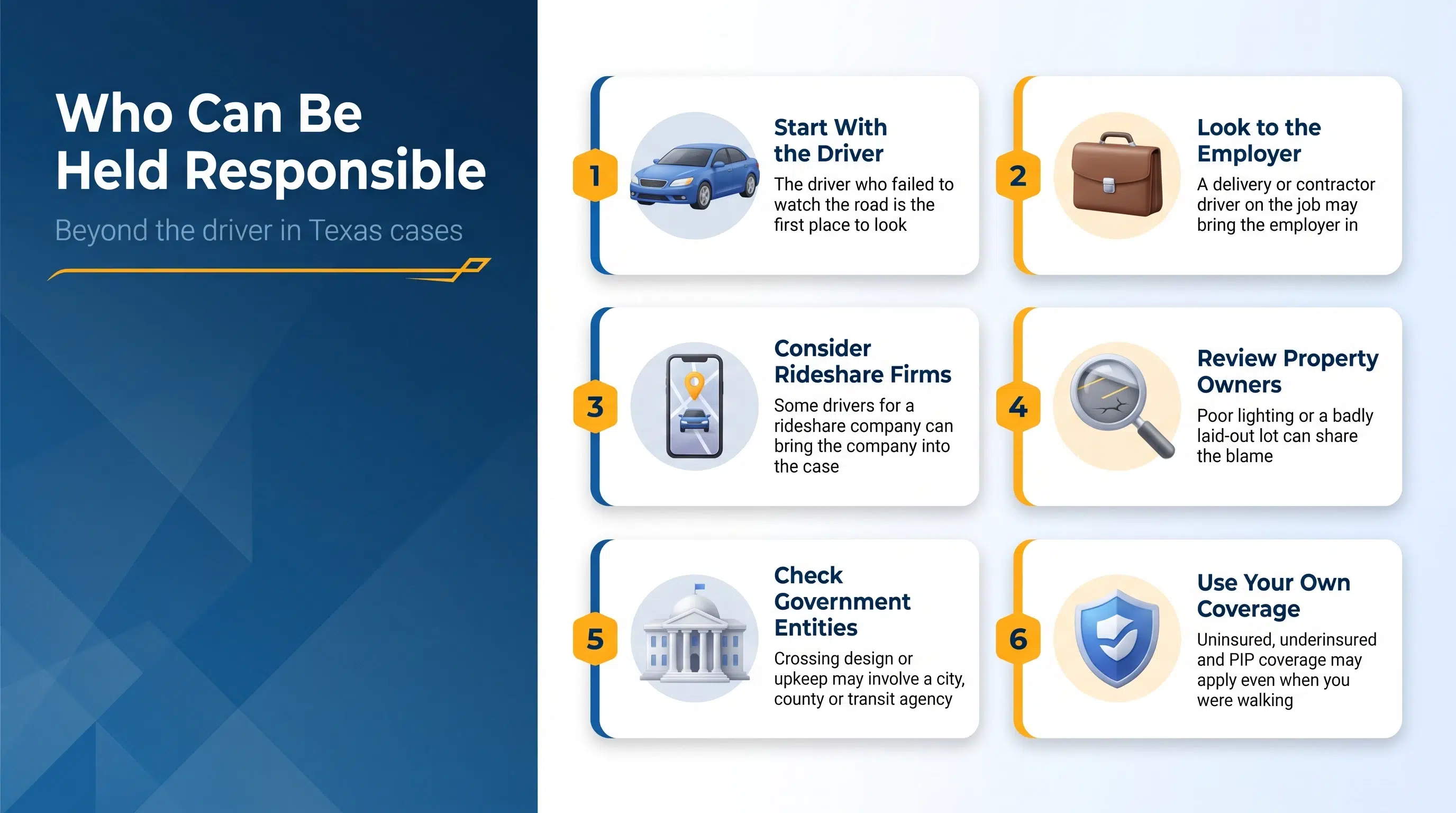
Start with the driver, but do not stop there. If the driver was working, the employer may answer for the crash. That covers delivery drivers, contractors in company trucks and, in some cases, drivers for a rideshare company. A property owner may share responsibility when poor lighting or a badly laid-out lot put people in harm’s way. A government entity can be involved when the design or upkeep of a crossing contributed, though those claims run under the Texas Tort Claims Act and carry notice requirements and limits that private claims do not.
Insurance is where many Texas cases get complicated. The minimum liability limit is $30,000 per person, which a hospital stay can use up quickly. Texas insurers must offer uninsured and underinsured motorist coverage and personal injury protection (PIP), and a policyholder can reject either in writing. If you did not reject them, they may apply to you even when you were walking. PIP can pay medical bills and lost wages regardless of who caused the crash. We read every policy that could apply before putting a number on the claim, including those of household members.
How are pedestrian injuries different from a regular car crash?
Inside a car, you have a seat belt, an airbag and a frame around you. On foot, you have nothing. Nationally, NHTSA reports that pedestrians were 18 percent of all traffic deaths in 2023. In Texas, TxDOT recorded 810 pedestrian deaths that year.
Many injuries are doubled. The bumper tends to strike at leg height, so fractures of the tibia, knee and ankle are common, and then the person is thrown onto the hood or the road. That second impact is what causes head, neck and spinal injuries. A concussion or brain injury can be missed at the scene, which is a good reason to be evaluated even if you feel able to walk away.
Recovery can mean surgery, months of therapy and time away from a job that requires standing, lifting or driving. Some people never go back to the same work. A claim has to account for that, not only for the bills that have arrived so far.
What is a Texas pedestrian claim worth?
No honest lawyer can give you a number before seeing the records. What we can describe is how the value is built.
- Medical costs: Ambulance, emergency care, surgery, hospital stays and rehabilitation, plus the future care your doctors expect you to need.
- Lost income: Paychecks missed during recovery, and lost earning capacity if the injury changes the work you can do.
- Pain and loss of normal life: Texas does not cap these damages in an ordinary pedestrian case, but they count for more when they are documented consistently.
- Shared fault: Your recovery is reduced by your percentage of responsibility and barred above 50 percent.
- Available coverage: The driver’s policy, your own UM/UIM and PIP coverage, an employer’s policy and any other source that applies.
- Liens: Health insurers and providers who treated on a lien may be owed repayment from the recovery. We negotiate these balances before a case closes because every dollar saved goes to the client.
Wrongful death claims follow a similar logic, with the spouse, children and parents of the person who died able to bring the case. If you lost someone, our wrongful death lawyers can explain who may file and when.
What to do after you are hit while walking in Texas
Get medical care the same day, even if you think you are fine. Call 911 so an officer writes a report, and ask for the report number before you leave the scene. Take pictures of the car, the road, the signals and your injuries, and write down who saw what. If the driver left, note any detail you remember about the vehicle, even a color or part of a plate.
Be careful with the other driver’s insurance company. You do not have to give a recorded statement, and a casual remark about how fast you were walking or whether you saw the car can be used against you later. Talk with a lawyer first. Our team can take over those calls. You can also read about how fault is argued in a real intersection dispute in our guide on proving right of way after an intersection crash in Dallas.
For related crash types, see our car accident lawyers, truck accident lawyers and the Dallas page for pedestrian injury lawyers. Our Texas personal injury team handles the full range of injury cases, and you can contact our team to talk through what happened.