- What we know about the crash at FM 51 and Texas 114
- First responder actions and patient status
- Why this intersection sees dangerous collisions
- Legal context: how Texas law views broadside and truck collisions
- Potential civil liability in an 18-wheeler T-bone
- Evidence to secure quickly
- How to get official records: crash reports, 911 audio, and medical documentation
- Medical care and transportation in Wise County and the Fort Worth region
- Insurance and trucking company playbook after serious crashes
- Steps to protect a potential injury claim now
- Community safety notes for drivers moving through Paradise and Decatur
- Commentary from Gosuits Paradise, Texas Personal Injury Attorney
- Action steps that matter right now
- References
What we know about the crash at FM 51 and Texas 114
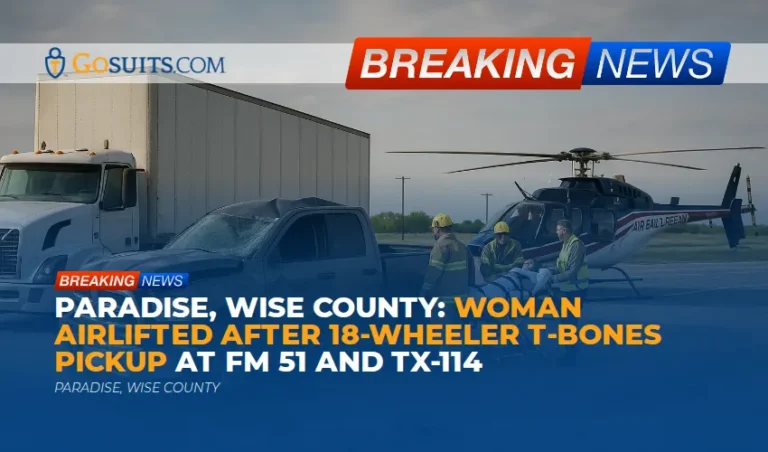
Late Thursday morning, a serious two-vehicle collision occurred at the intersection of N. Farm Road 51 and Texas 114 near Paradise in Wise County. Initial reports indicate a pickup was struck broadside by an 18-wheeler at about 11:30 a.m. The pickup’s lone occupant, a woman, was trapped inside her vehicle and required an extrication effort by Wise County ESD No. 3 firefighters. Given the severity of her injuries, she was flown by Air Evac Lifeteam 68 to Texas Health Harris Methodist Hospital in Fort Worth. The 18-wheeler’s driver, a man, was transported by Wise County EMS to Medical City Decatur in stable condition. At the time of this writing, no additional official details have been released by responding agencies.
This crossing is a key access point for folks moving between Paradise, Bridgeport, and Decatur. Traffic here blends local pickups, farm traffic, oilfield and aggregate haulers, and commuters heading toward Fort Worth on 114. If you live out that direction, you already know how quickly traffic can stack up at FM 51 as it meets state highway speeds on 114.
First responder actions and patient status
Wise County ESD No. 3 firefighters led the extrication, a technical process that can involve stabilizing the vehicle, removing doors and pillars, and coordinating continuously with EMS on patient protection. Wise County EMS managed on-scene medical care and made the decision to activate a medical helicopter for faster transport to a higher-acuity hospital in Fort Worth. Air Evac Lifeteam 68 commonly stages in North Texas to serve rural corridors like FM 51 and 114 where ground transport times can be long. The 18-wheeler driver’s stable condition and transport to Medical City Decatur suggests non-life-threatening injuries at the time of transport, but that does not rule out the possibility of later-diagnosed complications.
When a crash involves an 18-wheeler and a smaller pickup, the energy transfer often falls heavily on the lighter vehicle. Broadside, or T-bone, impacts concentrate forces on a limited area of the passenger compartment. That is one reason why emergency teams in Wise County frequently call for air transport when a patient is trapped and showing signs of significant trauma.
Why this intersection sees dangerous collisions
What makes FM 51 and Texas 114 challenging? Locals cite a mix of factors: differing speed environments, heavy truck volumes, complex sight lines at peak hours, and pressure from through traffic on 114. State and federal safety research has long recognized that intersection conflicts can be severe because crossing and turning movements intersect at acute angles, raising the likelihood of side-impact injuries that can be serious even at moderate speeds [1].
Large trucks add another layer. Tractor trailers take longer to stop and need more space to complete turns safely. Federal safety agencies emphasize that commercial motor vehicles have longer stopping distances and wider turning radiuses than passenger cars, and those characteristics can affect how quickly a hazard at an intersection can be avoided once it is detected [2]. When visibility is limited by terrain, roadside features, or queued traffic, timing and judgment at the point of decision become critical for both the truck driver and any driver entering or crossing the highway.

Legal context: how Texas law views broadside and truck collisions
In Texas, right-of-way rules and general duties to drive safely frame how fault is evaluated after an intersection crash. The Texas Transportation Code sets out duties when approaching or entering intersections, including yielding to a vehicle that has already entered the intersection from a different highway when required, as well as compliance with traffic-control devices when present [3]. Drivers also have a duty to operate at an appropriate speed for conditions, even when traveling below the posted limit, so they can timely stop or maneuver to avoid a collision that is reasonably foreseeable [4].
Texas civil law uses comparative responsibility to assign percentages of fault among those involved. Under the proportionate responsibility statute, a person generally cannot recover damages if they are more than 50 percent responsible for their own injuries. If less than or equal to 50 percent at fault, their recovery may be reduced proportionally by their share of responsibility [5]. This framework applies to intersection and trucking cases alike, and it often means evidence from multiple sources is needed to show precisely how an impact unfolded and which choices contributed most to the crash.
Potential civil liability in an 18-wheeler T-bone
It is too early to say what precisely caused this crash near Paradise. Still, there are common civil issues that experienced counsel evaluate in a tractor trailer broadside collision. These may include:
- Right-of-way and signal compliance. Which vehicle had the right-of-way, and did either driver disregard a traffic control or fail to yield as required by Texas law [3]?
- Approach speed and stopping distance. Did either driver approach at a speed that made it impossible to stop in time for conditions at the intersection [4]? For trucks, stopping distance can be substantial, especially with heavy loads [2].
- Commercial driver qualification and hours-of-service. Was the tractor trailer operator properly qualified and medically fit, and were hours-of-service rules followed to prevent fatigue [6]?
- Company safety policies and supervision. What training, oversight, and route planning did the motor carrier have in place for drivers navigating mixed rural-highway junctions? Federal rules require motor carriers to keep certain safety records that can be crucial to this analysis [7].
- Vehicle condition and brake performance. Were braking systems, tires, and lights properly maintained? Maintenance records can clarify whether a mechanical factor contributed [7].
- Visibility and roadway environment. Did roadside features, queued traffic, or weather reduce sight distance in a way that should have changed approach speeds or gap acceptance decisions?
- Load characteristics. Cargo weight and balance can affect stopping and turning. While not always a factor, improperly secured or overweight loads can lengthen stopping distances and reduce control [2].
Because commercial carriers must carry federally required liability coverage, insurance adjusters are typically on scene or working the file quickly after a serious crash [8]. Their job is to limit the carrier’s exposure. That is one reason people often consult with 18-wheeler accident lawyers to level the playing field on evidence access and claims handling.
Evidence to secure quickly
Time is the enemy of evidence in any intersection crash, especially one involving a commercial vehicle. Here are practical steps that often make a difference:
- Request the Texas crash report promptly. In Texas, official crash reports and supplemental documents are maintained through the state’s Crash Records Information System. Ordering the report as soon as it is released preserves key baseline facts for your records [9].
- Identify and preserve nearby video. Corner stores, gas stations along 114, and traffic-facing business cameras sometimes capture approach or impact sequences. Video systems overwrite routinely, often within days.
- Collect scene photos and measurements. Skid marks, yaw marks, debris fields, and vehicle rest positions help experts reconstruct speeds and vectors at a complex intersection.
- Document injuries and treatment. From first EMS contact through hospital discharge, keep copies of imaging, discharge summaries, and physician notes. Federal rules give patients the right to obtain copies of their medical records at reasonable cost and within set timeframes [10].
- Seek preservation of motor carrier records. Many critical trucking documents, such as certain driver logs and electronic data, have retention windows measured in months. Preservation requests prevent routine deletion while liability is assessed [7].
If you want a ready-made field starter, this single resource can help organize what to gather after a North Texas truck crash: Dallas Truck Crash Evidence Checklist for Victims. Use it as a guide to keep your notes, photos, and requests in one place.
How to get official records: crash reports, 911 audio, and medical documentation
Official documents help clarify what happened and show the scope of harm. These are the typical sources families consider in Wise County cases:
- Texas Peace Officer’s Crash Report (CR-3). Available through the Texas Department of Transportation’s Crash Records Information System. Once the investigating agency submits and the report is released, members of the public who are entitled by statute may purchase a copy online [9].
- Supplemental records from the investigating agency. Depending on who handled the scene near Paradise, this may be the Texas Department of Public Safety Highway Patrol or a county agency. Many non-crash-report records, such as incident logs or photographs, can be requested under the Texas Public Information Act [11].
- 911 calls, CAD logs, and radio traffic. Dispatch audio and call logs are often subject to the Public Information Act with certain privacy redactions. Submit requests promptly because audio retention can be limited [11].
- Fire and EMS incident reports. Wise County ESD No. 3 and Wise County EMS maintain run reports. Some information may be released through public records processes, and patient-specific medical details can be obtained by the patient or authorized representative under federal privacy rules [10].
- Hospital records. Patients are entitled to copies of their own records. Texas hospitals must comply with HIPAA’s right-of-access rules, which set timelines and reasonable cost limits for providing copies [10].
Be mindful of wording when requesting records. Ask for a copy of the CR-3 crash report, any supplemental narratives, scene photographs, and if available, body-worn camera or dash camera footage from responding officers and apparatus.

Medical care and transportation in Wise County and the Fort Worth region
In a high-energy side-impact crash, injuries can range from orthopedic fractures and internal injuries to head and neck trauma. It is common for EMS to activate air transport from rural intersections when travel time to major hospitals could delay critical care. The Fort Worth medical corridor along I-30 and in the Medical District hosts hospitals with broad trauma capability, and Decatur’s hospital provides an important regional hub for initial stabilization and imaging.
Even when someone is initially described as stable, follow-up imaging or specialist evaluations can reveal injuries that were not obvious in the first hours. Keep monitoring symptoms and return for care if pain, confusion, or mobility issues worsen. Documenting that timeline helps doctors and, if needed later, provides a medical record that connects injuries to the crash event.
Insurance and trucking company playbook after serious crashes
When an 18-wheeler is involved, insurance adjusters and motor carrier representatives typically mobilize quickly. Federal regulations require most interstate motor carriers to carry minimum levels of financial responsibility. Those insurance carriers manage claims with significant resources and experience [8]. It is routine for them to request recorded statements early and to send property damage appraisers within days.
That dynamic can feel one-sided for individuals who are recovering and unsure what to say. Statements given to insurance can be used later to dispute fault or minimize injuries. Before engaging with any insurer, many North Texans choose to consult a lawyer who regularly handles heavy truck collisions. Dallas 18-wheeler accident lawyers understand the traffic patterns on 114, 287, and 380, as well as how local agencies document scenes along FM 51.
Steps to protect a potential injury claim now
No two cases are the same, but practical early moves tend to look similar in North Texas trucking collisions:
- Talk with a qualified attorney before giving any recorded statement. A short consultation can help you understand what insurers will ask and why. What you say can be used against you later.
- Start a simple injury journal. Track pain levels, sleep disruptions, missed work, and daily limitations. Document any appointments, referrals, and medications. Consistent notes often make a real difference later.
- Secure the vehicles if possible. If the pickup or tractor trailer is accessible, a prompt inspection can capture electronic data and physical evidence that may be lost if the vehicle is moved or repaired.
- Keep all receipts and bills. From helicopter transport to co-pays and medical devices, save the paperwork. It is much easier to build an accurate picture of losses when items have been preserved from the start.
- Order the official crash report once available. TxDOT’s CRIS portal is the central place where CR-3 reports are accessed by eligible requestors in Texas [9].
When a collision involves a semi, people often look for guidance from 18-wheeler accident lawyers to help coordinate medical documentation, preserve evidence, and communicate with insurers while they focus on recovery.
Community safety notes for drivers moving through Paradise and Decatur
If you travel through the FM 51 and Texas 114 junction:
- Expect longer truck stopping distances. If you are crossing or turning across 114, give yourself more time than you think when a tractor trailer is approaching. The physics are unforgiving for both vehicles in a T-bone. Federal safety materials emphasize these differences for a reason [2].
- Watch for queues and sightline pinch points. The approaches at this junction can stack up at lunch and rush hours. That can block the view of vehicles in the near lane when you are judging a gap.
- Use headlights and signals early. Especially on overcast days or when a storm line moves through Wise County, extra conspicuity helps others judge your speed and intent.
- Slow your approach speed. Texas law expects every driver to adjust speed for conditions, including intersection complexity and traffic density, even if it means traveling under the posted limit [4].
Commentary from Gosuits Paradise, Texas Personal Injury Attorney
Our thoughts are with the woman who was airlifted to Fort Worth and with the 18-wheeler driver who was taken to Decatur. A broadside crash at a high-speed junction is frightening, and we hope for steady recoveries. This write-up is for education and general information to help neighbors understand what happens next after a serious truck collision.
From what’s been reported, this appears to be a side-impact collision at a junction known to locals for tough traffic dynamics. In our view, the investigation will likely focus on approach speeds, right-of-way, and whether any driver made a gap acceptance decision that turned unsafe once vehicle speeds and distances are reconstructed. In truck cases, it is also appropriate to review driver qualification, duty status, and the carrier’s safety systems. Those facts, along with scene measurements and any available video, often tell the story.
After crashes like this, insurance companies and motor carriers move fast. They know the value of early statements, quick vehicle inspections, and carefully shaped narratives. Individuals, on the other hand, are often in pain and juggling medical appointments. That information gap is where claims can tilt. Understanding your rights and the timeline of key evidence, especially in a trucking context governed by federal rules, helps keep the process on fair footing.
It is generally important to obtain a free consultation before speaking with any insurer. A short conversation can clarify how Texas fault rules work, what to do if the crash report has errors, and how to request preservation of company records before routine deletion deadlines arrive.

Action steps that matter right now
Here is what makes a timely difference after a serious intersection crash involving a commercial truck:
- Preserve the evidence. Send written preservation requests for vehicle data, driver logs, and company safety records. Physical and digital evidence can be lost or overwritten within weeks or months if no one asks for it.
- Document the medical story from day one. Keep a running log of symptoms, appointments, and limitations. This helps clinicians tailor care and creates a contemporaneous record tied to the crash.
- Order the official crash report when available. The CR-3 is the backbone of many insurance decisions in Texas. It anchors dates, times, involved parties, and basic narratives.
- Consult before you claim. Before initiating any insurance claim or giving a recorded statement, speak with an attorney to understand your rights and obligations. Statements to insurers can be used to dispute fault or minimize your injuries later on.
- Act within legal timelines. Evidence degrades, witnesses forget, and legal time limits begin running immediately. Early action puts you in control of the process rather than reacting to it.
Preserve Evidence Now Understand Your Rights Today
References
- Intersection Safety Overview – Federal Highway Administration
- CMV Driving Tips and Facts – Federal Motor Carrier Safety Administration
- Texas Transportation Code §545.151 Vehicle Approaching or Entering an Intersection – Texas Legislature Online
- Texas Transportation Code §545.351 Maximum Speed Requirement – Texas Legislature Online
- Texas Civil Practice and Remedies Code Chapter 33 Proportionate Responsibility – Texas Legislature Online
- Summary of Hours of Service Regulations – Federal Motor Carrier Safety Administration
- FMCSA Regulations, Parts 382 to 399 Recordkeeping and Safety Rules – Federal Motor Carrier Safety Administration
- Financial Responsibility Requirements for Commercial Motor Vehicles – Federal Motor Carrier Safety Administration
- Crash Records Information System CRIS Purchase Crash Reports – Texas Department of Transportation
- Your Right of Access to Your Health Information – U.S. Department of Health and Human Services
- Texas Public Information Act Rights of the Public – Office of the Texas Attorney General