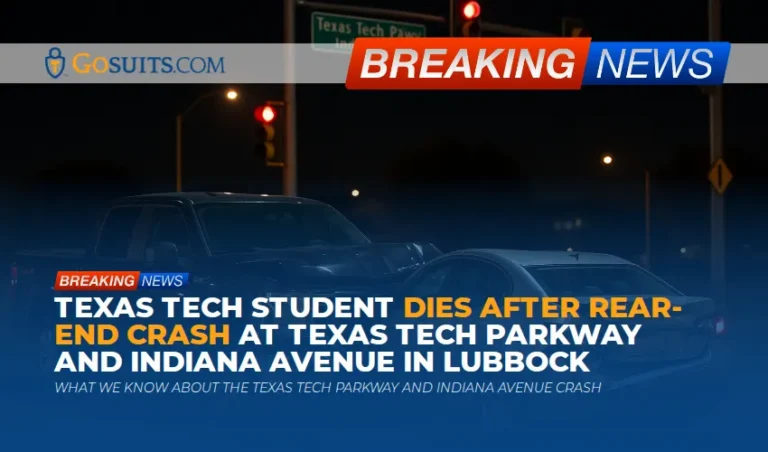
- What we know about the Texas Tech Parkway and Indiana Avenue crash
- Local context around the intersection and campus area
- Rear-end collisions and how Texas law views following distance
- What investigators typically examine after a fatal rear-end collision
- Immediate steps for families seeking official information
- How to obtain records: police reports, TxDOT crash report, autopsy, and death certificate
- Civil legal pathways in Texas: wrongful death and survival claims
- Insurance considerations and common pitfalls after a fatal crash
- Preserving evidence and local sources near Texas Tech
- Practical timeline: what usually happens in the first days and weeks
- Next steps: why acting promptly matters
- Commentary from Gosuits Lubbock, Texas Personal Injury Attorney
- References
What we know about the Texas Tech Parkway and Indiana Avenue crash
Texas Tech Police shared new details about a deadly two-vehicle crash that occurred just after 9 p.m. on April 4 at the intersection of Texas Tech Parkway and Indiana Avenue in Lubbock. According to the agency’s account, a 22-year-old Texas Tech student was stopped at a red light when a Ford F-150 approached at a high speed and struck the back of her vehicle. The impact propelled her car through the signalized intersection. She was transported to University Medical Center with life-threatening injuries and tragically passed away on April 7. The driver of the Ford pickup, an 81-year-old man, and his 81-year-old passenger reportedly sustained minor injuries and were also taken to UMC for care.
This brief summary mirrors what law enforcement has publicly reported so far. As with any serious collision, additional details may develop as agencies finalize crash reconstruction, gather witness statements, and analyze any available video or vehicle data.
Local context around the intersection and campus area
Residents and students know this corridor well. Texas Tech Parkway runs along the western edge of campus facilities and ties into Indiana Avenue, a busy north-south arterial that connects neighborhoods, student housing, and retail along the Marsha Sharp Freeway frontage. On weeknights, the approach lanes can be a mix of student traffic, commuters heading to and from shopping along 19th Street, and hospital-bound vehicles toward UMC.
The Texas Tech campus landmarks nearby include Jones AT&T Stadium to the northeast and Urbanovsky Park to the east. University Medical Center, a designated trauma facility for the South Plains, sits just south of the Marsha Sharp Freeway. In this area, signal timing, driver attention at reds and yellows, and vehicle speeds on wide corridors like Indiana Avenue become critical to safety.
Rear-end collisions and how Texas law views following distance
Rear-end crashes are among the most common urban collisions. Speeding and inadequate following distance increase the risk and severity of these impacts, particularly at signalized intersections where drivers ahead may be stopped or decelerating for reds. National safety data consistently link higher impact speeds with greater injury risks, especially for occupants in the lead vehicle who absorb the sudden force of a high-speed strike [8].
Texas law requires drivers to maintain an “assured clear distance” behind the vehicle in front. In simple terms, motorists must follow at a distance that allows them to safely stop without colliding with traffic ahead, considering speed and road conditions [1]. In civil cases arising from rear-end crashes, investigators and insurers commonly examine whether the trailing driver failed to maintain that safe following distance or was traveling at a speed that made stopping impossible under the circumstances.
What investigators typically examine after a fatal rear-end collision
When a collision causes catastrophic injury or death, multiple agencies often review the facts. In a case like this one, Texas Tech Police would coordinate response and documentation, and additional support may come from crash reconstruction units. Here are the typical focal points:
- Pre-impact speed and braking. Skid marks, yaw marks, and onboard vehicle data can provide insights into speed and braking inputs in the seconds before impact. These details often matter in assessing whether the striking driver had time and distance to stop safely [1].
- Signal phase and traffic flow. Investigators usually determine the light phase for each direction using controller logs or timing plans, then correlate with eyewitness accounts and any camera footage.
- Driver attention and condition. Distraction, fatigue, and impairment are routinely evaluated. With older adult drivers, investigators may also consider whether any acute medical episodes or medications affected reaction time, though conclusions depend on medical evidence rather than assumptions [9].
- Environmental and roadway conditions. Lighting, visibility, lane markings, and signage can influence driver behavior at night.
- Impact dynamics and injury biomechanics. Trajectory, crush patterns, and intrusion help explain injury mechanisms, which can be important in civil evaluations of causation.
These analyses feed into official reports and, over time, inform whether any civil claims are pursued by those with standing under Texas law.
Immediate steps for families seeking official information
When a tragedy like this occurs near campus, families often feel overwhelmed and unsure where to start. A few early calls can help anchor the process:
- Confirm the investigating agency. For on-campus or near-campus crashes, Texas Tech Police often lead. The agency can confirm report numbers, the status of report release, and whether additional reconstruction will occur. Texas Tech University Police information is published through the university’s site [13].
- Request the state crash report through TxDOT. Texas maintains crash reports through the Texas Department of Transportation’s system. Families can learn how to purchase certified reports on the TxDOT website [11].
- Ask about inquest or autopsy. In Texas, deaths under certain circumstances trigger an inquest. Depending on the county’s structure, a medical examiner or a justice of the peace oversees the process and records. The inquest framework is set out in the Texas Code of Criminal Procedure, Chapter 49 [12].
- Obtain death certificates. Death certificates are issued through the Texas Department of State Health Services. The state’s Vital Statistics office has instructions for requesting certified copies [6].
It can also help to keep a single folder for paperwork and notes. A practical tool many families find useful is a simple paperwork checklist tailored to wrongful death claims. One resource that walks through the most common documents families organize is this internal guide: Dallas wrongful death checklist families.

How to obtain records: police reports, TxDOT crash report, autopsy, and death certificate
Police incident and narrative reports
There are generally two layers of reports in a serious collision: the incident or offense report compiled by the investigating agency and the formal state crash report. Each agency has its own timeline for releasing the incident narrative and supplemental materials such as diagrams, photos, and audio. Because this case involved Texas Tech Police, families can start by asking that agency about the expected release schedule and any required open records request procedure through the university system [13].
State crash report through TxDOT
Texas uses standardized CR-3 crash reports for qualifying collisions. The Texas Department of Transportation maintains these records, and eligible requestors can purchase them online. TxDOT’s page titled Crash Reports and Records explains eligibility, fees, and how to order [11]. The certified CR-3 usually includes the investigating officer’s diagram, listed contributing factors, vehicle positions, citations if any, and key narrative fields.
Autopsy or inquest records
Under Texas law, inquests into certain deaths are carried out by the county medical examiner or, in counties without a medical examiner, by a justice of the peace. The legal framework, including when an inquest is required and what records exist, is codified in Chapter 49 of the Texas Code of Criminal Procedure [12]. Families can ask the county whether a medical examiner conducted an autopsy or whether the justice court handled the inquest, then request guidance on accessing any releasable portions of the record.
Death certificates
Certified death certificates in Texas are obtained through the Department of State Health Services’ Vital Statistics office. The agency explains who can order, required identification, and processing options. Because insurers, probate courts, and financial institutions typically require multiple certified copies, plan ahead on quantity [6].
Civil legal pathways in Texas: wrongful death and survival claims
When a fatal crash happens, Texas law provides two principal civil pathways that can apply at the same time, serving different purposes. These are not criminal proceedings and are distinct from any traffic or criminal enforcement that might occur.

Wrongful death claims
Texas’ wrongful death statute allows specific family members to bring a claim for the losses they personally suffer due to a loved one’s death. Eligible parties are the decedent’s spouse, children, and parents. If these individuals do not file within the time allowed, the executor or administrator may file on behalf of the estate for the benefit of the family [2].
Common categories in a wrongful death claim can include lost financial support, household services, and loss of companionship. Every family’s losses are unique, and the statute provides the framework for what may be considered.
Survival actions
Separate from wrongful death, a survival action carries forward the decedent’s own personal injury claim as if they had survived. In other words, it addresses the harms and losses the person experienced between injury and death, such as conscious pain and suffering, medical bills, and property damage. The Texas Civil Practice and Remedies Code authorizes survival actions, which are brought by the estate’s legal representative [3].
Time limits and responsibility rules
Generally, Texas sets a two-year limitations period for both wrongful death and personal injury claims. There are exceptions in certain circumstances, so it is important to verify the specific deadline tied to your situation [4]. Texas also applies proportionate responsibility principles. If a claimant is found to be more than 50 percent responsible, recovery is barred. If responsibility is 50 percent or less, allowable damages can be reduced by the assigned percentage [5].
Families often find it reassuring to have a clear explanation of these pathways before speaking with any insurer. Some choose to consult with car accident lawyers early so they understand how wrongful death and survival statutes fit their facts and what evidence will matter most in their case strategy.
Insurance considerations and common pitfalls after a fatal crash
Insurance issues begin quickly, sometimes within a day or two. Auto insurers for both vehicles will be interested in statements, vehicle inspections, and medical or funeral documentation. Texas requires all drivers to carry minimum liability coverage, often referred to as 30/60/25: at least 30,000 dollars for injuries per person, 60,000 dollars per crash, and 25,000 dollars for property damage. Many drivers carry higher limits, and some policies include additional coverages like underinsured motorist and personal injury protection. The Texas Department of Insurance provides a plain-language overview of these requirements and common coverages [14].
There are pitfalls to watch for:
- Recorded statements. What someone says to an insurance adjuster can be quoted back later. When a death is involved, clarity about facts and timing is vital. It is prudent to seek guidance before providing any detailed or recorded statement to an insurer.
- Early settlement pressure. Quick offers sometimes arrive before full information is available, particularly before autopsy records, complete medical billing, or wage documentation are in hand. Accepting too soon can foreclose claims.
- Multiple coverages. In a serious case, several policies can come into play, including liability coverage, underinsured motorist coverage, and potentially umbrella coverage. Sorting these out takes methodical review. Many families benefit from speaking with Dallas car accident lawyers to understand how those layers might apply under Texas law without committing to any decisions too early.
Before opening any claim or answering insurer questions, consider a confidential consultation with car accident lawyers to understand rights, timelines, and the documentation strategy that aligns with Texas statutes. What a person says at the outset can shape the entire claim.
Preserving evidence and local sources near Texas Tech
Evidence preservation starts immediately. In urban corridors around Texas Tech Parkway and Indiana Avenue, potential sources include nearby businesses with exterior cameras, university facilities, and traffic cameras tied to signal control systems. Some systems overwrite video in a matter of days.
- Vehicle evidence. If the vehicles are towed, ensure the tow yard and insurer know that no repairs or data downloads should occur without notice. Modern vehicles often have event data recorders that can store speed, braking, and other pre-crash information.
- Scene photographs. Nighttime lighting, skid marks, and debris fields can change quickly. Photographing the intersection from all approach lanes, including signal heads and stop bars, can matter later.
- Witness contacts. Students and residents regularly travel through this intersection. A short note capturing names, phone numbers, and what each person saw can prevent the all-too-common problem of lost witnesses.
Families who want a structured approach to documents and tasks during the first weeks often use checklists. Consider adapting a wrongful death paperwork checklist to the specifics of your case to track records, deadlines, and contacts alongside grief and logistical demands.
Practical timeline: what usually happens in the first days and weeks
Every family’s experience is unique, but the cadence of tasks after a fatal crash near campus follows a familiar pattern. Understanding the rhythm can reduce stress.
First 72 hours
- Hospital and notifications. University Medical Center is the receiving hospital for many serious injuries in Lubbock and is a designated trauma facility [7]. Hospital staff or law enforcement typically handle initial next-of-kin notifications and coordination.
- Agency confirmations. Confirm the investigating agency, obtain the incident number, and ask about expected report timelines.
- Funeral and religious arrangements. Begin discussing plans and gather the information needed for vital records and funeral providers.
First 1 to 2 weeks
- Crash report ordering. TxDOT generally posts qualifying crash reports after the agency completes the file. Check the TxDOT portal for availability and ordering instructions [11].
- Vital records. Request certified death certificates through the Department of State Health Services. Multiple copies are often needed for estate, benefits, and insurance matters [6].
- Evidence preservation. Send written requests to preserve vehicle and scene evidence. If needed, request counsel to send spoliation notices to relevant parties.
- Insurance notifications. Consider notifying insurers of the incident while avoiding detailed statements until you have clarity on rights and representation.
Weeks 3 to 6
- Record collection. Assemble medical records and bills, funeral invoices, wage documents, and any dependency details relevant to a wrongful death claim.
- Legal evaluation. A thorough review of Texas wrongful death and survival statutes, fault allocation, and available coverages helps set a roadmap for what comes next [2][3][5].

Next steps: why acting promptly matters
There are a few reasons timeliness matters after a fatal intersection crash.
- Evidence can disappear. Camera footage may be overwritten within days, and physical marks at the scene fade quickly. Early preservation requests protect objective proof.
- Official records take time. Inquests, autopsies, and crash reconstructions can take weeks or months. Starting the paperwork now prevents delays later when insurers or courts need certified documents.
- Deadlines apply. Texas sets firm time limits on civil claims, so tracking dates from the outset avoids last-minute scrambles later [4].
- Insurance positioning begins early. Adjusters often move quickly to frame the claim narrative. Getting educated on rights and duties before providing statements helps maintain accuracy and preserves options.
What should the community do in these situations? Prioritize safety, secure records, and take steps that keep options open. That generally means consulting with a trusted professional before calling insurers, documenting everything that might matter later, and staying organized through grief and logistics.
Commentary from Gosuits Lubbock, Texas Personal Injury Attorney
Our hearts go out to the Texas Tech community and the family grieving this devastating loss. The information above is shared for education and general understanding during a difficult time.
From a civil injury perspective, the publicly reported facts describe a stopped vehicle struck from behind at significant speed in a signalized intersection. In Texas, investigations of rear-end collisions focus closely on following distance and speed relative to traffic conditions. The combination of nighttime visibility, approach geometry, and driver attention all come under the microscope. It is appropriate that the investigation gathers and preserves every piece of objective data available, including any vehicle event data and signal timing logs.
In the background of every serious crash, insurers are working to limit their financial exposure. Corporations and insurance companies often leverage unfamiliar processes to their advantage. They ask for recorded statements early, float quick settlements before all facts are known, and emphasize uncertainty about fault while records are still in transit. Without context on Texas wrongful death and survival statutes, crucial coverages, and the practical value of objective evidence, families may inadvertently agree to terms that do not reflect the full harm.
Getting a free consultation early provides clarity without commitment. It allows a family to understand the role of TxDOT crash reports, inquest records, and medical documentation, and how proportionate responsibility works under Texas law. It also sets a plan for preserving vehicle data and scene evidence. Whether or not any claim is ultimately filed, a short conversation can prevent missteps that have long-lasting consequences.
References
- Texas Transportation Code 545.062 Following Distance – Texas Legislature Online
- Texas Civil Practice and Remedies Code 71.004 Wrongful Death Beneficiaries – Texas Legislature Online
- Texas Civil Practice and Remedies Code 71.021 Survival – Texas Legislature Online
- Texas Civil Practice and Remedies Code 16.003 Limitations – Texas Legislature Online
- Texas Civil Practice and Remedies Code 33.001 Proportionate Responsibility – Texas Legislature Online
- Death Records and Certificates – Texas Department of State Health Services
- Trauma Facility Designation in Texas – Texas Department of State Health Services
- Speeding: A Threat to Everyone on the Road – National Highway Traffic Safety Administration
- Older Adult Drivers – Centers for Disease Control and Prevention
- Crash Avoidance and ADAS Overview – National Highway Traffic Safety Administration
- Crash Reports and Records – Texas Department of Transportation
- Texas Code of Criminal Procedure Chapter 49 Inquests – Texas Legislature Online
- Texas Tech University Police Department – Texas Tech University
- Auto Insurance in Texas – Texas Department of Insurance