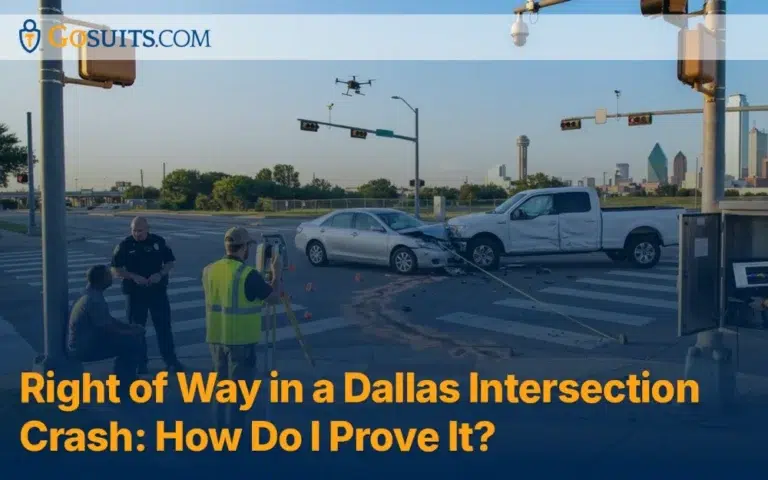
Proving who had the right of way at a Dallas intersection often determines which driver bears liability for an injury crash. Texas law assigns the right of way to the vehicle that lawfully enters the intersection first or that responds correctly to traffic control signals, but when both drivers claim a green light or allege the other ran the red, the dispute must be resolved with objective evidence. Texas Transportation Code Chapter 545 governs the rules that apply. Signal phase logs, physical damage patterns, and camera footage from nearby businesses frequently supply the hard proof that oral accounts alone cannot.
Legal Snapshot
- Legal Topic: Right of Way at Signalized and Unsignalized Intersections, Texas
- Case Stage: Investigation / Pre-litigation through trial
- Primary Legal Issue: Establishing fault at an intersection through traffic law, signal data, and physical evidence
- Primary Authority: Texas Transportation Code §§ 545.151–545.155 (traffic signal indications and right of way); Texas Transportation Code § 545.153 (left-turn right of way); Texas Civil Practice and Remedies Code Chapter 33 (proportionate responsibility); Texas Civil Practice and Remedies Code § 16.003 (two-year limitations)
- Date Legal Authority Last Reviewed: July 2025
What Texas Law Says About Right of Way at Intersections
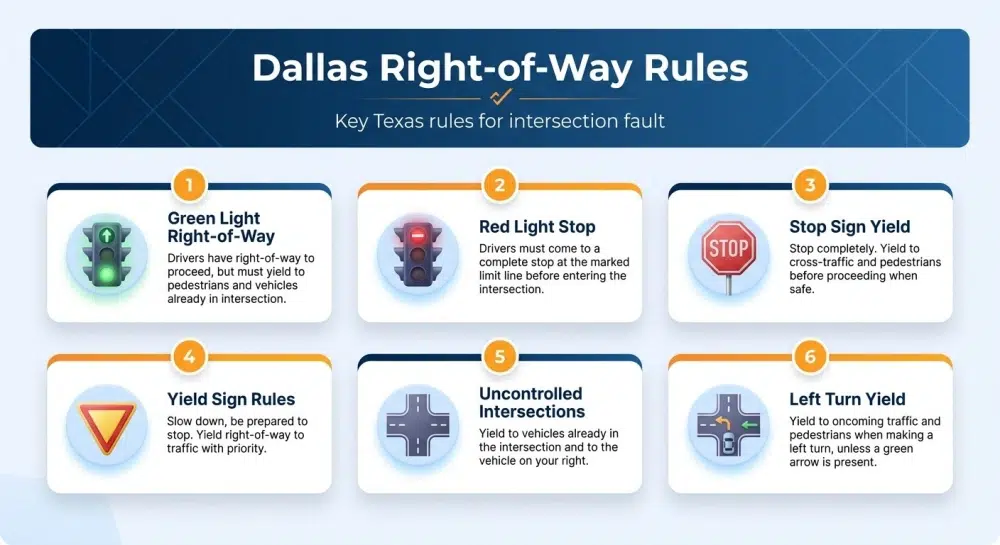
The Texas Transportation Code Chapter 545, Subchapter D, contains the foundational rules governing intersections and traffic signals. [1] These rules matter in a civil injury case because a driver who violates them may be found negligent per se, meaning the statutory violation itself can establish the breach-of-duty element of a negligence claim, subject to the applicable comparative fault framework.
Traffic Signal Indications: What Each Color Means Legally
Texas Transportation Code § 545.152 describes the legal meaning of each signal phase. A driver facing a steady green light may proceed, but still owes a duty of care to traffic already in the intersection and to pedestrians. A driver facing a steady red light must stop before entering the intersection and may not proceed until a green signal is displayed. A driver facing a steady yellow light is warned that the signal is about to change to red and should stop before entering unless stopping cannot be accomplished safely. [1]
The practical legal consequence: if signal phase data shows Driver A’s approach was displaying red at the moment of impact, Driver A’s entry into the intersection was unlawful under Texas law. That statutory violation, combined with evidence of causation and damages, is a powerful foundation for a civil liability claim.
Right of Way for Left-Turn Movements
Left-turn crashes are among the most disputed intersection collision types in Dallas, and they arise constantly in heavy commute traffic along corridors such as US-75 (Central Expressway), I-30, and the Dallas North Tollway. Texas Transportation Code § 545.152 addresses protected green-arrow turns, and general left-turn right-of-way principles are embedded in the signal-compliance sections of the code. [1]
A vehicle making a left turn under an unprotected green (a circular green, not a green arrow) generally must yield to oncoming traffic that is proceeding straight through the intersection. If the left-turning driver enters the oncoming path while oncoming traffic still has the right of way, the turning driver is typically at fault. However, the analysis becomes more complex when the oncoming driver ran a stale yellow or entered on a red, or when the intersection phasing itself permitted both movements simultaneously. Signal phase data cuts through the dispute by establishing precisely which phase was active at the moment of impact.
Unprotected Green and the Duty to Yield
When a driver proceeds through an intersection on an unprotected green, that driver has the right of way over cross-traffic that is facing a red or yellow signal. The duty to yield does not disappear simply because the driver was technically moving before the light changed. Texas’s proportionate responsibility framework under Texas Civil Practice and Remedies Code Chapter 33 means that if both drivers share some degree of fault, a jury apportions percentages. [2] A driver who was 51% or more responsible cannot recover. Intersection evidence that clearly shows which light was red and which was green prevents conjecture and anchors the percentage attributable to each driver.
How Signal Phase and Timing Data Is Obtained from the City of Dallas
Traffic signal controllers at many Dallas intersections maintain logs of phase changes, timing events, and fault conditions. These logs may reside on the controller unit at the intersection, at a centralized traffic management center, or both. The Texas Department of Transportation (TxDOT) also operates traffic management centers that monitor freeway and arterial corridors, including segments of I-635 (LBJ Freeway), I-35E, and I-30 that pass through the Dallas metro area. [3]
How to Request the Data
Signal data held by a government entity in Texas is subject to the Texas Public Information Act, Texas Government Code Chapter 552. [4] An open-records request can be submitted to the City of Dallas Department of Transportation or to TxDOT, identifying the intersection by street name, the date, and the approximate time of the crash. The request should specifically ask for signal phase logs, controller event logs, timing plans in effect at the time of the crash, and any malfunction or fault records.
An attorney can also send a preservation letter to the relevant government entity immediately after the crash, citing the specific date, time, and location and demanding that all signal data be retained. A formal Texas Public Information Act request should follow within days. Because many controller logs overwrite on cycles as short as 30 days, and some older systems retain only 72 hours of data, this step must be treated as a 24-to-72-hour priority. [5]
| Data Location | Typical Retention | Who to Contact |
|---|---|---|
| Local controller at intersection | 30 days or less; some systems 72 hours | City of Dallas Dept. of Transportation / Public Works |
| Dallas Traffic Management Center (DART/City) | Varies; often 30 days | City of Dallas Open Records; DART if applicable |
| TxDOT regional traffic management center | Varies; often 30–90 days on some systems | TxDOT Dallas District Office – Texas Public Information Act request |
How Nearby Business Cameras and TxDOT Traffic Cameras Help
Dallas’s dense commercial corridors along Deep Ellum, downtown, Oak Cliff, Plano, and Carrollton are lined with properties whose security cameras point at parking lots, driveways, and adjacent streets. Gas stations, convenience stores, bank branches, and retail centers near a busy intersection sometimes capture the actual crash event or, equally important, the approach behavior of each driver in the seconds before impact. [6]
Investigators working on a right-of-way dispute conduct a systematic canvass of properties within roughly 300 to 500 feet of the crash point. They identify camera angles, send written legal hold notices to property owners, and follow up with subpoenas or court orders if production is refused. The critical variable is time: gas-station and convenience-store cameras typically overwrite on loops of three to seven days, larger commercial systems in seven to thirty days, and dashcam footage in other vehicles can overwrite within hours.
TxDOT operates a network of freeway traffic cameras on I-635, I-35E, and the High Five interchange, among others, that transmit real-time video to the TxDOT regional traffic management center. Footage from these cameras may be retained for as few as 14 to 30 days. Requests for TxDOT camera footage should be submitted under the Texas Public Information Act within the first week after the crash. [3]
How Business Camera Footage Is Located and Preserved
- Identify the crash location from the police report and scene photographs
- Walk the surrounding area to locate all camera-equipped properties with a sight line to the intersection or approach
- Send a written legal hold notice to each property owner within 24–72 hours, specifying the crash date, time, location, and the footage needed
- Follow with a formal written request or subpoena if the owner does not respond
- Submit Texas Public Information Act requests to TxDOT and the City of Dallas for government-operated camera footage
Because personal injury lawyers for Dallas intersection crashes can initiate these steps immediately after being retained, early contact with an attorney directly protects evidence that disappears on its own in days.
How the Physical Damage Pattern Establishes Impact Angle
When signal data is unavailable or disputed, the geometry of the crash itself carries significant evidentiary weight. A vehicle’s crush damage and the angle at which two vehicles contacted each other create a physical record that is independent of what either driver says happened.

What the Damage Pattern Shows
A side impact, sometimes called a T-bone, to a vehicle’s driver-door panel means that vehicle was broadside to the striking vehicle at the moment of impact. That geometry is consistent with the struck vehicle entering on a green while the striking vehicle entered on red from a perpendicular approach. A front-corner-to-front-corner engagement suggests a different scenario, perhaps a left-turn conflict in which both vehicles were partially committed to the intersection simultaneously.
A qualified accident reconstruction analyst measures the direction of crush, the width and depth of the deformation, and the orientation of each vehicle’s major structural components. Using established engineering databases and kinematics, the analyst calculates the angle of approach and the approximate pre-impact speed of each vehicle. The resulting opinion describes which vehicle entered the intersection first and from which direction each vehicle was traveling, without relying solely on driver accounts. [7]
Vehicle Data Recorders and Impact Angle
Most passenger vehicles manufactured since the mid-2000s contain an event data recorder (EDR). In addition to recording pre-impact speed and brake application, many modern EDR systems record the vehicle’s heading change during the crash event. That delta-v vector, combined with the physical damage pattern, gives a reconstructionist two independent data sources to triangulate impact geometry. [8]
EDR data must be preserved before the vehicle is repaired or moved to a facility where a new qualifying event could overwrite the record. An attorney can seek a court-ordered preservation hold or send a preservation letter to the at-fault driver’s insurer within days of the crash. For a deeper explanation of how attorneys preserve vehicle black box evidence, see the full analysis of reconstructing fault in a disputed Dallas crash.
What If the Other Driver Disputes Who Had the Green?
In right-of-way disputes, “he said / she said” is extremely common. Without objective evidence, insurers routinely deny liability entirely or offer nominal settlements on the theory that fault cannot be determined. The three categories of evidence discussed in this article, signal phase data, camera footage, and physical damage geometry, are the tools that convert a “disputed” crash into one that can be evaluated and resolved based on facts.
Texas follows a modified proportionate responsibility rule: a claimant who is more than 50% responsible for the accident cannot recover damages, and any recovery below that threshold is reduced proportionally by the claimant’s percentage of fault. [2] A strong evidence record pushes the fault allocation toward the driver who ran the red light and away from the injured party.
What Evidence May Matter in a Dallas Intersection Crash
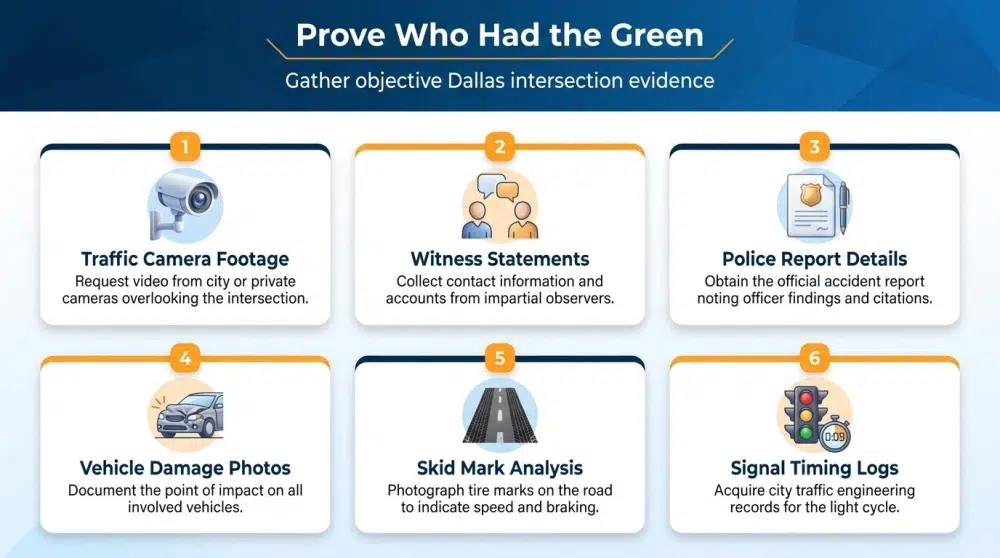
- Traffic signal phase logs: The single most direct evidence of who had the green. Request from the City of Dallas and TxDOT within 24–72 hours
- Commercial surveillance footage: Gas stations, restaurants, banks, and retail centers near the intersection; overwrite in 3–30 days depending on the system
- TxDOT traffic camera footage: Available for freeway corridors; often retained 14–30 days
- Dashcam footage from other vehicles: Witnesses or other drivers at the scene; loops can overwrite within hours
- Vehicle damage crush analysis: Establishes impact angle and pre-impact speed
- Event data recorder (EDR/black box): Pre-impact speed, brake application, heading change; preserve before vehicle is repaired
- Police report and scene diagrams: Retained permanently; obtain within the first week
- Witness statements: Taken at the scene or located through canvassing later
- Debris and fluid patterns: Cleared within hours by maintenance crews; police scene photographs are the primary record
- Skid marks or yaw marks: Can fade within 48 hours on high-volume Dallas streets
What Damages May Be Available
An injured person who establishes the other driver’s liability at an intersection crash in Texas may recover damages in several categories, subject to the facts of the case and applicable law. Recoverability is never guaranteed, and outcomes depend on the evidence, the parties’ fault allocations, and the applicable coverage. Recognized categories under Texas law include:
- Past and future medical expenses
- Lost wages and loss of earning capacity
- Physical pain and mental anguish
- Physical impairment
- Disfigurement
- Property damage, including vehicle repair or replacement
- Wrongful death damages for surviving family members when a crash proves fatal, under Texas Civil Practice and Remedies Code Chapter 71 [9]
- Exemplary (punitive) damages where the defendant’s conduct is found to constitute gross negligence under Texas Civil Practice and Remedies Code § 41.003 [10]
How Long Do I Have to Act in Texas?
The general statute of limitations for personal injury claims in Texas is two years from the date of injury, under Texas Civil Practice and Remedies Code § 16.003. [11] Claims against government entities, including the City of Dallas or TxDOT if a traffic signal malfunction contributed to the crash, carry a shorter notice period under the Texas Tort Claims Act, Texas Civil Practice and Remedies Code Chapter 101, and failure to serve notice within six months can bar the claim. [12]
The limitations deadline, however, does not protect the evidence. Signal logs, camera footage, and EDR data all begin disappearing within hours to days of the crash. Waiting even two or three weeks to consult an attorney may result in permanent loss of the most probative evidence in the case. The evidence clock and the lawsuit clock run at very different speeds.
[DEADLINE REQUIRES LEGAL VERIFICATION – Specific deadlines depend on all potentially liable parties, including any government entity. Confirm all applicable notice periods and limitations deadlines with a licensed Texas attorney promptly after the crash.]
What Should I Do Next?
- Seek medical attention immediately – even minor symptoms after a collision should be evaluated by a physician
- Photograph everything at the scene – including signal heads, lane markings, skid marks, vehicle damage, and the intersection itself
- Collect witness contact information before leaving the scene
- Do not authorize vehicle repair until a legal hold has been evaluated
- Do not give a recorded statement to the other driver’s insurer without first consulting an attorney
- Contact a personal injury attorney within the first 24–48 hours – signal data and camera footage begin disappearing immediately
A Dallas personal injury attorney can review the circumstances of an intersection crash and explain your legal options. If you or a family member were injured when another driver ran a red light or violated right-of-way rules in Dallas, our team can help coordinate evidence preservation, signal data requests, and reconstruction analysis before critical evidence is lost.
Related Texas Personal Injury Resources
- Reconstructing Fault in a Disputed Texas Crash: How Is It Done? – detailed coverage of EDR data, crush analysis, debris mapping, and signal evidence
- What Should You Do Right After a Car Accident in Texas?
- Texas Modified Comparative Fault: The 51 Percent Bar
- Statute of Limitations for Personal Injury in Texas
- Challenging an Inaccurate Crash Report in Dallas
- Dallas Car Crash Photo Checklist
- Finding All Insurance Coverage After a Dallas Crash

Talk With a GoSuits Dallas Personal Injury Attorney
A disputed right-of-way claim involves signal data that overwrites in days, camera footage that loops in hours, and physical evidence that disappears from the roadway the same night. If you were injured in a Dallas intersection crash where the other driver is contesting who had the green light, a GoSuits personal injury attorney can review the facts, explain your options, and coordinate evidence preservation before the window closes.
The consultation is free, confidential, and carries no obligation.
We serve car accident lawyers in Dallas and throughout the DFW metro area, including Plano, Carrollton, McKinney, Irving, and Greenville. Personal injury lawyers at GoSuits represent injured people throughout Texas, California, and Illinois.
References
- Texas Transportation Code Chapter 545, Subchapter D – Right of Way and Traffic Control Signals – Texas Legislature Online
- Texas Civil Practice and Remedies Code Chapter 33 – Proportionate Responsibility – Texas Legislature Online
- Texas Department of Transportation – Traffic Engineering Publications and Traffic Management
- Texas Government Code Chapter 552 – Public Information Act – Texas Legislature Online
- Texas State Law Library – Guide to Texas Court Rules and Procedural Law
- Reconstructing Fault in a Disputed Texas Crash: How Is It Done? – GoSuits Knowledge Base
- Federal Rule of Evidence 702 – Testimony by Expert Witnesses (Daubert Standard) – Cornell Law School / LII
- 49 C.F.R. Part 563 – Event Data Recorders – Cornell Law School / LII
- Texas Civil Practice and Remedies Code Chapter 71 – Wrongful Death Act – Texas Legislature Online
- Texas Civil Practice and Remedies Code Chapter 41 – Exemplary Damages – Texas Legislature Online
- Texas Civil Practice and Remedies Code § 16.003 – Two-Year Limitations Period – Texas Legislature Online
- Texas Tort Claims Act, Texas Civil Practice and Remedies Code Chapter 101 – Texas Legislature Online