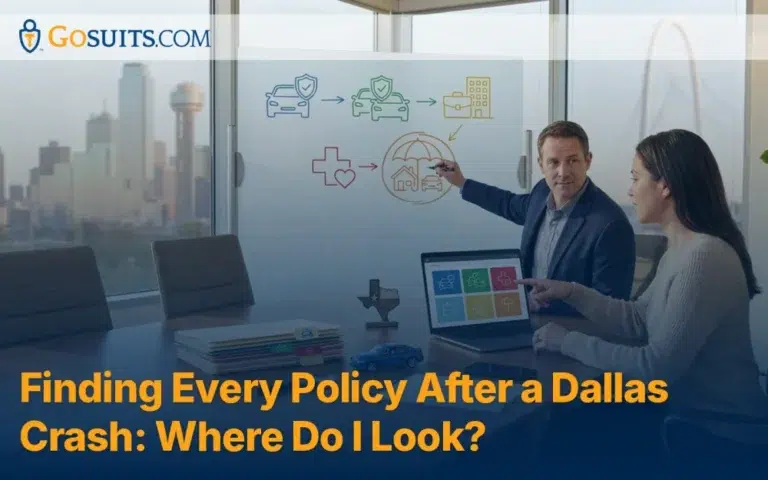
After a serious crash in Dallas, the at-fault driver’s liability policy is often the first number anyone focuses on. In many cases it is not the last. Texas allows an injured person to pursue compensation from every available insurance source that may apply, and a thorough coverage inventory can make the difference between a recovery that covers your losses and one that does not. This article walks through each layer of potential coverage in the order a claimant or attorney would typically examine them.
Legal Snapshot
- Legal Topic: Multiple insurance policies after a Texas car accident
- Jurisdiction: Texas (state law governs); Dallas / Dallas County
- Primary Legal Issue: Identifying and accessing all applicable insurance coverage after a motor vehicle crash
- Primary Authority: Texas Insurance Code, Chapter 1952 (UM/UIM); Chapter 1952, Subchapter F (PIP); Texas Transportation Code, Chapter 601 (minimum financial responsibility); Texas Labor Code (employer liability context)
- Date Legal Authority Last Reviewed: July 2025
Why a Single Policy Is Rarely the Whole Answer
Texas requires every registered motor vehicle to carry a minimum of $30,000 per person / $60,000 per occurrence in liability coverage under Chapter 601 of the Transportation Code. [1] That statutory minimum is a floor, not a ceiling on your damages. A serious injury involving surgery, rehabilitation, or permanent impairment routinely generates losses that exceed even a moderate policy. When that happens, your recovery depends on whether other coverage sources exist and whether you can reach them.
Dallas traffic patterns amplify this reality. Stop-and-go congestion on I-635 (LBJ Freeway) and merge conflicts at the High Five interchange mean rear-end and lane-change crashes are common, and many of those crashes involve commercial vehicles, delivery trucks, or drivers operating company vehicles during the workday. Each of those scenarios opens a different coverage layer.
Layer 1: The At-Fault Driver’s Liability Policy
The starting point is always the policy carried by the driver who caused the crash. Under Texas law, the at-fault driver’s liability insurer owes a duty to pay damages for bodily injury and property damage up to the policy limits, provided liability is established. [1]
To locate this policy, you should:
- Request the declaration page from the at-fault driver or their insurer.
- Review the crash report obtained from the Dallas Police Department or the Texas Department of Transportation, which typically lists the insurer of each vehicle. [2]
- Ask your own insurer to conduct a coverage search on your behalf.
Obtain the policy limits in writing. Texas Insurance Code Section 1952.109 gives an injured claimant a statutory right to demand policy-limit information from a liability insurer in some circumstances, and an attorney can help navigate that process where appropriate. [3]
Layer 2: The Vehicle Owner’s Policy (Permissive Use)
If the at-fault driver was operating someone else’s vehicle with permission, the vehicle owner’s liability policy may cover the crash under the principle of permissive use. Texas follows this rule: a liability policy covering a vehicle generally extends to any permissive driver. [4]
This matters in several common Dallas scenarios:
- A driver borrows a friend’s car for a delivery or errand.
- A family member drives another household member’s vehicle.
- A company vehicle is used by an employee who has permission from the employer.
Layer 3: Employer and Commercial Policies Under Respondeat Superior
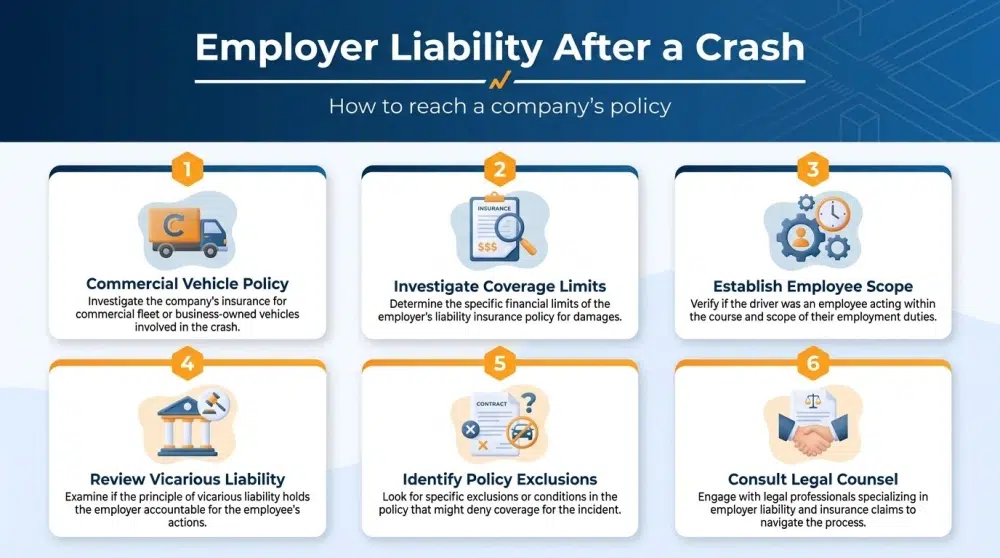
When an at-fault driver was working at the time of the crash, the employer may be liable under the doctrine of respondeat superior, which holds employers responsible for the negligent acts of employees acting within the scope of their employment. [5]
Commercial auto insurance policies carried by Texas businesses generally provide substantially higher limits than personal policies, sometimes $1 million or more per occurrence. To determine whether a commercial policy applies, you need to establish:
- Whether the driver was an employee (not an independent contractor) at the time of the crash.
- Whether the driver was acting within the scope of employment, meaning performing a task connected to their job duties.
- Whether the employer’s vehicle was being used, or whether the employer’s policy extends to non-owned vehicles.
Dallas routes like I-35E and the Dallas North Tollway carry heavy commercial traffic during business hours. A delivery driver, a service technician, a sales representative, or any employee using a company vehicle or running a work errand at the time of a crash may trigger employer liability. The car accident lawyers Dallas residents consult after a commercial vehicle crash should request the employer’s full insurance declaration page as part of early investigation.
Note that independent contractors present a more complex analysis. Texas courts examine the actual level of control the hiring company exercised over the contractor’s work. A misclassification of a worker as an independent contractor when the hiring company controlled the manner of work does not necessarily defeat employer liability.
Layer 4: Your Own Uninsured and Underinsured Motorist Coverage
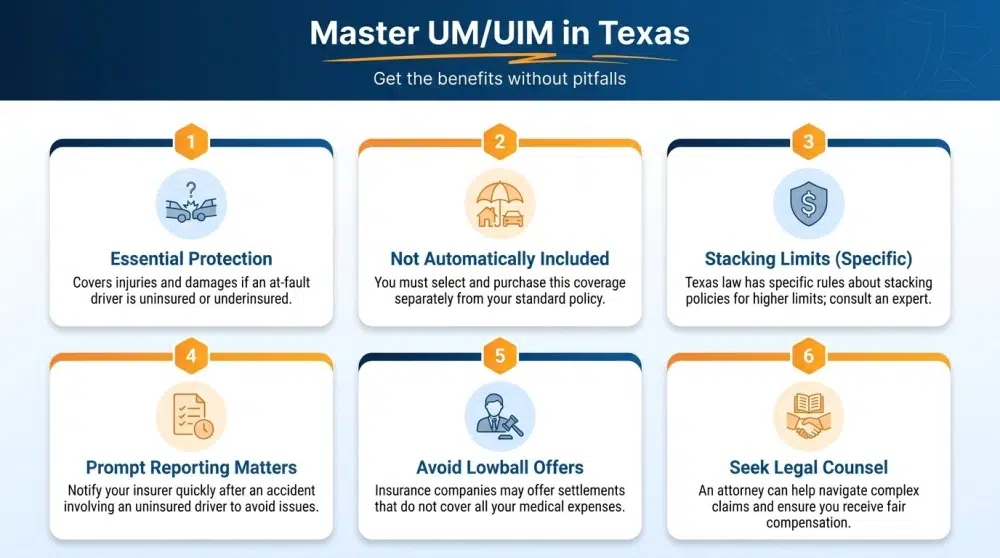
Texas Insurance Code Chapter 1952 requires every insurer offering personal automobile coverage to offer uninsured motorist (UM) and underinsured motorist (UIM) coverage unless the policyholder rejects it in writing. [3] If you did not sign a written rejection, your policy likely includes UM/UIM coverage.
These two coverages protect you in different situations:
| Coverage | When It Applies | How It Pays |
|---|---|---|
| Uninsured Motorist (UM) | At-fault driver has no liability insurance; hit-and-run driver; phantom vehicle | Pays your damages up to your UM limits |
| Underinsured Motorist (UIM) | At-fault driver has insurance, but limits are lower than your damages | Pays the gap between at-fault limits and your damages, up to your UIM limits |
The Critical Notice Requirement for UIM Claims in Texas
Before you can recover UIM benefits, Texas law generally requires you to give your own insurer timely notice of the claim and, importantly, notice before settling with or releasing the at-fault driver’s insurer. Settling with the liability carrier and executing a release without your UIM carrier’s consent can extinguish your UIM claim. Your insurer retains a subrogation interest that the settlement may need to address. Review your policy language and consult an attorney before accepting any settlement offer from the at-fault driver’s insurer when UIM coverage may be in play. [3]
Texas and Anti-Stacking
Texas generally permits insurers to include anti-stacking clauses in their policies, meaning you may not be able to add together the limits of multiple UM/UIM policies you purchased to create a larger coverage pool. However, whether stacking is available depends on the exact policy language and the specific facts of the crash. Some scenarios where coverage from more than one policy may be accessed include policies covering different insureds or policies that do not contain enforceable anti-stacking language. An attorney can read the actual policy provisions to advise you on what is available in your situation. [3]
Layer 5: Personal Injury Protection and MedPay
Texas Insurance Code Chapter 1952, Subchapter F, governs Personal Injury Protection (PIP) coverage. Texas insurers must offer PIP unless the policyholder rejects it in writing. If you did not reject it, you may have PIP on your policy. [3]
PIP pays your medical expenses and a portion of lost wages regardless of who was at fault. In Texas, the minimum PIP coverage offered is $2,500, though higher limits are available. PIP pays quickly and does not require proving the other driver’s negligence first, which makes it useful for covering early medical treatment after a crash on a busy stretch like I-30 or I-35E.
Medical Payments coverage (MedPay) operates similarly, covering medical expenses without regard to fault, though MedPay typically does not include the lost income component that PIP covers. Not every Texas policy includes MedPay, and it is not legally required to be offered in the same way as PIP. Review your declarations page carefully.
Layer 6: Resident Relative Coverage in Your Household
Many personal auto insurance policies extend UM/UIM and sometimes liability coverage to a “resident relative” of the named insured. If you live in the same household as a family member who carries auto insurance, you may qualify as a covered person under their policy even if you were not driving their vehicle at the time of the crash.
This coverage can be particularly significant for:
- Adult children living at home who are injured while a passenger in another vehicle.
- Spouses or domestic partners whose own vehicle coverage limits are lower than a family member’s policy.
- Individuals who are pedestrians or cyclists injured by an underinsured motorist.
The definition of “resident relative” varies by policy. Some policies require the relative to be listed on the policy; others simply require residency in the household. Reading the policy definition precisely is essential. Your attorney can make this determination from the actual policy language.
Layer 7: Umbrella Insurance Policies
An umbrella policy is a personal liability policy that sits above the limits of underlying auto and homeowner policies, providing additional coverage when underlying limits are exhausted. Umbrella policies typically provide $1 million or more in coverage and are commonly purchased by individuals, families, and businesses.
Umbrella policies can be relevant in two different directions after a Dallas crash:
The at-fault party carries an umbrella policy. If the person who caused the crash has an umbrella policy, and their auto liability limits are exhausted, their umbrella coverage may be available to pay additional damages. Identifying whether the at-fault party carries umbrella coverage requires discovery or direct inquiry. An attorney who handles a personal injury claim in Dallas can compel disclosure of that information through the litigation process if necessary.
You carry an umbrella policy. Some umbrella policies include uninsured or underinsured motorist protection that extends to automobile crashes. If your damages exceed the limits of your auto UM/UIM coverage and you carry an umbrella policy, review whether that umbrella extends to UM/UIM-type losses. Not all umbrella policies cover this scenario, but some do, and the distinction can be significant in a serious injury case.
For victims dealing with complex, multi-carrier situations, the GoSuits knowledge base article on uninsured and underinsured drivers in Dallas provides additional context on navigating these coverage gaps.
Building the Full Coverage Inventory: A Practical Checklist
After a crash in the Dallas area, a thorough coverage inventory should be assembled as quickly as possible. Evidence of commercial use, employer policies, and umbrella coverage can be difficult to locate without early action. The following checklist reflects the documents and inquiries that are typically part of a full coverage search:
| Coverage Type | Documents to Request | Who to Contact |
|---|---|---|
| At-fault driver’s liability | Policy declaration page, policy limits letter | At-fault driver’s insurer |
| Vehicle owner’s liability | Owner’s policy declarations, permissive use endorsements | Vehicle owner’s insurer |
| Employer / commercial | Commercial auto declarations, workers’ comp data, employment records | Employer’s risk management or insurer |
| Your own UM/UIM | Your auto policy declarations, written rejection forms (or absence thereof) | Your insurer |
| PIP and MedPay | Your auto policy declarations | Your insurer |
| Resident relative UM/UIM | Household members’ auto policy declarations | Household insurer(s) |
| Umbrella (yours or at-fault party’s) | Umbrella policy declarations, underlying limits schedules | Your insurer; at-fault party’s insurer (via discovery if needed) |
What Happens When Limits Still Are Not Enough?
Even after identifying every policy, your total damages may exceed the combined limits of all available coverage. When that happens, a personal injury claim may be the only path to recovering the unpaid balance, which requires pursuing a lawsuit against the responsible party or parties directly and obtaining a judgment. In Texas, the general statute of limitations for a personal injury claim is two years from the date of the injury under Civil Practice and Remedies Code Section 16.003. [6] Waiting too long to act can eliminate your legal options permanently.
Claims filed at the George L. Allen Sr. Courts Building in Dallas County follow the Texas Rules of Civil Procedure, and Dallas County District Court judges are familiar with complex multi-carrier automobile cases. Getting an attorney involved early enough to properly evaluate all coverage sources before deadlines expire is important.
Wrongful death claims arising from a fatal Dallas crash follow the same two-year limitations period under Texas Civil Practice and Remedies Code Section 71.002. [6] Families dealing with fatal crashes where the at-fault driver’s limits are insufficient should understand that every coverage layer described above applies equally to wrongful death claims. Families in that situation may also want to review information about Dallas wrongful death claims from our Dallas personal injury team.
How Long Do I Have to Make These Claims?
- Bodily injury personal injury claim (Texas): Generally 2 years from the date of injury. Tex. Civ. Prac. & Rem. Code § 16.003. [6]
- Wrongful death claim (Texas): Generally 2 years. Tex. Civ. Prac. & Rem. Code § 71.002. [6]
- UM/UIM claim against your own insurer: Your policy may contain separate notice and claim filing deadlines that are shorter than the statute of limitations. Review your policy promptly.
- PIP and MedPay claims: Subject to your policy’s reporting requirements. Texas Insurance Code requires insurers to acknowledge a claim within 15 days and accept or reject within 15 business days after receiving all required information, under the Texas Prompt Payment of Claims Act. [3]
- Property damage claims: Two years from the date of the crash is the general limitation. [6]
[Deadline Requires Legal Verification for Your Specific Situation] Deadlines depend on facts unique to each case, including when injuries were discovered, whether any government entity is involved, and individual policy language. Consult an attorney promptly to identify all deadlines that apply.
What to Do Next
- Gather all vehicle insurance information from the crash scene, including the at-fault driver’s insurer, policy number, and vehicle owner’s information.
- Obtain the crash report from the Dallas Police Department or Texas DPS as soon as it is available. [2]
- Locate your own auto policy declarations and check for UM/UIM, PIP, and MedPay coverage. If coverage was rejected, locate the signed rejection form.
- Notify your own insurer of the crash in writing, even if you did not cause it. Preserving your UM/UIM rights requires timely notice.
- Do not sign any release from any insurer without consulting an attorney first, particularly if your damages may exceed the at-fault driver’s limits.
- Investigate whether the at-fault driver was working at the time of the crash. Employer and commercial policies may provide substantially higher limits.
- Consult an attorney promptly. The two-year limitations period under Texas law and individual policy notice deadlines run from the date of the crash. Delay can cost you coverage.
Talk With a GoSuits Personal Injury Attorney in Dallas
A serious crash raises insurance questions that can determine whether your medical bills, lost income, and other losses are covered. A GoSuits personal injury attorney can review all available coverage sources, identify policies you may have overlooked, and explain your options before critical deadlines pass. This article is general legal information, not legal advice for your specific situation.
Related Dallas Personal Injury Resources
- Dallas personal injury lawyers – GoSuits Dallas Personal Injury
- Dallas car accident lawyers – GoSuits Dallas Car Accident
- Dallas truck accident lawyers – GoSuits Dallas Truck Accident
- Wrongful death claims in Dallas – GoSuits Dallas Wrongful Death
- Uninsured or underinsured driver in Dallas: What to Do After a Dallas Crash with an Uninsured Driver
References and Legal Authorities
- Texas Transportation Code, Chapter 601 – Motor Vehicle Safety Responsibility Act (Financial Responsibility) – Texas Constitution and Statutes
- Texas Department of Public Safety – Obtaining Crash Reports
- Texas Insurance Code, Chapter 1952 – Uninsured and Underinsured Motorist Coverage; Personal Injury Protection – Texas Constitution and Statutes
- Respondeat Superior – Legal Information Institute, Cornell Law School
- Texas Civil Practice and Remedies Code, Chapter 101 – Texas Tort Claims Act – Texas Constitution and Statutes
- Texas Civil Practice and Remedies Code, Chapter 16 – Limitations (Section 16.003 – Two-Year Limitation Period) – Texas Constitution and Statutes
- Texas Civil Practice and Remedies Code, Chapter 71 – Wrongful Death; Survival (Section 71.002) – Texas Constitution and Statutes
- Texas Courts Online – Official Texas Courts Website
- Texas State Law Library – Primary Legal Sources for Texas Law
- Texas Department of Insurance – Auto Insurance Consumer Resources