
A Texas Peace Officer’s Crash Report (CR-3) that contains wrong facts or an unfavorable “contributing factor” notation is not the end of your personal injury claim. Under Texas law, the report is generally excluded from evidence as hearsay at trial, the officer’s fault opinion carries no binding legal weight, and correctable factual errors can be addressed through a supplemental report or direct contact with the filing agency. Independent evidence – dashcam video, photographs, witness statements, and physical reconstruction – routinely overrides what appears in the CR-3.
Legal Snapshot
- Legal Topic: Texas Crash Report (CR-3) – Challenge, Correction, and Evidentiary Weight
- Case Stage: Pre-litigation and litigation
- Primary Legal Issue: Correction of factual errors; admissibility of crash reports; officer opinion vs. independent evidence
- Primary Authority: Texas Transportation Code §§ 550.062, 550.065; Texas Rules of Evidence 803, 901; Texas Rules of Civil Procedure
- Date Legal Authority Last Reviewed: July 2025
- Jurisdiction: State of Texas – Dallas County and statewide
What Is the Texas CR-3 Crash Report?
When a Texas peace officer investigates a motor vehicle crash that results in injury, death, or at least $1,000 in property damage, Texas Transportation Code § 550.062 requires the officer to submit a written report to the Texas Department of Transportation (TxDOT) within ten days of the crash. [1] That document is the Texas Peace Officer’s Crash Report, commonly called the CR-3.
The CR-3 is a standardized form managed by TxDOT’s Crash Records Information System (CRIS). It captures objective details – road conditions, vehicle positions, posted speed limits, contributing factors, and unit information – as observed and recorded by the responding officer. TxDOT, not the individual officer’s agency, is the official custodian of CR-3 records for the state of Texas. [2]
Two distinct types of content appear in every CR-3: (1) factual entries, such as vehicle identification numbers, weather conditions, or the location of the crash; and (2) the officer’s opinion on contributing factors, such as “failure to yield” or “following too closely.” These two categories are governed by different rules when you want to challenge an inaccurate report.
Correctable Factual Errors Versus the Officer’s Contributing Factor Opinion
Understanding the difference between these two categories determines how to respond to an inaccurate CR-3.
Correctable Factual Errors
A factual error is an objective mistake that can be verified against independent data. Common examples include:
- A driver’s name or license number recorded incorrectly
- The wrong vehicle identification number or license plate
- An incorrect street address, highway mile marker, or intersection
- Weather or lighting conditions noted incorrectly
- The number of vehicles or occupants listed inaccurately
- Injuries listed for the wrong person
- Insurance information omitted or listed for the wrong vehicle
Factual errors of this kind are the clearest candidates for correction because they can be documented with objective proof – your driver’s license, vehicle registration, medical records, or photographs.
The Officer’s Contributing Factor Opinion
The “contributing factor” or “unit action” boxes on a CR-3 reflect the investigating officer’s professional judgment at the scene. These are not factual findings in the same sense as a license plate number. The officer may check a box indicating distracted driving, improper lane change, failure to yield, or speeding based on observations, witness statements, or physical evidence gathered during the on-scene investigation.
Critically, this opinion is not a judicial finding. It does not determine fault as a matter of law. In a civil personal injury case in Dallas County, fault is a question for the jury or the judge, not the investigating officer. The officer’s contributing factor notation can influence insurance adjusters in the early stages of a claim, which is why addressing an inaccurate notation promptly matters – even though the notation has no binding effect in court.
Texas courts and practitioners recognize that officers often arrive after the fact, rely on statements from participants who may be upset or inaccurate, and complete paperwork under time pressure. The contributing factor entry is that officer’s best assessment at that moment, nothing more.
How to Request a Supplemental Report or Correction
There is no single statewide statutory process that allows a civilian to directly amend a CR-3, but there are established practical avenues for addressing inaccurate factual entries.
Contact the Investigating Agency
The first step is to contact the law enforcement agency that filed the report – for example, the Dallas Police Department, the Dallas County Sheriff’s Office, or a Texas Department of Public Safety (DPS) trooper’s district office, depending on where and how your crash was investigated. Request to speak with the officer’s supervisor or the records division.
If the officer agrees that a factual error exists, the officer or agency can file a supplemental or amended report with TxDOT. A supplemental report does not erase the original, both remain in the file, but the supplemental report can clarify or correct the earlier entry and becomes part of the official record.
Provide Documentation
When asking for a correction, bring or submit evidence that establishes the accurate fact:
- Driver’s license or state ID showing the correct name or number
- Vehicle registration showing the correct VIN or plate
- Photographs from the scene showing road conditions, signage, or vehicle positions
- Dashcam video or nearby surveillance footage
- Medical records confirming your injuries were listed for you, not another occupant
- Weather service records for the date, time, and location
What If the Agency Refuses?
Law enforcement agencies are not obligated to amend a report based on a request alone. If the agency declines, the inaccuracy does not simply end the matter. In a civil case, your attorney can present independent evidence at every stage, during insurance negotiations and, if necessary, in a Dallas County District Court proceeding, to demonstrate that the CR-3 entry is wrong. Because the report is generally inadmissible as substantive hearsay at trial, the officer’s incorrect notation carries far less weight there than in pre-litigation settlement discussions.
A personal injury claim can also involve a deposition of the investigating officer, during which the officer can be asked about the basis for every entry, including contributing factor notations. Depositions routinely reveal that an officer did not personally observe the event, relied on one party’s account, or failed to consider evidence that was available at the scene.
How to Obtain a Copy of Your CR-3
Before you can evaluate or challenge a crash report, you need a copy. TxDOT provides two primary channels for individuals directly involved in a crash to obtain their CR-3 through CRIS, the Crash Records Information System.
TxDOT’s Online Purchase System
TxDOT’s Crash Report Online Purchase System allows qualified requestors to purchase a CR-3 online. Customers receive the report by email after purchase. Texas Transportation Code § 550.065 governs who qualifies to receive a copy, including the people involved in the crash, their authorized representatives, vehicle owners, employers of involved drivers, and the insurance companies for any vehicle or person involved in the crash. [3]
The current cost is $6 for a regular copy or $8 for a certified copy. A certified copy is typically required for legal proceedings.
Obtaining the Report Through the Dallas Police Department
If the crash in the Dallas area was investigated by the Dallas Police Department (DPD), you may also request a copy directly from DPD’s Open Records division. You will need to provide sufficient identifying information about the incident, such as the date, location, and names of the parties involved. The report that DPD maintains is the same CR-3 that was submitted to TxDOT.
CRIS Query Tool
TxDOT also makes public crash data available through the CRIS Query Tool. This tool does not provide individual crash reports but allows researchers and the public to access aggregated crash statistics and summary data. It is not a substitute for obtaining the actual CR-3.
TxDOT retains crash records for ten years plus the current calendar year. Reports outside that window may not be available. [2]

Why the CR-3 Is Generally Inadmissible as Hearsay at a Texas Trial
One of the most important and frequently misunderstood rules about the CR-3 is that it is generally not admissible as substantive evidence at a Texas civil trial. This has significant implications for both plaintiffs and defendants.
The Hearsay Problem
Under the Texas Rules of Evidence, a statement made outside of court offered to prove the truth of the matter asserted is hearsay. [4] A crash report is a written out-of-court statement. If offered to prove, for example, that a driver was speeding or failed to yield, it is offered for the truth of what it states and is therefore hearsay.
The Public Records Exception and Its Limits
Texas Rule of Evidence 803(8) recognizes an exception to the hearsay rule for public records and reports. However, this exception explicitly excludes “factual findings resulting from an investigation of a particular person made pursuant to authority granted by law” when offered against that person in a civil action, and critically opinions and conclusions. [4]
Texas courts have consistently held that an investigating officer’s contributing factor notations, speed estimates, and fault-related opinions are not simply recorded facts, they are conclusions the officer drew. These conclusions face significant admissibility challenges and are generally excluded as inadmissible opinion hearsay when a party attempts to introduce them as proof of fault at trial.
What This Means in Practice
Because the CR-3 cannot typically be placed before a Texas jury as proof that you caused or contributed to the crash, the report matters most in the early insurance and settlement phase. Adjusters may use it to assess initial liability. Once a case proceeds toward litigation, the report moves to the background and independent evidence, physical evidence, eyewitness testimony, photographs, video, and expert reconstruction takes center stage.
If you were injured in a crash on I-635 in Dallas or along I-30 near the Deep Ellum corridor, the stop-and-go traffic conditions common on those routes can create genuine ambiguity about following distance or lane position. That ambiguity is precisely why a thorough investigation with independent evidence matters far more than a single contributing factor entry in a CR-3. When independent evidence contradicts the CR-3, the CR-3 generally loses.
What Evidence Can Override an Inaccurate CR-3 in Practice?
Texas personal injury claims are built on evidence, not on the crash report. If the CR-3 contains an unfavorable notation or factual error, the following categories of evidence can establish the accurate picture of the crash.
| Evidence Type | Why It Can Matter |
|---|---|
| Dashcam footage (your vehicle or another) | Shows vehicle positions, speeds, and driver behavior in real time often more reliable than any witness account |
| Fixed surveillance cameras | Traffic cameras, business cameras, and residential cameras along roads like the Dallas North Tollway or Central Expressway often capture crash sequences |
| Witness statements and testimony | Independent bystanders who have no interest in the outcome can rebut the officer’s account of what happened |
| Photographs taken at the scene | Vehicle damage patterns, tire marks, road debris, and final rest positions tell a physical story that may contradict the report |
| Event data recorder (EDR / black box) | Many vehicles record speed, brake application, and throttle position in the seconds before impact EDR data can confirm or refute a speed-related contributing factor notation |
| Cell phone records | May establish that the other driver was using a phone at the time of the crash, contradicting a distracted-driving notation assigned to you |
| Traffic signal data | Intersections with monitored signals can confirm the state of lights at the exact time of impact |
| Accident reconstruction by a qualified expert | A reconstruction professional can analyze physical evidence to determine speed, direction, and point of impact with precision that exceeds the officer’s scene-side assessment |
| Medical records | Establish the nature, timing, and cause of injuries, important when a CR-3 incorrectly lists injuries for the wrong person or understates their severity |
Evidence gathered promptly after a crash is more reliable and easier to obtain. Surveillance footage may be overwritten in days. Tire marks fade. Witness memories change. If you believe your CR-3 is inaccurate, the time to begin building contrary evidence is immediately after the crash, not months later when preparing for trial.
How This Works in a Real Scenario
Hypothetical Example:
A driver is stopped in rush-hour traffic on the LBJ Freeway (I-635) in Dallas when a distracted driver rear-ends their vehicle. The investigating officer arrives later, speaks primarily with the rear driver, and notates “following too closely” in both units’ contributing factor fields, suggesting shared fault. The rear driver also provided a slightly different account of who moved into whose lane.
The injured driver’s dashcam captured the entire sequence: the vehicle had been fully stopped for more than eight seconds before impact, and the rear driver never applied the brakes. The injured driver’s attorney obtains the dashcam footage, requests the traffic camera footage from TxDOT’s signal management system, and has an accident reconstruction professional prepare a report.
The attorney contacts the DPD records division with the dashcam footage and requests that the officer review the contributing factor notation. The officer files a supplemental report removing the notation from the injured driver’s unit. Even without the supplement, the independent evidence would have been far more persuasive at trial than the original CR-3 notation.
This is a hypothetical illustration only, not a description of an actual GoSuits case or result.
What If the Other Driver Uses the CR-3 to Dispute Your Claim?
In the pre-litigation phase, insurance adjusters routinely review the CR-3 as one input in their initial liability assessment. If the CR-3 contains a contributing factor notation that favors the other driver, the opposing insurer may argue that shared fault reduces or eliminates your claim.
Texas follows a modified comparative fault rule under Chapter 33 of the Texas Civil Practice and Remedies Code. A plaintiff who is found more than 50 percent responsible for the crash cannot recover damages from the other party. A plaintiff who is found partially responsible (but 50 percent or less) may recover damages reduced by their percentage of fault. [5]
This means an inaccurate contributing factor notation has real economic stakes. If an insurer believes the CR-3 supports shared fault, they may offer a reduced settlement or deny the claim outright. Presenting independent evidence that contradicts the CR-3 entry, before litigation can change that calculus significantly.
For injured people in Dallas navigating negotiations with a major insurer after a crash, understanding how personal injury lawyers help recover damages can clarify the path forward. The process involves gathering evidence, presenting a documented demand, and negotiating on the basis of the actual facts – not the CR-3 alone.
How Does Insurance Factor Into a Wrong CR-3?
Texas requires all motor vehicle owners to maintain minimum liability insurance coverage. After a crash, both parties typically report to their own insurers, and the insurance companies investigate the event. The CR-3 is one document they review, but it is not the only one and it is not treated as conclusive.
A diligent insurer performs its own investigation, which may include requesting photographs, speaking with witnesses, and reviewing any available video. Your attorney can present independent evidence directly to the opposing insurer to challenge an inaccurate CR-3 contribution, often as part of a demand letter or claim presentation.
If your own insurer uses a wrong CR-3 to deny coverage or reduce your uninsured/underinsured motorist (UM/UIM) claim, your attorney may also raise concerns about the insurer’s obligation to conduct a reasonable investigation under the Texas Insurance Code’s prompt payment and good faith requirements. [6]
How Long Do I Have to Act?
The deadline for challenging an inaccurate CR-3 through the law enforcement agency is not set by statute – it is a practical matter. The sooner you act, the more likely the officer or agency will remember the investigation and the more likely physical and digital evidence remains available. Surveillance footage in particular may be overwritten within 30 to 90 days.
For the civil personal injury claim itself, Texas generally imposes a two-year statute of limitations for personal injury actions arising from negligence, running from the date of the crash. [7] However, the practical steps – preserving evidence, notifying insurers, and consulting a personal injury attorney – should begin as soon as possible after the crash.
Waiting until close to the statute of limitations to begin building the evidentiary record significantly reduces the available tools for challenging an inaccurate report.
[Note: Deadlines may vary depending on specific facts, the identity of the parties, and applicable exceptions. This article is general legal information only. An attorney should review the specific deadline applicable to your situation.]
What Should I Do Next?
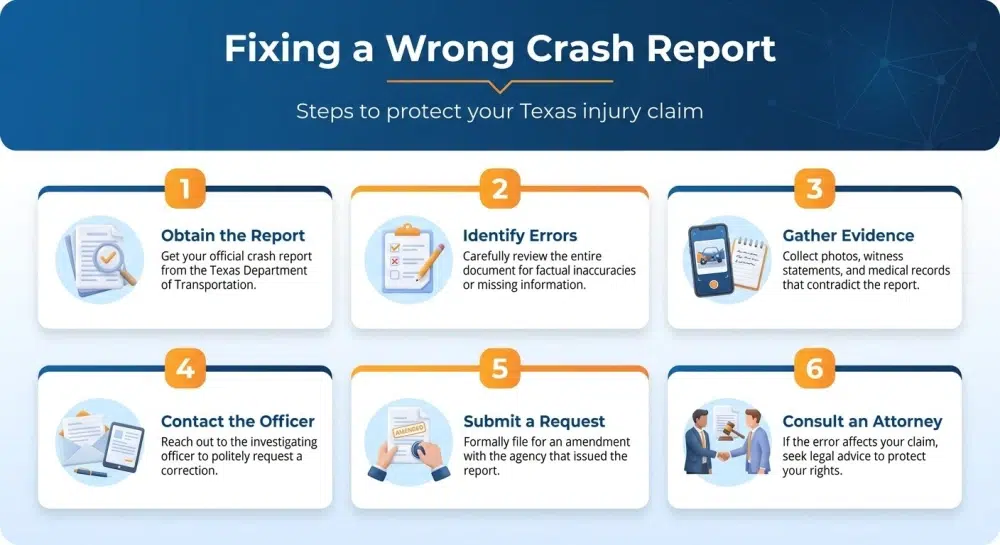
- Obtain the CR-3 immediately. Purchase a copy through TxDOT’s online CRIS system or request it from the investigating agency. Identify every entry that appears to be wrong.
- Preserve all independent evidence. Download dashcam footage. Request surveillance video from businesses near the crash site. Photograph vehicle damage, skid marks, and the scene before it changes.
- Write down your account of the crash. Do this while details are fresh, and note specifically what you observed about the other driver’s behavior before impact.
- Identify and contact witnesses. Independent witnesses can provide signed statements. Get their contact information before they become difficult to locate.
- Contact the investigating agency about factual errors. If a specific objective entry is demonstrably wrong, bring documentation and ask for a supplemental report.
- Consult a personal injury attorney before signing anything. Insurance adjusters may contact you shortly after the crash. Signing a release or recorded statement without legal guidance can limit your options.
A personal injury claim involving a wrong police report touches evidence law, insurance negotiations, and civil procedure. If you were injured in a Dallas crash and the CR-3 contains inaccurate information, a GoSuits personal injury attorney can review the report alongside the available evidence and help you understand your options. Schedule a free consultation today.

What Damages May Be Available in a Texas Personal Injury Claim?
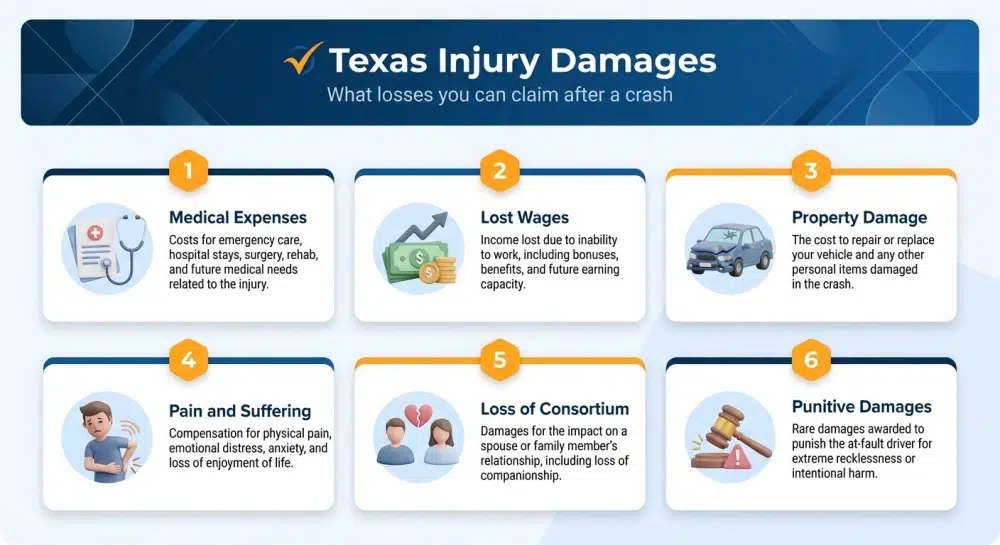
If another driver’s negligence caused the crash, Texas law allows an injured person to pursue compensation for a range of losses. The recoverability of any particular category depends on the facts of the case, the applicable law, and the evidence presented.
- Past and future medical expenses
- Lost income and reduced earning capacity
- Physical pain and mental anguish
- Physical impairment
- Disfigurement
- Property damage to your vehicle
In cases involving egregious conduct – such as a driver who was intoxicated – Texas law may permit exemplary damages in addition to compensatory damages, subject to specific statutory requirements. [8]
No specific recovery can be promised in any case. The recoverable amount in a given claim depends on the facts, the evidence, the applicable law, and how the claim is resolved. For a deeper look at what categories of damages Texas law recognizes, this resource on types of damages available in Texas personal injury cases provides a useful reference.
Talk With a GoSuits Dallas Personal Injury Attorney
An inaccurate crash report can affect how insurance adjusters approach your claim long before a lawsuit is filed. If you were injured in a Dallas crash and the CR-3 contains wrong facts or an unfavorable contributing factor notation, a personal injury claim can involve medical records, insurance coverage disputes, liability questions, and important legal deadlines.
Our Dallas personal injury team can review the CR-3 alongside the available evidence and help you understand what your options are. We serve injured people throughout Dallas County, including those involved in crashes along I-35E, the Dallas North Tollway, I-30, and US-75 (Central Expressway). Cases filed in Dallas County are heard at the George L. Allen Sr. Courts Building.
car accident lawyers in Dallas work on a contingency basis – no fee unless there is a recovery. Schedule a free consultation with our Dallas team today.
Learn more about our Dallas personal injury team and the full range of services available to injured people throughout the DFW area: Dallas Personal Injury Attorneys | Dallas Car Accident Lawyers | Dallas Wrongful Death Lawyers.
This article is provided for informational purposes only and does not constitute legal advice. No attorney-client relationship is created by reading this content. The legal information provided reflects Texas law as of July 2025. Laws change; always consult a licensed attorney regarding your specific situation.
References and Sources
- Texas Transportation Code Chapter 550 – Accidents and Accident Reports – Texas Legislature Online
- Crash Reports and Records – Texas Department of Transportation (TxDOT)
- Texas Transportation Code § 550.065 – Release of Crash Report – Texas Legislature Online
- Texas Rules of Evidence – Texas Courts
- Texas Civil Practice and Remedies Code Chapter 33 – Proportionate Responsibility – Texas Legislature Online
- Texas Insurance Code Chapter 542 – Processing and Settlement of Claims – Texas Legislature Online
- Texas Civil Practice and Remedies Code Chapter 16 – Limitations – Texas Legislature Online
- Texas Civil Practice and Remedies Code Chapter 41 – Damages – Texas Legislature Online
- Federal Rules of Evidence Rule 803 – Hearsay Exceptions – Cornell Law School Legal Information Institute
- Crash Report Online Purchase System – TxDOT CRIS