In Texas, the driver who caused the crash is legally responsible for the injured person’s reasonable medical expenses, but that responsibility is usually settled at the end of a claim, not while treatment is happening. In the meantime, the bills are commonly paid by your own personal injury protection (PIP) or medical payments coverage, your health insurance, Medicare or Medicaid, or you directly. Those payers may later seek reimbursement from any recovery. Texas also limits recoverable medical expenses to the amounts actually paid or incurred by or on behalf of the injured person under Texas Civil Practice and Remedies Code section 41.0105. The answer for any person depends on the policies involved, who was at fault, and the facts of the crash. [3]
Legal Snapshot
-
Legal Topic: Payment of medical expenses after a Texas motor vehicle collision
-
Jurisdiction: Texas state law, with federal law where Medicare or employer health plans are involved
-
Case Stage: Early treatment through settlement or lawsuit
-
Primary Legal Issue: Which insurer or payer covers bills now, and what the at-fault party must ultimately pay
-
Primary Authority: Tex. Ins. Code ch. 1952 (PIP and UM/UIM); Tex. Civ. Prac. & Rem. Code §§ 16.003, 33.001, 41.0105; Tex. Prop. Code ch. 55; Haygood v. De Escabedo, 356 S.W.3d 390 (Tex. 2011)
-
Filing Deadline (general): Two years for most personal injury suits
-
Date Legal Authority Last Reviewed: November 11, 2026 (attorney confirmation against current statute text pending)
What Does “Who Pays My Medical Bills” Mean After a Texas Crash?
Two different questions are hiding inside this one. The first is who pays the hospital, ambulance, and clinic bills as they arrive. The second is who is ultimately responsible for those costs because they caused the crash. Texas law answers the second question through fault-based civil liability, while insurance contracts and statutes answer the first.
That gap matters on busy corridors such as I-35 through Austin or I-10 in Houston, where a single stop-and-go collision can send several people to the emergency room before anyone has decided who was at fault. Treatment is billed immediately. Fault is sorted out over weeks or months.
What Does Texas Law Say?
Texas is an at-fault state, not a no-fault state. A person injured by another driver’s negligence may bring a civil claim against that driver for damages, including medical expenses. The general deadline to sue for personal injury is two years from the day the claim accrues. [1]
Texas uses proportionate responsibility. A claimant’s recovery is reduced by his or her percentage of responsibility, and a claimant found more than 50 percent responsible may not recover damages. [2] Fault disputes therefore affect not only who pays the bills at the end of a case but whether they are recoverable at all.
Drivers must carry liability insurance. The state minimums are $30,000 per person and $60,000 per accident for bodily injury, and $25,000 for property damage. [6] Those limits can be exhausted quickly by serious injuries, which is one reason your own coverages matter.
What Legal Rules Apply to Each Possible Payer?
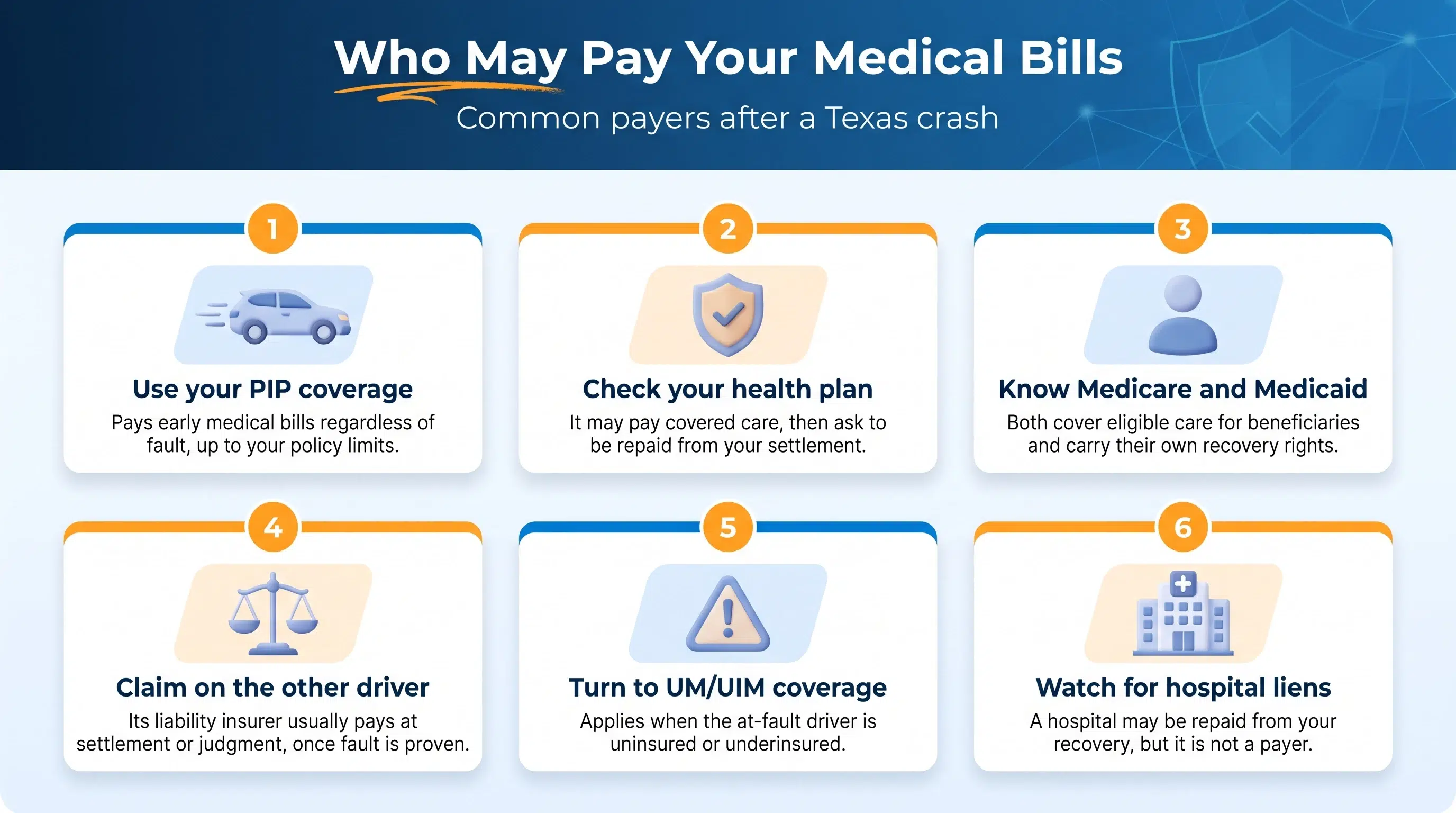
Several payers may be involved at once. The table summarizes the most common ones, and each is explained below.
|
Payer |
When it may pay |
Key Texas or federal authority |
|---|---|---|
|
Your PIP coverage |
Early medical bills and some lost income, regardless of fault, up to policy limits |
Tex. Ins. Code §§ 1952.151 to 1952.156 [5] |
|
Medical payments coverage |
Medical bills under your auto policy, if purchased |
Policy terms |
|
Your health insurance |
Covered care, subject to deductibles, network rules, and reimbursement rights |
Plan terms; federal ERISA for many employer plans [12] |
|
Medicare or Medicaid |
Covered care for beneficiaries, with recovery rights |
42 U.S.C. § 1395y(b)(2) [11]; Tex. Hum. Res. Code ch. 32 [13] |
|
At-fault driver’s liability insurer |
Damages for a valid claim, usually at settlement or judgment |
Tex. Civ. Prac. & Rem. Code chs. 33, 41 [2] |
|
Your UM/UIM coverage |
When the at-fault driver is uninsured or underinsured |
Tex. Ins. Code §§ 1952.101 to 1952.106 [5] |
|
Hospital (as a lienholder) |
Not a payer, but may be repaid from your recovery |
Tex. Prop. Code ch. 55 [7] |
Personal injury protection (PIP)
PIP is first-party coverage in your own auto policy. By statute, it provides payment to the named insured, household members, and authorized operators or passengers for reasonable expenses that arise from the accident and are incurred within three years, including necessary medical, hospital, ambulance, and funeral services, plus replacement of lost income or essential household services in some cases. [5]
An insurer may not issue a Texas auto liability policy without providing PIP, but the named insured may reject it in writing. [5] The mandatory coverage does not require the insurer to provide more than $2,500 in aggregate benefits per person, although higher limits may be available for purchase. [5] Once an insurer receives satisfactory proof of a claim, benefits are generally due within 30 days, and a policy may require proof of loss within a period of not less than six months after the accident. [5] Check your declarations page rather than assuming you have or lack PIP.
Health insurance, Medicare, and Medicaid
Your health plan may pay covered treatment even though someone else caused the crash. The plan may then assert a right to be repaid from a settlement or judgment. Reimbursement rights differ depending on whether the plan is fully insured, self-funded under federal ERISA, Medicare, or Medicaid, so the contract and the governing statute control. [11] [12] [13] An attorney should review if a particular plan can recover anything and how much.
Hospital liens
Under Texas Property Code section 55.002(a), a hospital has a lien on the injury claim of a person who receives hospital services for injuries caused by an accident attributed to someone else’s negligence, but only if the person was admitted within 72 hours of the accident. [7] The lien attaches only to the injury claim and any resulting judgment or settlement, not to the patient’s other property, such as real estate (Tex. Prop. Code § 55.003). A release of the claim generally is not valid against the lien unless the hospital’s charges were paid as the statute requires. The amount is limited by statute, and a hospital must follow filing and notice steps to perfect it.[7] Chapter 55 liens belong only to hospitals and certain emergency medical services providers (Tex. Prop. Code § 55.002), so other clinics asserting a “lien” may be relying on a contract or a letter of protection rather than the statute.
What Does “Paid or Incurred” Mean for My Medical Bills?
Texas limits recovery of medical expenses to the amount actually paid or incurred by or on behalf of the claimant. [3] In Haygood v. De Escabedo, the Texas Supreme Court held that the statute limits recovery to expenses that have been or must be paid, and excludes the difference between that amount and charges a provider bills but has no right to be paid. [4]
In practice, the large number on a hospital’s initial bill may not be the number a jury hears. If your health insurer negotiated a lower rate, the recoverable past medical expense generally reflects the amount paid plus any balance you still owe. This is one reason it matters which payer handles the bills.
Texas lawmakers considered a bill in 2025 (Senate Bill 30) that would have changed how medical expenses are proved. It did not become law because the Legislature did not agree on a final version before the regular session ended. [9] [14] Current law should be confirmed with an attorney before relying on any summary, including this one.
How Does This Apply to a Real Case?
Example (hypothetical, not a GoSuits case): A driver is rear-ended in stop-and-go traffic on I-35 and taken by ambulance to a hospital, where she is admitted that night. She has $5,000 in PIP, a health plan through her employer, and the other driver carries the Texas minimum of $30,000 per person.
The hospital may file a Chapter 55 lien because she was admitted within 72 hours. Her PIP insurer may pay early bills up to its limit regardless of fault. Her health plan covers additional treatment at negotiated rates and later asserts reimbursement rights. Her claim against the other driver depends on proving fault and damages, and the $30,000 limit may fall short, which could bring her underinsured motorist coverage into play. None of these payers cancels the others, and each can affect how much she nets from a settlement. The result in any real case depends on the specific policies and facts.

What Evidence Can Matter?
Evidence does not automatically prove liability or damages, but it shapes both. Common categories include:
-
Police crash report and photographs: help document the scene, vehicle positions, and reported contributing factors.
-
Medical records and itemized bills: show diagnosis, treatment, and the connection between the crash and the injury.
-
Payment records and explanations of benefits: show what insurers actually paid, which bears on the paid-or-incurred figure.
-
Provider affidavits: Texas allows reasonableness and necessity of charges to be addressed through affidavits under Tex. Civ. Prac. & Rem. Code § 18.001, which the other side can contest. [8]
-
Your insurance declarations pages: identify PIP, medical payments, and UM/UIM coverage.
-
Lien notices and health plan correspondence: identify who may claim repayment.
-
Video, dashcam footage, and witness statements: bear on fault and the percentage of responsibility.
-
Employment and wage records: support lost income, including any PIP income benefits.
What Damages or Remedies May Be Available?
If another party is legally responsible, recoverable damages may include past and future medical expenses, lost income, loss of earning capacity, physical pain, mental anguish, physical impairment, disfigurement, and property damage. Recoverability depends on Texas law and the evidence. Past medical expenses are subject to the paid-or-incurred limit. [3] An attorney should review how that limit applies to future medical expenses. Exemplary damages are available only in limited circumstances under Texas Civil Practice and Remedies Code section 41.003. No outcome or amount is guaranteed.
What If the Other Party Disputes Liability?
A dispute over fault does not stop your own coverages from working. PIP is available regardless of who was at fault, up to its limits. [5] A liability dispute does, however, delay any payment from the other driver’s insurer and can reduce the claim through the proportionate responsibility rules. [2] Defendants may also contest whether treatment was necessary, whether charges were reasonable, or whether an injury was caused by the crash. These disputes are common, and a lawyer can help evaluate how they affect the case.
What If Insurance Is Involved or the Other Driver Is Uninsured?
Most claims involve at least two insurers. The at-fault driver’s liability insurer evaluates the claim against its insured, while your own insurer handles PIP and any medical payments claim. Statements given to either insurer can affect the claim, so many people consult a lawyer before giving recorded statements.
If the at-fault driver has no insurance or too little, uninsured and underinsured motorist coverage may apply. Texas law requires insurers to offer UM/UIM coverage, and the named insured may reject it in writing. [5] The Texas Department of Insurance publishes a consumer guide describing these optional coverages. [10] If you were hurt as a rideshare passenger or as a pedestrian, a different layer of coverage questions may apply.
Reimbursement claims from health plans, Medicare, Medicaid, and hospitals can reduce what you keep from a settlement. Some of these claims can be negotiated, but the rules differ by payer.
How Long Do I Have to Act?
Most Texas personal injury lawsuits must be filed within two years after the day the claim accrues. [1] Several shorter or separate timelines can apply earlier:
-
PIP proof of loss: a policy may require proof of loss within a period of not less than six months after the accident. [5]
-
PIP expenses: covered expenses must be incurred within three years of the accident. [5]
-
Policy notice terms: insurers may require prompt notice of the accident, so check your policy for its specific requirements.
-
Government vehicles: involving a city, county, or state vehicle can carry shorter notice requirements.
Because the right deadline depends on the facts, do not assume the two-year period is the only one.
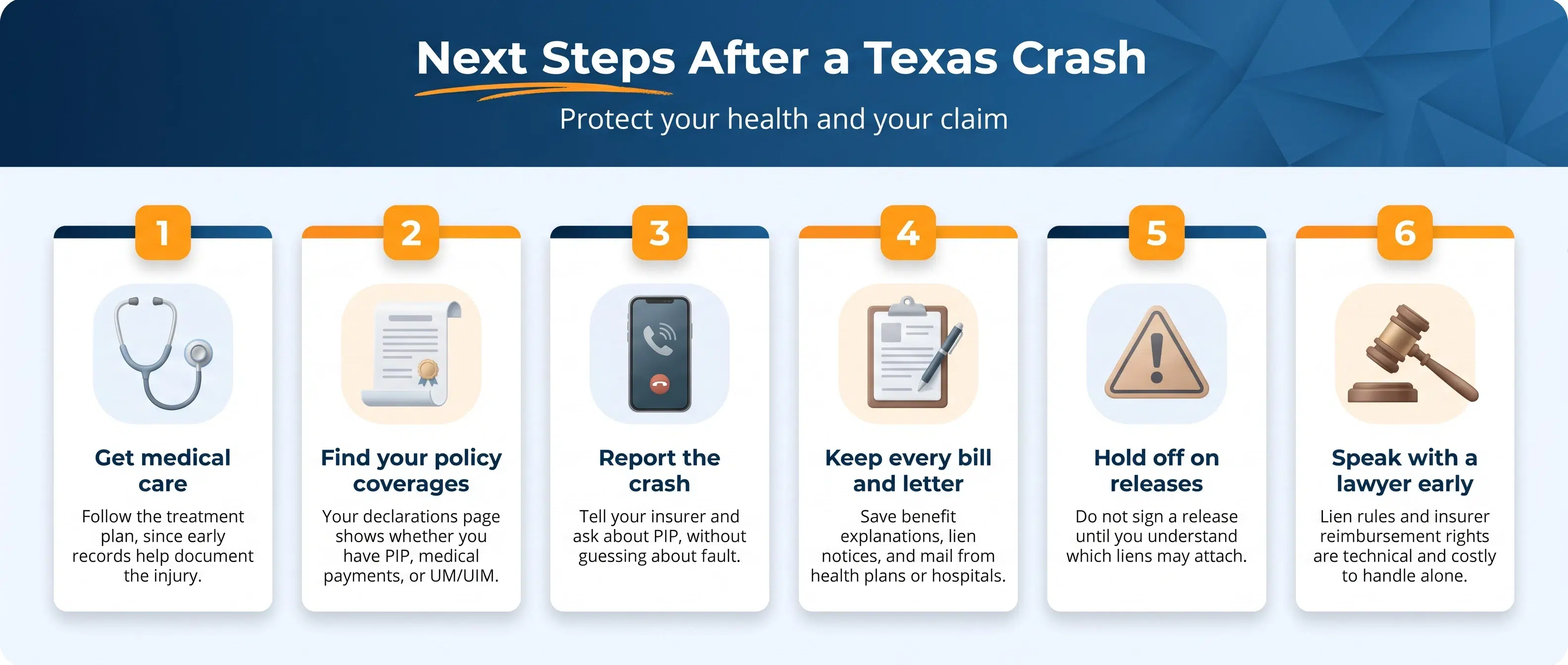
What Should I Do Next?
-
Get medical care and follow the treatment plan. Your health comes first, and records created early help document the injury.
-
Find your declarations page and identify PIP, medical payments, and UM/UIM coverage.
-
Report the crash to your insurer and ask about PIP, without guessing about fault.
-
Keep every bill, explanation of benefits, lien notice, and letter from a health plan or hospital.
-
Do not sign a release or accept a settlement until you understand what liens and reimbursement claims may attach.
-
Speak with a lawyer early. Texas deadlines, lien rules, and insurer reimbursement rights are technical, and handling them without legal help can be costly.
Related Texas Personal Injury Resources
For broader background, see GoSuits’ Texas personal injury resource page. Rideshare and pedestrian crashes raise their own coverage questions, which are addressed on the Texas rideshare accident and Texas pedestrian accident pages.

Talk With a GoSuits Attorney
A Texas injury claim can involve several insurers, hospital liens, reimbursement demands, fault disputes, and legal deadlines at the same time. Experienced personal injury lawyers can review how the policies and bills in your situation fit together, and a car accident lawyers consultation can help you understand your options. You can schedule a free consultation to discuss your case. Past results do not guarantee a similar outcome.
This article provides general legal information about Texas law. It is not legal advice and does not create an attorney-client relationship.
References
-
Civil Practice and Remedies Code, Chapter 16 (Section 16.003) – Texas Statutes
-
Civil Practice and Remedies Code, Chapter 33 (Proportionate Responsibility) – Texas Statutes
-
Civil Practice and Remedies Code, Chapter 41 (Section 41.0105) – Texas Statutes
-
Haygood v. De Escabedo, 356 S.W.3d 390 (Tex. 2011) – Case Summary, LawPipe
-
Insurance Code, Chapter 1952 (Automobile Insurance Policy Provisions) – Texas Statutes
-
Transportation Code, Chapter 601 (Motor Vehicle Safety Responsibility) – Texas Statutes
-
Property Code, Chapter 55 (Hospital and Emergency Medical Services Liens) – Texas Statutes
-
Civil Practice and Remedies Code, Chapter 18 (Section 18.001) – Texas Statutes
-
Texas Senate Bill 30 (89th Legislature, 2025) Status – LegiScan
-
Auto Insurance Guide (CB020) – Texas Department of Insurance
-
42 U.S.C. § 1395y (Medicare Secondary Payer) – Cornell Legal Information Institute
-
29 U.S.C. § 1132 (ERISA Civil Enforcement) – Cornell Legal Information Institute
-
Human Resources Code, Chapter 32 (Medical Assistance Program) – Texas Statutes