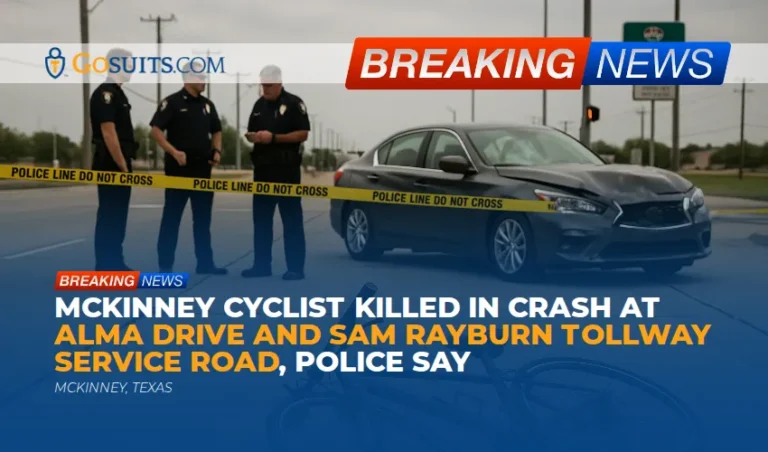
- What happened at Alma Drive and the Sam Rayburn Tollway service road
- Local context around the intersection
- How Texas authorities typically investigate bicycle and vehicle collisions
- Where families can request official records and information
- Texas traffic and bicycle laws that often matter in fatal crashes
- Potential civil liability and insurance considerations after a fatal bicycle crash
- Preserving evidence and documenting the scene
- Community safety reflections and roadway design considerations
- Why acting promptly matters
- References
- Commentary from Gosuits McKinney, Texas Personal Injury Attorney
What happened at Alma Drive and the Sam Rayburn Tollway service road
According to McKinney Police, a cyclist died Thursday in a collision with a vehicle at the busy intersection of Alma Drive and the Sam Rayburn Tollway (SRT, State Highway 121) southbound service road. Officers responded to the scene, and the cyclist was pronounced deceased there. Police temporarily closed the southbound SRT service road at Alma Road to allow first responders to work safely. The victim’s identity is being withheld pending notification of next of kin, and the investigation remains open. No additional official details had been released at the time of the report.
That junction is a heavily traveled access point where tollway frontage lanes meet a major north-south arterial. On typical weekdays and weekend shopping peaks, traffic flows between McKinney, Allen, and the SH 121 retail corridors can be brisk. Given the mixed speeds and frequent turns onto and off of service roads, visibility and timing at crossings like Alma Drive can be challenging for road users on bicycles.
Local context around the intersection
Residents in west McKinney know how dynamic the traffic can be along the SRT service roads. The Alma Drive crossing serves commuters heading to business parks and shopping areas along SH 121 and toward neighborhoods such as Craig Ranch to the west. The proximity to other high-volume junctions and signals in the corridor means drivers, cyclists, and pedestrians often navigate multiple conflict points in short succession.
Seasonally, spring brings clearer mornings and more riders on local routes that connect neighborhood streets to retail centers, gyms, and trailheads. Cyclists commonly choose parallel neighborhood streets where possible, but sometimes the only practical way to reach destinations involves crossing or riding short stretches along service roads. When that happens, small mistakes by any road user can carry serious consequences.
How Texas authorities typically investigate bicycle and vehicle collisions
After a fatal crash, McKinney Police and other responding agencies typically secure the scene, render aid, and document physical evidence. In a collision involving a cyclist and a motor vehicle, investigators may:
- Map the scene with measurements, photographs, and, where available, 3D imaging of roadway markings, debris fields, and final rest positions of bicycle and vehicle.
- Document visibility and signals including the status and timing of the traffic signal phases, signage, and any obstructions.
- Collect statements from involved drivers, potential witnesses, and nearby workers or residents who heard or saw the impact or moments before it.
- Review onboard data such as vehicle event data recorder information and available dash camera footage.
- Seek video from businesses, city traffic cameras, and roadway operators with jurisdiction over the corridor.
- Obtain medical findings from the Medical Examiner to help correlate injuries with impact dynamics and timing.
Investigations take time. Early public updates tend to be brief and cautious, particularly before witness statements are corroborated and video evidence is gathered. Families can request periodic updates from investigating agencies, but many details remain confidential until the investigation concludes.

Where families can request official records and information
When the time is right, families often need documents for estate, insurance, and potential legal claims. The following offices and record types are common in a fatal roadway incident in Collin County:
Police crash reports and supplements
- Investigating agency: McKinney Police Department typically prepares the crash report and related supplements. Under Texas law, crash reports are release-restricted to certain parties, including the involved driver, the victim’s authorized representative, and insurers. Access is generally controlled by statute and by the agency’s records division under the Texas Public Information Act and crash report laws. See the Texas Government Code Chapter 552 for the framework of public records and exemptions [1].
- State crash record system: Texas maintains a centralized crash record system and prescribes the CR-3 crash report format. The substantive rules of the road and definitions cited in many crash reports are found in the Texas Transportation Code [2] [3].
Medical Examiner and autopsy information
- Medical Examiner jurisdiction: In fatal incidents, a Medical Examiner investigates cause and manner of death under the Texas Code of Criminal Procedure Chapter 49. This chapter governs inquests, autopsies, and related reporting in Texas [4].
- Contacting the Medical Examiner: Families can typically request information about the status of the examination and, when available, certified copies of the autopsy report through the county Medical Examiner’s Office.
Death certificates
- Vital records: Certified Texas death certificates are issued through the Texas Department of State Health Services, Vital Statistics Section. These are often required by financial institutions, life insurers, and probate courts [5].

Traffic signal data and roadway video
- Signal timing and maintenance logs: Cities and roadway authorities maintain traffic signal timing plans and maintenance records. Requests may be submitted under the Texas Public Information Act. Agencies may redact sensitive security details under statutory exemptions [1].
- Adjacent cameras: Depending on placement and retention policies, business-facing security cameras and certain public roadway cameras might capture useful footage. Retention periods can be short, so timely requests can be critical.
For a practical checklist that helps families stay organized with the documents commonly needed after a fatal incident, consider this resource: dallas wrongful death checklist families.
Texas traffic and bicycle laws that often matter in fatal crashes
Texas law treats a bicycle as a vehicle for many rules-of-the-road purposes, and riders generally have the same rights and duties as motorists when operating on roadways. Several statutes commonly appear in civil analyses of bicycle crashes:
- Rights and duties of bicycle operators: Bicycle riders generally have the rights and are subject to the duties of a driver of a vehicle under Transportation Code Chapter 551 [2].
- Position on roadway: A bicyclist moving slower than traffic should ride as near as practicable to the right curb or edge of the roadway, subject to exceptions such as preparing for a left turn or avoiding unsafe conditions. See Transportation Code 551.103 and related provisions [2].
- Turning and signaling: Drivers approaching intersections and making turns must do so safely and with signals that provide adequate notice to others. Turn and lane-use rules are found in Transportation Code Chapter 545 [3].
- Right-of-way at intersections: Texas rules governing signals, stop/yield requirements, and turns assign duties to drivers approaching and entering intersections to prevent collisions. These live in Chapter 544 and 545; civil cases frequently analyze whether a driver yielded appropriately or kept a proper lookout [3].
Families should know that a civil wrongful death claim is distinct from any criminal or citation decisions. Meeting the civil negligence standard can involve a detailed reconstruction of timing, visibility, speed, and compliance with the Transportation Code, even if no citation is issued.
Potential civil liability and insurance considerations after a fatal bicycle crash
When a cyclist is killed in a collision, the potential civil defendants may include an at-fault driver and, in some situations, a vehicle owner or an employer if the driver was working at the time. The specific facts matter. Texas follows a modified comparative responsibility rule. If a claimant’s responsibility is found to be more than 50 percent, recovery is barred; if 50 percent or less, recovery is reduced by that percentage [6].
In the Dallas area, insurers frequently deploy rapid response teams to serious collisions. It is common for liability carriers to request recorded statements or authorizations from grieving families soon after a crash. Before any family member speaks with an insurance adjuster or signs medical or blanket authorizations, it is prudent to consult an attorney who handles wrongful death and roadway cases. What is said to an insurer can be used later to dispute fault or damages.
In general terms, potential civil claims in a fatal bicycle crash may examine issues like:
- Negligent turning or failure to yield at a signalized intersection.
- Unsafe speed or failure to maintain a proper lookout approaching a crossing.
- Driver distraction or impairment evidence where warranted by the investigation.
- Employer responsibility if the driver was in the course and scope of employment.
- Comparative fault defenses and how they affect recovery under Chapter 33 [6].
Families exploring their civil options often look for fatal accident lawyers who regularly review crash data, roadway design, insurance coverages, and evidence preservation steps. In larger metro areas, Dallas fatal accident lawyers are familiar with the speed, volume, and camera coverage characteristics of tollway service roads and major arterials that can be pivotal in building a record.
Texas law imposes time limits. Most wrongful death claims must be filed within two years of the date of death, subject to narrow exceptions codified in the Texas Civil Practice and Remedies Code [7]. Timely legal consultation can help clarify which deadlines apply in a given situation.
Preserving evidence and documenting the scene
Evidence can disappear quickly after a service-road crash. Here are practical, community-informed steps people in North Texas commonly take when trying to protect critical information:
- Request nearby video promptly: Corner gas stations, restaurants, and retail facades near Alma and SH 121 often overwrite video within days. A brief, polite in-person request followed by a written preservation letter can make a difference.
- Note lighting and visibility: The visibility at the Alma crossing can vary with sun angle, lane queues, and turning traffic. Photographs from the same time of day and weather conditions can help accident reconstruction efforts.
- Identify debris and markings: Skid marks, gouges, and scattered bike components help reconstruct paths of travel and impact orientation. If safely possible, promptly photograph them before they fade or the roadway is swept.
- Document the bicycle and gear: Retain the bicycle, helmet, lights, and any cycling computer or GPS device. Location data from GPS head units and smartphones sometimes fills in crucial timing details.
- Record witnesses: Employees at corner businesses and fellow commuters using the service road may have seen the incident or its lead-up. Capture names, best contact information, and a brief note of what they observed.
- Preserve vehicle data: Modern vehicles store limited pre-impact speed and brake information. Counsel can send preservation letters to vehicle owners and, when appropriate, seek court orders to secure the data before it is overwritten.
Even when families are still awaiting official updates, preserving third-party evidence reduces the risk of gaps later in the process.
Community safety reflections and roadway design considerations
Bicyclists are vulnerable road users. National safety agencies consistently stress that speed and separation from motor traffic are key determinants of injury severity in a crash. The Federal Highway Administration emphasizes speed management as a core safety strategy because lower operating speeds reduce both the likelihood of a crash and the severity of injuries when one occurs [8].
Design guidance also points to intersection treatments that can improve conditions for people bicycling, such as protected approaches, high-visibility crossings, and signal phasing that reduces conflict during turns. FHWA’s bikeway selection and design resources outline context-driven tools for cities evaluating corridors with high turning volumes and wide crossing distances [9].
Locally, any review of the Alma and SRT service road area will consider driver approach speeds, turn radii, signal timing, and sight lines at the stop lines. Community members often suggest practical improvements like additional leading intervals for through movements, daylighting at corners to improve sight lines, or refreshed crosswalk and stop-bar markings. The right mix depends on measured conditions, competing demands, and engineering judgment.
While roadway engineering evolves, individual behavior still matters. NHTSA reminds all road users to avoid distractions, obey signal indications, yield appropriately, and use lights at night for conspicuity [10]. For riders, predictable lane positioning and clear hand signals help drivers anticipate movements. For drivers, scanning for cyclists before turning and maintaining safe speeds near crossings remain fundamental.
Why acting promptly matters
When a fatal crash occurs at a high-volume intersection, time-sensitive steps can shape what is known later. There are practical reasons to act sooner rather than later, even while investigations are ongoing:
- Video retention windows are short: Corner businesses often overwrite footage within 3 to 7 days, sometimes sooner. A quick preservation request can be the difference between having objective video and losing it forever.
- Witness recall fades fast: The best time to capture accurate recollections is within days while details are fresh. Short contemporaneous notes or recorded statements protect against memory drift.
- Vehicle and device data can be overwritten: Event data recorders and some GPS units store only limited segments. Preservation letters and secure storage help lock in digital evidence.
- Deadlines start running immediately: Wrongful death statutes of limitation, notice requirements for certain government-related claims, and insurer-imposed timelines may all apply. Understanding which timelines matter helps avoid unintentional forfeiture of rights [7].
- Insurance positioning begins early: Liability and UM/UIM carriers typically open files within hours and may seek statements or records. Early guidance reduces the risk of harmful admissions or overbroad releases.
The concrete next steps usually include identifying the investigating agency report number, noting which businesses have exterior cameras at the intersection corners, securing the bicycle and any onboard devices, and tracking medical and funeral-related expenses for later documentation. Families considering civil options often speak with fatal accident lawyers before communicating with insurers.

References
- Public Information Act Overview – Office of the Texas Attorney General
- Texas Transportation Code Chapter 551: Operation of Bicycles – Texas Legislature Online
- Texas Transportation Code Chapter 545: Operation and Movement of Vehicles – Texas Legislature Online
- Texas Code of Criminal Procedure Chapter 49: Inquests Upon Dead Bodies – Texas Legislature Online
- Death Certificates – Texas Department of State Health Services
- Texas Civil Practice and Remedies Code Chapter 33: Proportionate Responsibility – Texas Legislature Online
- Texas Civil Practice and Remedies Code Section 16.003: Limitations for Personal Injury and Wrongful Death – Texas Legislature Online
- Speed Management Program – Federal Highway Administration
- Bikeway Selection Guide – Federal Highway Administration
- Bicyclists: Safety Tips and Resources – National Highway Traffic Safety Administration
Commentary from Gosuits McKinney, Texas Personal Injury Attorney
Our thoughts are with the family and friends affected by this heartbreaking loss at Alma Drive and the Sam Rayburn Tollway service road. Incidents like this reverberate through an entire community, from nearby neighborhoods and businesses to the riders and drivers who pass that intersection every day. This note is intended for general information and education during a difficult time.
Based on what is publicly known, this was a fatal collision at a signalized intersection along a high-volume frontage road. In civil cases involving cyclists, the analysis often centers on visibility, approach speeds, turn movements, lane positioning, and whether drivers and cyclists followed applicable Transportation Code duties. The absence of immediate public details is common in open investigations. Objective evidence such as traffic camera footage, corner business video, and vehicle data can do a lot of the talking once preserved.
From experience, insurers and large corporations move quickly after serious incidents. Adjusters may call early, ask for recorded statements, or request broad medical and employment authorizations. Those requests can feel routine, but they are calculated to shape the claim record. People sometimes do not realize that casual comments can be reframed later to dispute fault or minimize losses. It is wise for families to consult counsel first, understand their rights, and only then decide how and when to communicate with insurers.
A free consultation can clarify timelines, evidence priorities, and the range of potential insurance coverages at play, including liability, employer policies, and uninsured or underinsured motorist coverage. Early guidance helps ensure that essential records are preserved and that critical steps are taken in the right order, especially where grief, logistics, and paperwork converge all at once.